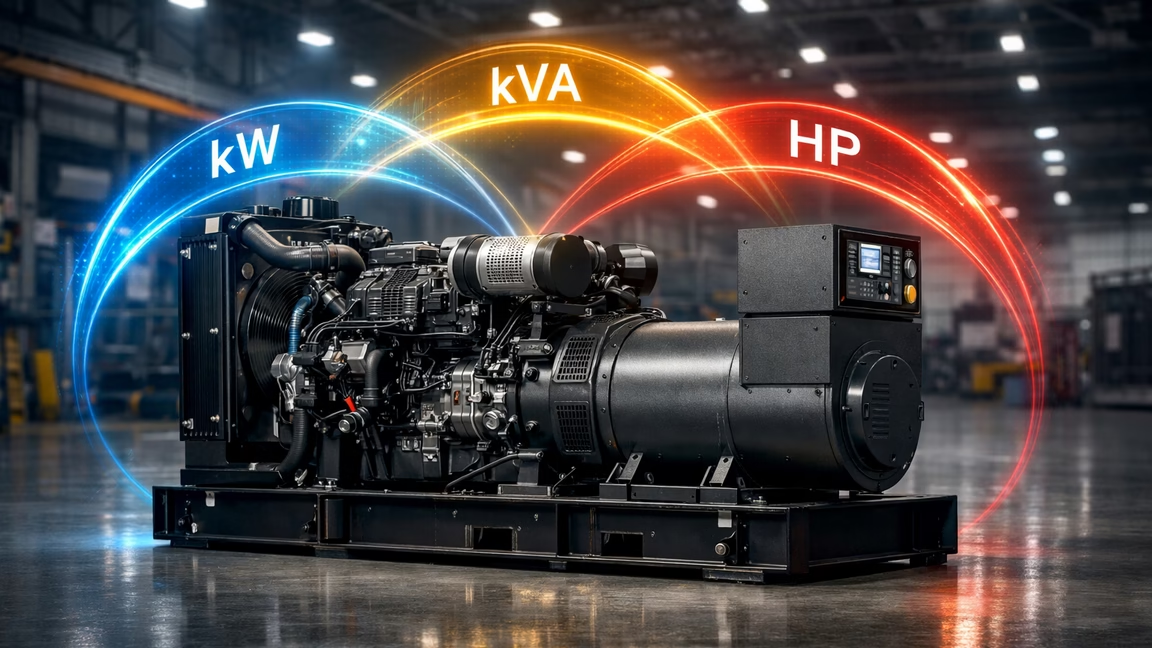
You need a generator. You start looking at spec sheets. Suddenly, you hit a wall of confusing letters. One machine boasts 100 kVA. Another claims 80 kW. Your heavy equipment just asks for 50 HP. It feels like a secret code. Why can’t they just pick one way to measure power?
Mixing up these terms is a costly mistake. It is the number one reason people buy the wrong size generator. Buy too small, and the system trips offline when you need it most. Buy too big, and you waste huge amounts of fuel and money. You might even damage your equipment.
We are going to clear this up for good. This guide will break down generator power units in plain English. You will learn exactly what each term means. We will also share simple formulas and easy charts. Soon, you will use our kW to kVA converter with total confidence. No more guessing. No more costly mistakes. Just the right power for your job.
The Big Three: What Do Generator Power Units Actually Measure?
To size a generator right, you must speak the language. Let’s look at the three main ways we measure power.
kW (Kilowatts) – The “Real” Work
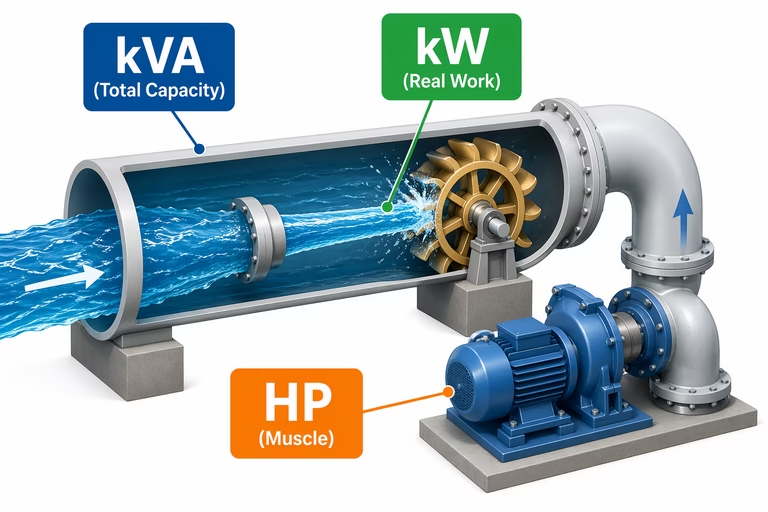
Think of a water hose. Kilowatts measure the water that actually fills the bucket. This is real power. It does the actual work. It lights up your bulbs. It heats your oven. It turns the blades on your fans. When you pay your electric bill at home, you pay for kilowatts. If you want to know what your tools can actually get done, you look at the kW.
kVA (Kilovolt-Amperes) – The “Total” Capacity
Let’s go back to the hose. kVA measures all the water flowing through the hose. Yes, it counts the water filling the bucket. But it also counts the water sloshing back against the walls of the hose. This is apparent power. It combines real work with the pushback from the system. Industrial machines and big job sites use this term. You will almost always see it on large generator nameplates.
HP (Horsepower) – The “Mechanical” Muscle
Horsepower is a bit different. It measures raw mechanical muscle. It is the twisting force that spins an engine. Think of the truck delivering the water. The engine inside your generator rates its raw strength in HP. The motors on your job site pumps and compressors also use HP. Later, we will use the HP to kW formula to switch this muscle into electrical terms you can use.
The Missing Link: What is Power Factor (pf)?
Why do we have two units for electricity? Why is kVA not equal to kW? The answer comes down to reactive power.
Some machines need a magnetic field just to work. Motors and transformers need this field to operate. They draw extra power to build that field. This power bounces back and forth in the cables. It does not do any real work. It just takes up space in the system.
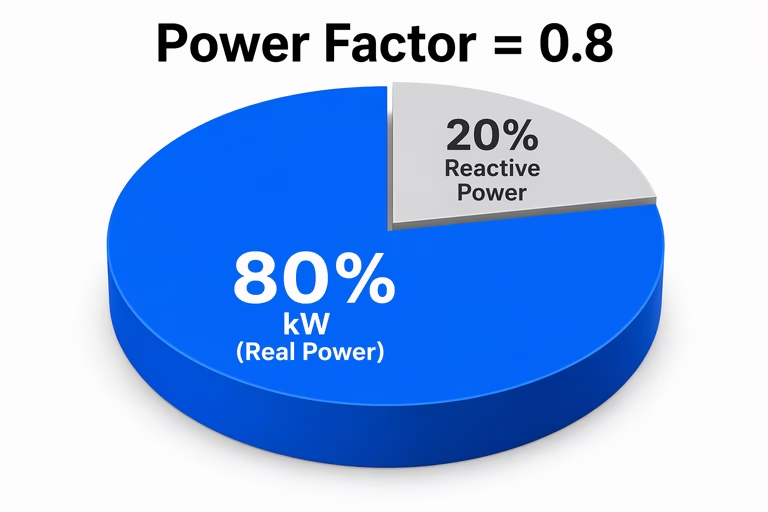
This is where power factor comes in. It is the bridge between real power and total power. Power factor tells you how much of the total power actually does real work. We write it as a decimal. It ranges from zero to one.
Most modern generators have a standard power factor of 0.8. What does this mean for you? It means only 80% of the total power does real work. The other 20% builds those magnetic fields.
Let’s look at a quick example. If a generator makes 100 kVA of total power, it only gives you 80 kW of real work. This rule is vital. If you ignore it, you will pick the wrong machine. Do not guess on this. Use our kW to kVA converter to get it right the first time.
The Math: Conversion Formulas & Quick Charts
Now let us crunch the numbers. You do not need a math degree to figure this out. We just need simple formulas and quick charts.
kW to kVA Converter Formula
Changing kW to kVA is easy when you know the power factor. The rule is simple. kW equals kVA times the power factor. To flip it around, kVA equals kW divided by the power factor.
Let us try an example. You need 80 kW of real power. Your system has a standard 0.8 power factor. Divide 80 by 0.8. You need a 100 kVA generator to do the job.
kW to kVA Conversion Chart (0.8 Power Factor)
- 8 kW | 10 kVA | Small backup
- 20 kW | 25 kVA | Home or small shop
- 40 kW | 50 kVA | Medium job site
- 80 kW | 100 kVA | Large commercial
- 800 kW | 1000 kVA | Industrial plant
The HP to kW Formula
Horsepower measures muscle. Kilowatts measure electrical work. To switch between them, you use a simple number. One HP equals 0.746 kW.
But wait, there is a catch. Motors are not perfect. They lose some power to heat and friction. You must factor in motor efficiency. Standard efficiency is usually around 0.9. So, the real HP to kW formula is kW equals HP times 0.746 divided by efficiency.
Need to go the other way? HP equals kW divided by 0.746.
HP to kW Conversion Chart
- 5 HP | 3.73 kW | 5.2 kVA Required
- 10 HP | 7.46 kW | 10.4 kVA Required
- 50 HP | 37.3 kW | 51.8 kVA Required
- 100 HP | 74.6 kW | 103.6 kVA Required
- 500 HP | 373 kW | 518 kVA Required
Real-World Application: How to Size Your Generator Properly
Math is great, but how does it work on the job? Let us look at real life. You need to size your generator power units correctly. A mistake here costs time and money.
Sizing for Residential and Reactive Loads
Homeowners care about kW. You just need to add up the watts for your fridge, lights, and AC. But watch out for starting surges. Your air conditioner might need 4 kW to run smoothly. But it takes a huge spike of power just to start up. That spike can trip your breaker. Always check the starting watts, not just the running watts. Use a kW to kVA converter to make sure your generator handles that starting kick.
Sizing for Industrial and Motor-Driven Loads
Factories and job sites care about HP and kVA. If you run big pumps or saws, you deal with motors. A 50 HP motor does not just need 37 kW of power. You must account for motor efficiency and starting surges. A motor can draw three to six times its running power just to spin up. You cannot just buy a generator that matches the running kW. You need extra room to handle the start.
The Rule of Thumb Check
Here is a fast way to check your math. Add up all your loads in kW. Divide that number by 0.8 to find your kVA. Then, add a 20 percent safety margin. Generators run best at about 80 percent load. This saves fuel and helps the machine last longer.
Common Calculator Mistakes (And How to Avoid Them)
Even with the best tools, people make errors. Let us look at the top mistakes folks make when they use a power calculator. Avoid these, and you will get the right generator every time.
Mistake 1: Mixing Up kW and kVA Fields
This is the biggest trap. People type their kW number into the kVA box. What happens? You pick a generator that is 20 percent too small. When the power goes out, the machine shuts down right away. It simply cannot handle the load. Always double-check your labels before you hit calculate.
Mistake 2: Forgetting Motor Efficiency in the HP to kW Formula
A 10 HP motor does not use exactly 7.46 kW of electricity. It loses some power to heat. It really pulls closer to 8.3 kW. If you forget the efficiency step in the HP to kW formula, you will undersize your generator. The motor will starve for power and fail to run right.
Mistake 3: Ignoring the Power Factor
Never assume your power factor is a perfect 1.0. That only happens with simple heaters and old-school light bulbs. If you run motors or old tools, your power factor drops. If you guess wrong, you will not have enough total power to keep the system running. Stick with the 0.8 standard for industrial sites. Use a reliable kW to kVA converter that includes the power factor so you do not get caught short.
Conclusion & CTA
You did it. You now speak the language of generator power units. Let us do a quick recap. kW is the real work that runs your tools. kVA is the total capacity the machine can hold. HP is the raw muscle of the engine. Power factor is the bridge that ties them all together.
When you know these terms, you take control. You no longer have to guess what size machine you need. You can read any spec sheet and know exactly what it means. This saves you cash. It keeps your equipment safe. It gives you peace of mind.
Do not let the math slow you down. Stop guessing your power needs. Get it right the first time. DG load calculator to find your exact requirements in seconds. Our tool does the heavy lifting for you.
🔌 Generator Sizing & Load Resources
Expert guides, calculators & case studies
Frequently Asked Questions
Is kVA bigger than kW?
Yes, kVA is always equal to or larger than kW. Think of kVA as the whole pie. kW is just a slice of that pie. The size of the slice depends on your power factor. If your power factor is a perfect 1.0, then kVA and kW are exactly the same. This only happens with simple heat elements. For almost all other gear, kVA is bigger.
How many kW is a 100 kVA generator?
Most generators use a standard 0.8 power factor. To find the real work, you multiply 100 kVA by 0.8. A 100 kVA generator gives you 80 kW of usable power. You can use a kW to kVA converter to check the math for other sizes. It always pays to check the spec sheet first.
What is the HP to kW formula?
The basic HP to kW formula is very simple. You multiply the HP by 0.746. This gives you the raw kilowatts. But remember to factor in motor efficiency. Real motors lose some power to heat. To get the true electrical draw, divide your result by the efficiency rating.
Why do generators use kVA instead of kW?
Generators supply two kinds of power. They give you real power to do work. They also give you reactive power to build magnetic fields in motors. The generator must handle both at the same time. The cables and alternator must be big enough to carry the total load. That total load is the kVA.
How do I convert kW to HP?
You just flip the HP to kW formula around. Take your kW number and divide it by 0.746. For example, if you have 10 kW, you divide by 0.746. That gives you about 13.4 HP. This is handy when you know your electrical load but need to match it to an engine rating.