The Frustrating Scenario: When Good Generators Go Bad
The storm rolls in. The power goes out. You fire up your trusty backup generator. Everything is going great. The lights are on. The fridge is cold. Then, the well pump kicks on.
Click.
Darkness. The generator bogs down and shuts off. You are left in the dark again, wondering what just happened.
It is a huge pain point. You spent good money on a generator to keep your home or job site running. It should handle your appliances, right? But there you are, trudging out to the generator to reset the breakers in the freezing cold.
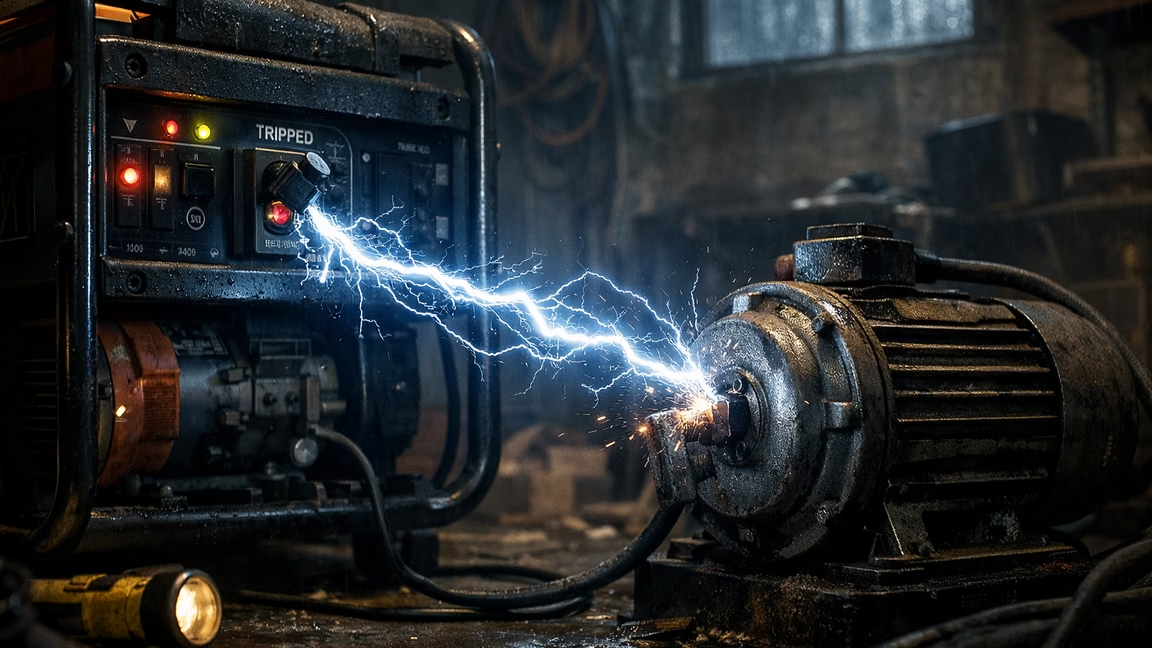
Your generator is not broken. It is just overwhelmed. When an electric motor starts up, it demands a massive, instant rush of power. This spike is simply too much for the generator to handle. That is exactly why your generator trips when motor starts up.
You do not need a new generator. You just need to understand this power spike. Once you know how it works, you can fix it. We will show you the science behind the surge. We will show you how to calculate it. And we will give you proven ways to stop it for good.
The Science of the Surge: What is Motor Inrush Current?
Think of a car. It takes a lot of gas to get a heavy truck moving from a dead stop. But once you are cruising on the highway, you need less gas to keep it going. Electric motors work the exact same way.
Running Current vs. Starting Current (The 300% to 800% Rule)
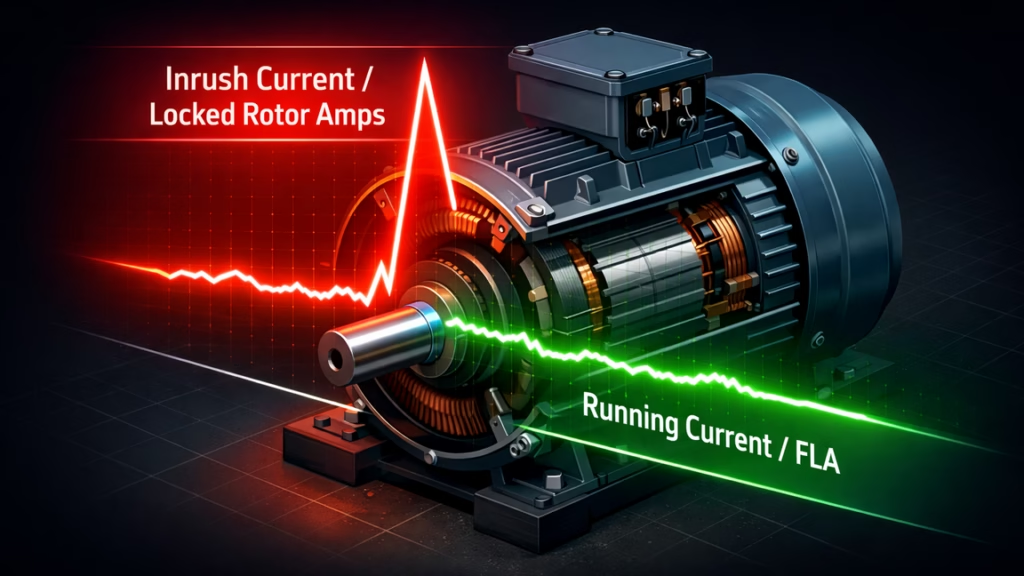
When a motor runs normally, it uses a steady, small amount of power. This is called running current. You might also see it called Full Load Amperage (FLA) on the motor’s label. It is just enough juice to keep the pump or fan spinning smoothly.
But starting is a totally different story. A motor at a dead stop acts like the brakes are locked on. To break it free and get it spinning, the motor yanks a huge amount of power all at once. This instant demand is called inrush current. You will also hear pros call it locked rotor amps.
The difference between the two is shocking. The starting surge can be 300% to 800% higher than the running power. That means a motor that uses 5 amps to run might pull 40 amps for a split second just to wake up. This is the key to understanding inrush current vs running current. That split-second yank is what causes all your trouble.
Why Your Generator Freaks Out
Let’s look at this from your generator’s point of view. Your generator is humming along nicely. It is running at an easy 30% load. The lights are on. The TV is going. Life is good.
Then, you flip the switch for the air compressor. In a fraction of a second, the motor asks for 600% more power than it normally uses.
Your generator panics. It tries to push out that extra power instantly, but it just cannot do it. The engine RPM drops fast. The voltage takes a nosedive. The generator’s safety system sees this massive power drain. To keep the wires from melting and the engine from stalling out completely, it trips the main circuit breaker. The system shuts down to save itself.
It is a safety feature, not a flaw. But it is still super annoying. To fix the problem, we have to know exactly how much power your motor needs at startup. That is where the math comes in.
Do the Math: How to Calculate Your Motor’s Starting Surge
You cannot fix a problem if you do not know its size. To stop your generator from tripping, you need to know exactly how much power your motor needs at startup. This takes a little math, but it is easy to figure out.
The Formula for Inrush Current
The basic formula is simple. You take the running current and multiply it by a surge multiplier. Usually, this multiplier is between 3 and 8. So, how do you find the exact multiplier?
Look at the motor’s data plate. You will see a NEMA code letter. This letter tells you the locked rotor amps per horsepower. For example, Code G means the motor needs about 6 kilovolt-amperes per horsepower to start. Code H is higher. Code J is even higher. This is vital info for proper generator sizing for motors.
Using a Motor Inrush Current Calculator
Motor Inrush Current
Estimate Locked Rotor Amperage (LRA) using NEMA code letters — essential for breaker sizing, soft-start selection & protection coordination.
LRA = (kVA/HP × HP × 1000) / (√3 × V) for 3Φ |
LRA = (kVA/HP × HP × 1000) / V for 1ΦDoing the math by hand is a real chore. Why not let a smart tool do the heavy lifting? You can use this motor inrush current calculator to find your exact starting surge in seconds. Just plug in your motor specs, and it takes the guesswork right out of sizing your generator setup.
Doing this math by hand is a hassle. That is why pros use a digital tool. A motor inrush current calculator does the heavy lifting for you. You just plug in a few numbers. Enter your voltage, horsepower, phase, and that NEMA code letter. The calculator instantly spits out your starting surge in amps. It takes the guesswork out of the job. No more scratching your head over complex formulas.
Real-World Example Calculation
Let’s look at a common issue. Say you have a 5 HP well pump. It runs on 240 volts. The data plate shows a running current of 28 amps. The NEMA code is H, which gives us a multiplier of about 8.
Now, do the math. 28 amps times 8 equals 224 amps. Your well pump needs 224 amps for a split second just to wake up!
Now, look at your generator. A standard 8kW generator puts out about 33 running amps. Its surge capacity might push to 50 amps for a brief moment. Fifty amps is nowhere near 224 amps. The generator gives up instantly. This is exactly why your generator trips when motor starts up. The math simply does not work out.
5 Proven Ways to Stop Your Generator from Tripping on Motor Startup
Now you know why it happens. Let’s talk about how to fix it. You have several options, ranging from simple habit changes to adding new gear. Here are five proven ways to solve the problem.
Fix #1: Upsize Your Generator (The Brute Force Method)
The simplest fix is to get a bigger generator. If your current unit cannot handle the surge, buy one that can. Generator sizing for motors must focus on the starting surge, not the running watts. A good rule of thumb is to pick a generator with a surge wattage three to five times higher than the motor’s running wattage. For heavy generator load startup like air compressors, you might need seven times the running watts.
Pros: It is a 100% reliable fix. Cons: It is expensive. A bigger generator costs more, takes up more space, and burns more fuel.
Fix #2: Install a Soft Starter (The Best ROI)
A soft starter is a small device you wire into the motor’s power box. It slowly ramps up the voltage to the motor over a few seconds. Instead of yanking 800% of the power instantly, it eases into it. It drops the starting surge down to around 200% or 300%. This is often the best fix for well pumps and air compressors. Adding a soft starter for generator setups is cheap and works like a charm.
Pros: Very cost-effective. It fits right into your existing setup. Cons: It is not great for machines that need instant, full torque to start.
Fix #3: Use a Variable Frequency Drive (VFD)
A VFD for motor starting is even smarter than a soft starter. It controls both the voltage and the frequency to give the motor a perfectly smooth, zero-surge start. It basically tricks the motor into starting in slow motion. These are great for large HVAC systems, industrial fans, and conveyors.
Pros: Offers the best motor protection. It also saves energy while the motor is running. Cons: Higher upfront cost. It can also create electrical noise that messes with some generator electronics.
Fix #4: Sequential Loading (The Operator’s Discipline)
You can fix this problem without spending a dime. You just need to change how you run your gear. Never start a heavy motor while other big items are running. If the electric water heater is on, do not try to start the well pump.
Use the “largest load first” rule. Start the biggest, baddest motor you have when the generator is totally idle. Once that motor is running smoothly, you can turn on smaller loads one by one. Good load management stops the generator circuit breaker tripping in its tracks.
Pros: Completely free. Cons: You have to be vigilant. If someone else in the house flips a switch at the wrong time, the generator still trips.
Fix #5: Adjust Generator Voltage/Frequency DIP Settings
Some modern generators have smart control panels. Brands like Deep Sea Electronics let you change the voltage dip settings. By adjusting these settings, you tell the generator to tolerate a bigger voltage drop before it trips the breaker.
This can stop the generator circuit breaker tripping when a motor starts. But be careful. If you let the voltage dip too far, the motor’s contactor will let go. It chatters on and off fast. This will damage your motor over time. Use this fix with caution.
Quick Troubleshooting Checklist: Is it Really the Inrush Current?
Before you start buying new parts, let’s make sure you have the right culprit. Sometimes a generator trips for other reasons. Run through this quick checklist to see if that motor starting surge is truly to blame.
Check 1: Is the Breaker Thermal or Magnetic?
Look at the breaker on your generator. Breakers trip in two ways. A thermal breaker trips when wires get too hot over time. If it takes a few seconds or minutes to trip, you might just have too much stuff running at once.
A magnetic breaker trips instantly. It reacts to massive power spikes in milliseconds. If your breaker trips the exact microsecond you flip the motor switch, it is definitely the inrush current. An instant trip means the starting surge overwhelmed the system right away.
Check 2: Are You Experiencing “Cogging” or “Chattering”?
Listen to the motor when you try to start it. Does it click rapidly but never actually spin? That sound is called chattering. It happens when the generator voltage drops too low.
Electric motors have a contactor inside. It is basically an electromagnet that pulls the switch shut. If the generator voltage dips too far, the magnet gets weak. The switch pops open. Then the voltage shoots back up, the magnet grabs, and it pops shut again. This rapid clicking means your generator is struggling hard to supply the power the motor needs.
Check 3: Inspect Your Extension Cords
This is a huge one. Long, thin extension cords are the enemy of electric motors. A skinny cord creates resistance. That resistance causes a massive voltage drop.
When the voltage drops, the motor has to pull even more current to get going. This makes the starting surge way worse than it needs to be. Always use the shortest cord possible. Make sure it has a thick wire gauge. A beefy cord is a cheap and easy way to soften the blow of a heavy generator load startup.
Don’t Let a Motor Surge Leave You in the Dark
Dealing with a generator that shuts down on you is incredibly frustrating. But now you know the secret. Your generator is not broken. It is just reacting to a massive, instant demand for power.
When your generator trips when motor starts, it is simply a math problem. The motor needs a huge gulp of power to overcome inertia. The generator cannot provide that gulp fast enough. The safety system kicks in, and the power goes out.
You do not always have to go out and buy a massive, expensive generator to fix the issue. Often, a simple soft starter for generator setups is all you need. Sometimes, you just need to change the order you turn things on. Better cables or a quick setting tweak can also save the day.
Do not let the math catch you off guard next time the power goes out. Use our motor inrush current calculator to figure out your exact starting surge. Once you know your numbers, you can pick the right fix and keep your home running smoothly, no matter what the weather throws at you.
Frequently Asked Questions (FAQ)
Why does my generator trip the breaker when my air compressor starts?
Air compressors are notorious for this. They have a check valve and an unloader valve. The unloader valve lets the pump start with zero air pressure inside. If that valve fails, the motor tries to start against a tank full of compressed air. This creates a massive heavy generator load startup. Combine that locked strain with the normal locked rotor amps, and your generator simply gives up instantly.
Will a bigger breaker stop my generator from tripping?
Absolutely not. This is a very dangerous idea. Never swap in a larger breaker than the generator is rated for. The breaker is there to protect the copper wires inside the generator. If you put in a bigger breaker, the wires will overheat and melt before the breaker ever trips. You could start an electrical fire or destroy your generator. Fix the power surge instead of disabling the safety alarm.
Does a soft starter reduce running current?
No, it does not. A soft starter only works during the first few seconds of startup. It ramps up the voltage slowly to lower the massive spike of inrush current vs running current. Once the motor hits its full speed, the soft starter bypasses itself. The motor then runs on normal power. It will not save you money on your electric bill, but it will stop your breaker from popping.
Can I run a well pump on a portable generator?
Yes, you can. But you must plan for that starting surge. Well pumps pull a huge amount of power to get going. You need a portable generator that can handle three to five times the running watts just to start the pump. If your portable unit is too small, do not worry. You can easily install a soft starter on the well pump. This drops the starting demand down to a level that almost any portable generator can handle.
🔌 Generator Sizing & Load Resources
Expert guides, calculators & case studies
Final Thoughts: Beat the Motor Starting Surge
Dealing with a generator that shuts down on you is incredibly frustrating. But you are no longer in the dark about why it happens.
When your generator trips when motor starts, it is just a simple math problem. The motor wants a giant gulp of power to overcome a dead stop. The generator cannot serve it up fast enough. The safety system does its job, and the power shuts off.
You do not always need to buy a bigger, pricier machine to solve the problem. A simple soft starter can work wonders. Sometimes, you just need to manage your loads better or upgrade a cheap extension cord.
Do not let the math catch you off guard next time the power goes out. Use a motor inrush current calculator to figure out your exact numbers. Pick the right fix for your setup. Then, you can keep the lights on and the water flowing, no matter what the weather throws at you.