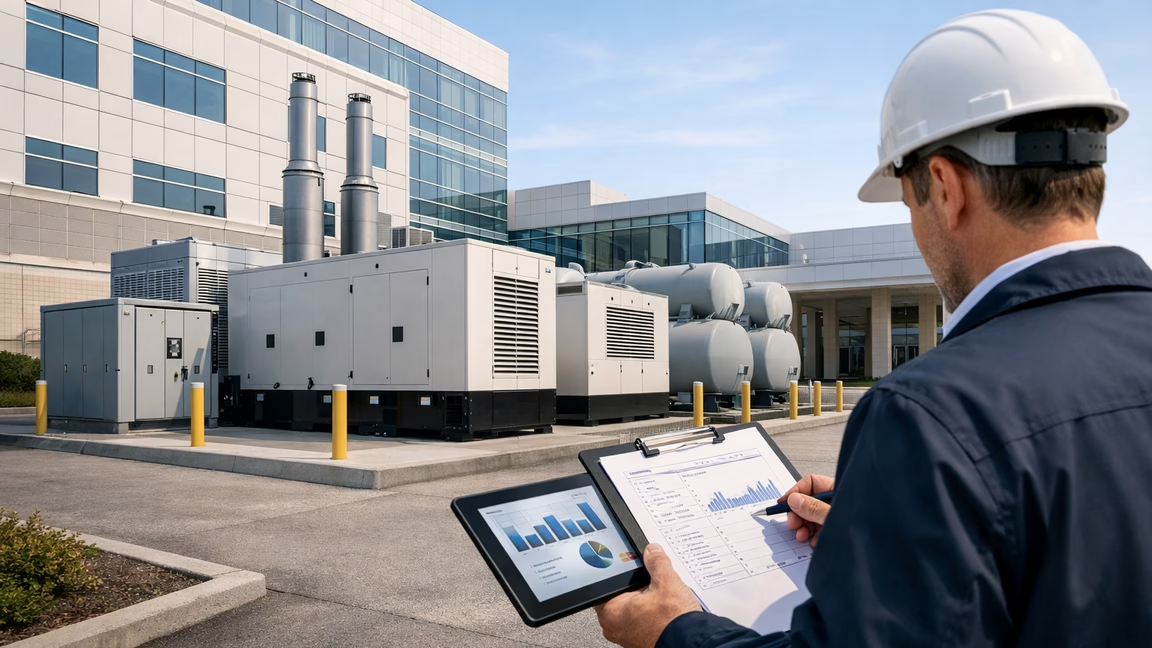
A hospital can live with a lot of problems. It cannot live with a power failure.
That was the real issue here. A regional hospital needed a new backup power plan. The first proposal looked safe. It also looked expensive. Very expensive. The system was sized with a wide safety margin, broad assumptions, and a long list of loads that did not all need to run at once.
On paper, that sounds careful. In real life, it often leads to wasted money.
This case study shows how hospital generator sizing works when the goal is not just “more power,” but the right power. The team needed to protect patient care, meet backup needs for critical systems, and avoid paying for capacity that would sit idle most of the year. That meant looking past rough guesses and digging into what the facility truly needed during an outage.
The lesson is simple. Bigger is not always safer. In backup power planning, bigger can mean higher fuel use, a larger footprint, more maintenance, and a budget that gets hard to defend. A smart plan starts with the load, the risk, and the real-world use case.
If you are still early in your research, our Generator sizing guide breaks down the basics in plain language. And if you want to estimate demand before you read on, our Diesel load calculator can help you frame the numbers faster.
The Challenge: Reliable Backup Power Without Paying for Excess Capacity
Hospitals do not size generators the same way a warehouse or office building does.
The stakes are much higher. During a power cut, some systems must stay live right away. Others can wait. Others do not need backup at all. The trouble starts when all of those loads get lumped into one giant number. That is how costs spiral.
This hospital was facing that exact problem. The leadership team had a simple question: how do we protect essential services without buying a system built for every possible worst-case event at the same time?
It is a common trap in hospital generator sizing. A consultant or supplier takes the full connected load, adds a healthy margin, includes future equipment, and then rounds up again for comfort. The result feels safe. But it may have little to do with how the building actually performs during an outage.
That kind of oversizing creates more than just a bigger invoice.
It can lead to:
- a higher upfront equipment cost
- a larger installation scope
- more fuel storage needs
- lower efficiency at partial load
- more maintenance over the life of the system
- more noise, more space pressure, and more complexity
None of those issues improve patient care on their own.
This is why backup generator sizing for healthcare facilities should start with one hard question: what must run, what can wait, and what does the real load look like under outage conditions?
That is where this case began to shift. Instead of treating the hospital like one giant block of demand, the team split the facility into priority layers. Life safety. Core clinical functions. Essential support systems. Deferred loads. Nice-to-have loads. Once that happened, the original number started to look less like a requirement and more like a guess.
This is also where many buyers confuse connected power with usable demand. If you have ever had to convert ratings across equipment types, kw to kva converter guide can help keep those comparisons clean. Small mistakes here can snowball into a much larger generator than the site truly needs.
There was another issue hiding in the background. Some of the hospital’s equipment included motors and systems with a sharp startup pull. That matters because a generator is not sized only for what runs. It is also sized for how things start. If that startup demand is handled poorly, the unit may trip, sag, or force the design team to oversize as a workaround. We cover that in more detail in motor starting surge, why your generator trips on startup.
The hospital did not want a “safe-looking” design. It wanted a design it could defend. That meant tying every sizing choice back to actual need.
Facility Profile: The Hospital’s Power Needs at a Glance
The facility in this case was a mid-sized community hospital with a busy emergency department, inpatient beds, operating rooms, diagnostic imaging, lab services, pharmacy storage, and a growing IT footprint. It was not a giant academic medical center. But it was large enough that even a short outage could disrupt patient care, delay procedures, and put sensitive systems at risk.
The hospital also had a practical problem. Its current backup setup had been built for an earlier version of the site. Over time, the facility had added new equipment, expanded clinical use, and layered in more digital systems. On top of that, the leadership team was planning modest growth over the next few years. That growth mattered, but not enough to justify buying for every future scenario on day one.
Here is the profile the team worked from:
At a glance
- Mid-sized regional hospital
- Emergency department with 24/7 operations
- Surgical and procedural areas
- Imaging and lab functions
- Pharmacy refrigeration and medicine storage
- Core HVAC support for key zones
- IT, communications, and nurse station loads
- Moderate expansion expected within three to five years
This matters because hospital backup generator requirements are rarely just about total size. They are about priority. A refrigeration load tied to medication storage may matter more than comfort cooling in a non-clinical office. A nurse station may matter more than a break room circuit. A surgical area has different needs than general admin space. The right generator plan reflects that.
The team also reviewed how the hospital used power across a normal week, not just during theoretical peak events. That helped them separate what was always critical from what only mattered under certain operating conditions. It also helped them identify loads that could be sequenced instead of starting all at once.
That last point is easy to miss. In many facilities, systems do not need to come online at the same second. With smarter sequencing, you can reduce the required generator size without giving up resilience. That is why a generator load calculation hospital teams can trust should reflect both steady demand and startup behavior.
The hospital also had to think about power quality. Modern healthcare sites rely on digital systems, control boards, imaging support gear, and other equipment that may not behave like simple linear loads. If your site includes more electronics and sensitive systems than older facilities did, generator sizing for non linear loads becomes a useful side topic. It is one of those details that rarely shows up in rough estimates but can affect how well a generator performs in the field.
There was one more practical factor: site conditions. Ambient temperature, ventilation, and local operating conditions can reduce real output if they are not handled properly. That is why the team did not just look at catalog ratings. They also reviewed installation assumptions and equipment performance under local conditions. If that part gets skipped, a design may look fine on paper and still come up short later. We break that down in generator derating explained.
In short, the hospital’s power needs were serious, but not random. Once the team mapped the facility by function and risk, the sizing path became much clearer.
What Was Driving the Original Oversized Recommendation?
The first recommendation was not reckless. It was just too broad.
That happens all the time in backup power planning. A design team wants to avoid undersizing, so it reaches for the simplest path: add everything, add margin, and move up to the next larger unit. The problem is that this approach often mixes real needs with imagined ones.
In this case, the original oversized recommendation came from five common mistakes.
1. Total connected load was treated like real demand
This was the biggest issue.
The initial estimate leaned too hard on connected load. That means the design assumed that all major loads could matter at once, even though the hospital’s real outage profile showed something very different. Some systems would never run together. Others would cycle. Some would stay off until core services were stable.
Connected load is useful as a rough check. It is not a smart final answer.
2. Essential and non-essential loads were not clearly separated
This is where overspending often hides.
If lighting in a storage area gets counted with life safety systems, or if comfort cooling in a low-priority zone gets bundled with patient-critical areas, the generator size starts to swell. The hospital needed a cleaner list: what must stay live, what can wait, and what does not belong on emergency power at all.
Once the team stripped the list down to true priorities, the target size changed fast.
3. Too much future growth was added too early
Planning for growth is wise. Prepaying for every possible future load is not.
The original proposal included expansion assumptions that may not happen for years. Some of those loads could be handled later through phased upgrades, distribution changes, or modular planning. But they were being priced into the current purchase as if they were immediate requirements.
That is one of the simplest ways to inflate a project budget.
4. Startup behavior was handled with brute force
Some equipment creates a sharp surge when it starts. If the design does not account for that, teams often respond by jumping to a much larger generator. It works, but it is usually the most expensive fix.
A better approach is to study which loads start first, which can be delayed, and which systems need a soft, staged return. In this case, startup logic was one of the reasons the first design looked bigger than necessary.
5. Real equipment selection had not been narrowed down
At the early stage, many projects use broad equipment assumptions. That can be useful. But it can also lead to oversizing if the team keeps planning around the top end of every category. When the hospital started comparing realistic generator classes and practical capacity bands, the design choices became easier to evaluate. If you are at that stage too, our guide to the best diesel generators by kva tier can help you see how sizing choices change by range and application.
There is also a wider lesson here for other mission-critical sites. The same habit shows up in a data center backup power case study, even though the load profile is different. Data centers often oversize from uptime anxiety. Hospitals often oversize from life safety caution. Different industries. Same budgeting mistake. In both cases, the cure is the same: use real demand, clear load priorities, and a sizing model grounded in how the site actually operates.
By the time the hospital finished reviewing the original assumptions, one thing was clear. The problem was not that the team cared too much about reliability. The problem was that reliability had been translated into a bigger number instead of a better plan.
That is where the project started to get smarter.
The Step-by-Step Sizing Process the Team Used
Once the hospital stopped chasing a “bigger is safer” answer, the work got much more practical.
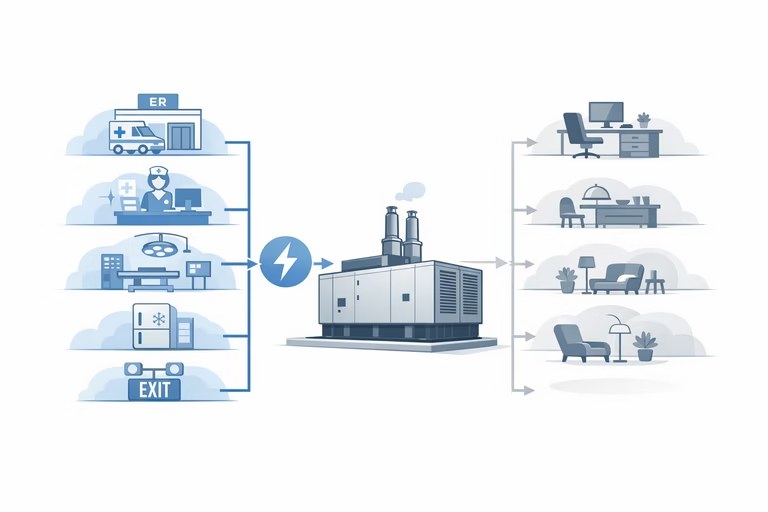
The team did not start with the generator. It started with the building. More specifically, it started with one simple question: what has to stay on when the grid goes down, and what does not?
That shift changed everything.
1. They separated critical loads from everything else
The first pass through the load list was too broad. It treated many systems as equal when they were not.
So the team rebuilt the list from the ground up. They grouped loads into clear tiers.
Tier one included the systems that had to stay live right away. These were the loads tied to life safety, core patient care, emergency response, communications, and critical medication storage.
Tier two included systems that mattered a lot, but did not all need to come online at the first second of an outage. Some support areas fit here. So did parts of the building that could tolerate a short delay while the emergency system stabilized.
Tier three included loads that were useful, but not essential during a power event. These were the easiest to remove from the backup power plan.
This sounds obvious. It rarely happens cleanly on the first try.
In many projects, the real savings come from better decisions, not smaller equipment. Once the hospital had a clear list of must-run loads, the generator sizing target became much easier to defend.
2. They checked real power use instead of trusting rough estimates
Next, the team reviewed actual demand data.
This mattered because nameplate values can distort the picture. A facility may own equipment with high rated power, but that does not mean all of it runs at once, at full load, during the same outage window.
The hospital looked at historical usage, demand patterns, and how different areas behaved during busy periods. The team wanted to understand the real load shape, not the maximum imaginable one.
That helped in two ways.
First, it trimmed out false assumptions. Some loads that looked large on paper had a much smaller impact in real use.
Second, it showed where demand was steady and where it was spiky. That gave the team a better sense of what the generator would need to handle during normal emergency operation.
This was a major turning point. The original recommendation was built around caution. The revised plan was built around evidence.
3. They studied how equipment starts, not just how it runs
A generator is not sized only for steady demand. It also has to survive the moment things start.
That is where many designs get inflated.
The hospital had several systems that pulled extra power during startup. Motors, pumps, and certain mechanical loads were part of the problem. If too many of those came online at once, the generator had to be large enough to absorb that hit.
But the team found a smarter option.
Instead of assuming everything would start together, they looked at sequence. Which systems truly needed instant recovery? Which could start a few seconds later? Which could wait until the first wave had settled?
That sequencing approach reduced the peak burden on the generator. It did not reduce reliability. It improved the plan.
This is one of the clearest lessons from the case. If startup behavior is handled with control logic instead of brute force, the required generator size often drops without adding risk.
4. They planned for growth without buying all of it today
The hospital was not a static site. It had expansion plans. That part was real.
But the team drew a sharp line between near-term growth and distant possibilities.
Instead of sizing for every future project at once, they focused on the loads that were likely to arrive within the next few years. Anything beyond that was treated as a planning factor, not a hard requirement for the current purchase.
That helped the hospital avoid one of the costliest mistakes in backup power planning: paying now for expansion that may change later anyway.
The final design still left room to grow. It just did so in a measured way. The team preserved headroom where it made sense and left open paths for future upgrades. That gave the hospital flexibility without forcing it to overspend today.
5. They compared more than one equipment path
At this point, the team had a better load profile, a better startup plan, and a better view of future growth. Now it could compare options on equal terms.
That comparison did not stop at generator size. It also looked at how the system would operate over time.
The team weighed one larger unit against a more flexible setup. It looked at the trade-off between simplicity, redundancy, maintenance planning, fuel use, and floor or yard space. It also looked at how each option would perform during part-load operation, because real systems spend much more time in normal standby than in full emergency stress.
This wider comparison helped the hospital make a better decision. It stopped the conversation from turning into a simple race toward the largest number.
By the end of the sizing process, the team had something it did not have at the start: a plan built on real operating needs, not vague fear.
The Final Recommendation: What the Hospital Actually Chose
The hospital did not choose the largest generator it could afford. It chose the one that fit the job.
That distinction matters.
After reviewing the critical load list, real demand data, startup sequencing, and near-term growth, the team settled on a backup power design sized around verified essential demand rather than full connected load. It kept a sensible reserve margin, but not an inflated one. The design also accounted for startup events in a controlled way instead of using raw oversizing to solve every problem.
In plain terms, the hospital chose a system that was strong enough for the loads that truly mattered and disciplined enough to avoid paying for loads that did not.
The final recommendation balanced four goals.
Reliable support for essential operations
First, the system had to protect the hospital’s core mission. Emergency care, life safety systems, key treatment areas, critical refrigeration, communications, and selected HVAC support all remained in the emergency power plan.
That gave the leadership team confidence that patient care would not be left to chance during an outage.
Practical headroom without waste
Second, the design kept room for growth, but only where that growth was realistic. The hospital did not buy for every imagined future expansion. It reserved enough capacity for the most likely next step and left space for future upgrades if and when they became necessary.
That made the decision easier to defend in both engineering and budget terms.
Better control over startup behavior
Third, the system design used load priority and sequencing to reduce stress during the transition to generator power. That meant the hospital did not need to chase a larger unit just to survive the first surge of returning equipment.
This is where the final recommendation became much smarter than the original one. It solved the real problem instead of buying around it.
A better fit for day-to-day ownership
Fourth, the team looked beyond the purchase itself. A generator is not a one-time expense. It has to be tested, maintained, fueled, and supported for years.
The selected option was easier to live with. It placed less strain on space, budget, and long-term upkeep. It also reduced the chance that the hospital would end up with a system that ran too lightly for most of its life.
In the end, the recommendation was not flashy. It was disciplined. That was the point.
The hospital did not need the biggest answer. It needed a credible one.
Cost Savings: Where the Hospital Avoided Overspending
The most important outcome was not that the hospital bought a smaller number. It was that the hospital avoided paying for the wrong number.
That distinction is worth keeping in mind.
Oversizing does not just increase the price of the generator itself. It drives cost into the whole project. Once the team right-sized the system, savings showed up in several places.
Lower equipment cost
This was the most obvious one.
A generator sized around actual essential demand costs less than one sized around total connected load plus an oversized buffer. That does not mean cutting corners. It means refusing to fund capacity that the site is unlikely to use.
For the hospital, this reduced the amount of capital tied up in standby equipment from day one.
Lower installation cost
Bigger units often trigger bigger supporting work.
That can mean a larger pad, a larger enclosure, heavier handling needs, more demanding ventilation planning, and a more complex fuel setup. It can also affect switchgear, cable runs, and site layout.
By stepping back from the oversized recommendation, the hospital reduced the scope of work around the generator, not just the generator itself.
Lower fuel and operating burden
A right-sized generator tends to perform better than an oversized one that spends most of its life running far below the sweet spot.
That matters during testing. It matters during long outage events. And it matters for the long-term cost of ownership.
A larger-than-needed system can burn more fuel, create more maintenance work, and add complications without giving much real benefit in return.
The hospital wanted resilience, not drag.
Lower maintenance exposure over time
Every extra layer of capacity comes with a support cost.
The larger the system, the more there is to inspect, test, service, and eventually replace. Those costs do not disappear after the equipment is installed. They follow the facility year after year.
By sizing the system with more discipline, the hospital cut down on avoidable maintenance exposure over the long term.
Better use of capital
This may have been the biggest win of all.
Money not spent on excess generator capacity could be used elsewhere. That could mean upgrades in distribution, controls, monitoring, fuel reliability, or other resilience improvements that deliver more real value than simply buying a larger machine.
That is the heart of this case study.
The hospital did not save money by lowering standards. It saved money by aiming the budget at real risk instead of imagined demand.
And that is what smart hospital generator sizing should do. It should protect what matters most, leave room for practical growth, and keep the project grounded in reality.
What This Means for Other Hospitals Planning Backup Power
This case was about one hospital. But the lesson travels well.
Many healthcare teams start generator planning with the wrong fear. They worry so much about coming up short that they forget the cost of going too far. That is how projects get heavy, slow, and hard to approve.
A better approach is more focused.
Start by asking what truly matters in an outage. Not in theory. In real life. Which systems protect patients? Which ones keep care moving? Which ones support safety, communication, and core treatment? Once you answer that, the sizing process gets much clearer.
That does not mean cutting corners. It means making sharp choices.
For most hospitals, the biggest wins come from five habits.
1. Separate “critical” from “important”
These are not always the same thing.
Some loads must stay live right away. Others matter, but can wait a few minutes. Others can stay off until normal power returns. If you treat all three groups the same, your generator plan will grow fast.
Strong hospital generator sizing starts with clear priorities.
2. Use real demand, not rough guesses
It is easy to fall in love with easy math. Add everything. Add margin. Round up.
But facilities are not math problems. They are living systems. Real demand changes by time, season, workflow, and building use. If your plan ignores that, you may be buying around assumptions instead of needs.
Actual load data leads to better decisions. It also gives you a stronger case when budgets get tight.
3. Do not let future growth dominate today’s design
Expansion matters. But future growth should not swallow today’s budget.
If a new wing, added imaging, or a larger digital footprint is still years away, treat it with discipline. Plan for it. Leave room for it. But do not force every future possibility into the current purchase unless the timeline is firm.
A right-sized plan can still be flexible.
4. Think in systems, not just equipment
A generator does not work alone.
Transfer logic, startup order, distribution design, fuel planning, controls, and maintenance access all shape the outcome. Sometimes the smartest move is not a bigger generator. It is a better sequence, a cleaner priority list, or a stronger operations plan.
That is one reason backup generator sizing for healthcare facilities should never be treated as a one-number exercise.
5. Build a plan you can explain
This may sound simple. It is not.
A good design should make sense to more than one audience. Engineers should trust it. Operations should live with it. Finance should understand it. Leadership should be able to approve it without feeling like the number came from a black box.
That is what made this hospital’s final decision strong. The answer was not just technically sound. It was easy to defend.
So if your team is planning an upgrade now, take this case as a warning and an opportunity. Do not let fear write the spec. Let real loads, real risk, and real priorities guide the design.
How Hospital Generator Sizing Differs From Data Center Backup Power
Hospitals and data centers both hate downtime. But they do not size backup power the same way.
At first glance, the two seem similar. Both are mission-critical. Both rely on continuous operations. Both need a high level of resilience. But once you look closer, the priorities start to split.
That matters because a data center backup power case study may teach useful lessons, but it cannot be copied straight into a hospital project.
Hospitals protect care. Data centers protect uptime.
That is the clearest difference.
In a hospital, backup power exists to support life safety, patient care, emergency response, and essential operations. The power plan is built around people, treatment, and clinical continuity.
In a data center, the focus is different. The priority is keeping servers, storage, networking, cooling, and digital services online. A short failure can mean lost transactions, service disruption, and huge business impact.
Both are serious. But they do not create the same load profile.
Hospital loads are more mixed
Hospitals have a wide range of equipment types.
Some loads are highly critical. Some cycle on and off. Some are mechanical. Some are electronic. Some can wait. Some must return right away. That mix makes hospital generator sizing less about one stable block of demand and more about layers of priority.
Data centers are often more uniform in one key way: a large share of the load is tied to IT and cooling. That can make the load easier to model in some respects, even if redundancy requirements are stricter.
Startup behavior plays out differently
Hospitals often deal with motors, pumps, air handling, and other systems that create startup challenges. That means sequencing matters a lot. Smart startup planning can reduce the required generator size without hurting performance.
In data centers, the biggest issue is often less about mixed motor behavior and more about maintaining seamless support across UPS systems, cooling paths, and redundant power architecture. The backup design may be less about “what can wait” and more about “what must never drop.”
Redundancy can mean different things
Hospitals need resilience. But not every hospital uses the same redundancy model.
Data centers, especially larger ones, often design around tighter uptime standards. That may push them toward more layered redundancy and more conservative backup planning. The goal is to protect digital continuity with as little interruption as possible.
A hospital may also need strong resilience, but it usually makes more distinctions between essential and non-essential loads. That gives it more room to right-size the emergency system.
The oversizing mistake still shows up in both
This is where the two industries look alike.
Hospitals often oversize from caution around patient care. Data centers often oversize from fear of downtime and growth. In both cases, the same pattern appears: broad assumptions, oversized margins, and expensive decisions that are hard to unwind later.
So the lesson crosses industries even when the details do not.
Use actual demand. Understand startup behavior. Separate real priorities from vague future risk. Build the backup system around how the site operates, not around abstract worst-case thinking.
That is true in healthcare. It is true in digital infrastructure. And it is why a hospital generator sizing project needs its own logic, not a borrowed template.
A Simple Checklist for Right-Sizing a Backup Generator
If this case study had to shrink down to one practical tool, it would be this.
Use the checklist below before you approve any generator size. It will not replace engineering work. But it will help you spot the most common reasons projects drift into overspending.
Define what must stay on
Start with the essentials.
List the systems that must remain live during an outage. Be strict. Focus on life safety, patient care, emergency response, critical storage, communications, and other true must-run loads.
Do not mix these with loads that are simply helpful or convenient.
Separate immediate loads from delayed loads
Not everything needs to start at once.
Mark which systems need instant support and which ones can come online in stages. This one step can change the generator size more than many teams expect.
Review real power use
Do not stop at equipment ratings.
Look at actual demand data, operating patterns, and periods of heavy use. A generator load calculation hospital teams can trust should reflect real conditions, not a stack of maximum labels.
Check startup behavior
Find out which loads pull extra power when they start.
Then ask a better question: can those loads be sequenced, delayed, or controlled more intelligently? If the answer is yes, you may not need as much generator capacity as the first estimate suggests.
Challenge future growth assumptions
Growth matters. But every future idea should not land in today’s budget.
Split growth into two groups: likely soon and maybe later. Size the current system around what is real, then create a path for expansion if it becomes necessary.
Compare more than one path
Do not accept the first equipment option as the only option.
Compare unit sizes, reserve margins, control strategies, and phased approaches. The best design is often the one that balances resilience, flexibility, and cost instead of maximizing only one of those.
Review the long-term ownership burden
Ask what the system will cost to live with, not just to buy.
Fuel, maintenance, testing, space, noise, and service access all matter. A larger generator may solve a short-term design worry while creating a long-term ownership problem.
Make sure the plan is easy to explain
If the design cannot be explained in simple language, it may not be ready.
A strong backup power plan should answer three questions clearly:
- What loads are covered?
- Why is this size enough?
- Where is future flexibility built in?
If your team can answer those without vague language, you are probably much closer to a smart decision.
This is the real goal of right-sizing. Not just a smaller generator. Not just a lower cost. A backup power plan that protects what matters, avoids waste, and makes sense long after the purchase order is signed.
FAQ: Hospital Generator Sizing and Backup Power Planning
How do you size a backup generator for a hospital?
You start with the loads that truly matter during an outage.
That means listing the systems that must stay live for life safety, patient care, emergency response, critical storage, communications, and key support functions. Then you review real demand, not just equipment ratings. After that, you factor in how loads start, which ones can be delayed, and how much near-term growth is realistic.
Good hospital generator sizing is not about adding up every circuit in the building. It is about matching backup power to real risk.
What loads should be included in hospital generator sizing?
The short answer is: the loads that the hospital cannot safely lose.
That often includes life safety systems, emergency lighting, fire protection support, critical care areas, emergency department functions, selected surgical spaces, pharmacy refrigeration, nurse stations, communications, IT support, and other essential systems.
It does not always include every comfort load, office area, or non-critical part of the building. The right list depends on how the facility operates and what must continue during an outage.
Is it safer to oversize a hospital backup generator?
Not always.
Oversizing can look safe because it adds more capacity. But it can also increase cost, fuel use, maintenance burden, and installation complexity. In some cases, an oversized generator may also spend too much time running lightly loaded, which is not ideal for long-term performance.
A better goal is to right-size the system. That means enough capacity for critical loads, startup needs, and realistic growth, without paying for capacity the hospital is unlikely to use.
How much spare capacity should a hospital generator have?
There is no one perfect number for every hospital.
A smart design usually includes a reasonable reserve margin for operational flexibility and near-term growth. But that margin should be based on real conditions, not fear. If the buffer is too small, the system may feel tight. If it is too large, the hospital may overspend on equipment it does not need.
The best answer comes from balancing current critical demand, startup behavior, and realistic expansion plans.
Why do hospitals often overspend on backup generators?
Most overspending comes from broad assumptions.
Common causes include using total connected load instead of real demand, treating all loads as equally urgent, adding too much future growth too soon, and using a larger generator to solve startup issues that could be handled with better sequencing.
In plain terms, hospitals often overspend when they size for every possible event at once instead of sizing for how the facility actually works.
What is the difference between connected load and real demand?
Connected load is the total rated power of equipment tied into the system.
Real demand is what the facility actually uses under real operating conditions.
Those numbers can be very different. Not every piece of equipment runs at the same time. Some loads cycle. Some stay off during an outage. Some can be delayed. That is why backup generator sizing for healthcare facilities should rely on real operating patterns, not just a long list of nameplate values.
Why does startup surge matter in hospital generator sizing?
Because some equipment needs more power to start than it needs to keep running.
Motors, pumps, and certain mechanical systems can create a short but sharp demand spike. If too many of those loads start at the same time, the generator may need much more capacity than the steady load alone would suggest.
That does not always mean you need a bigger generator. In many cases, smart sequencing can reduce the startup burden and help the hospital avoid oversizing.
Can a hospital plan for future expansion without oversizing today?
Yes. And it often should.
The key is to separate likely near-term growth from long-range possibilities. If a new wing, added imaging, or expanded support area is coming soon, it may make sense to reserve some headroom now. But if the timing is unclear, it is often smarter to leave a path for future upgrades instead of buying all that capacity today.
That approach helps the hospital stay flexible without locking too much money into unused standby power.
How is hospital generator sizing different from data center backup power planning?
Hospitals and data centers both need resilience, but they protect different things.
Hospitals focus on patient care, life safety, and essential clinical operations. Data centers focus on digital uptime, cooling, network continuity, and uninterrupted service delivery. Hospitals usually have a more mixed load profile, with more variation between critical and non-critical areas.
That is why a data center backup power case study can offer useful ideas, but hospital generator sizing still needs its own logic.
What data should a hospital review before choosing generator size?
The most useful data usually includes:
- critical load lists
- real power demand trends
- peak usage patterns
- startup behavior for major equipment
- outage response priorities
- near-term expansion plans
- site and installation conditions
- fuel and runtime goals
The more clearly a hospital understands those inputs, the easier it becomes to choose a generator size that is both safe and cost-effective.
Can better controls reduce the generator size a hospital needs?
Often, yes.
If the hospital can control which loads start first, which ones wait, and how the system returns to normal after an outage, the peak burden on the generator may drop. That can reduce the amount of standby capacity needed without reducing reliability.
This is one of the smartest ways to improve a backup power design. Better control can be more valuable than simply buying a larger machine.
What is the biggest mistake hospitals make when sizing backup power?
They size from fear instead of function.
That fear is understandable. No hospital wants to come up short during an outage. But when that fear leads to vague assumptions, oversized margins, and too many non-critical loads in the plan, costs rise fast.
The best hospital generator sizing decisions come from clear load priorities, real demand data, practical startup planning, and a realistic view of future growth.
Need Help Validating Your Backup Power Plan?
If your hospital is planning a generator upgrade, the biggest risk is not always undersizing.
Sometimes the bigger risk is approving a number no one can fully explain.
That is how projects get bloated. A broad load list turns into a large equipment recommendation. A large equipment recommendation turns into a large budget. And before long, the team is paying for backup capacity that may never be needed in a real outage.
A better process starts with a simple review.
Look at the loads that truly matter. Check how the building actually uses power. Review what needs to start right away and what can wait. Test growth assumptions. Then compare your current design against a plan built on real priorities.
That kind of review can answer the questions that matter most:
- Is this generator size based on real need or broad estimates?
- Are critical and non-critical loads clearly separated?
- Are startup demands being handled with smart controls or brute force?
- Is the reserve margin practical, or just oversized for comfort?
- Are future expansion plans realistic enough to justify today’s cost?
If your team can answer those questions with confidence, you are in a strong position.
If not, it may be time to step back before the project locks in.
A good validation process does not only protect budget. It protects decision quality. It helps the hospital avoid buying too much, while still protecting the systems that cannot fail.
That is the real goal. Not the biggest generator. Not the lowest number. The right number.
🔌 Generator Sizing & Load Resources
Expert guides, calculators & case studies
Conclusion: The Smartest Backup Power Plans Are Not the Biggest
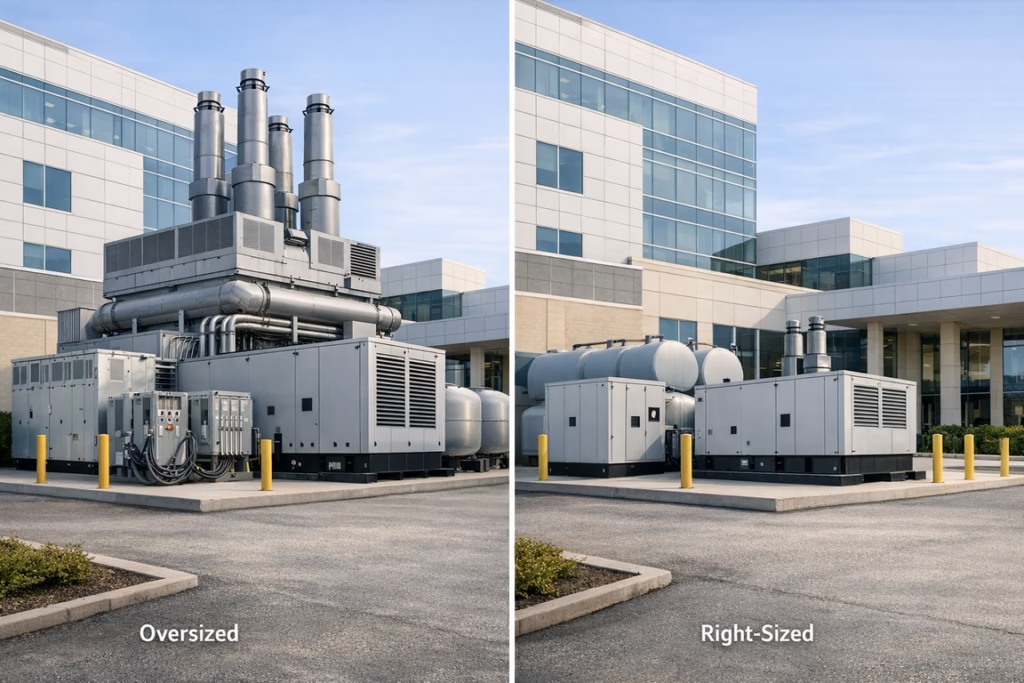
This case study started with a common assumption: when the stakes are high, bigger must be better.
But that is not how smart backup power planning works.
The hospital got a better result by doing the hard part first. It sorted critical loads from non-critical ones. It reviewed real demand instead of relying on rough totals. It looked at startup behavior, growth plans, and long-term ownership costs. Then it sized the system around what the facility truly needed.
That changed the outcome.
Instead of paying for excess capacity, the hospital moved forward with a backup power plan that supported essential operations, left room for practical growth, and kept the budget grounded in reality.
That is the real lesson here.
Strong hospital generator sizing is not about fear. It is about clarity. It is about knowing which loads matter most, what the site actually demands, and where flexibility belongs in the design.
The best backup power plans do not win because they are oversized. They win because they are well judged.
If your team is working through a generator upgrade now, use this case as a reminder. Start with the real load. Challenge vague assumptions. Build the design around how the hospital actually operates.
That is how you protect reliability without overspending.