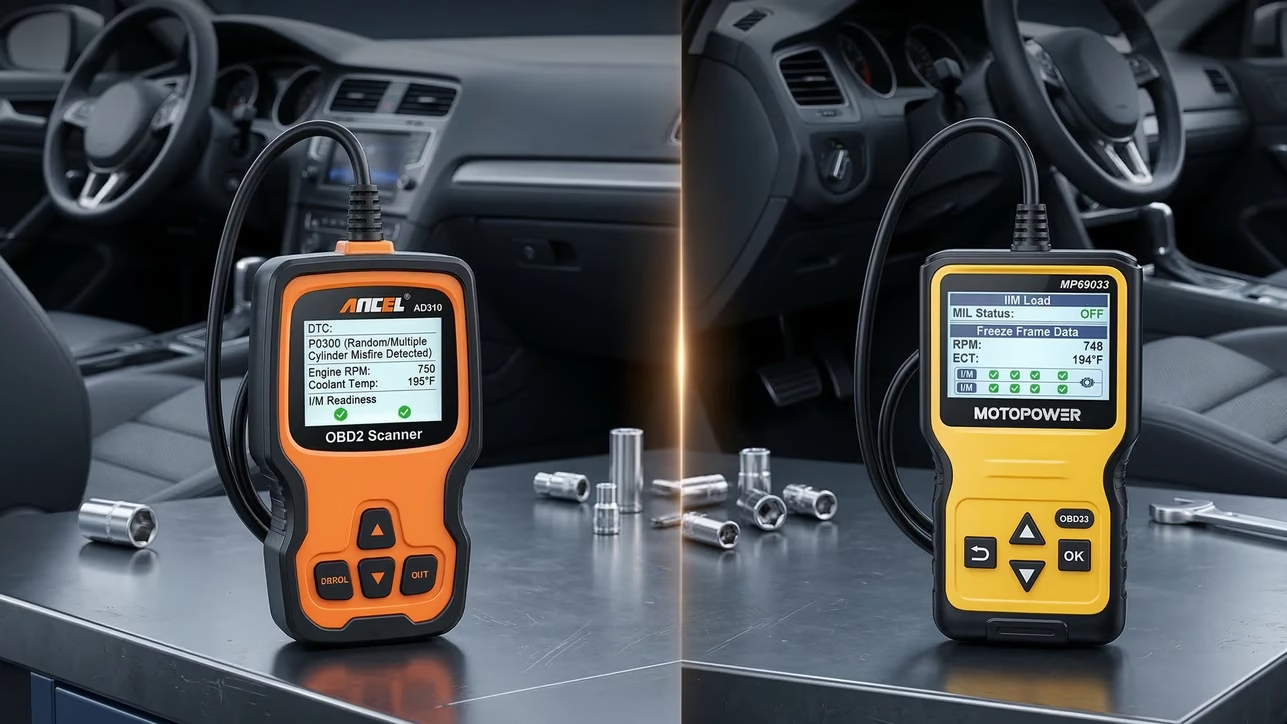
Introduction
This guide breaks down the ANCEL AD310 vs MOTOPOWER MP69033 in real terms. Not hype. Not generic filler. Just what each scanner does well, where each one falls short, and which one makes more sense for your car, your skill level, and your diagnostic needs in 2026.
Quick Specs Table
| 🔍 FEATURE |
ANCEL AD310 📦 affiliate link
 |
MOTOPOWER MP69033 📦 affiliate link
 |
|---|---|---|
| Scanner type | Wired handheld OBD2 code reader | Wired handheld OBD2 code reader |
| Main use | Engine & emissions diagnostics | Engine & emissions diagnostics |
| Vehicle compatibility | 1996+ US, 2000+ EU, 2005+ Asian (most) | 1996+ US, 2000+ EU & Asian (most) |
| Protocol support | All OBD2 (J1850 PWM/VPW, ISO9141, KWP2000, CAN) | 9 protocols incl. CAN, J1850, ISO9141, KWP2000 |
| Power source | OBD2 port (no batteries) | OBD2 port (no batteries) |
| Cable length | 2.5 ft (≈75 cm) | 2.5 ft (≈75 cm) |
| Display | 2.4″ backlit LCD, 128×64, monochrome, contrast adjust | 2.8″ backlit LCD, 128×64, white backlight, contrast adjust |
| Screen size claim | Commonly listed as 2.4-inch class | Commonly listed as 2.7–2.8-inch class |
| Buttons | 4 tactile buttons | 6 tactile buttons |
| Shortcut keys | No dedicated quick keys | ✅ Dedicated VIN + DTC shortcut buttons |
| Languages | 🇬🇧🇫🇷🇩🇪🇪🇸🇳🇱🇫🇮🇵🇹🇷🇺 (8 languages) | 🇬🇧🇩🇪🇳🇱🇪🇸🇫🇷🇮🇹 (6 languages) |
| Read codes | Yes | Yes |
| Erase codes | Yes | Yes |
| Pending codes | Yes | Yes |
| Freeze frame | Yes | Yes |
| Live data stream | Yes (text / numbers) | Yes (text / numbers) |
| I/M readiness (emissions) | Yes | Yes |
| Vehicle info / VIN | Yes (VIN, CID, CVN) | Yes (VIN shortcut button) |
| Built-in DTC definitions | Yes (code lookup on screen) | Yes (internal database) |
| ABS / SRS / transmission | No (engine only) | No (engine only) |
| 🌟 Key pros |
|
|
| ⚠️ Key cons |
|
|
| 🗣️ Real user feedback (Reddit/forums) | “The glovebox essential – tells you if it’s a loose gas cap or a real misfire. Anti‑tech choice: just works.” Praised for instant connection and honesty check against mechanics. | “Faster cheapie with snappier menus. Great for smog checks, but it’s still a code reader, not a diagnostic tool.” Some VW/Audi owners note rare protocol hickups. |
| 🏆 Best known strength | Proven reliability & dead‑simple operation | Bigger display feel & shortcut keys for speed |
| Processor / special | Standard MCU, emphasis on durability | ARM microprocessor, faster data retrieval |
| Design / color | Black / gray, compact | Bright yellow (hard to lose) |
| 🔗 Buy link | 🛒 ANCEL AD310 on Amazon | 🛒 MOTOPOWER MP69033 on Amazon |
ANCEL AD310 Breakdown
Design and Build Quality
The ANCEL AD310 is the classic small wired scanner. It looks like what most people picture when they think of a basic code reader. Black housing. Large enough to hold without feeling flimsy. Small enough to keep in a glove box. The shape is practical. It is not flashy. That is part of the appeal.
Build quality is one of the main reasons this tool has stayed relevant. The housing feels dense for a budget reader. It is not trying to impress you with color or design tricks. It is built to get plugged in, tossed on the seat, dropped once or twice, and used again. The 2.5-foot cable has thick insulation, and that matters more than most buyers realize. With handheld scanners, the cable is the first part that gets abused. It is bent around the steering column, pinched against trim, pulled from odd angles, and left twisted in the glove box. A cable that feels robust is a real advantage.
The AD310 also has a straightforward control layout. Four buttons are all you get. Up, down, enter, and exit. That sounds basic because it is basic. But in practice, that simplicity helps beginners. There is less to learn. Fewer keys mean fewer wrong presses. If your goal is to read a code fast, clear it after a repair, or check readiness status before inspection, the stripped-down control scheme works.
Screen and Readability
The AD310 uses a 128 x 64 backlit LCD. On paper, that sounds dated. In use, it is enough. The screen is not fancy. It does not need to be. A budget OBD2 scanner does not need bright graphics. It needs clear text and good contrast. The AD310 delivers that.
What matters is how easily you can read the screen while leaning into a cabin, often in bad light, with the scanner hanging from the port or resting on your knee. The AD310 does well here. The text is clean. The backlight is useful. The contrast adjustment helps if you are using it in strong sunlight or low light.
This is not a scanner for graphs, charts, or advanced data analysis. It is a scanner for quick answers. If you accept that, the display does its job.
Core Features
The AD310 covers the core features most owners actually use.
Read and Erase Codes
This is the main reason people buy it. The scanner reads generic and many manufacturer-specific engine and emissions codes. That means when the check engine light comes on, you can pull the code immediately instead of guessing. If the code is something like P0456, you know you may be dealing with a small EVAP leak. If it is P0302, you know cylinder two is misfiring. That changes your next move. You go from panic to plan.
After the repair, the AD310 can erase the code and turn off the MIL, or Malfunction Indicator Lamp. That saves a trip to the shop just to clear the light. One warning, though: clearing a code is not fixing a problem. If the fault is still there, the light comes back. That is not the scanner failing. That is the car telling the truth.
I/M Readiness
This feature is more useful than many first-time buyers expect. I/M Readiness shows whether the emissions monitors have completed their self-checks. Those monitors include things like catalyst efficiency, EVAP system, oxygen sensors, and misfire monitoring. If your car is not ready, you can fail an emissions test even with no check engine light on.
Real-world example: you replace an oxygen sensor, then clear the code. The light goes off. You drive straight to inspection. You fail, not because the repair was bad, but because the OBD monitors are still incomplete. A scanner like the AD310 shows that before you waste time and money on a retest. That alone can justify owning it.
Freeze Frame Data
Freeze frame is a snapshot of engine conditions when the fault was set. Think of it like the still image before the warning light came on. It can show engine load, coolant temperature, RPM, vehicle speed, fuel trim, and more. This helps with pattern recognition.
Example: if a lean code was set at idle with high positive fuel trims, that can point toward a vacuum leak. If the same lean code was captured under load, you may start thinking fuel delivery instead. That context matters.
Live Data
This is where a budget scanner becomes more than just a code reader. Live data lets you watch real-time parameters while the engine runs. Common values include RPM, coolant temperature, vehicle speed, short-term fuel trim, long-term fuel trim, throttle position, oxygen sensor behavior, and calculated load.
This helps a DIYer in practical ways. If coolant temperature stays too low during warm-up, you may be looking at a thermostat stuck open. If fuel trims shoot positive at idle but improve off idle, a vacuum leak becomes more likely. If RPM is unstable and throttle position is normal, you may start checking idle control issues or intake leaks. You are not doing deep lab-grade diagnostics here. But you are getting clues that narrow the problem.
Ease of Use
This is where the AD310 earns its reputation. Plug it in. Turn the key on. Enter diagnostics. Read the code. It is hard to overstate how much that matters for beginners. A scanner can have every feature in the world and still be annoying if the menu feels clumsy. The AD310 avoids that problem by keeping the workflow simple.
For a first scanner, that simplicity is a strength. For an experienced owner who only wants a dedicated engine code tool, it is also a strength. No app pairing. No Wi-Fi. No updates to chase. No account setup. Just a cable, a screen, and a result.
MOTOPOWER MP69033 Breakdown
Design and Build Quality
The MOTOPOWER MP69033 takes a slightly different approach. It is still a wired handheld OBD2 scanner, but it leans harder into convenience and presentation. The bright yellow housing makes it easier to spot in a drawer or toolbox. That sounds minor, but on a practical level, it does help. The physical shape is compact, but the face is laid out to emphasize the display and buttons.
Like the ANCEL, the MP69033 uses a 2.5-foot cable with heavy insulation. That is good news because it means you are not sacrificing durability for a lower price. The connector feels like it is built for repeated plug-ins, which matters if you use the tool often across more than one car.
Where the MOTOPOWER starts to separate itself is the button layout. You get six buttons instead of four. The extra keys are not wasted. They include dedicated shortcuts for VIN lookup and DTC lookup. That changes how fast you move through common tasks. If you regularly scan cars, or if you help friends and family with basic code checks, those dedicated buttons shave off steps every time.
This scanner feels like it was designed by someone who knew buyers hate extra menu digging. That is a smart decision in the budget category.
Screen and Display Experience
The MP69033 is often listed with a larger physical screen size than the AD310, even though both share a similar 128 x 64 style display resolution. That is an important distinction. Resolution is not the whole story. Physical screen area, font scale, layout, and contrast all affect readability.
In real use, the MOTOPOWER feels easier on the eyes. The screen looks larger. The layout feels roomier. The white backlight and contrast control help the display stay usable in different lighting. If you are older, wear glasses, or simply hate squinting at small monochrome screens, this is a real advantage.
No, it is not a color tablet-style scan tool. It is still a basic budget reader. But among basic readers, display comfort matters. And the MP69033 does a little better here.
Core Features
The MP69033 matches the expected basics and adds convenience on top.
Read and Erase Codes
Like the ANCEL, it reads and clears engine and emissions-related trouble codes. That includes the usual check engine light situations that most drivers face. If the MIL is on, the scanner can pull the code, display its meaning, and help you decide whether the issue is urgent or manageable.
This is especially useful on the road. Imagine your check engine light comes on during a family trip. If the engine still runs normally, you can scan the code at a gas station and quickly see whether you are dealing with something like an EVAP fault or a more serious misfire. That does not replace a full diagnosis, but it helps you make a smarter call about whether to continue driving.
Built-In DTC Lookup
The built-in code library is a simple but valuable feature. It saves you from searching code meanings on your phone while standing next to the car. That matters more than people think. Mobile signal is not always available. And even when it is, quick onboard definitions are faster.
The dedicated DTC shortcut key also makes the scanner feel more purpose-built than many cheap competitors. If you use a code reader often, small workflow improvements become big quality-of-life improvements.
I/M Readiness
The MP69033 handles readiness checks well. This makes it a useful pre-inspection tool. If you recently disconnected the battery, cleared a code, or completed a repair, the readiness screen tells you whether the car has completed the necessary emissions self-tests.
This matters because many drivers assume “light off” equals “inspection pass.” That is wrong. A car can have no MIL and still fail if key monitors are incomplete. Using this scanner before heading to the test station can save a wasted trip.
Live Data
The MP69033 offers live data and, in some listings and user impressions, basic real-time curve support for selected values. Even when used as plain text data, the feature is useful for troubleshooting. You can watch coolant temperature rise during warm-up, check idle RPM stability, observe fuel trims, and monitor throttle response.
Practical scenario: you suspect your thermostat is stuck open because the heater is weak and fuel economy dropped. Plug in the scanner on a cold start. Watch coolant temperature. If it climbs too slowly or stalls below normal operating range, the thermostat becomes a strong suspect. Another example: if long-term fuel trim is highly positive and short-term fuel trim spikes at idle, you may be dealing with unmetered air from a vacuum leak. These are not final diagnoses by themselves, but they point you in the right direction.
Vehicle Information and VIN Access
The dedicated VIN shortcut is one of the scanner’s standout convenience features. On a single-car household, it is not life-changing. On multiple vehicles, it becomes useful. It confirms what the scanner is seeing and helps when you want to log diagnostics, verify a used car’s identity against paperwork, or just avoid menu wandering.
Ease of Use
The MP69033 is also plug-and-play, so setup is easy. The difference is that it feels a touch more user-friendly once you are inside the menus. The larger display feel and shortcut keys make it feel slightly faster and more direct during repeated use.
For absolute beginners, the extra buttons may look busier at first. But they are not hard to learn. After one or two uses, they become an asset. For users who value speed and convenience over minimalism, the MOTOPOWER has the better interface design.
Feature-by-Feature Comparison
Diagnostics and Code Reading
At the most basic level, both tools do the job. They read and erase engine and emissions-related OBD2 trouble codes. They both pull generic codes and many manufacturer-specific ones. They both let you check pending, stored, and active fault information. They both help you understand why the check engine light came on.
So which one is better here? In pure capability, it is close. In user experience, the edge depends on what you value.
The ANCEL AD310 wins on simplicity. It gives you the core diagnostic menu without distraction. If you want a straightforward scan, especially as a beginner, it feels less intimidating. There is almost no learning curve.
The MOTOPOWER MP69033 wins on convenience. The DTC shortcut key and more direct workflow make repeated use quicker. If you scan more than one vehicle, or if you are the go-to person for family members when a warning light appears, the extra speed becomes noticeable.
Real-world use case: your check engine light comes on after refueling. You suspect a loose gas cap. Both scanners can pull the code. If you get an EVAP small leak code, you can tighten or replace the cap, drive the car, and clear the code after confirming the repair. That avoids a pointless trip to the shop. In this scenario, either scanner works. The difference is not capability. It is how quickly you get from plug-in to answer.
Live Data Performance
This is the most important comparison after basic code reading because live data is where a simple scanner starts to become useful for diagnosis instead of just code retrieval.
Both tools show live PIDs, or Parameter IDs. That can include RPM, coolant temperature, vehicle speed, fuel trims, throttle position, oxygen sensor feedback, and load values. Some listings and user experiences suggest the MOTOPOWER presents certain data in a basic graph-like format. The ANCEL is often praised for offering strong basic live data coverage for its class, though it remains a simple handheld unit.
What matters is how a DIYer uses this data.
Coolant Temperature
If the scanner shows coolant temperature taking too long to reach operating range, the thermostat may be stuck open. That can hurt heater performance, fuel economy, and emissions readiness.
RPM
If idle RPM hunts up and down at stoplights, live RPM data helps you confirm whether the fluctuation is real or just your perception. Pair that with fuel trims and throttle position, and you get a stronger clue.
Short-Term and Long-Term Fuel Trim
These are some of the most useful values on any basic scanner. Positive trims often mean the ECU is adding fuel because it sees a lean condition. If trims are high at idle but improve with throttle, that often points to a vacuum leak. If trims stay high under load, fuel delivery problems become more likely.
Oxygen Sensor Activity
Watching upstream oxygen sensors switch and downstream sensors stabilize can give basic insight into mixture control and catalyst behavior. A beginner should not expect laboratory precision here, but even simple live data can reveal obvious abnormalities.
Between the two, the MP69033 has a slight usability edge because the larger display feel makes data easier to read quickly. The AD310 remains fully useful if your priority is basic, dependable live data without caring about screen comfort.
User Interface and Navigation Speed
This is where the two tools clearly separate.
The ANCEL AD310 is the cleaner experience. Four buttons. Direct menus. Few distractions. That is ideal for users who hate clutter.
The MOTOPOWER MP69033 is the faster experience for repeated use. The extra buttons reduce steps. Dedicated VIN and DTC keys are not gimmicks. They cut menu time.
If you only use a scanner three times a year, the AD310’s minimalist design will likely feel perfect. If you use a scanner monthly, or on multiple family cars, the MP69033’s button layout may save enough time to become the better pick.
Compatibility and Protocol Support
Both scanners target the same broad market: OBD2-compliant vehicles, especially 1996 and newer US-market cars, 2000 and newer European vehicles, and a broad range of newer Asian vehicles. Both support CAN and the standard OBD2 protocol family expected in this class.
But there is a hidden truth in budget scanners: broad compatibility claims are not universal compatibility. And this matters.
A basic code reader can only talk to cars that expose standard OBD2 engine/emissions data cleanly. If a vehicle is older, region-specific, diesel with odd implementation, or known for being picky, compatibility can be inconsistent. This is especially true with some older European and Asian models.
The ANCEL AD310 has a stronger reputation for broad day-to-day success on mainstream gasoline vehicles. The MP69033 is also widely compatible, but user sentiment shows a few more cases where certain older or less standard vehicles did not connect as expected.
That does not make the MP69033 a bad scanner. It means the AD310 feels slightly safer if your only concern is reliable connection on common cars over the long term.
Important limit: neither scanner is a full-system tool. They do not replace a professional scanner. They are built for engine and emissions diagnostics. They do not give you full access to ABS, SRS, body, HVAC, or advanced manufacturer modules. If you need airbag codes, transmission adaptation, battery registration, or service resets, you are shopping in the wrong category.
Durability and Cable Quality
This category matters more than spec sheets suggest. Cheap scanners often fail at the cable or connector before the electronics die.
The AD310 has built a strong reputation here. Owners often keep it for years. The cable insulation is thick. The housing is compact and tough. It feels like the glove-box survivor of the pair.
The MP69033 is also solidly built for a budget reader. The cable is heavy-duty, and the housing does not feel disposable. But the AD310’s long-standing reliability reputation gives it the edge if durability is your top priority.
Real use case: if you want a scanner to live in a work truck, daily driver, or family glove box year-round, the ANCEL feels like the safer long-haul choice. If you keep your tools in a dry garage and value ease of reading and menu shortcuts, the MOTOPOWER gives you more convenience without a major durability penalty.
The Hidden Differences
Shortcut Keys vs Proven Reliability
On a shopping page, both scanners can look like the same thing with different plastic shells. They are not.
The MOTOPOWER MP69033’s biggest hidden advantage is workflow. The dedicated VIN and DTC shortcut buttons are genuinely useful. They make the scanner feel faster than it really is because they remove friction. If you often use a code reader, friction matters. Less menu digging means less annoyance, fewer wrong presses, and faster checks when you are in a hurry.
The ANCEL AD310’s hidden advantage is trust. It is the tool many owners buy once and keep for years. That kind of reputation does not happen by accident. The AD310 is not trying to impress anyone with design extras. It focuses on doing the basics consistently, which is exactly what many glove-box scanners fail to do over time.
This creates a simple split.
If you care more about day-one ease and repeat-use convenience, the MOTOPOWER feels more modern in operation. The larger display feel and shortcut keys add real value every single time you plug it in.
If you care more about a scanner that has a long history of being dependable, the ANCEL carries less risk. Its interface is simpler, its reputation is stronger, and it has fewer moving parts in the user experience.
Another hidden difference is buyer confidence. The AD310 is easier to recommend blindly because it has a cleaner identity: basic, durable, proven. The MP69033 is easier to recommend to someone who already knows they hate tiny interfaces and slow menu paths.
Neither difference shows up clearly in spec tables. Both matter in real ownership.
Real-World User Sentiment: What the Community Says
ANCEL AD310 Community Feedback
The community tends to describe the ANCEL AD310 the same way over and over: simple, reliable, and good enough for most people. That consistency matters. When many owners use the same words, it usually points to a real pattern.
Owners like that it works without setup drama. You plug it in, it powers up, and it gets to the point. That sounds obvious, but cheap scan tools often lose buyers on exactly that step. Either they fail to connect on certain cars, or they bury simple tasks in clumsy menus. The AD310 usually avoids both complaints.
Another theme is trust. Many users describe it as a scanner they have had for years. That says more than any marketing bullet. A code reader is not exciting hardware. If people keep it around for five years or more, it means it solved problems when needed and did not give them a reason to replace it.
Common praise includes accurate basic code reading, solid live data for the class, and a cable that feels tougher than expected. The common limitation is also predictable: it is a basic engine/emissions reader. People who buy it expecting ABS, SRS, or full manufacturer data end up disappointed, but that is a buyer expectation problem, not an AD310 problem.
MOTOPOWER MP69033 Community Feedback
The MOTOPOWER MP69033 gets praise for value, visibility, and ease of use. Many users like the larger screen feel right away. It is one of those benefits you notice in the first minute. If you have ever used a tiny code reader with cramped text, the MOTOPOWER feels more comfortable.
Owners also like the shortcut keys. People who scan more than one car tend to appreciate the faster navigation. It makes the scanner feel more polished than the usual ultra-basic reader.
The main caution from community feedback is compatibility consistency on edge-case vehicles. On mainstream OBD2 cars, it tends to do fine. On some older or less standard vehicles, especially certain older European applications, there are more reports of connection issues or limited usefulness. That does not mean it fails on most cars. It means the odds of an oddball miss seem a bit higher than with the ANCEL.
Another user sentiment pattern is that the MP69033 feels more feature-rich than many budget scanners, even when the real feature list is still basic. That impression comes from the screen, button layout, and generally smoother task flow. It feels easier to live with.
Bottom Line on Community Sentiment
If you read enough owner comments, one clear pattern appears.
The ANCEL AD310 is the safer choice for buyers who want proven dependability and do not care about extra convenience.
The MOTOPOWER MP69033 is the smarter choice for buyers who want a friendlier display, quicker shortcuts, and a more comfortable day-to-day interface.
That is the real split. Reliability confidence versus user-interface comfort.
Pros and Cons Table
Real Use Cases
Use Case 1: The Night Before an Emissions Test
You repaired a P0420 catalyst efficiency code last week. The light is off now. You need inspection tomorrow.
With either scanner, you can check I/M Readiness before you go. If the catalyst monitor and oxygen sensor monitor are still incomplete, you know the car is not ready. That saves a failed test and a retest fee. If the monitors are complete and the MIL stays off, you can go in with confidence.
For this job, both tools work. The MOTOPOWER is slightly easier to read at a glance. The ANCEL is just as capable.
Use Case 2: Rough Idle and Poor Fuel Economy
Your car idles rough. Fuel economy dropped. No major noise. No obvious smoke.
Plug in the scanner and watch live data. Check coolant temperature, RPM, short-term fuel trim, and long-term fuel trim. If coolant never reaches proper operating temperature, suspect a thermostat stuck open. If fuel trims are heavily positive at idle but improve off idle, suspect a vacuum leak. If RPM wanders with unstable trims, you now have a direction.
This is where live data matters. A basic scanner will not replace a smoke machine or scope, but it helps you stop guessing.
Use Case 3: Check Engine Light on During a Road Trip
The light comes on two hours from home. The car still drives normally.
You plug in the scanner at a fuel stop. If you find an EVAP code or a minor efficiency code with no drivability issue, you may choose to continue the trip and inspect it later. If you find a current misfire code, especially with flashing MIL behavior, you know to back off and avoid catalytic converter damage.
A scanner does not make the repair. It helps you make the right decision under pressure.
Use Case 4: Buying a Used Car
You are checking out a used car from a private seller. The light is off.
Plug in the scanner. Check for stored or pending codes. Check readiness monitors. If all monitors are “not ready,” that can be a red flag that the seller recently cleared codes to hide a fault. Then check live data for coolant temperature, fuel trims, and idle stability during warm-up.
This is not a full pre-purchase inspection. But for a small handheld tool, it gives you a lot of useful leverage.
Who Should Buy Which?
Buy the ANCEL AD310 if:
You want the safer pick. That is the blunt truth.
The AD310 makes more sense for drivers who want a dependable basic scanner and nothing more. If your main goals are to read the check engine code, clear it after a repair, check emissions readiness, and view basic live data, the AD310 covers the job with very little drama.
It is also the better fit if you are a beginner who wants the least confusing interface possible. Four buttons. Clear menus. Minimal fuss. That matters when you are already stressed because the MIL just came on.
This scanner also suits people who own common mainstream gasoline vehicles and want a proven glove-box tool. If you care more about reliability history than interface extras, buy the ANCEL.
Best fit:
- First-time scanner buyers
- Owners who want the simplest possible operation
- People who prioritize long-term dependability
- Drivers who want a permanent glove-box scanner
- Buyers who do not care about shortcut keys
Buy the MOTOPOWER MP69033 if:
You value ease of reading and speed of use more than brand reputation.
The MP69033 is the better match if you hate cramped screens, want faster navigation, or scan cars often enough that shortcut buttons make a difference. If you help family members, own multiple vehicles, or just want a code reader that feels easier to use every time, the MOTOPOWER makes sense.
It is also the better choice for buyers who want the most user-friendly interface in this exact budget lane. The display feels more comfortable. The shortcuts are real, not filler. The scanner feels a bit more convenient day to day.
Best fit:
- DIY users who scan more than one vehicle
- Buyers who want a larger, easier-to-read screen
- Users who prefer shortcut buttons and faster workflow
- People comfortable trading a little reputation strength for a better interface
- Drivers who want a more convenient budget scanner experience
Final Verdict: The Winner for 2026
If I had to pick one winner in the ANCEL AD310 vs MOTOPOWER MP69033 debate for 2026, it would be the ANCEL AD310.
Not because it crushes the MOTOPOWER on features. It does not. In fact, the MP69033 is arguably the nicer scanner to use on a day-to-day basis thanks to its larger display feel and dedicated shortcut keys. If interface comfort were the only factor, MOTOPOWER would take it.
But budget scanners live or die by trust. You buy them to work when the light comes on, not to impress you on paper. And the AD310 has the stronger reputation for doing the basics well, consistently, over time. It is the lower-risk buy. It is easier to recommend to the average car owner without caveats. It reads codes fast, checks readiness properly, shows useful live data, and has the kind of long-run dependability that matters more than cosmetic convenience.
That said, the MOTOPOWER MP69033 is not the loser in any practical sense. If you want the better user experience and you drive mainstream OBD2 vehicles, it is still a smart buy.
The blunt verdict is this:
- Best overall for most people: ANCEL AD310
- Best if you want easier reading and faster shortcuts: MOTOPOWER MP69033
FAQ
Is the ANCEL AD310 better than the MOTOPOWER MP69033?
For most buyers, yes. The ANCEL AD310 is the safer overall pick because of its stronger reliability reputation and simpler operation. The MOTOPOWER MP69033 is still excellent if you care more about screen comfort and shortcut keys.
Can both scanners clear the check engine light?
Yes. Both can read and erase engine and emissions-related DTCs. But remember this: clearing the light does not fix the problem. If the fault is still present, the light will return after the ECU runs its checks again.
Do these scanners work for ABS, airbag, or transmission codes?
No. These are basic OBD2 engine/emissions scanners. They are built for powertrain emissions-related diagnostics. If you need ABS, SRS, transmission, service reset, or full-system scanning, you need a more advanced tool.
Can either scanner help me pass an emissions test?
Yes, indirectly. Both tools can check I/M Readiness monitors. That is crucial. A car can fail inspection even if the check engine light is off if the readiness monitors are not complete. These scanners help you verify readiness before you go.
Which scanner is easier for a beginner?
The ANCEL AD310 is easier for total beginners because the control layout is simpler. The MOTOPOWER is also beginner-friendly, but the AD310 feels more stripped down and less intimidating on first use.
Which scanner is better for live data?
They are close. Both can show the basic live data most DIYers need, like coolant temperature, RPM, fuel trims, and speed. The MOTOPOWER has the slight edge in usability because its larger display feel makes the data easier to read quickly.
Will these scanners work on all cars since 1996?
Not all. They work on many OBD2-compliant vehicles from that period onward, but compatibility is never perfect on every vehicle, especially older, region-specific, or nonstandard diesel applications. On mainstream OBD2 gasoline cars, both are usually a safe bet.
Which scanner should I keep in the glove box?
The ANCEL AD310. It is compact, straightforward, and has the stronger “buy it once, keep it for years” reputation. If you want a scanner that simply stays in the car and works when needed, the ANCEL is the better glove-box choice.
Bottom Line
If you want the cleanest answer to ancel ad310 vs motopower mp69033, here it is:
Choose the ANCEL AD310 if you want the most dependable all-around budget code reader.
Choose the MOTOPOWER MP69033 if you want the friendlier display and faster shortcuts.
Both are good. The ANCEL is the safer buy. The MOTOPOWER is the easier one to enjoy using.