
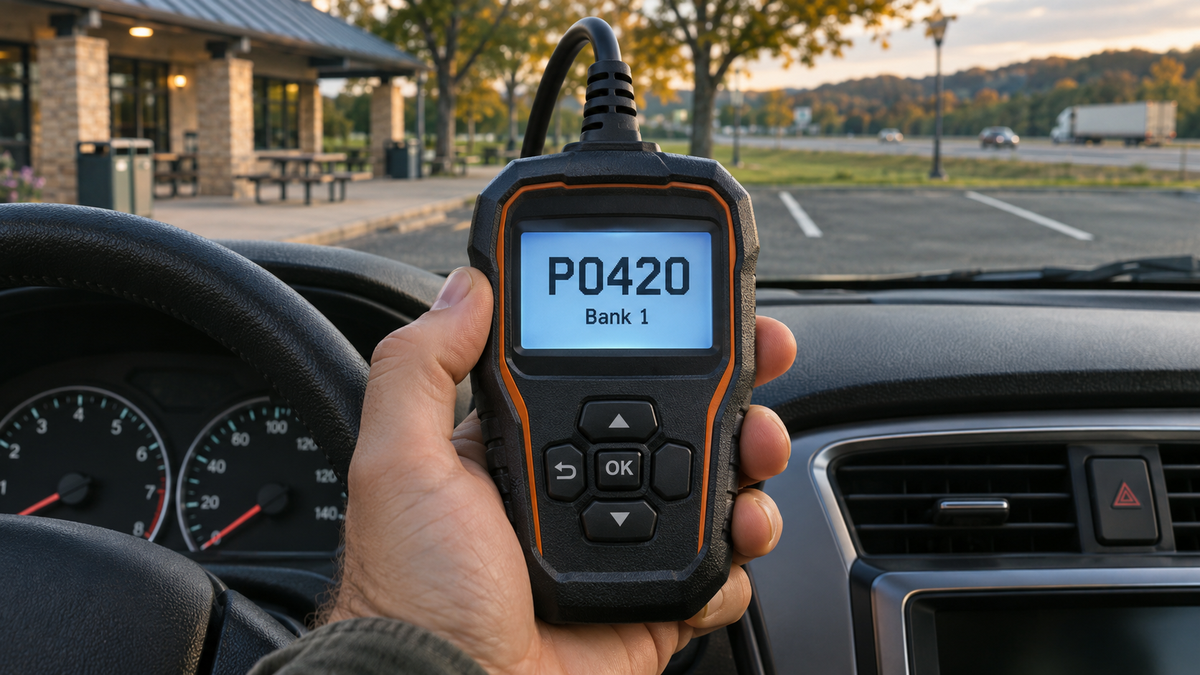
If you see P0420 after a long drive, your car may have just finished a test it skipped on shorter trips. The engine computer found that the Bank 1 catalyst fell short of its efficiency target. The light tells you little about when the trouble began. It also leaves open which part needs work.
Before you clear anything, save the codes, the freeze frame, and the catalyst readiness screen. Those three records can tell you more than the number of miles you drove.
Why does P0420 show up after a long drive?
What the Bank 1 catalyst monitor actually measures
Your catalytic converter helps clean up exhaust gas. Inside it, a coating can store oxygen and release it as the exhaust mix changes. On many gas engines, the computer watches how sensors before and after the converter respond to those changes. That gives it a way to estimate how well the catalyst works.
Bank 1 means the side of the engine that contains cylinder one. P0420 tells you which bank fell short on the test. It gives you no direct reading of what came out of the tailpipe. If your scan also shows P0430, see what it means when both banks flag low efficiency.
Why a short trip can end before the test finishes
Think about a quick run to the store. The dash gauge may reach its usual spot just as you park. That gauge tracks engine coolant. The exhaust and the catalyst have their own heat cycle.
The computer may also need a certain range of airflow, a working exhaust sensor, or a change in engine load. Some faults can block the test altogether. If a needed condition never occurs, the trip can end without a fresh result.
If you drive a Corolla Hybrid, see how gas-engine run time affects Toyota hybrid P0420 testing.
Why it may seem to happen only on the highway
On a longer trip, the engine warms up and spends time under load. Then you lift off the gas for an exit. The car may still be moving fast, but the load has dropped.
Some Ford gas engines use just such a change. The computer watches what happens when fuel cuts off as you slow down. It collects more evidence when fuel flow resumes. On those engines, the exit ramp can matter as much as the cruise.
If you see P0420 only on the highway, write down when you first saw the light. Keep that time separate from when the computer detected the fault. Neither one dates the first loss of catalyst efficiency.
If you added injector cleaner before that trip, here’s what to check when P0420 appears after fuel system cleaning.
Why P0420 comes and goes
Did the light go out, or did the code disappear?
If the light goes out by itself, scan the car again. Write down whether P0420 still shows as pending, confirmed, or permanent. The light can go out after qualifying checks even while the computer keeps a record.
If someone cleared the codes, mark that in your notes. A week of short trips after a reset means little if the catalyst test still shows incomplete.
An occasional test versus a fault that changes with conditions
Say the light returns on your first weekend trip after a reset. If the catalyst check was incomplete all week, the same fault may have been there each day. The car just needed a chance to test it.
An intermittent P0420 can also reflect a result near the test limit. A worn catalyst might meet the target on one check and miss it on another. A lamp that comes and goes cannot tell you which pattern you have. Save the results each time so a shop can compare them.
Which clues make an intermittent fault worth testing?
A tick on a cold start or a soot mark near a joint gives you a place to check for a leak. A leak near a sensor can let air into the exhaust and affect its reading. Note whether the tick fades as the engine warms.
A sensor circuit code or a wire rubbed bare gives a shop a different lead. Rough running, a misfire code, or fuel trims that keep moving far from their usual range point toward the engine. Each clue helps you choose a test before you buy a part. If the light first appeared after engine work, start with the P0420 checks that fit your recent repair.
Before clearing P0420, read the code status and catalyst readiness
With the car parked, open the scanner’s emissions codes and readiness menus. Choose the readiness view marked “since codes cleared” if your tool offers more than one. Save both screens.
| Scanner reading | What it means | Your next step |
|---|---|---|
| Pending P0420 | The computer saw a potential fault. The light may still be off. | Save it and check again after a qualifying trip. |
| Stored or confirmed P0420 | The fault met the rules for confirmation. The lamp may since have gone out. | Record both the code and the current lamp state. |
| Permanent P0420 | On cars that support it, this record can outlast a repair. The car clears it once its checks verify the fix. | Check pending and confirmed codes too. A scanner reset or battery disconnect cannot erase the permanent entry. |
| Catalyst incomplete | The catalyst test has yet to finish since the last reset. | Leave the codes alone so the car can finish the test. |
| Catalyst complete | The test ran at least once since the reset. This field gives no date or pass/fail result. | Read it with the code states. It cannot tell you the test ran on today’s trip. |
How to read the P0420 freeze frame, step by step
Open the saved frame and verify its code
Plug in your reader while parked. Follow its ignition prompt, then open Diagnostics and choose Freeze Frame. Some tools call this Mode $02. Check the code shown at the top before you read the numbers.
A reader may show only one frame. A misfire or fuel fault can take priority. If the frame belongs to another code, save it with that code’s name. Take a screenshot that includes the units, date your notes, and add the mileage.
Read speed, RPM, load, and coolant temperature together
Speed tells you how fast the car was moving at capture. RPM tells you how fast the engine was turning. Calculated load gives you a clue to how hard it was working. At the same road speed, climbing a hill and easing off the gas can produce quite different loads.
Coolant temperature helps you judge how warm the engine was. A single frame cannot tell you how long you held that speed or how hot the converter got.
Check fuel-system status before interpreting fuel trims
In closed loop, the computer uses sensor feedback to adjust fuel. Look for Bank 1 short-term fuel trim (STFT) and long-term fuel trim (LTFT). The first shows a quick correction. The second reflects adjustments the computer has learned over time.
A positive trim means the computer adds fuel to its base amount. A negative trim means it takes fuel away. If the frame shows open loop or fuel cutoff, feedback may be paused. Give more weight to a correction that keeps showing up under similar closed-loop conditions. If your reader leaves a field blank, record it as unavailable.
Work through one illustrative scan
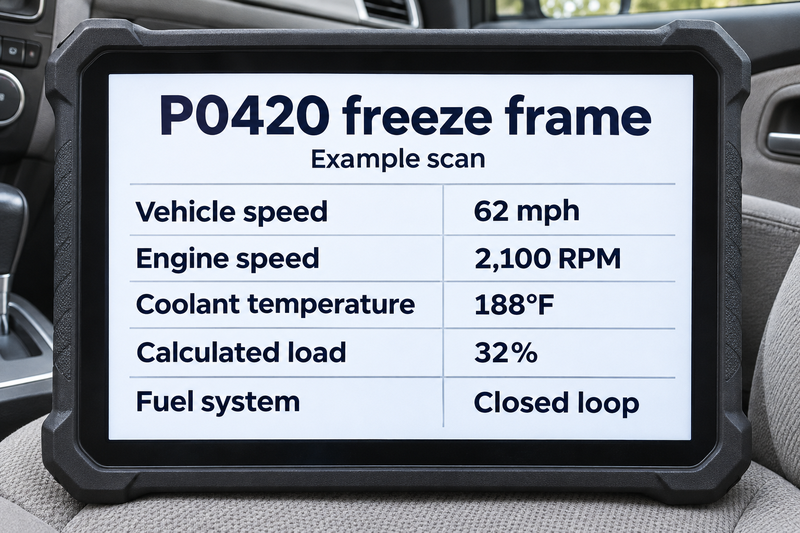
Suppose your P0420 frame shows 62 mph, 2,100 RPM, 188°F coolant, 32% load, and closed loop. You can say the car was moving at road speed with a warm engine. You cannot tell whether you had cruised for an hour or just reached that speed.
Now suppose you also have a lean code and repeated positive trims at a similar load. Ask the shop to check why the engine keeps adding fuel. If you have just the one P0420 frame, keep it as a record of the conditions. It gives you too little evidence to choose a sensor or converter.
What to check before replacing the converter or an oxygen sensor
1. Start with the full scan. Save all code states, the frame, and readiness. Note recent engine or exhaust work. Give the shop your year, model, and engine so it can check the right service procedure and bulletins.
If you drive a Subaru, use these Subaru P0420 checks by model to narrow down what to test next.
2. Follow companion codes first. Tell the shop about rough running and any misfire, fuel-mixture, or sensor-circuit codes. A misfire changes the exhaust that reaches the converter. Ask which engine checks need to come first and whether the catalyst test can run with those faults present. Once you’ve checked the other codes, use this step-by-step P0420 repair guide to plan the next test.
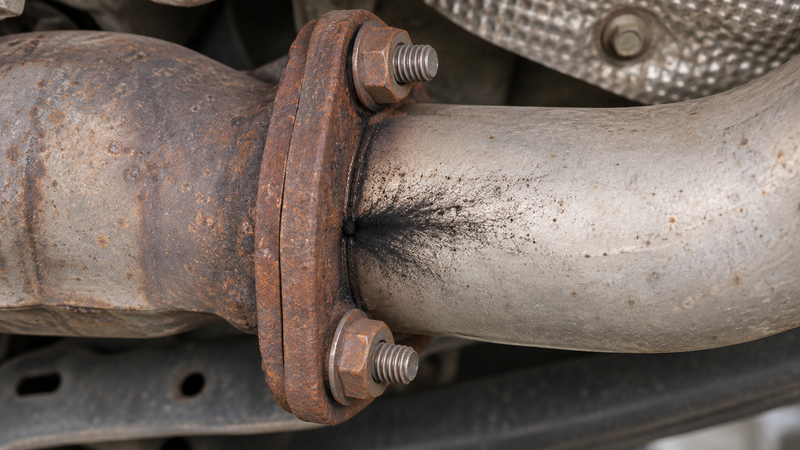
3. Look over the cold exhaust. From a safe spot, check visible manifold joints, flanges, sensor fittings, and wires. Note soot, loose plugs, or a harness against a hot pipe. Leave hard-to-reach joints to a shop. A small leak may need a leak test even if the joint looks clean.
4. Check the sensor type before reading a graph. Save the sensor names, units, and driving conditions with any graph. A wideband air/fuel sensor uses a different scale from a conventional oxygen sensor. A technician can check each sensor’s response against the factory procedure. Two similar traces on a phone screen are too little evidence to approve a converter. If you’ve already changed a sensor, verify the replacement oxygen sensor and its fit before buying another part.
5. Ask how the repair will be verified. Once the engine, exhaust, and sensors check out, ask what vehicle-specific test points to the converter. After a repair, look for a completed catalyst check and see whether P0420 returns as pending or confirmed. A permanent entry can remain while the car verifies the fix. If the converter is new, here’s what to check before paying for a second converter.
If you drive an Accord, check Honda’s engine-specific guidance before approving a converter quote.
Frequently asked questions
Why does my P0420 freeze frame show low speed when I noticed the light on the highway?
First check the code attached to the frame. If it says P0420, the car may have captured it as you slowed. You may have noticed the light later. If the frame names a different code, its road speed describes that event.
How many highway miles should it take for the catalyst monitor to become ready?
There’s no set distance. Your engine may need a mix of conditions that an hour at steady speed never provides. If the monitor stays incomplete, check the drive procedure for your exact engine. Have the shop check for faults that could keep the test from running.
If you own a 2022–2023 F-150 PowerBoost, check Ford’s software update and drive procedure before trying another highway trip.
I forgot to save the freeze frame before clearing P0420. Can I get it back?
Check your scanner app’s saved reports or scan history. Clearing codes erases the associated frame from the car, but your app may already have a copy. If you see P0420 after a long drive again, park and save the new frame before you tap Clear.