
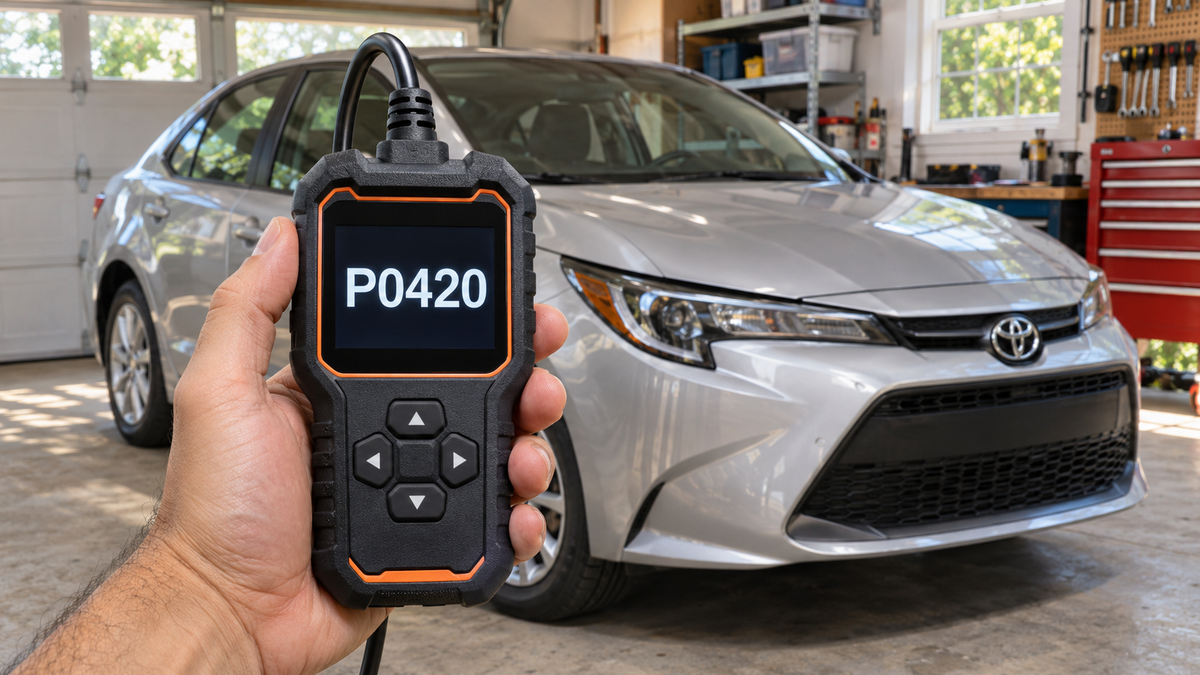
If your Toyota Corolla shows P0420, the cheapest first step is to save the scan. Check for other engine codes and for an exhaust leak near the sensors. A leaking joint may need just a gasket. If the exhaust is sealed and both sensors pass, ask the shop to test the converter. Check your warranty before you pay for a new one.
What does P0420 mean on a Toyota Corolla?
Your scanner may say “catalyst system efficiency below threshold, Bank 1.” The catalyst sits inside the converter and helps clean the exhaust. Once the engine is warm, the car can use exhaust sensor readings to check how well the catalyst works. P0420 means the system fell short during that check.
On a four-cylinder Corolla, all four cylinders share one bank. Sensor 1 sits upstream of the monitored catalyst. Sensor 2 sits downstream. If a quote says “Bank 1 sensor,” ask the shop to name which one.
Write down your model year, engine size, and whether you have a hybrid. Two Corollas can show the same code yet need different tests or parts.
How to diagnose Toyota Corolla P0420, step by step
Step 1. Save the scan before clearing anything
Open the codes menu on your scanner. Take a photo of each stored and pending code. Then open “freeze frame.” This screen shows what the engine was doing when it logged a fault.
Save the code tied to that frame, the speed, and the coolant temperature. Next, open the readiness screen and record the status beside “catalyst.” Clearing codes can wipe out clues and reset that status.
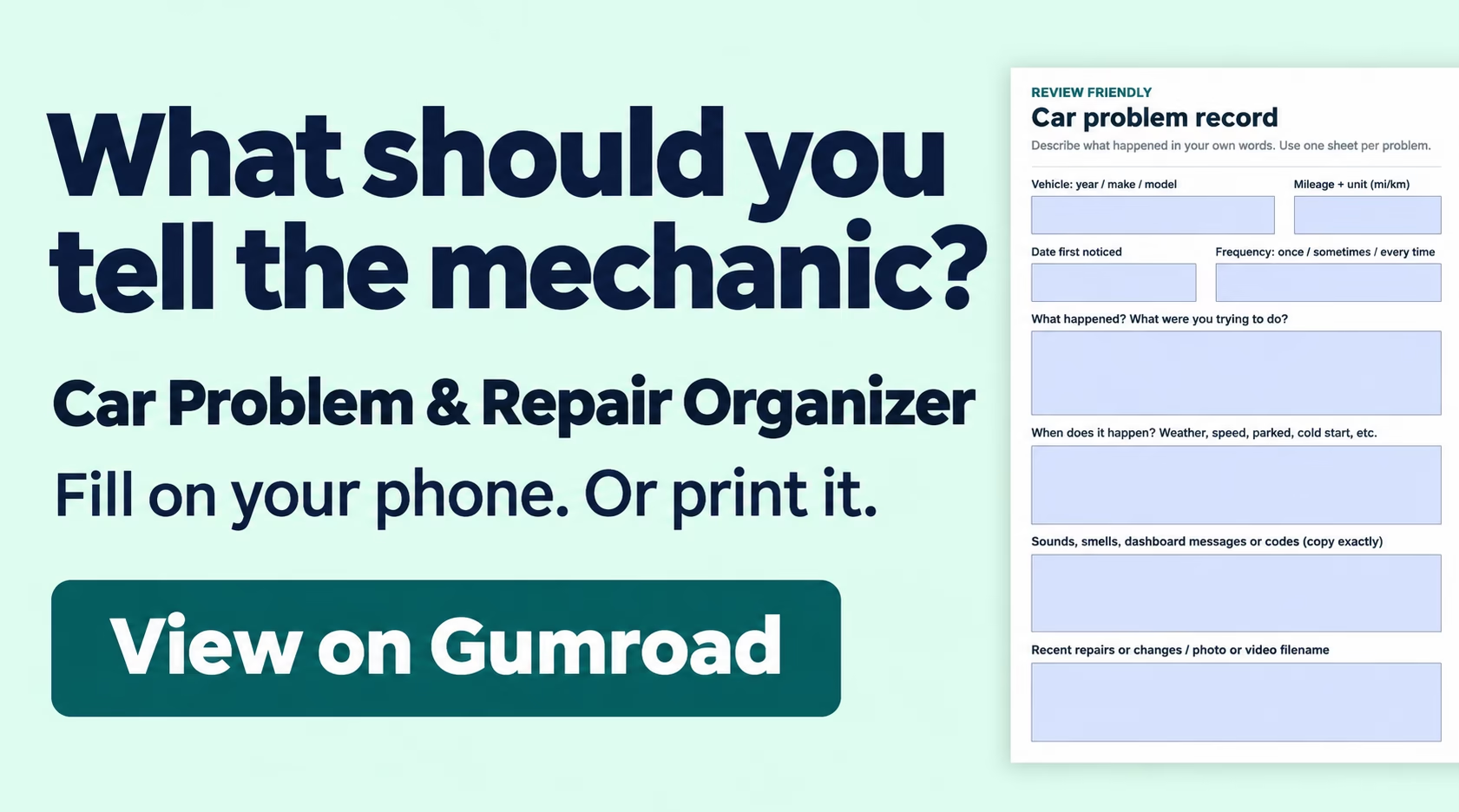
Keep those photos with the date, mileage, and last repair bill. If the light came back on a highway trip, say so. That may be when the car first had the right conditions to run the test.
If the light comes back on longer trips, here’s how to read the P0420 freeze frame after a long drive.
Step 2. Follow companion codes before pricing a converter
If P0420 stands alone, move on to the leak check. If another code points to a misfire, a fuel mix problem, or a sensor circuit, start there. Each gives the shop a more specific fault to test.
Say you also have P0302 and the engine shakes. That code points to a misfire in cylinder two. Ask the shop to find the cause, fix it, then check whether P0420 comes back. If the engine light flashes and the car shakes, pull over safely and arrange help.
Step 3. Check for an exhaust leak where it could affect the reading
Did a tick start just after exhaust work? With the car off and the pipes cold, look at joints you can see from above. A black soot trail near a flange or sensor mount gives the shop a place to check. Leave under-car checks to a shop with a lift.
Ask the mechanic to show you where the gas escapes. A gap near a sensor can draw in fresh air and skew its reading. A hole in the rear muffler, well past both sensors, calls for a different explanation.
If the shop confirms a leak near the sensors, get a price for that repair alone. Have them seal it and run the catalyst check again. You may be able to stop there.
Step 4. Test the sensor response before buying an oxygen sensor
Ask the shop to check the plugs and wires near the hot pipe. Then ask how each sensor responds when the technician commands a richer or leaner fuel mix. A good wire and a sensor that fails its response test give you a reason to buy that part.
Be careful with charts from a phone app. Some Toyota sensors report voltage, while others report current. The right units and expected response depend on your engine. Two lines that look alike on a screen give you little to go on by themselves.
If you already replaced a sensor, check why P0420 can return after an oxygen sensor change before buying another part.
Step 5. Confirm catalyst failure and check warranty coverage
Ask for the result of the catalyst test for your year and engine. A repeat failure carries more weight once the exhaust is sealed, the engine runs well, and both sensors respond as they should. Have the shop name the failed assembly on the quote.
Call Toyota with your VIN, mileage, and the date the car first went into service. The U.S. federal emissions warranty covers eligible converter failures for eight years or 80,000 miles, whichever comes first. Ask the dealer to check state coverage too, before you approve outside work.
Step 6. Verify the repair after the monitor runs
After the repair, look for “catalyst” under readiness again. “Incomplete” means the car still needs to run that check. A dark dash light on the way home tells you little if someone just cleared the codes.
Look for a completed catalyst check with no new pending or confirmed P0420. If the monitor stays incomplete, ask for the drive procedure for your model. There’s no fixed mileage that makes every Toyota run the test.
If the code returns with a new converter, use this post-replacement checklist when you call the installer.
What changes on a Prius, Camry Hybrid, or Corolla Hybrid?
P0420 on a Prius: Was the gas engine running during the test?
You can see READY on a Prius while the gas engine is silent. If your scan graph goes flat at a stop, check engine speed. A reading taken at zero rpm tells you little about a sensor’s response to a change in fuel.
On a 2008 Prius, the shop procedure calls for inspection mode and a warm gas engine. The tech changes the fuel mix and watches both sensors respond. Ask whether the shop captured its readings with the engine running under those test conditions.
P0420 on a Toyota Camry: Gas or hybrid, and which year?
Give the shop the year and engine before you send a screenshot. A 2010 Camry Hybrid procedure shows voltage from the front air/fuel sensor and rear oxygen sensor. A 2020 Camry Hybrid with the A25A-FXS engine uses a test that reads current from both air/fuel sensors.
That difference matters if you compare your graph with one you found online. For a gas Camry, use the test for its gas engine. For a Corolla Hybrid, check that the engine ran during the test and use the specs for your Corolla.
What changes on a Tacoma, 4Runner, or Avalon?
On a Tacoma or 4Runner with a V6, Bank 1 means the side with cylinder one. Ask the shop to mark that bank and the failed assembly on a parts diagram. Guessing by the driver’s side or passenger’s side can send you shopping for the wrong part.
For an Avalon, start with gas or hybrid. On a hybrid, ask about gas-engine speed during the test. On a V6, if a quote lists converters for both banks, ask what failed on the second bank. P0420 identifies Bank 1.
Toyota Corolla P0420 repair costs in the U.S.
Use these U.S. estimates as a guide to what one job might cost. Read the row that fits your test result. Your year, local labor rate, emissions package, and taxes can change the bill.
| Check or repair | U.S. estimate | When it makes sense |
|---|---|---|
| Save scan data | $0 with your scanner | Before you clear codes |
| Check-engine-light diagnosis | $122–$179 | When you need the cause confirmed |
| Exhaust manifold gasket (2016 Corolla example) | $226–$325 | The shop traced a leak to this gasket |
| Oxygen sensor replacement | $500–$570 | The named sensor failed its test |
| Catalytic converter replacement | $2,039–$2,103 | The catalyst failed and warranty coverage has been checked |
Before you book, ask what the diagnostic fee covers. A code read takes a few moments. Finding a small leak and testing a sensor take more work. Get a call-back price limit if the first round of tests leaves the cause unclear.
Buying an aftermarket converter in California or another CARB state
Check the emissions label before ordering
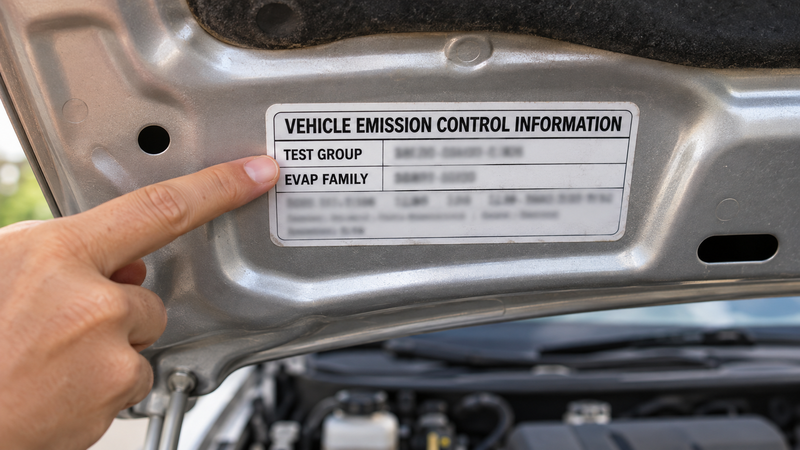
Take a clear photo of the emissions label under your hood. Find the engine family, also called the test group. Keep that photo handy along with the model year and engine size.
In California, a new aftermarket converter needs a California Air Resources Board (CARB) approval for the specific application. Look up the part in CARB’s aftermarket converter database. Match the part number, Executive Order number, and vehicle details, including the engine family and converter position where listed.
Two boxes may both say “fits Corolla.” If only one listing covers your engine family under its approval, the cheaper box could cost you a second install. Ask the shop to put the match in writing before you order.
Compare installed quotes for the same approved application
Ask each shop to list the brand, part number, labor, gaskets, and warranty. Where CARB approval applies, get the Executive Order number too. Compare the full installed prices and check who pays labor if the part fails under warranty.
Outside California, check your state’s emissions rules for your vehicle before you buy. New York, for example, has its own aftermarket installation guidance. A seller’s shipping options tell you little about which part your state allows.
FAQs
1. What is the cheapest thing to check first for P0420 on a Toyota Corolla?
If you own a scanner, save the codes and freeze frame for free. If the light came on after exhaust work, call the installer with that scan. Ask them to check the joints they disturbed before you spend money on parts.
2. Will replacing the downstream oxygen sensor fix P0420?
It can if that sensor failed and caused the code. Ask what changed on the scan when the shop changed the fuel mix. If the rear sensor responded as expected, ask what evidence still points to it.
3. Why did P0420 come back on my Prius or Camry Hybrid after several trips?
The gas engine and exhaust need the right conditions for the car to test the catalyst. Short trips may delay that check. Ask whether the monitor had finished when you picked up the car.
4. Can a cheap aftermarket converter pass California smog inspection?
A lower-priced part can qualify if its approval covers your exact vehicle and the shop installs it correctly. Check the part number and Executive Order before you pay. The car still has to meet the other smog check requirements.
5. What should I ask before approving a $2,000 converter replacement?
Ask the shop where it checked for leaks, how both sensors responded, and which test the catalyst failed. Then ask for the part number and the warranty decision. With those answers, you can weigh a Toyota Corolla P0420 repair quote against a second estimate for the same job.