
Introduction
Is your 2017 Nissan Qashqai radiator fan not turning? If the gauge climbs into the hot zone or you see steam, pull over safely. Shut off the engine and call for recovery. If the engine is cool and the gauge reads normal, the fan may simply be off by design.
When the car heats up in traffic, start with a cold coolant check and the right fan fuse. If both look fine, a garage can command the fan on. That test can help you avoid paying for a fan you don’t need.
Why the radiator fan matters and when to stop driving
Air flows through the radiator as you drive. When you stop, the fan pulls air through it as needed. On a hot day in slow traffic, a dead fan can let engine heat build fast.
The fan also helps move air through the A/C condenser. That’s why your A/C may blow cool on the move but warm at a stop. Heat in traffic and weak A/C at idle are good reasons to check the fan.
If the temperature gauge reaches the hot zone or a heat warning comes on, stop as soon as it’s safe. Shut off the engine if you suspect a dead fan. Call for recovery, even if the gauge drops after the engine cools. Driving it hot can cause engine damage.
Symptoms of a radiator fan fault
- The gauge climbs in traffic or at idle, then drops once you get moving.
- The A/C cools better on the move than at a stop.
- You hear a rattle or scrape near the fan, or the fan starts and stops when it should stay on.
- The fan stays still when a scan tool tells it to run.
One owner of a late-2017 1.2 DIG‑T reported heat spikes after long stops in traffic. The fan stayed off even though the fuses checked out. The cause of the fan fault was left open. A good fuse is one clue, so the next step is to check for a fan command and power at the plug.
If your Qashqai also runs hot at road speed or keeps losing coolant, check beyond the fan. A leak or poor coolant flow can also make the gauge climb.
Safety precautions before any checks
Park on level ground and set the parking brake. Switch off the ignition and let the engine cool fully. If steam is coming out, keep the bonnet shut and stand clear. For more on what you may be seeing, read our guide to steam or smoke under the bonnet.
- Leave the coolant cap closed while the engine is hot. Hot coolant can spray out and burn you.
- Keep hands, loose clothes and tools clear of the fan and drive belts. The fan can start on its own, even after shutdown on some versions.
- Leave live wire tests and direct battery tests to a garage. Use a torch for cold checks and keep clear of the blades.
How to diagnose a 2017 Qashqai radiator fan that won’t turn
Start with checks that cost little and tell you where to look next. If the car has already run hot or lost coolant, skip the running checks at home.
Step 1. Identify the engine and build version
Find the VIN and note your engine size, fuel type and gearbox. A 2017 registration can be a pre-facelift J11 or a facelift J11. Build date matters when you look up the right part or fuse plan.
- Petrol: Check whether you have the 1.2 or 1.6 DIG‑T. Some markets also got a 2.0 petrol with its own wiring.
- Diesel: Check whether you have the 1.5 or 1.6 dCi. Both have documented low-speed circuits that use a resistor. Check the layout for your VIN before you buy a part.
Step 2. Check coolant and look for visible damage
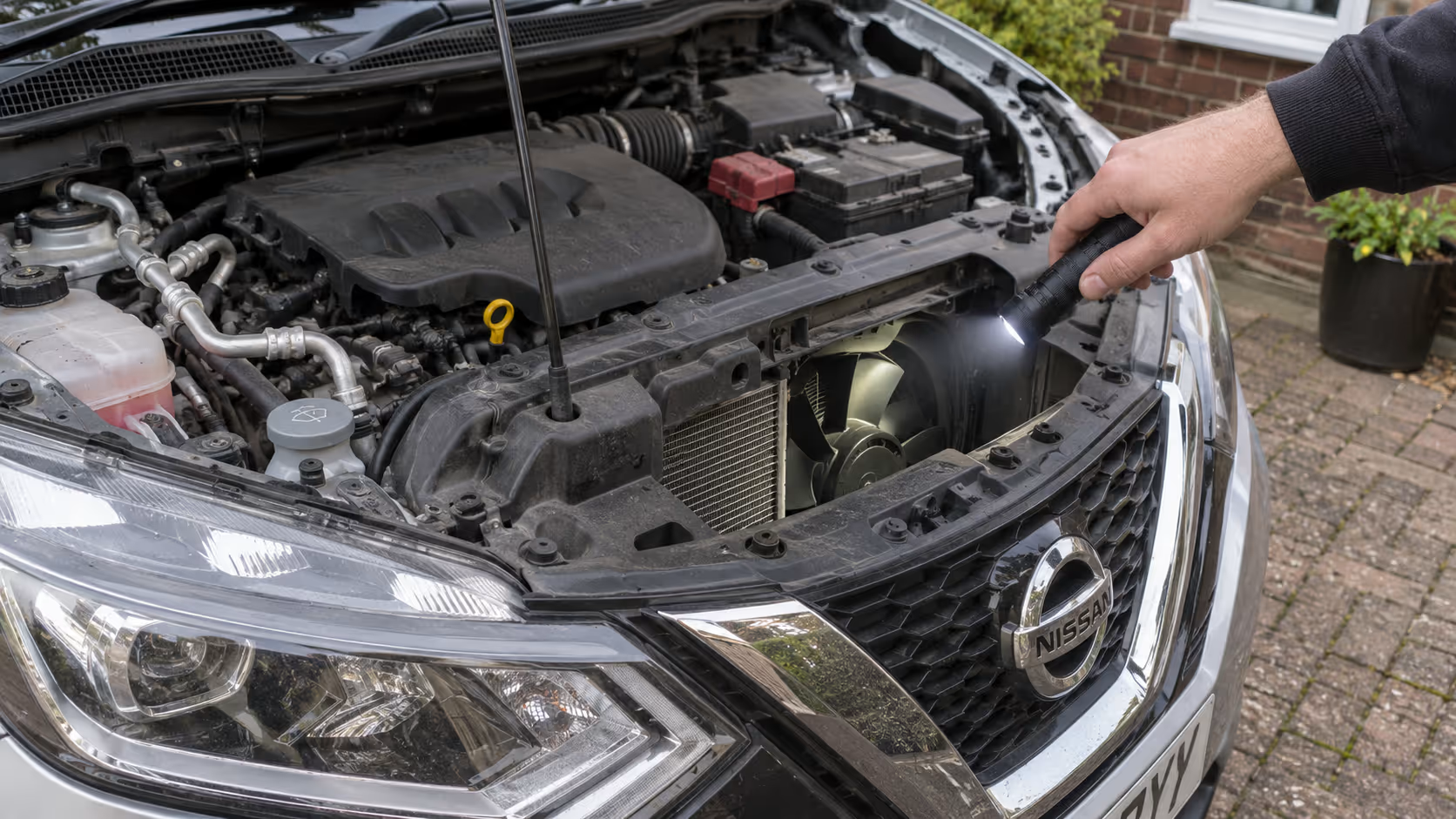
With the engine cold and off, use a torch to read the marks on the coolant tank. Look for damp spots, dried stains or a puddle below the car. If the tank is empty or the level keeps falling, have the leak checked before you run the engine again.
Look at the fan and the parts you can see from above. Check for a cracked shroud, debris or a plug that looks loose or scorched. Make this a visual check. Keep your hands out of the fan area.
Step 3. Check the correct fuse
Use the fuse-box label and a wiring diagram that matches your car. The fuse position and rating can vary by build. If the right fuse is easy to reach, switch the ignition off and use a fuse puller. With the fuse out, use a multimeter set to continuity to check it.
If the fuse has blown, use only the same type and amp rating. If a new fuse blows again, stop there. A short or a fan that draws too much current needs a proper test. See why a car fuse keeps blowing for the next clues.
Step 4. Observe A/C response and record scan data
Only try this if the car has shown no signs of overheating or coolant loss. With the car outdoors and parked, switch on the A/C. Watch the fan from a safe spot and keep an eye on the gauge. End the check if the temperature starts to climb past normal.
A shop test for the 1.5 dCi uses the A/C to check low fan speed under set conditions. On your car, the A/C system may hold back the fan request based on pressure and other inputs. Treat what you see as one clue. You can skip this check if you’re unsure.
If you have an OBD reader with live data, note any codes and the coolant temperature. On a fully cold engine, the reading should be close to the air temperature. A reading far off that mark calls for a sensor and wiring check. A basic reader may show temperature without being able to command the fan. See our guide to code readers and scan tools.
Step 5. Have a garage command the fan and test the circuit
Ask the garage to command the fan on with a compatible scan tool. Ask them to test both speeds if your car supports that. If the fan fails the check, ask for power and ground to be tested while the circuit is under load.
- Correct power and ground, fan still off: Check the fan motor or assembly.
- Fan runs on high only: Check the low-speed circuit for that build.
- Missing feed or ground: Trace the fuse, plug, wires and control circuit.
- Fan runs on command, engine still gets hot: Check for coolant loss or poor flow. The shop can test the thermostat, radiator and water pump as needed.
Likely causes, fixes and difficulty
Use this order to guide the checks once you know the fan should be on. Start with the clue that fits your car. If high speed works, move the low-speed circuit up the list. Owner reports show how faults can look, but they can’t tell you how often each part fails on a 2017 J11.
1. Failed fan motor or assembly
A rattle, a wobble or a fan that works only now and then can point to wear. If the fan won’t run and the shop confirms the right power and ground at the plug, the fan itself is a strong suspect.
The fix may be a motor or a whole fan unit, based on what you can buy for your VIN. Access can make this a hard DIY job. UK aftermarket examples run about £55–£310 for the part.
2. Blown fuse, damaged connector or wiring fault
A blown fuse, melted plug or lost feed can stop the fan. An easy-to-reach fuse is a basic check. If it blows again, a garage can check for a short, excess draw or damage at the plug.
A basic blade-fuse pack can cost about £2. Confirm the fuse type first. A plug or wire fix needs a quote based on how much of the circuit the shop has to trace.
3. Failed low-speed resistor, relay or fan controller
If the fan runs on high but stays off on low, check the low-speed path first. The 1.5 and 1.6 dCi service layouts include a resistor in that path. On a petrol car, use the engine code and VIN to find out what controls the fan on your build.
A shop can test the resistor, relay or fan controller that your car uses. If the failed part can be bought on its own, ask for a price for that repair. If it comes with the fan, use the assembly range as a parts guide.
4. Incorrect coolant-temperature signal or control fault
A bad sensor signal can throw off the fan request. Start with live data and check the sensor plug and wires. If the signal makes sense, the garage can check the other inputs and the control circuit before it quotes a module.
Sample UK prices for 1.2 DIG‑T coolant temperature sensors are about £11–£21 for the part. The cost to test the wires or fix a control module depends on the fault and the build.
DIY checks vs. when to go to a mechanic
You can check the coolant level when cold, look for leaks and check an accessible fuse. If you have a scan tool, save the codes and live temperature before you clear anything. Note if the fault shows up in traffic, with A/C on or after a long run.
Call a garage for a fuse that blows twice, a melted plug or a fan that won’t run when asked. If the car has run hot and you think the fan is dead, arrange recovery. Ask the garage to prove which part failed before fitting a new one.

Estimated UK repair costs
A fuse can be cheap. A quote for a fan can be much higher once you add labour. These UK figures give you a starting point.
| Work or part | UK price guide | What the figure covers |
|---|---|---|
| Standard diagnostic check | About £65 | A starting price. Ask if fan command and electrical checks are included. |
| Aftermarket fan assembly | About £55–£310 | Selected parts only. Match the assembly to your build. |
| Qashqai cooling fan repair | About £395 | A UK booking service average across Qashqai model years. Get a quote for your car. |
Ask for a quote based on your VIN or registration. Check whether it covers tests, parts, labour and VAT. Ask if the diagnostic fee also covers tracing a fault in the wires. That work can cost more than a basic scan.
Prevention and maintenance
Check the coolant level from time to time with the engine cold. If it drops again after a top-up, have the leak checked. Use the coolant grade and change schedule for your exact Qashqai.
Get a new fan rattle or a rise in heat at idle looked at before a long trip. After a repair, save the invoice and ask which fan speeds the garage tested. That gives you a record if the fault comes back.
FAQs
Can I drive my Qashqai if the radiator fan has stopped?
If the gauge goes hot, a warning comes on or you see steam, pull over safely. Shut off the engine if you suspect the fan has failed and call for recovery. If you’ve only seen the fan still on a cool engine, check whether cooling was being called for.
When should the radiator fan turn on, and should it run with A/C?
The fan runs when the car calls for more airflow. That request can depend on coolant heat, road speed and A/C pressure. A fan that stays off with the A/C on gives you a clue. A command test for your engine gives you a clearer answer.
Where is the radiator fan fuse on a 2017 Qashqai?
Start with the fuse legend and a wiring diagram for your VIN. The location and rating can change with the build. If the legend is unclear, ask a garage to point out the right fuse before you pull one.
Why does my Qashqai overheat in traffic but cool down while moving?
Road speed pushes air through the radiator. At a stop, you need the fan when the engine calls for more cooling. That pattern puts the fan high on the list. Check for coolant loss as well, since more than one fault can be present.
If the fan runs when called for, check other reasons a car overheats at idle.
How much does a Qashqai radiator fan cost to replace?
For UK budgeting, some aftermarket fan units sell for about £55–£310. The broad Qashqai repair average is about £395 across model years. Ask for a quote based on your VIN so you can see the cost for your car.
Conclusion and call to action
2017 Nissan Qashqai radiator fan not turning? If the engine runs hot, stop and arrange recovery. If the car stays cool, start with the coolant level and the right fuse. Then ask a garage to command the fan and check power and ground before you buy parts.
If you share what happened, include your engine, gearbox and when the gauge started to rise. For another example of how to work through a fan fault, see our Jeep Commander cooling fan guide.