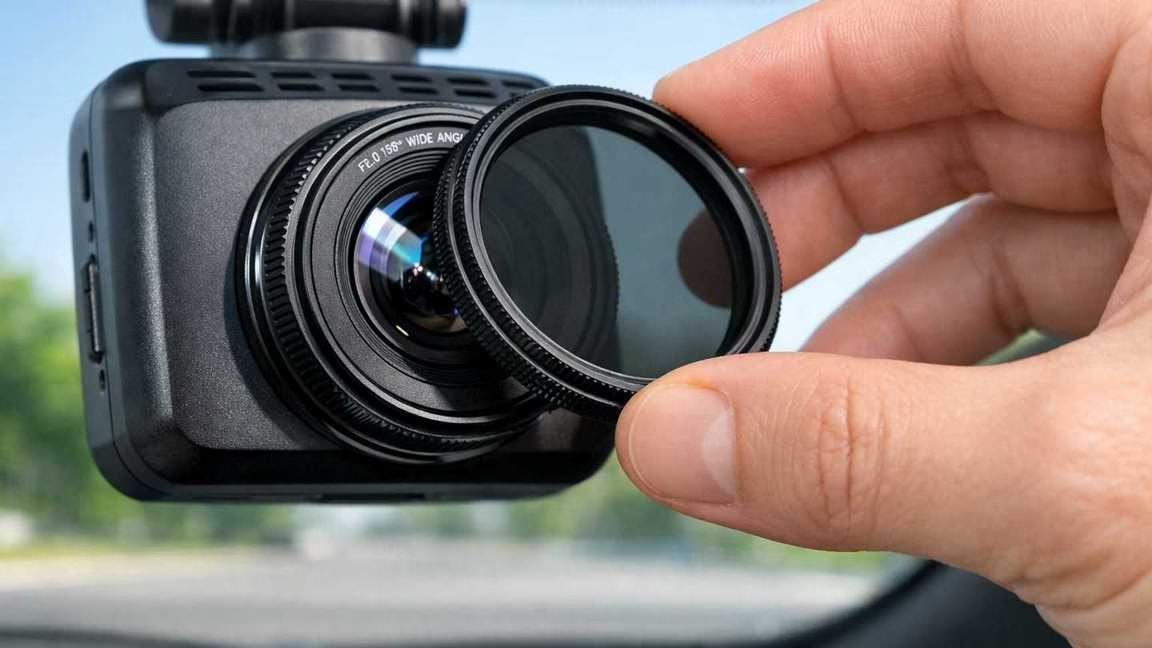
A CPL (circular polarizing) filter is a rotating lens filter that can cut certain types of reflections—mainly the shiny glare you get from dashboards and windshields in bright light.
Here’s the part most accessory pages skip: a CPL is not a free upgrade. It trades light for reflection control. That trade can be worth it in strong daylight, and actively harmful in low light.
If you drive at night, in rain, or on dim roads, a CPL can make your footage worse. Not “slightly different.” Worse: darker video, more motion blur, and less readable plates.
What a CPL Filter Actually Does (Technical but Simple)
Light bounces off smooth surfaces (dashboard plastics, the windshield itself) in a more “organized” way than light coming from the road. A polarizing filter works like blinds on a window: turn it one way and it blocks a chunk of that organized glare.
That’s why a CPL can reduce:
- Dashboard reflections that float over the road view
- Windshield glare from sun angle
- Harsh sheen on glossy interior trim that reflects into the lens
What it cannot do is fix a weak camera.
A CPL will not rescue:
- A small sensor struggling at night (it will usually make it struggle more)
- Low bitrate compression that turns fine detail into mush
- Bad placement (too high, too low, pointed at the hood, aimed through a dotted tint band)
- A dirty or hazy windshield (the filter can’t “polarize away” grime)
If your video is already borderline at night, adding a filter that blocks light is the opposite of a solution. If night performance is your priority, your money is better spent on a camera that’s actually built for low light (for context, see the night-visibility discussion here: https://reviewfriendly.com/best-dash-cam-night-vision-license-platesnight license plate visibility guide).
When a CPL Filter Helps (Specific Use Cases)
A CPL has a real job, but it’s narrow. These are the scenarios where it genuinely earns its keep.
Bright daytime driving with strong sun angles
Midday sun and low-angle morning/evening sun can turn the windshield into a mirror. If you see your dashboard clearly reflected in the video, a properly rotated CPL can reduce that overlay so road markings and vehicles look cleaner.
Why it works: there’s plenty of light to spare. Losing some light to the filter doesn’t push the camera into “high ISO, low shutter” territory.
Sunlight reflecting off a light-colored dashboard
Beige and light gray dashboards are reflection factories. Even dark dashboards can reflect if they have a smooth finish or you use protectants that leave shine.
Why it works: dashboard reflection is exactly the kind of glare polarization can target, and daytime brightness covers the light loss.
Urban driving with lots of reflective interior surfaces
City driving often means glass towers, bright concrete, and high-contrast scenes that amplify windshield glare. If your interior has chrome accents, glossy infotainment trim, or a shiny dash mat, those reflections can show up as a foggy veil.
Why it works: the filter can knock down that “veil” so the scene looks less washed out—again, assuming strong daylight and correct rotation.
One important caveat: if your windshield has heavy tint, gradient bands, or special coatings, you may see uneven dark patches or odd color shifts. That’s not the CPL “failing.” It’s an interaction between polarization and the glass/coating.
When a CPL Filter Hurts Footage (Critical Section)
This is the part people learn the hard way: a CPL is also a light-reduction filter. It commonly cuts a noticeable chunk of incoming light. In bright sun, that’s fine. In low light, it’s a penalty you feel immediately.
Night driving and low-light roads
At night, dash cams already fight physics. They need light to keep shutter speeds high enough to freeze motion and keep noise low enough to preserve detail.
A CPL reduces the light hitting the sensor. The camera compensates by:
- Slowing the shutter (more motion blur)
- Raising gain/ISO (more noise and smearing)
- Or both (the worst combo)
Result: darker footage, blurrier moving vehicles, and plates that become harder to read—especially on cross traffic.
If you mostly drive after dark, a CPL is usually a net negative. If you’re already chasing plate clarity, focus on the fundamentals first: sensor choice, exposure behavior, and bitrate (again, this is why low-light-focused cameras exist: https://reviewfriendly.com/sony-starvis-1-vs-starvis-2-review sensor differences).
Rainy or overcast environments
Overcast days look “bright” to your eyes, but they’re often a low-contrast, lower-light scenario for cameras. Rain makes it worse by adding reflective surfaces everywhere: wet roads, droplets, and glare from headlights.
A CPL can’t fix rain glare the way people expect. It can reduce some windshield reflections, but it also reduces light—pushing exposure in the wrong direction.
If your footage already looks dim on rainy days, the CPL is contributing.
Cheap dash cams with small sensors
Lower-end cameras tend to have:
- Smaller sensors
- Worse noise performance
- Aggressive noise reduction that smears detail
- Lower real bitrate than the box suggests
Those cameras need every photon they can get. A CPL forces them into compensation modes faster. The result is a double hit: darker base exposure plus heavier noise processing.
In blunt terms: a CPL makes mediocre cameras look more mediocre.
Any situation where light loss matters
This includes:
- Tunnels
- Tree-covered roads
- Parking garages
- Dawn/dusk commuting
- Rural highways with minimal lighting
If you’re frequently in these conditions, you want maximum light to the sensor. A CPL is the opposite of that.
5) The Most Common CPL Mistake (Must Be Highlighted)
The most common mistake is treating CPL setup like a one-time install.
A CPL works by rotation. If the angle is wrong, you don’t get meaningful reflection reduction—yet you still pay the light-loss penalty.
There are three predictable outcomes when people “set it once and forget it”:
1) Darker footage for no gain
If the filter isn’t aligned to the reflection you’re trying to cut, it’s basically just a dimmer switch.
2) Loss of fine detail
The camera compensates for lost light. That compensation (higher ISO, slower shutter) strips away crisp texture—exactly what you need for identifying details.
3) Reduced license plate readability
Plate capture is already hard because plates are small, reflective, and often moving relative to you. If you cut light, the shutter slows, and plates blur. This is why many people blame the camera when the filter is the real culprit.
Another mistake that shows up constantly: leaving the CPL on at night because “it helped during the day.” Day and night are not the same problem. A solution for one can sabotage the other.
6) How to Properly Set Up a CPL Filter (Actionable Steps)
Do this while parked. Not at a stoplight. Not while rolling. Treat it like any other camera adjustment.
Step 1: Clean the windshield (inside and out)
A dirty windshield creates haze and streaks that no filter can fix. If your glass is smeared, you’ll misjudge whether the CPL is working.
Step 2: Pick the right time to adjust
Adjust the CPL in the conditions you care about most:
- If your goal is daytime reflection control, adjust in bright daylight.
- If you drive mixed conditions, prioritize the most common scenario—and be willing to change it seasonally.
If you mainly drive at night, the “correct” setup is often removing the CPL entirely.
Step 3: Use the live view (or recorded test clip) and rotate slowly
Most CPLs rotate. Turn it in small increments while watching the reflections on the screen.
You’re looking for a clear change in:
- Dashboard reflection strength
- Glare streaks across the windshield area
- Washed-out “veil” over the road scene
If nothing changes as you rotate, one of these is true:
- The reflections you hate aren’t strongly polarized (common at certain angles)
- Your dash reflection is coming from a different source than you think
- The windshield/tint/coating is interacting oddly with polarization
Step 4: Set it for the problem you actually have
If the main issue is dashboard reflection, rotate until the dashboard reflection is minimized—even if other parts of the image get slightly darker.
If the main issue is external glare (sun glare off the road), understand the CPL may help less than you expect. Polarizers aren’t magic against every bright thing; they’re best against reflections at specific angles.
Step 5: Confirm with a short drive clip
Record 30–60 seconds and review it parked afterward. You’re checking for:
- Reflection reduction that’s obvious, not subtle
- No weird uneven dark patches across the frame
- No sudden exposure “struggle” in shaded areas
Step 6: Know when to remove it entirely
Remove the CPL when:
- It’s night and your roads aren’t brightly lit
- It’s raining or heavily overcast and your video looks dim
- You’re entering winter with shorter daylight commutes
- Your camera already looks noisy or blurry in low light
If you’re using parking mode overnight, don’t handicap the camera with unnecessary light loss. Parking mode already has challenges (power management and exposure behavior matter more than accessories; see: Voltage Cutoff Parking mode voltage cut-off basics and Harwire options overview).
7) Do You Actually Need a CPL Filter? (Decision Framework)
Use this checklist. If you’re mostly answering “no,” skip the filter.
Quick decision checklist
- Do you drive mostly in bright daytime?
If yes, CPL is more likely to help. If no, be cautious. - Do you see clear dashboard reflections in your footage?
If yes, a CPL can be worthwhile. If your issue is “night is blurry,” a CPL won’t fix that. - Is your dash/interior glossy or light-colored?
If yes, you’re a better candidate. Matte interiors often don’t benefit much. - Is your dash cam already strong in low light?
If no, adding a CPL is usually the wrong direction. - Do you regularly drive in rain, dusk, tunnels, or rural darkness?
If yes, a CPL can easily cost you more than it gives.
A practical rule: if you’re shopping because your video is “too dark,” don’t buy a CPL. Fix the camera problem first (sensor, exposure behavior, bitrate). Even SD card reliability can affect perceived quality through dropped frames or corrupted clips; if you’re troubleshooting overall recording reliability, start with basics like: From Here card selection and formatting.
Verdict: A CPL is situational, not mandatory. It’s a tool for a specific glare problem, not a universal “upgrade.”
8) Final Verdict (Balanced but Firm)
A CPL filter can clean up daytime footage by reducing dashboard and windshield reflections—when it’s rotated correctly and when you have enough light to spare.
The trade-off is unavoidable: it reduces incoming light. In low light, that trade is often destructive. Night driving, rain, overcast skies, and budget cameras are where CPL filters regularly make footage worse, not better.
If you buy one, treat it like a configurable tool, not a permanent attachment. Adjust it intentionally, verify with short clips, and remove it when conditions shift toward low light.
Most disappointment with CPL filters comes from unrealistic expectations and lazy setup. Used properly, it can solve a real problem. Used blindly, it becomes a self-inflicted quality loss.