The Engineer’s Summary
- The Myth: “4K is always better.” False. Tiny 4K pixels create noise in the dark.
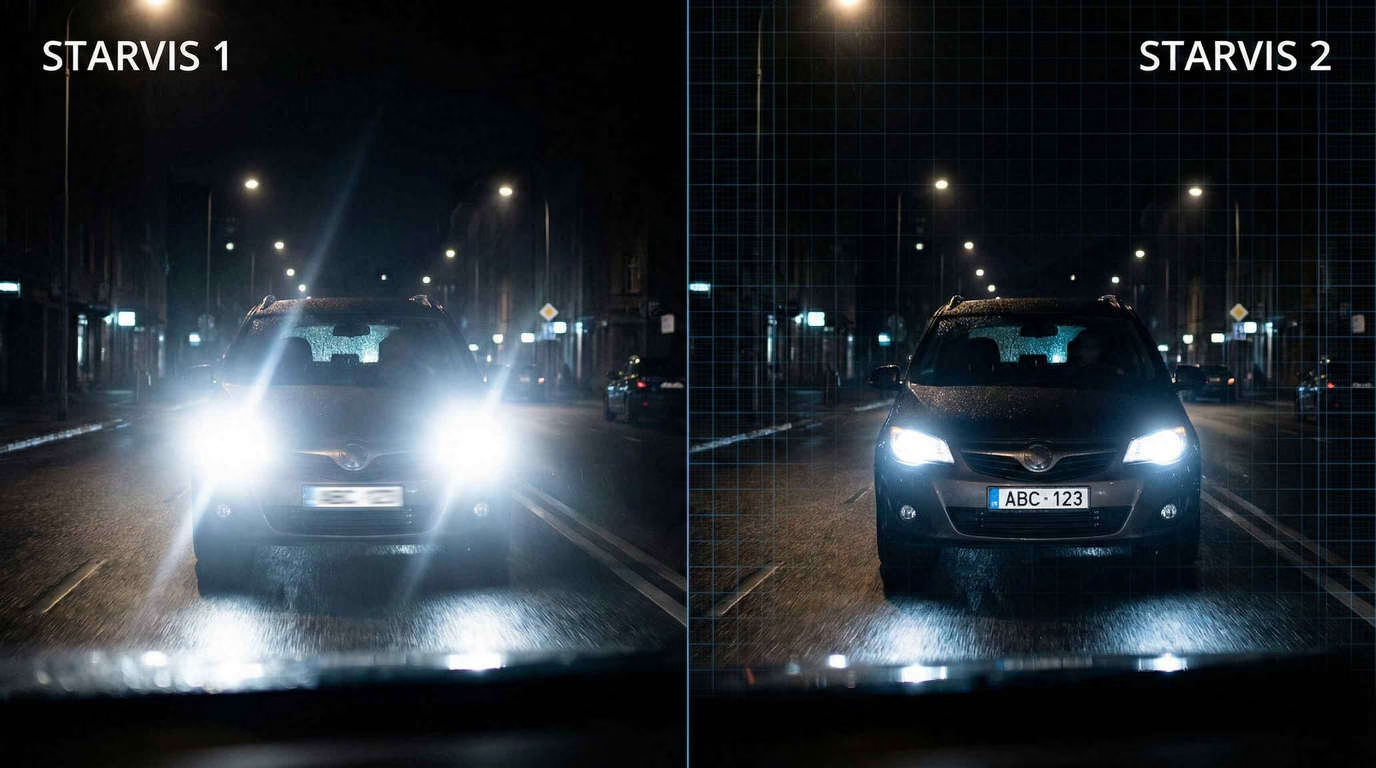
- The Old Tech (STARVIS 1): Great for stationary objects, but blurs license plates at high speeds due to “sequential” HDR.
- The New Tech (STARVIS 2): Uses “Clear HDR” (simultaneous exposure) to freeze motion. It captures plates where older cams see white blobs.
- Verdict: Mandatory for city drivers and Uber. Optional for rural highway drivers.
Marketing departments love the term “4K.” They plaster it on $50 dash cams that use cheap, interpolated sensors. As an optical engineer, I can tell you that resolution does not equal clarity.
In fact, cramming 8 million pixels (4K) onto a tiny sensor is usually a disaster for night vision. The pixels become so small they can’t gather enough photons to create a clean image.
The real battle for night vision isn’t about resolution; it’s about Dynamic Range and Shutter Speed. This is where the war between Sony’s STARVIS 1 and the new STARVIS 2 is fought.
The Old Guard: Sony STARVIS 1 (IMX335 / IMX307)
For the last five years, the Sony IMX335 (5MP) has been the king of the “Best Budget Dash Cam” category (found in the Viofo A119 V3).
It was revolutionary because it was “Back-Illuminated,” meaning the wiring didn’t block the light path. It could see in the dark reasonably well. However, it had a fatal flaw: Motion Blur.
To handle bright headlights and dark streets, STARVIS 1 used an older form of HDR (High Dynamic Range) called DOL-HDR (Digital Overlap).
- How it worked: It took two photos in rapid succession—one short exposure (for headlights) and one long exposure (for shadows)—and stitched them together.
- The Problem: Because there was a tiny time gap between the two photos, fast-moving objects (like a car passing you at 40mph) would “ghost.” The result? You see the car clearly, but the license plate is a smeared, unreadable white bar.
The New Tech: Sony STARVIS 2 (IMX678 / IMX675)
Sony released the STARVIS 2 series (specifically the IMX678 for 4K and IMX675 for 2K) to solve the physics problem of motion.
1. Bigger Pixels (The “Light Bucket” Theory)
The IMX678 sensor is physically larger (1/1.8″ type) compared to the older standards (typically 1/2.8″). Think of a pixel as a bucket collecting rain (light). A larger bucket catches more rain in less time. Bigger pixels mean the camera doesn’t have to work as hard to see in the dark, resulting in less “grain” or noise in the image.
2. Clear HDR: The Ghost Killer
This is the real reason to upgrade. STARVIS 2 introduces Clear HDR (or improved DOL-HDR timing). Instead of taking two photos one after another, it captures the bright and dark data simultaneously (or with virtually zero time gap).
- The Result: No time gap means no ghosting. The camera can freeze a moving license plate without the “double vision” effect that plagued the older models.
| Feature | STARVIS 1 (IMX335) | STARVIS 2 (IMX678/675) | Winner |
|---|---|---|---|
| HDR Type | Sequential (Ghosting risk) | Simultaneous (Clear HDR) | STARVIS 2 |
| Motion Handling | Prone to blur at night | Sharpens moving plates | STARVIS 2 |
| NIR Sensitivity | Standard | Enhanced (Better in pitch black) | STARVIS 2 |
| Power Draw | Standard | ~30% Lower | STARVIS 2 |
The Real World Test: Motion Blur & License Plates
Let’s look at a specific scenario: You are driving 40mph at night, and a car passes you in the opposite lane.
- STARVIS 1 Result: You will see the make and model of the car clearly. But when you pause the video to check the license plate, you will see a bright white rectangle. The sensor was too slow to adjust the exposure for the reflective plate, and the motion blur smeared the numbers together.
- STARVIS 2 Result: The improved dynamic range instantly dims the reflective plate while keeping the rest of the street bright. The faster shutter speed captures the numbers “E,” “4,” and “9” clearly.
- Note: It is not magic. If the combined speed is over 70mph, even STARVIS 2 will struggle. But for city driving, the difference is night and day. (See our full breakdown in Best Dash Cam for Night Vision).
The Verdict: Is it Worth the Extra $100?
The price gap is real. A STARVIS 1 camera costs around $80-$100 (like the A119 V3), while a STARVIS 2 flagship costs $200+ (like the A139 Pro).
Scenario A: Save Your Money
Buy STARVIS 1 If…
- You primarily drive during the day.
- You live in a rural area (deer don’t have license plates).
- You are on a strict budget (Check our Best Budget Dash Cam list ).
Scenario B: Buy the Upgrade
Buy STARVIS 2 If…
- You drive for Uber/Lyft at night (See Best Dash Cam for Uber ).
- You park on busy city streets (Hit-and-run protection).
- You want the best possible chance of capturing a plate number.
Bottom Line: If you can afford it, the IMX678/675 sensors are the only “true” upgrades we have seen in years. They don’t just add pixels; they fix the physics of light capture. For 2026, STARVIS 2 is the new baseline for premium protection.