
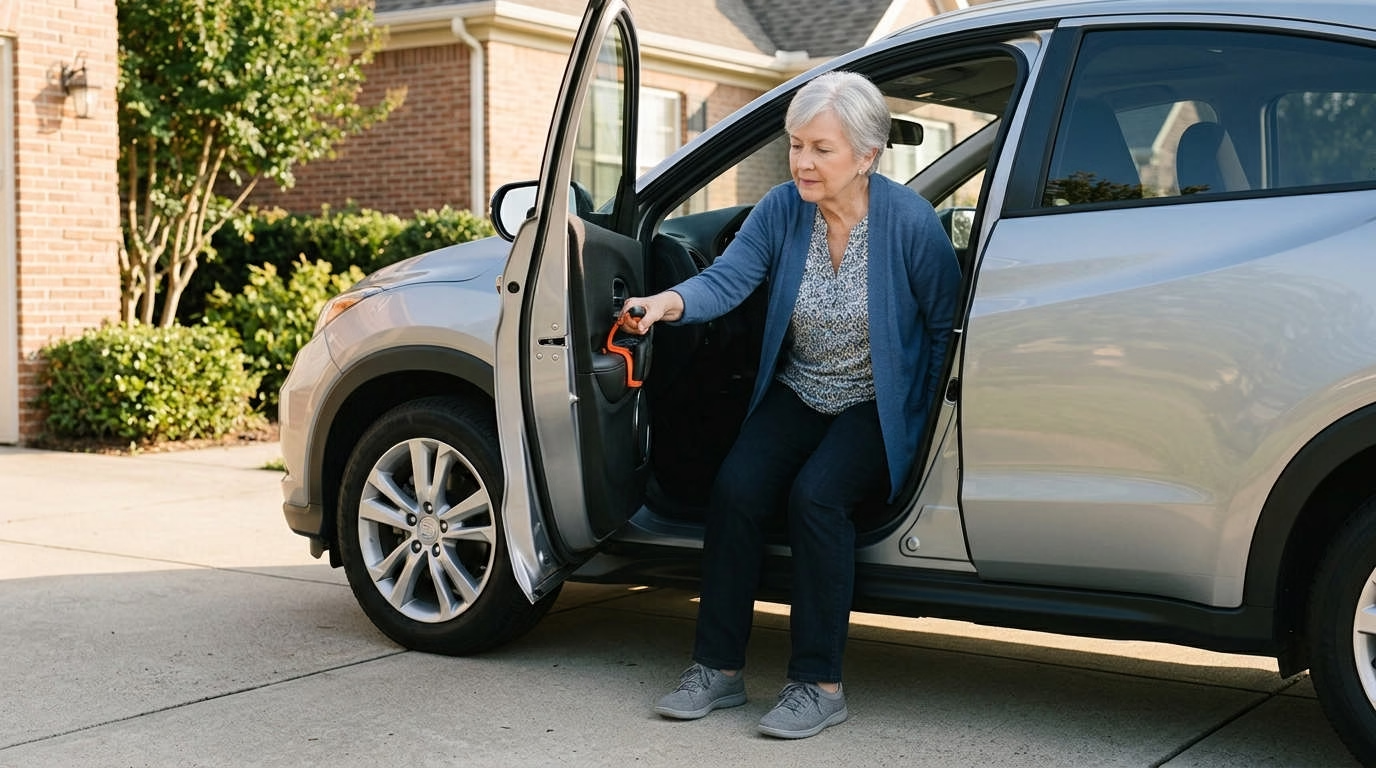
How these products were assessed: Before I ranked these handles, I reviewed a large volume of owner feedback and buyer discussions. The results below reflect repeated reports from people who use these aids day after day. Marketing claims alone did not decide the rankings.
The best car handle assist for elderly people should offer firm support without adding more stress. It must fit the vehicle, feel good in your hand, and stay steady as you stand.
For most people, the Stander HandyBar is the best all-around choice. Yet a lighter handle, hanging strap, or higher-capacity model may better suit your needs.
This guide compares six strong options. You will also learn how to check fit, use a handle safely, and avoid common mistakes.
A car assist handle supports part of your movement. It does not lift you from the seat. If you cannot bear weight or keep a firm grip, you may need help from a caregiver or mobility expert.
Best Car Handle Assists for Elderly People at a Glance
Car Assist Handle Comparison
Side-by-side breakdown of the top 6 car assist handles for seniors and mobility support
Compare Features | 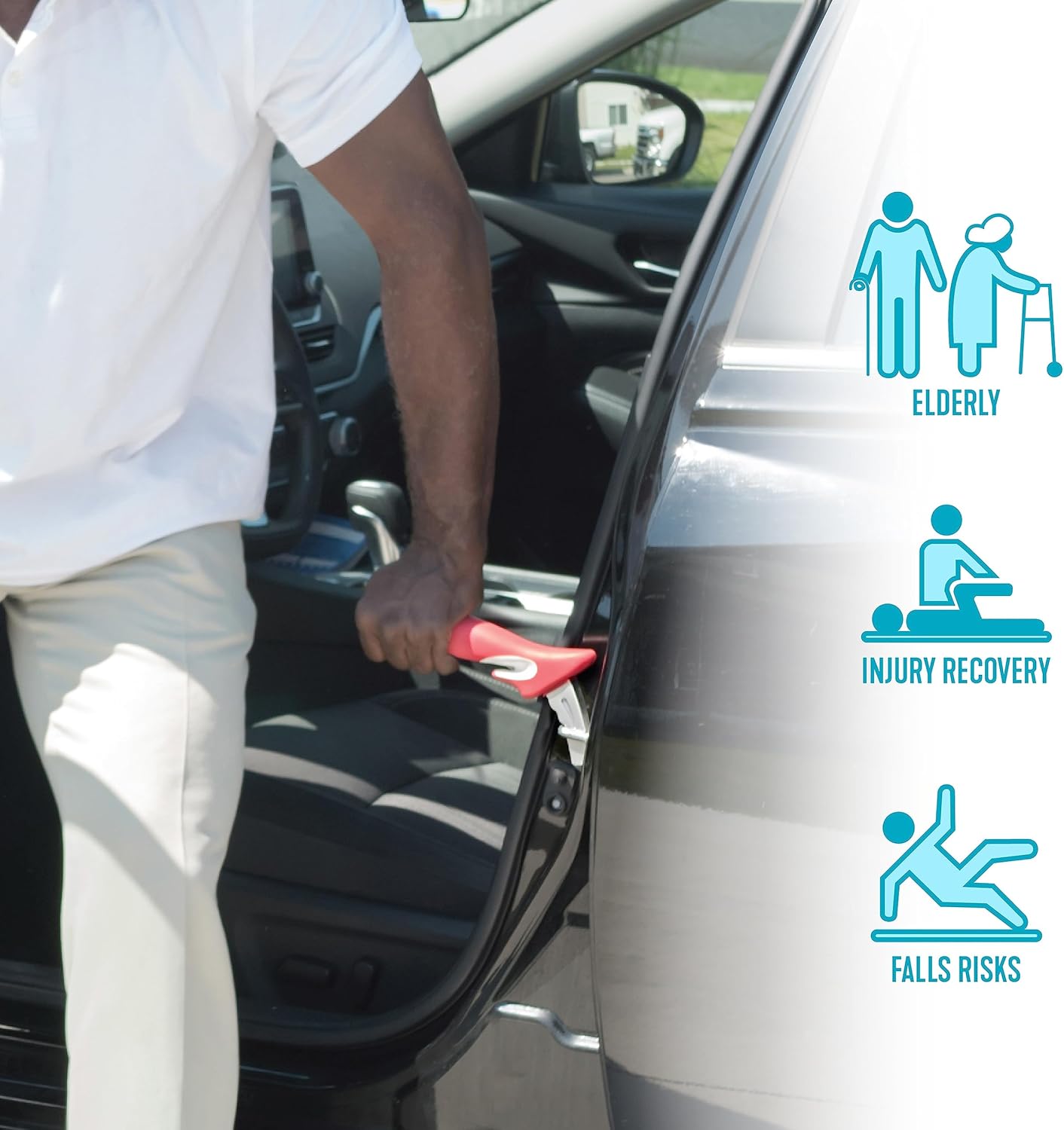 Stander HandyBar
Best Overall
View on Amazon |  Able Life Auto Cane
Best Ergonomic Grip
View on Amazon |  KOUNATSURI Car Door Handle
Best Heavy-Duty
View on Amazon |  Stander CarCaddie
Best for SUVs & Trucks
View on Amazon | 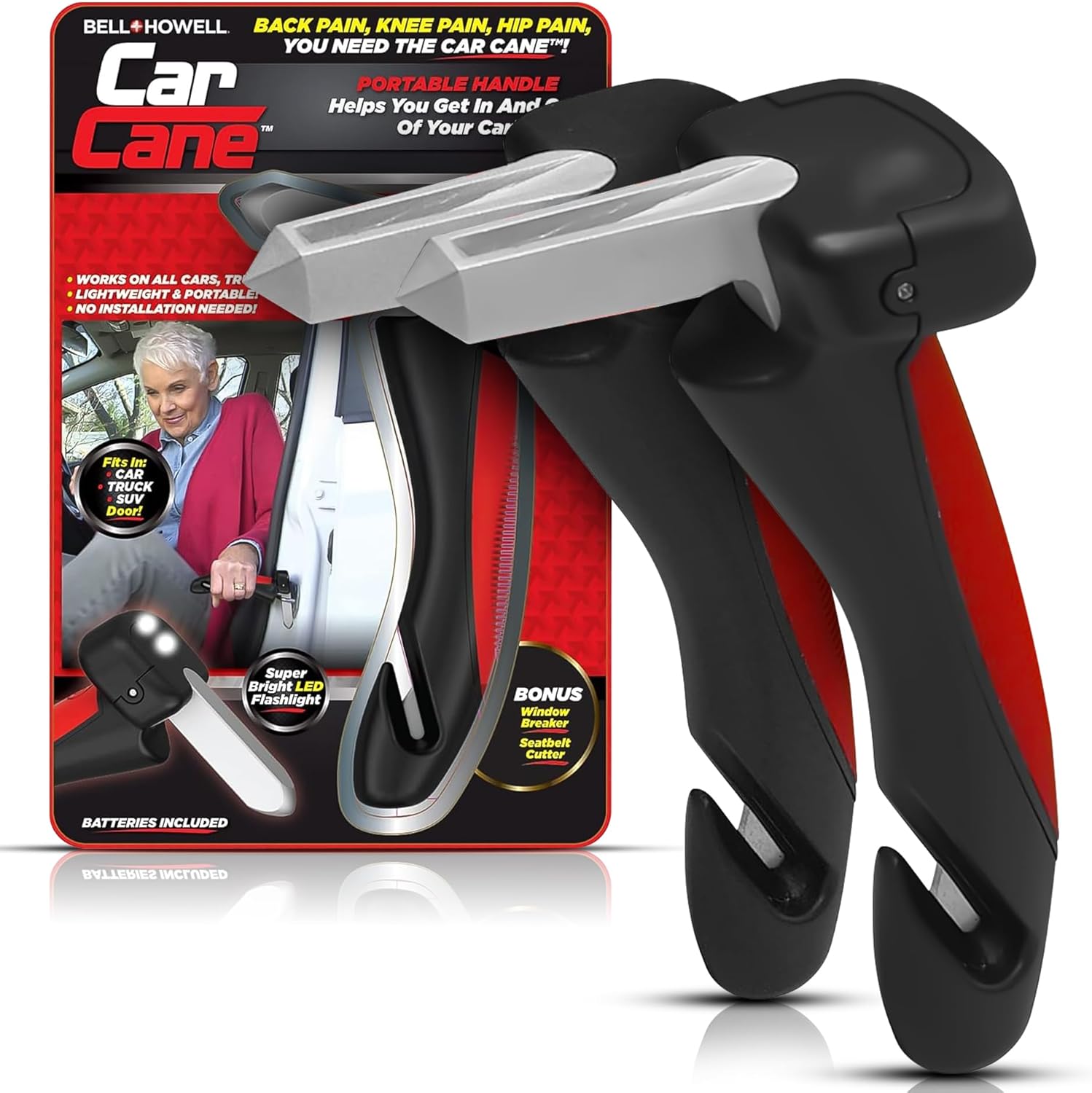 Emson Original Car Cane
Best Emergency-Ready
View on Amazon |  Vive Car Assist Handle
Best Budget
View on Amazon |
|---|---|---|---|---|---|---|
| Best For | Best Overall | Best Ergonomic Grip | Best Heavy-Duty | Best for SUVs & Trucks | Best Emergency-Ready | Best Budget |
| Handle Type | Door-striker bar | Door-striker bar | Door-striker bar | Hanging strap | Door-striker bar | Door-striker bar |
| Stated Capacity | 350 pounds | 300 pounds | 400 pounds | 250 pounds | 350 pounds | 300 pounds |
| Emergency Tools | Cutter and window breaker | None | Cutter and window breaker | None | Cutter, breaker, and light | None |
| Main Advantage | Strong track record and large grip | Light and easy to hold | High stated capacity and padded grip | Lets you pull upward | Useful mix of support and safety tools | Small, light, and low priced |
| Main Drawback | Costs more than basic models | Shorter handle gives less reach | Foam may move during use | Does not fit every window frame | Larger than simple handles | Fit varies between vehicles |
Fast picks:
- Best for most users: Stander HandyBar
- Best lightweight choice: Able Life Auto Cane
- Best for larger users: KOUNATSURI Car Door Handle
- Best for pulling upward: Stander CarCaddie
- Best emergency features: Emson Original Car Cane
- Best low-cost option: Vive Car Assist Handle
All stated weight limits come from the product makers. They do not prove how well a handle will fit your car.
How We Chose the Best Car Assist Handles
Many car assist handles look alike. That makes careful comparison important.
I looked past color, package size, and bold weight claims. I focused on the points that affect daily use.
Safety and Stability
A handle must sit well in its mounting point. It should not lift, twist, or slide under light pressure.
Most rigid handles fit into the metal loop beside the car seat. This loop is called a door striker [metal loop that holds the door shut].
Fit can still vary. Two cars may have similar loops but different angles or space around them.
I gave more weight to these traits:
- A secure fit in common U-shaped strikers
- A grip that resists slipping
- Clear weight limits
- A controlled angle for pushing down
- Few repeated reports of bending or sudden movement
A high weight rating does not settle the issue. A poorly fitted 400-pound handle may feel less secure than a well-fitted 300-pound one.
Construction and Durability
Steel handles often feel firm under pressure. They also tend to weigh more.
Aluminum can cut weight while still offering good support. Composite parts are lighter and cheaper, but some users may prefer the feel of metal.
I also considered smaller details:
- Grip wear
- Loose foam sleeves
- Cracks in plastic covers
- Sharp edges around emergency tools
- Rust or damage at the metal tip
- Parts that loosen with repeat use
Simple products have fewer parts to fail. Added lights and tools can be useful, but they also need care.
Comfort and Ease of Use
A handle can be strong yet hard to use. This matters if your hands hurt or your grip is weak.
A good grip should:
- Fit your palm without strain
- Stay dry and stable
- Avoid hard pressure points
- Offer enough room for your fingers
- Remain easy to find inside the car
Weight matters too. A heavy handle may become hard to place if you have weak wrists.
Expert and Customer Feedback
Product claims tell only one side of the story. Daily use reveals much more.
I looked for repeated themes across:
- Mobility product reviews
- Rehabilitation equipment sellers
- Major store reviews
- Caregiver discussions
- Senior mobility forums
- Automotive forums
- Long-term owner comments
Strong praise from one page was not enough. I favored products with similar feedback across several places.
I also treated complaints with care. One fit issue may relate to one car. The same complaint from many owners points to a wider problem.
Availability and Value
A good guide should not send you toward a product that is hard to replace. Each choice here is still sold through common retail channels.
Value does not mean the lowest price. It means the quality matches the cost.
A cheap two-pack may seem useful. Yet it offers poor value if the grips move or the handles do not fit your car.
The 6 Best Car Handle Assists for Elderly Drivers and Passengers
Each handle below solves a slightly different problem. Your vehicle, weight, grip, and transfer style should guide the final choice.
1. Stander HandyBar: Best Overall
The Stander HandyBar offers the best mix of strength, comfort, and trusted owner feedback. It is a full-size steel handle with a large non-slip grip.
The metal tip fits into a U-shaped door striker. You then push down on the handle as you rise from the seat.
Key specifications
- Type: Door-striker handle
- Material: Steel
- Stated capacity: 350 pounds
- Handle: Large, shaped non-slip grip
- Emergency tools: Seatbelt cutter and window breaker
- Storage: Door pocket, console, or glove box
- Fit: Exposed U-shaped door strikers
Why we like it
The large handle gives you more room to place your hand. That may help if you have stiff fingers or mild arthritis.
Its length also provides useful leverage. You do not need to bend your wrist at a sharp angle as you push.
The steel body feels firm. It has a longer sales history than many generic handles, which adds trust.
The built-in cutter and window breaker are useful extras. You may never need them, but they do not get in the way during normal use.
What could be better
The HandyBar costs more than many short car canes. It is also heavier and takes up more space.
It may have some play inside certain strikers. A small amount of movement does not always mean it is unsafe. Still, the handle should never lift out under pressure.
It will not work with every door design. Check the striker before ordering.
Best for
The Stander HandyBar suits:
- Older adults with weak knees
- People who need more leverage
- Users with stiff or sore hands
- People recovering from some joint procedures
- Drivers who want emergency tools
- Families seeking one well-known option
Review summary
Mobility specialists tend to praise its large grip and firm steel build. Owners often mention easier exits from low seats.
Users also report more confidence during transfers. That matters because fear can make a person rush or grab the moving door.
The main complaints involve price, weight, and loose fit in some cars. A few users may find the long body awkward to store.
Forum discussions about this style are mostly positive. Yet experienced users stress three rules. Check for rust, push near the base, and avoid sideways force.
Editorial rating: 9.3/10
The Stander HandyBar earns first place for its balance of support, comfort, and owner trust. It is not the cheapest, but it has fewer unknowns than most copies.
Check Price2. Able Life Auto Cane: Best Ergonomic Grip
The Able Life Auto Cane is smaller and much lighter than the HandyBar. Its rounded grip feels less bulky in your palm.
This model works well if you want steady support without carrying a large tool. It can fit inside a door pocket or small bag.
Key specifications
- Type: Door-striker handle
- Material: Metal support with a rubberized grip
- Stated capacity: 300 pounds
- Weight: About 0.35 pound
- Emergency tools: None
- Fit: Exposed U-shaped door strikers
Why we like it
The low weight makes it easy to lift, place, and remove. That helps if your wrists tire fast.
Its shaped grip gives your fingers a clear resting point. Bright color choices can also make the handle easier to see.
Owners often use it after knee or hip problems. It may also help during some wheelchair transfers if you can stand with support.
The simple design has no battery or moving tool. There is little to maintain beyond cleaning and checking for damage.
What could be better
The short body gives you less reach. It may not help as much if you sit deep inside a wide vehicle.
It also lacks a cutter and window breaker. That may not matter if you already carry a car safety tool.
Some SUV users find the angle less helpful. A hanging strap may suit a tall vehicle better.
Best for
The Able Life Auto Cane is a good fit for:
- People with mild arthritis
- Users with weak wrists
- Drivers with little storage space
- People who want a light daily aid
- Sedan and crossover passengers
- Users below the stated limit
Review summary
Owners often praise its small size and easy setup. Many say it gives enough support without feeling heavy.
Positive reports also mention post-surgery use. Caregivers like that it reduces the need to pull on a person’s arm or clothes.
The most common limits are its short reach and vehicle fit. You may need to practice where to place your hand.
Editorial rating: 9.0/10
This is one of the best car assist handles for seniors who value comfort and low weight. It falls just short of first place due to its lower reach and capacity.
Check Price3. KOUNATSURI Car Door Handle: Best Heavy-Duty Option
The KOUNATSURI handle targets users who want a higher stated weight limit. Its maker rates it for up to 400 pounds.
It uses forged steel and a soft foam sleeve. Many versions include two handles, which can serve two cars.
Key specifications
- Type: Door-striker handle
- Material: Forged steel
- Stated capacity: 400 pounds
- Handle: Foam-covered grip
- Emergency tools: Seatbelt cutter and window breaker
- Pack options: Single and two-pack versions
Why we like it
The steel body feels solid under controlled downward pressure. The thick grip adds comfort for sore hands.
The two-pack can help if family members use more than one car. It also gives you a spare if one handle gets misplaced.
The cutter and window breaker add emergency use. Its size remains small enough for most door pockets.
What could be better
Soft foam has a clear trade-off. It feels nice, but the sleeve may turn around the metal body.
The handle can also sit at different angles. That depends on the size and shape of your striker.
The brand has less long-term history than Stander. The 400-pound rating is still a maker claim, not a reason to misuse the device.
Best for
This KOUNATSURI model suits:
- Larger users
- Buyers who want a higher stated limit
- Homes with two vehicles
- People who prefer a padded grip
- Users who want emergency tools
- Value-focused buyers
Review summary
Owners often praise the solid feel and soft handle. Larger users report that the device gives them useful leverage.
Truck and SUV passengers also mention better control during exits. The handle can help your body move at a slower pace.
The main complaint involves moving foam. Some users also dislike the angle it takes in their car.
There is less detailed forum talk about this exact model. General safety advice for striker handles still applies.
Editorial rating: 8.7/10
This is the best heavy-duty option in the group. Its value is strong, but it lacks the deep history of the top two picks.
Check Price4. Stander CarCaddie: Best for SUVs and Trucks
The Stander CarCaddie does not use the door striker. It hangs from the upper window frame.
This changes the movement. You pull upward instead of pushing down.
That can feel more natural when you climb into a truck, van, or tall SUV.
Key specifications
- Type: Adjustable hanging strap
- Attachment: Framed upper window area
- Stated capacity: 250 pounds
- Adjustment range: About 7 to 16 inches
- Handle: Wide non-slip rubber grip
- Emergency tools: None
Why we like it
The adjustable strap lets you set the grip at a useful height. This can reduce awkward reaching.
Its five-inch handle gives your hand more room. You can pull with one or both hands, based on your needs.
The strap avoids strain on the door striker. It may also remain ready for use after correct setup.
Many truck and SUV users prefer the pulling motion. A rigid bar may sit too low in those vehicles.
What could be better
The CarCaddie has a lower stated limit than the metal bars. It also feels less firm because the strap can swing.
Its fit depends on the window frame. Some cars have frameless glass or trim that blocks safe setup.
The handle may help you enter but feel less useful when you exit. You may need a second support point.
Best for
The Stander CarCaddie suits:
- Pickup trucks
- SUVs
- Vans
- People with good pulling strength
- Users who dislike striker handles
- Vehicles with a suitable window frame
Review summary
Owners often praise the simple setup and adjustable height. Many report good results in tall vehicles.
Caregivers also note that the handle gives the user a clear place to grip. That may reduce unsafe pulling on the door or headrest.
Complaints focus on position and fit. The grip can hang too far away in some cars.
A few users need two handles at different spots. One may help with entry, while another helps during the exit.
Editorial rating: 8.5/10
The CarCaddie is not the best fit for every car. Yet it can beat a rigid handle in tall vehicles.
Check Price5. Emson Original Car Cane: Best Emergency-Ready Option
The Emson Original Car Cane combines a support handle with three safety tools. It includes a light, window breaker, and seatbelt cutter.
That mix may appeal to older drivers who travel alone. The light can help you see the striker at night.
Key specifications
- Type: Door-striker handle
- Material: Metal
- Stated capacity: 350 pounds
- Handle: Non-slip grip
- Emergency tools: Light, seatbelt cutter, and window breaker
- Power: Batteries for the light
Why we like it
The handle offers firm support and a useful stated limit. Its grip gives your palm a stable surface.
The added light can help in dark parking areas. It may also serve during basic roadside checks.
The cutter and breaker add another layer of use. However, you must keep the tool close enough to reach it.
Its long sales history also helps. There is more owner feedback than you will find for many low-cost copies.
What could be better
The extra tools add size and weight. They do not improve the support you get while standing.
The light also needs working batteries. Check them several times each year.
Broad fit claims can be misleading. The handle still needs a suitable U-shaped striker.
A no-start problem can leave any driver stuck. Our guide on a car clicking but not starting explains several common causes.
Best for
The Emson Car Cane works well for:
- Older drivers
- Night travel
- Emergency kit use
- People who want several tools in one
- Users below its stated limit
- Cars with exposed U-shaped strikers
Review summary
Many owners praise the firm grip and added confidence. People recovering from knee or hip issues often report easier exits.
Users also like getting several functions in one tool. The light earns praise in dark garages and parking areas.
The main limits are bulk and battery care. There is also little detailed feedback about real emergency use.
Editorial rating: 8.3/10
The Emson Car Cane is a sound support aid with useful extras. Pick it for the tool set, not because it offers better transfer support than the HandyBar.
Check Price6. Vive Car Assist Handle: Best Budget
The Vive Car Assist Handle is small, light, and easy to store. It comes from a known mobility brand but costs less than many top models.
Its six-inch body fits inside most door pockets. The cushioned grip also feels soft in your hand.
Key specifications
- Type: Door-striker handle
- Material: Composite body
- Stated capacity: 300 pounds
- Length: About six inches
- Handle: Cushioned non-slip grip
- Emergency tools: None
Why we like it
The low price makes it easy to try. Its small size also helps if you switch between cars.
The grip has enough padding for short daily use. Setup takes only a few seconds in the right striker.
There are no batteries or added tools. You only need to keep it clean and check it for wear.
What could be better
The composite body may not feel as firm as steel. Some people will prefer the extra weight of a metal bar.
Fit is also a concern. At least some owners have reported that it can lift out of certain strikers.
The product has less long-term feedback than the top choices. That makes careful testing even more important.
Best for
The Vive Car Assist Handle suits:
- Occasional use
- Mild mobility limits
- Smaller budgets
- Users below 300 pounds
- People who need a compact aid
- Cars where the handle fits snugly
Review summary
Positive feedback focuses on price, comfort, and size. Some owners say it gives an older relative enough help to stand.
The most serious concern is an unstable fit in some vehicles. If the handle rises or slips during a light test, do not use it.
Storage can also be a small issue. A compact handle may drop low inside a deep door pocket.
Editorial rating: 7.8/10
The Vive is a fair budget choice for light or occasional support. It is not my first pick for severe balance loss or heavy daily use.
Check PriceHow to Choose the Right Car Handle Assist
The highest-ranked handle may not be the right one for you. Start with your movement and your vehicle.
Choose Between a Latch Handle and a Hanging Strap
A latch handle gives you a firm place to push down. This often works well when rising from a low car seat.
A hanging strap gives you a place to pull. It may feel better in a tall truck or SUV.
Use this quick guide:
- Choose a latch handle if you push through your arms.
- Choose a hanging strap if you pull yourself upward.
- Consider both if entry and exit need different motions.
- Avoid either style if you cannot bear some weight.
Try the movement without force first. Notice whether your body wants to push or pull.
Check Your Car’s Door Striker
Open the door and look beside the seat. Most rigid handles need a visible U-shaped metal loop.
Do not assume all loops are the same. Check the space around the loop too. A thick handle may hit the trim.
Before use, inspect for:
- Rust
- Loose bolts
- Bent metal
- Cracked paint around the mount
- Damage from a past crash
- A recessed shape that blocks full insertion
Do not force a handle into a poor fit. Return or replace it instead.
Confirm the Weight Capacity
Choose a limit above the user’s body weight where possible. This gives more room for error.
Yet the printed number is only one part of safety. The car, fit, angle, and force direction also matter.
Be careful with very high limits from unknown brands. A 500-pound label means little without a sound design.
Consider Grip Size and Hand Strength
A narrow grip may dig into sore fingers. A wide grip can spread pressure across your palm.
Look for:
- Soft but stable padding
- A shape that matches your hand
- Enough room for all fingers
- A dry, non-slip surface
- No sharp edges
- A grip that does not spin
If your hand cannot close around the grip, choose another size. Never wrap cloth around it, since the cloth may slip.
Match the Handle to the Vehicle Height
A low sedan and a tall truck need different motions.
In a low car, you often push down while leaning forward. A long striker bar may work well.
In a truck, you may need to pull upward while stepping onto a board. A hanging strap can offer a better angle.
Also check:
- Seat height
- Seat depth
- Door width
- Roof height
- Ground clearance
- Distance from seat to striker
One handle may work well in the driver’s seat but poorly in the rear.
Compare Steel, Aluminum, and Composite Handles
Each material has a place.
- Steel: Firm and strong, but often heavy
- Aluminum: Light and resistant to rust
- Composite: Light and cheap, but may flex more
- Rubber grips: Stable and easy to clean
- Foam grips: Soft, but may turn or wear
Material alone does not set quality. Shape and fit matter just as much.
Decide Whether You Need Emergency Tools
A seatbelt cutter or window breaker can be useful. Yet you must be able to reach it after a crash.
A light may help in dark parking lots. It also requires fresh batteries.
Ask yourself:
- Do you already carry an escape tool?
- Can you reach the handle from your seat?
- Will you check the batteries?
- Does the added size bother your hand?
- Is the cutter safely covered?
Choose the support function first. Treat emergency tools as a bonus.
Consider Portability and Storage
Your handle must be ready before you stand. That sounds simple, but storage often causes trouble.
A good location should be:
- Easy to reach
- Clear of the pedals
- Away from seat tracks
- Safe during a sudden stop
- Easy to remember
- Dry and clean
A door pocket often works best. A bright handle can be easier to spot.
How to Use a Car Assist Handle Safely
A good handle can still fail if you use it the wrong way. Follow these steps each time.
Step 1: Park on a Stable, Level Surface
Use level ground where possible. Set the parking brake before starting the transfer.
Avoid ice, mud, loose gravel, and steep curbs. Your feet need a firm base.
Step 2: Open the Door Fully
Give yourself enough room to turn and place both feet.
Check for traffic, posts, walls, and nearby cars. Do not rush the movement.
Step 3: Inspect the Attachment Point
Look at the striker before inserting the handle.
Stop if you see:
- Rust
- Cracks
- Loose parts
- Bent metal
- Flaking paint around the mount
- Signs of crash damage
A damaged mount needs repair before use.
Step 4: Insert the Handle Completely
Place the metal tip into the striker as directed. Let the handle rest at its natural angle.
Do not hammer, twist, or force it. A poor fit will not improve under body weight.
Step 5: Test It With Light Pressure
Press down with one hand before you rise.
Watch for:
- Lifting
- Sliding
- Twisting
- Cracking sounds
- Sudden movement
- Contact with weak trim
Stop if anything feels wrong.
Step 6: Keep the Hand Close to the Base
Place your hand near the car side of the grip when possible. This reduces leverage on the mount.
Move slowly. Keep your feet firm and lean forward before standing.
The handle should guide your motion. It should not carry all your weight.
Step 7: Remove the Handle Before Closing the Door
Take the handle out as soon as you finish the transfer.
Store it where you can reach it next time. Never close the door with a rigid bar still installed.
Common Mistakes to Avoid
Even a good handle cannot fix poor setup. Avoid these common errors:
- Buying before checking the striker
- Trusting the phrase “universal fit”
- Twisting the handle sideways
- Using it on a rusty mount
- Passing the stated weight limit
- Ignoring a loose fit
- Storing the handle out of reach
- Grabbing the moving car door instead
- Using the handle as a lifting device
- Choosing by price alone
- Trusting a high limit from an unknown brand
- Closing the door with the handle installed
- Using a cracked or worn grip
- Letting the handle block the pedals
- Rushing the transfer
Practice with another person nearby for the first few uses. This can expose fit or balance problems early.
Are Car Door Assist Handles Safe?
A car door assist handle can be safe when it fits well. The mount must also be free from damage.
Use slow, controlled force in the intended direction. Stop if the handle slips, lifts, or turns.
No portable handle can remove all fall risk. It adds one support point, not full-body protection.
Can a Car Assist Handle Damage the Door Striker?
A sound door striker can take strong loads. It helps keep the door shut during normal use and a crash.
Still, a striker handle applies force in a different way. Side pressure and long leverage may add stress.
Reduce risk by following these rules:
- Inspect the striker often.
- Apply mostly downward force.
- Keep your hand near the base.
- Never twist the bar.
- Stop if the mount moves.
- Avoid use after body damage.
- Ask a mechanic to check any rust.
The car may lean as you press down. This can happen due to suspension movement. It does not always mean the striker is bending.
When a Car Handle Is Not Enough
A car cane works best when you can still help with the transfer.
It may not be enough if you:
- Cannot bear weight through either leg
- Cannot hold the grip
- Faint without warning
- Have severe balance loss
- Need another person to lift you
- Cannot follow the steps
- Have major shoulder pain
- Cannot place both feet safely
Other tools may help more:
- Swivel seat cushion
- Transfer board
- Vehicle step
- Running board
- Wheelchair transfer device
- Powered seat
- Caregiver support
A physical or occupational therapist can assess the full movement. They may spot a safer hand or foot position.
Car Assist Handle vs. Other Vehicle Mobility Aids
A car assist handle solves one part of the transfer. Other aids may solve a different part.
Car Assist Handle vs. Swivel Seat Cushion
A car handle helps you rise. A swivel cushion helps you turn.
The cushion may reduce twisting at your knees and hips. You sit first, then rotate your legs into the car.
These tools can work well together. The cushion handles the turn, while the bar supports standing.
Make sure the cushion does not raise you too close to the roof. It must also stay stable on the seat.
Car Assist Handle vs. Running Board
A running board reduces the step into a tall vehicle. A handle gives your upper body a support point.
Trucks and large SUVs may benefit from both. The board supports your foot while the handle supports your balance.
Running boards cost more and need vehicle-specific installation. Portable handles cost less and move between cars.
Car Assist Handle vs. Transfer Board
A transfer board forms a bridge between two seats. It helps you slide while remaining seated.
A car handle assumes you can perform at least part of a stand. That requires more leg strength and balance.
Transfer boards often require training. Poor setup can cause a slide or pinch injury.
If you cannot rise, a transfer board may make more sense. Seek hands-on advice before first use.
Car Assist Handle vs. Vehicle Grab Strap
A rigid handle lets you push down. A grab strap lets you pull upward.
Rigid bars often suit low car seats. Straps can work well in trucks and vans.
A strap may swing as you pull. A bar feels more fixed but needs a compatible striker.
Your stronger movement should guide the choice. If pushing hurts your wrist, try a pulling aid.
Long trips can bring other comfort problems. If motion makes you feel ill, see our guide to what causes car sickness.
Who Benefits Most From a Car Assist Handle?
These aids can help many people with mild or moderate movement limits.
They may suit:
- Older adults with weaker legs
- People with arthritis
- Users recovering from knee surgery
- Users recovering from hip surgery
- People with mild balance issues
- Wheelchair users who can partly stand
- People who struggle with low seats
- People entering tall vehicles
- Caregivers who want a clear support point
You must still take part in the transfer. The handle does not lift a passive person.
Your upper body also needs enough strength to control the motion. If your arm shakes or gives way, use more support.
Frequently Asked Questions
What is the best car handle assist for elderly people?
The Stander HandyBar is the best choice for most users. It has a steel body, large grip, 350-pound stated limit, and long owner history.
Your best choice may differ. Check your weight, hand strength, car height, and striker shape first.
Do car assist handles fit every vehicle?
No. Most rigid handles need an exposed U-shaped striker beside the seat.
They may not fit recessed loops, striker bolts, or unusual door designs. Hanging straps also need a safe upper window frame.
How much weight can a car assist handle hold?
Most models state limits between 250 and 400 pounds. The true support also depends on fit and force direction.
Stay below the printed limit. Stop using the handle if it bends, shifts, or lifts.
Can a car assist handle damage the door latch?
Correct use on a sound striker is less likely to cause damage. Risk rises with rust, loose parts, and sideways force.
Push down slowly and keep your hand near the base. Ask a mechanic to inspect any doubtful mount.
Are car door handles safe for heavy people?
They may be safe within the stated limit. Heavy users should choose a steel handle with extra capacity.
The attachment point must also be sound. Test the device with light pressure before full use.
What is the easiest car assist handle for arthritic hands?
A wide, shaped grip is often easier to hold. The Able Life Auto Cane is light and easy to place.
The Stander HandyBar has a larger gripping area. That may suit users who need more leverage.
Is a car assist handle useful after hip or knee surgery?
It may help you rise with less strain. Yet your doctor may limit twisting, bending, or weight bearing.
Follow your care plan first. A swivel cushion may also make turning easier.
Which car assist handle is best for an SUV?
The Stander CarCaddie works well for many SUV users. Its strap lets you pull upward into the vehicle.
A rigid handle may work better while getting out. Your seat height and preferred motion matter.
Can I leave a car assist handle attached while driving?
Remove a rigid handle before you close the door. Store it in a secure spot inside the car.
A hanging strap must follow its own setup guide. It should not block your view or movement.
Are cheap car assist handles safe?
Some low-cost models work well. Price alone does not set safety.
Check the materials, grip, limit, fit, and owner history. Avoid products with vague claims or repeated breakage reports.
Can a car assist handle help a wheelchair user?
Yes, if the user can bear some weight and partly stand. It may support a wheelchair-to-car transfer.
It is not enough for someone who needs full lifting help. A transfer board may suit that need better.
Do window breakers and seatbelt cutters really matter?
They can help in an emergency if kept within reach. They do not improve daily standing support.
Inspect the cutter cover and breaker tip. Replace flashlight batteries on a set schedule.
Final Verdict
The best car handle assist for elderly users must match both the person and the car. The Stander HandyBar is the strongest all-around pick for most people. It offers a large grip, firm steel build, and useful leverage.
Choose the Able Life Auto Cane if low weight matters most. The KOUNATSURI may better suit larger users. For a tall truck or SUV, the Stander CarCaddie offers a useful pulling motion.
The Emson Car Cane adds more emergency tools. The Vive provides basic support at a lower price.
Before first use, inspect the attachment point and test the handle gently. If you cannot bear weight or keep a firm grip, seek help from a trained mobility professional.