
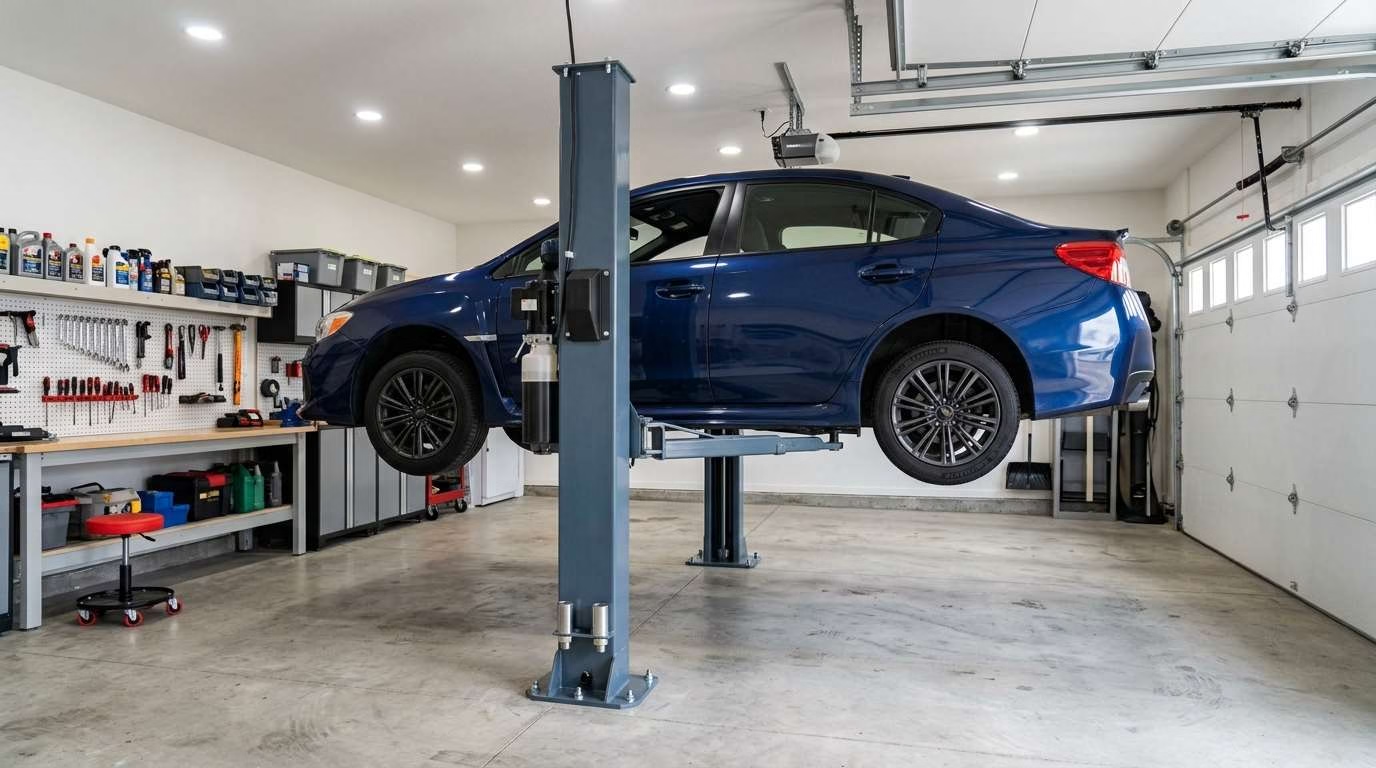
Finding the best 2 post car lift for an 8 foot ceiling is harder than it sounds. Most “low-ceiling” lifts still need at least nine feet of space.
For a true 96-inch ceiling, the MaxJax M7K is the best overall choice. Its 89.5-inch posts fit inside most eight-foot garages. The Triumph C-7000 also fits on paper, but its 95-inch posts leave little room for error.
Your ceiling is not the only limit. You must also plan for the car’s roof, floor condition, door tracks, lights, and lift anchors.
Quick answer: Choose the MaxJax M7K for the safest all-around fit. Consider the Triumph C-7000 if you have a tighter budget and exact measurements.
Our Top Picks at a Glance
This page contains Amazon affiliate links. If you buy through them, I may earn a small commission at no additional cost to you.
The last two lifts need more than eight feet. They are included for garages with a raised bay or planned ceiling work.
Do not rely on the term “low ceiling.” Always check the exact post height before choosing a lift.
Can a 2 Post Car Lift Fit Under an 8 Foot Ceiling?
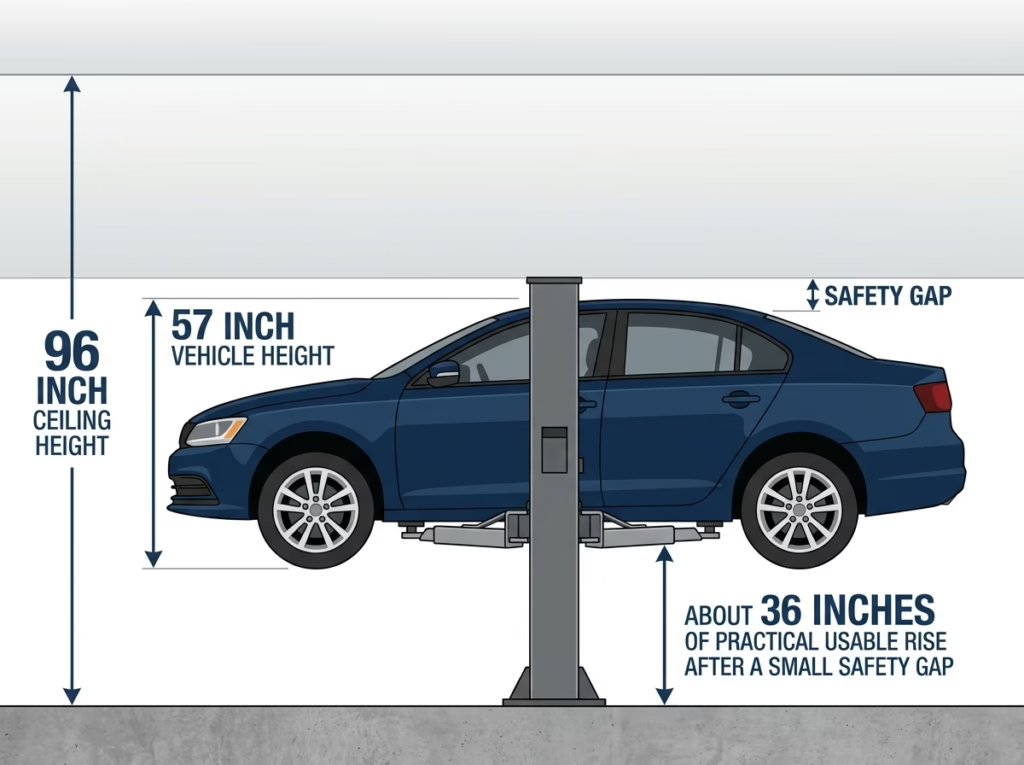
Yes, a two-post lift can fit under an eight-foot ceiling. However, your choices are limited to short portable or mid-rise models.
An eight-foot ceiling gives you exactly 96 inches. Most standard two-post lifts have posts taller than that. Many also have an overhead beam that connects both posts.
A portable lift avoids that top beam. Its shorter posts give you more room above the car.
Still, fitting the posts is only half the issue. The car’s roof rises as the lifting arms rise. A tall vehicle may touch the ceiling long before the lift reaches full height.
Use this simple formula:
Usable vehicle rise = Ceiling height – Vehicle height – Safety clearance
Here is an example:
96-inch ceiling
– 57-inch sedan
– 3-inch safety gap
= About 36 inches of usable rise
The result is an estimate. Lift points sit below the roof, and vehicle shapes vary. Measure the actual car before relying on the numbers.
Garage hardware can reduce your space further. Check for:
- Door tracks
- Ceiling lights
- Door openers
- Storage racks
- Fans
- Pipes
- Air ducts
- Low beams
A wall-mounted door opener may free space above the car. Wall storage can also keep tools away from the lift area. Our guides to wall-mounted heavy-duty shelving and 5-tier heavy-duty shelving units can help you plan the rest of the garage.
1. MaxJax M7K: Best Overall

The MaxJax M7K is the most practical choice for many eight-foot garages. It combines short posts with useful load capacity and open access under the car.
It is not a full-height shop lift. You will work from a stool or creeper. Yet it offers far more room than common jack stands.
Check PriceKey Specifications
- Rated capacity: 7,000 pounds
- Overall post height: 89.5 inches
- Lift height: About 47.5 inches
- Minimum pad height: About 4.75 inches
- Design: Portable two-post lift
- Power supply: Residential electric power
- Mounting style: Threaded concrete floor anchors
- Safety system: Mechanical locks at set heights
The 89.5-inch posts leave about 6.5 inches beneath a flat 96-inch ceiling. That gap helps account for small changes in the floor and ceiling.
The actual space above each post may differ. Many garage floors slope toward the door. Drywall can also sag near seams.
Why It Is Our Top Pick
The MaxJax M7K fits without placing the top of each post against the ceiling. That alone makes it easier to install than a 95-inch model.
Its two-post layout keeps the center of the car open. You can reach the exhaust, driveshaft, oil pan, and much of the transmission area.
The posts attach to fixed floor anchors. You can remove the bolts and roll the posts aside after use. The anchors stay level with the floor.
This setup works well in a shared garage. You can park in the bay once the posts are stored.
The 7,000-pound rating also covers many:
- Sports cars
- Sedans
- Classic cars
- Small crossovers
- Some light trucks
- Some sport utility vehicles
Check the exact weight and balance of your vehicle. A 7,000-pound total rating does not mean every heavy vehicle will fit.
What Owners Like
Owners often value the extra working room most. Even a modest rise can save your back during long repairs.
Common benefits include:
- The open middle allows broad underbody access.
- Raised wheels make brake work much easier.
- A rolling seat works well under many cars.
- Removable posts restore the parking bay.
- Several lock positions help match the ceiling.
- The arms reach many common lifting points.
The lift can also help with jobs that are awkward on ramps. This includes suspension, exhaust, wheel, and brake work.
You still need care during setup. Both posts must be placed and secured as the manual directs.
Potential Drawbacks
The MaxJax M7K is one of the more costly portable lifts. Its price can approach that of some full-height shop lifts.
The posts have wheels, but they are not light. Moving one takes some effort. Rough or cracked floors make that job harder.
Other concerns include:
- You must drill into the concrete.
- Hydraulic hoses can cross the work area.
- Fittings may need checks for small leaks.
- Both locks must engage at the same height.
- Low cars may need ramps for arm clearance.
- You cannot stand upright beneath the car.
- Tall vehicles get less usable rise.
Post storage also needs thought. Keep each post upright and secure. Do not leave it where a child or vehicle could knock it over.
Who Should Buy It?
The MaxJax M7K suits you if you:
- Work on cars often
- Need open underbody access
- Have a true eight-foot ceiling
- Still use the bay for parking
- Work on several vehicle types
- Want more room than jack stands provide
- Can verify and drill the concrete slab
It works best with low cars and average sedans. You can lift taller vehicles, but not as high.
Final Verdict
The MaxJax M7K offers the best mix of fit, access, and flexibility. Its 89.5-inch posts leave a useful margin beneath an eight-foot ceiling.
It costs more than some newer options. Still, its size and layout make it the safer all-around pick.
2. Triumph C-7000: Best Budget Option
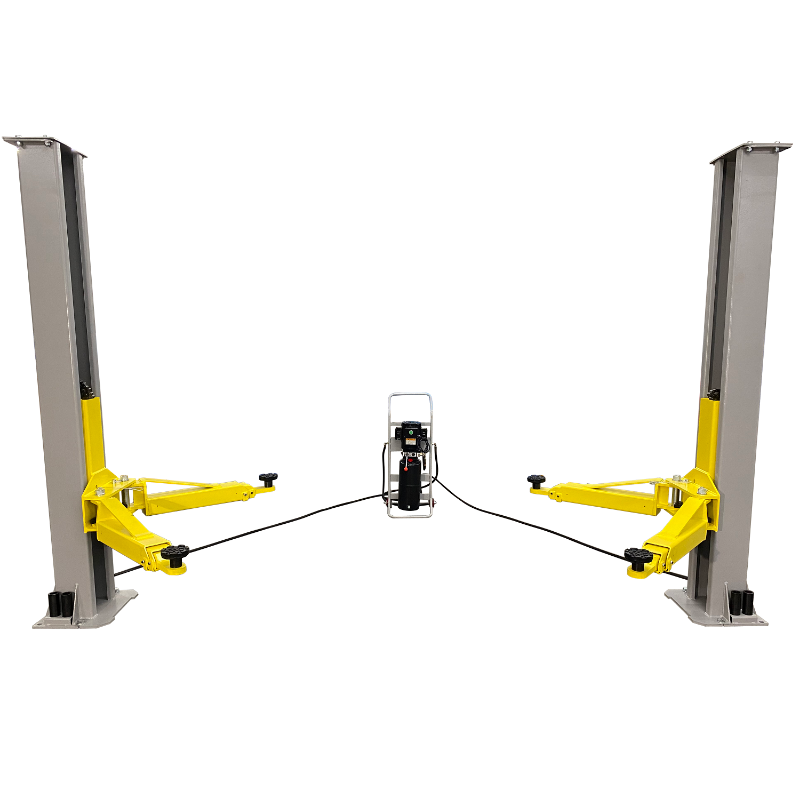
The Triumph C-7000 is a lower-cost portable two-post lift. It has a 7,000-pound rating and runs on standard 110-volt power.
Its posts stand 95 inches tall. This means the lift fits beneath a 96-inch ceiling in theory. In real garages, that one-inch gap needs close attention.
Check PriceKey Specifications
- Rated capacity: 7,000 pounds
- Overall post height: 95 inches
- Listed maximum lift height: Up to 69 inches
- Lowered arm height: About 4.5 inches
- Power supply: 110 volts
- Design: Portable two-post lift
- Post spacing: Adjustable
- Included equipment: Truck pad extensions
Its cable-free layout allows flexible post spacing. That can help if you work on both narrow and wide vehicles.
Keep in mind that a 69-inch lift range is not usable under an eight-foot ceiling with a car. The roof will stop you first.
Why It Stands Out
Price is the main draw. The C-7000 usually costs less than the MaxJax M7K while offering the same listed load rating.
It also gives you control over post width. You can adjust the setup for the vehicle and available garage space.
Other helpful points include:
- Standard household power
- Portable posts
- Open access under the car
- Low arm height
- Included pad extensions
- Flush floor mounting points
The lift may suit low sports cars well. Their short roofs leave more room for useful lift travel.
The One-Inch Clearance Problem
A 95-inch post under a 96-inch ceiling leaves one inch. That is not much room.
Your floor may slope by more than an inch across the lift area. The ceiling may also dip near a drywall seam.
Measure at both planned post locations. Do not measure only in the middle of the bay.
Check these areas before ordering:
- Measure from the concrete to the ceiling.
- Check the front and back of each base plate.
- Place a long level across the lift area.
- Find the lowest ceiling point.
- Check lights, tracks, pipes, and trim.
- Leave room to stand and position each post.
Do not force a post into place. It should not rub against the ceiling.
A small ceiling pocket might solve the issue. Yet you must not cut framing without expert advice.
Potential Drawbacks
The C-7000 has less long-term owner feedback than the MaxJax line. Its parts and service network may also vary by seller.
The one-inch post clearance is its biggest weakness. A listed fit does not ensure a safe real-world fit.
Other drawbacks include:
- Very little room above the posts
- Less proven long-term support
- Limited usable rise under eight feet
- Heavy posts despite the portable label
- Concrete drilling is still required
- Vehicle fit depends on arm reach
- Setup needs careful post alignment
Study the warranty before you choose a seller. Some warranties cover parts but not repair labor.
Who Should Buy It?
The Triumph C-7000 may suit you if you:
- Need to control the total cost
- Mainly work on low cars
- Have a flat slab
- Have a full 96 inches at both posts
- Need adjustable post width
- Accept a newer, less proven design
It is a poor fit if your ceiling measures less than 96 inches anywhere near the posts.
Final Verdict
The Triumph C-7000 has good features for its price. However, its 95-inch posts leave almost no room for uneven surfaces.
Measure with care before placing it on your shortlist. If your garage is not square and level, choose a shorter lift.
3. MaxJax M6K: Best Used Two-Post Lift

The MaxJax M6K is the older 6,000-pound model. It remains a smart used choice for cars and small crossovers.
Its short posts work beneath many eight-foot ceilings. It also shares the removable two-post idea that made the MaxJax line popular.
Check PriceWhy Consider a Used M6K?
A clean M6K can cost less than a new budget lift. It also has a longer track record than some new portable models.
Its 6,000-pound rating covers many:
- Compact cars
- Sports cars
- Sedans
- Classic cars
- Small crossovers
- Lightweight project vehicles
The difference between 6,000 and 7,000 pounds matters with trucks and large SUVs. For a low sports car, it may not matter at all.
A used M6K also gives you open center access. That remains its main benefit over many scissor lifts.
What to Inspect Before Buying
Do not judge a used lift by its paint. Check the parts that hold and control the load.
Inspect the following:
- Columns: Look for bends, dents, or cracks.
- Arms: Check for damage and poor repairs.
- Hydraulic cylinders: Look for oil and worn seals.
- Hoses: Check for splits, bubbles, and hard spots.
- Fittings: Look for leaks or damaged threads.
- Safety locks: Test smooth and even movement.
- Arm restraints: Confirm that they lock as designed.
- Lift pads: Replace torn or badly worn rubber.
- Adapters: Confirm the full set is present.
- Anchor bolts: Reject rusty or damaged hardware.
- Wheels and handles: Check safe post movement.
- Power unit: Listen for odd sounds during a test.
Ask for the manual and purchase details. Confirm that replacement parts remain available.
Floor anchors need special care. Used anchors may not suit your slab. New approved anchors may be the better choice.
M6K vs. M7K
The M7K carries 1,000 more pounds. That makes it a better match for larger vehicles.
The newer model may also offer newer safety and support features. Yet the M6K still meets the needs of many car owners.
Choose the M6K if:
- Your vehicles stay well below 6,000 pounds.
- The used lift is complete and in good shape.
- You can test it before payment.
- The savings leave room for new hoses and anchors.
Choose the M7K if:
- You work on heavier vehicles.
- You want a new warranty.
- You need current parts support.
- You prefer a larger weight margin.
Final Verdict
A clean MaxJax M6K can offer strong value. It often makes more sense than an unknown new lift at the same price.
Do not stretch its load limit. Choose the M7K if trucks or large SUVs are part of your plans.
4. BendPak GrandPrix GP-7LCS: Best Permanent Alternative
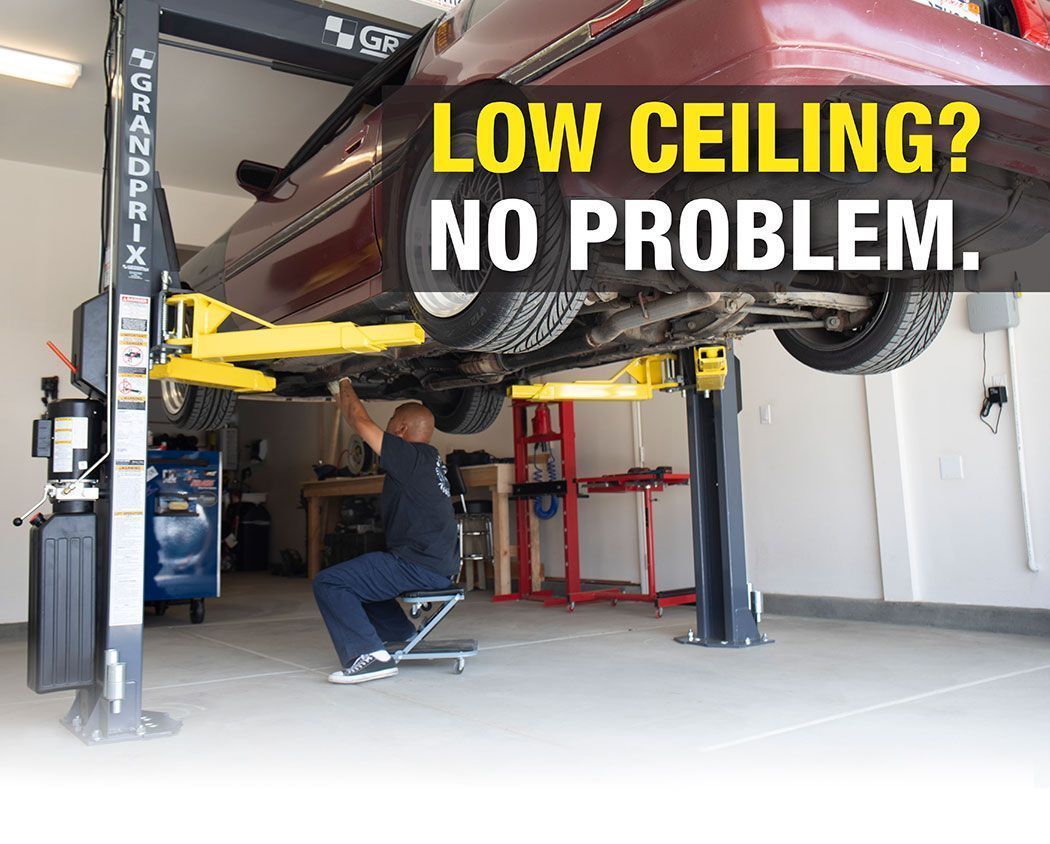
Fit warning: The GP-7LCS is 106.5 inches tall. It will not fit beneath an unchanged eight-foot ceiling.
The GP-7LCS is one of the shorter permanent two-post lifts. It needs about nine feet of ceiling height.
That makes it useful for raised bays and planned garage work. It is not a direct fit for 96-inch ceilings.
Check PriceWhy Include It?
Some garages have eight-foot ceilings with open space above the drywall. Others have storage rooms or roof areas that can be changed.
The GP-7LCS can make sense if you plan that work. It gives you more rise than most portable lifts.
Its permanent setup also means less preparation before each job. The posts stay anchored and ready.
You may prefer it if you:
- Repair cars several times each week
- Have a dedicated work bay
- Want fixed posts
- Can gain at least one foot of height
- Need more lift travel
A permanent lift also avoids the need to move and store heavy posts.
When It Makes Sense
The GP-7LCS works best in a garage with:
- A nine-foot ceiling
- A raised center bay
- An approved ceiling recess
- Open roof framing above the lift
- A planned garage addition
Any ceiling work must account for framing and building rules. Roof and floor supports should not be cut without a qualified plan.
A recess for the posts may be possible in some garages. However, the car’s roof still needs space as it rises.
Potential Drawbacks
The most obvious problem is height. Its 106.5-inch posts exceed your ceiling by 10.5 inches.
Other concerns include:
- Permanent loss of side space
- More complex installation
- Possible electrical work
- Greater freight and setup needs
- Ceiling work may cost more than the lift
- Poor anchor work can create a serious risk
The installer must level the posts without weakening the anchors. Thick stacks of small shims are not a sound fix for a poor slab.
Final Verdict
The GP-7LCS is a good permanent option for a modified garage. It is not suitable for an unchanged eight-foot room.
Consider it only if added ceiling height is already part of your garage plans.
5. Atlas BP8000: Best Higher-Capacity Alternative

Fit warning: The Atlas BP8000 is 108 inches tall. It needs more than nine feet of ceiling space.
The BP8000 supports up to 8,000 pounds. It can handle a wider range of cars, trucks, and SUVs than many portable lifts.
It has an open top with a floor plate between the posts. The plate covers the cables and hydraulic lines.
Check PriceKey Benefits
The added capacity gives you more room for future vehicles. It also reduces the chance of buying too close to your car’s weight.
Useful features include:
- 8,000-pound capacity
- Asymmetric lifting arms
- Open-top layout
- Single-point lock release
- Truck pad adapters
- Greater maximum rise
- Permanent post placement
Asymmetric arms place more of the vehicle behind the posts. This layout can improve door access with some cars.
Why It May Be Worth a Garage Upgrade
The Atlas can offer more value if you already plan to raise the ceiling. It provides more lift travel than short portable models.
It also suits heavier vehicles. That may matter if you own a pickup or plan to buy one later.
A workshop upgrade may include:
- Raised ceiling sections
- New lights
- Wall-mounted door controls
- Better tool storage
- Added power outlets
- Improved heat
If cold weather limits garage work, see our guide to the best garage heaters for an uninsulated garage. Keep all heat sources clear of fuel and vapors.
Potential Drawbacks
The BP8000 does not fit an eight-foot ceiling. Raising the roof or ceiling can turn it into a large project.
It also needs a 220-volt supply. You may need an electrician to add a safe circuit.
Other drawbacks include:
- A permanent footprint
- A floor plate between the posts
- Less clear space for rolling tools
- Higher setup costs
- Freight unloading needs
- More room required around each post
The floor plate can catch wheels from stools, jacks, and tool carts. Keep the crossing area clear.
Final Verdict
The Atlas BP8000 is useful if you need more capacity and can raise the ceiling. It offers more working height than a short portable lift.
It is not a true choice for an unchanged eight-foot garage.
How to Choose a 2 Post Lift for an 8 Foot Ceiling
The best lift must fit your garage, car, and concrete. A good price cannot make up for a poor fit.
Work through each point before you compare final costs.
1. Measure the Entire Garage
Measure the bay in several places. Old garages are rarely square or level.
Record:
- Height at each post
- Height above the car
- Floor slope
- Width between walls
- Distance to the garage door
- Distance behind the car
- Door-track height
- Lowest light or pipe
- Space for the power unit
- Space for post storage
Take each height from the concrete surface. Do not measure from mats, tile, or raised flooring.
Mark the planned post bases with tape. Then repeat your measurements at all four corners.
2. Compare Column Height, Not Just Lift Height
Sellers often focus on how high a lift can raise a car. That number does not tell you if the posts fit.
Compare these terms:
- Overall height: Total height of each post
- Lift height: Maximum upward arm travel
- Pad height: Lowest point under the car
- Body rise: How far the car itself moves
- Underbody space: Room available for you
Overall height decides whether you can install the lift. Vehicle height decides how far you can use it.
3. Calculate the Vehicle’s Raised Roof Height
Measure your car from the floor to its highest point. Include roof racks, antennas, and open hoods if they may rise.
Subtract that figure from 96 inches. Then remove at least a small safety gap.
For example:
- A 48-inch sports car leaves about 48 inches.
- A 57-inch sedan leaves about 39 inches.
- A 65-inch crossover leaves about 31 inches.
- A 72-inch SUV leaves about 24 inches.
These are rough figures before a safety gap. The actual lift points may change the result.
4. Check the Concrete Slab
A two-post lift places high force at small anchor points. The slab must meet the lift maker’s rules.
Check:
- Concrete thickness
- Concrete strength
- Slab age
- Visible cracks
- Control joints
- Patched areas
- Distance from edges
- Embedded pipes
- Post-tension cables
Post-tension cables are steel cables inside some slabs. Drilling into one can cause severe harm and major damage.
If you do not know the slab design, arrange a proper check. Do not guess from the garage’s age.
5. Choose the Right Capacity
Do not choose a 7,000-pound lift for a vehicle that weighs nearly 7,000 pounds. Leave a useful margin.
The total rating is not the full story. Each end of the lift may have its own load limit.
Check:
- Total vehicle weight
- Front axle weight
- Rear axle weight
- Engine location
- Added cargo
- Tools stored in the car
- Future vehicle plans
Electric vehicles can be much heavier than similar gas models. Confirm the exact curb weight before lifting one.
6. Check the Arm Reach
The arms must reach the approved lift points. Load capacity does not ensure good arm fit.
Short cars, wide trucks, and long-wheelbase models may need different arm designs.
Check:
- Shortest arm reach
- Longest arm reach
- Pad height
- Door opening room
- Rocker panel clearance
- Approved lifting-point locations
Some low cars need small ramps. The ramps raise the tires so the arms can swing underneath.
7. Decide Between Portable and Permanent
Your work habits should guide this choice.
Portable Lift Advantages
- Restores the parking bay
- Fits beneath lower ceilings
- Works well in shared garages
- May use household power
- Allows flexible post storage
Portable Lift Disadvantages
- Posts are heavy
- Setup takes time
- Hoses may cross the floor
- Floor anchors are still needed
- Lift height is limited
Permanent Lift Advantages
- Always ready for use
- Often provides more rise
- Works well for frequent repairs
- Usually offers more capacity
- No need to store posts
Permanent Lift Disadvantages
- Most models exceed eight feet
- Posts reduce side space
- Installation costs more
- Electrical work may be needed
- The bay cannot return to open use
For most true eight-foot garages, a portable model is the practical choice.
How Much Can You Raise a Car Under an 8 Foot Ceiling?
Your car’s height sets the working limit. Low cars gain far more space than tall trucks.
| Vehicle Type | Approximate Vehicle Height | Theoretical Space Under a 96-Inch Ceiling |
|---|---|---|
| Low sports car | 48 in. | 48 in. |
| Average sedan | 57 in. | 39 in. |
| Compact crossover | 65 in. | 31 in. |
| Full-size SUV | 72 in. | 24 in. |
These figures do not include a safety gap. They also do not account for roof racks or ceiling hardware.
Here is what common lift heights may offer:
- 18 to 24 inches: Better access than basic jack stands
- 30 to 36 inches: Useful space for creeper work
- 36 to 48 inches: Seated work may be possible
- More than 60 inches: Rarely possible under an eight-foot ceiling
Mark a safe stop point for each vehicle. Do not rely on memory during every lift.
You can also place a soft hanging marker near the roof limit. It can give you an early visual warning. It must never replace direct supervision.
Portable 2 Post Lift vs. Scissor Lift for a Low Ceiling
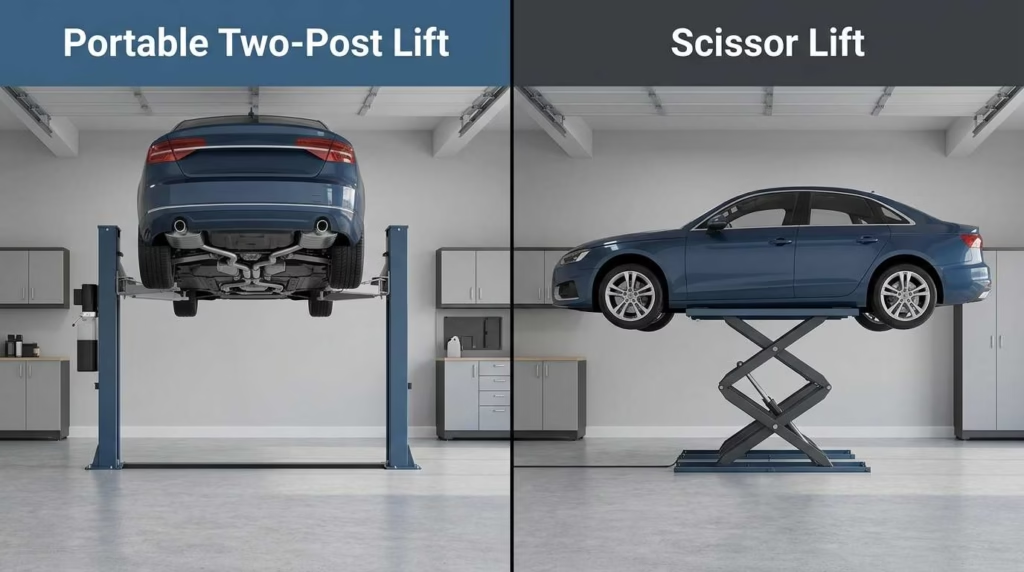
Both designs can work in a short garage. The right choice depends on the jobs you plan to do.
Compare the Two Designs
Two-Post Lift
A two-post lift supports the car at its frame lift points. The wheels hang free.
Main benefits include:
- Clear access to the center
- Easy wheel and brake service
- Better exhaust access
- Better transmission access
- Open space below the engine
Common drawbacks include:
- Concrete anchors
- Side posts
- Longer setup time
- Lift-point placement
- Hoses near the work area
Scissor Lift
A scissor lift raises the car from platforms near its center. It often needs less side space.
Main benefits include:
- Compact design
- Simple storage
- Stable platform
- No tall side posts
- Good access to wheels
Common drawbacks include:
- Center structure blocks access
- Transmission work becomes harder
- Exhaust access may be limited
- Some cars need special blocks
- Drive-over height may be an issue
Recommendation
Choose a portable two-post lift if you need open access along the car’s center. It is the better layout for exhaust and transmission work.
Choose a scissor lift for brakes, tires, detailing, and basic care. It may also suit garages with narrow side space.
Common Mistakes to Avoid
A poor lift choice can waste money or create a safety risk. Avoid these common errors:
- Buying a nine-foot lift for an eight-foot garage
- Trusting a “low-ceiling” label
- Measuring only one point
- Forgetting the vehicle roof
- Ignoring floor slope
- Overlooking door tracks
- Drilling near post-tension cables
- Installing through damaged concrete
- Using random anchor hardware
- Choosing capacity too close to vehicle weight
- Ignoring front and rear load limits
- Placing posts too close to walls
- Lifting from the wrong points
- Working while the lift rests on hydraulic pressure
- Letting the roof approach an opener or light
- Moving posts without safe handling
Do not rush the low-height balance test. Raise the car a few inches first. Check all four pads and vehicle balance before going higher.
Installation and Safety Checklist
Use this list before the first full lift:
- Confirm the exact post height.
- Measure at both post locations.
- Check floor slope.
- Measure each vehicle.
- Remove low ceiling hazards.
- Check garage-door movement.
- Verify the slab thickness.
- Confirm concrete strength.
- Locate cables and hidden utilities.
- Use the approved anchor pattern.
- Confirm each arm reaches its lift point.
- Test the lift without a vehicle.
- Perform a low-height balance test.
- Check both mechanical locks.
- Lower the lift onto its locks.
- Recheck anchor torque as directed.
- Inspect hoses and fittings.
- Check lift pads for wear.
- Keep the floor free from oil.
- Stay within all load limits.
Read the full manual before installation. If the instructions conflict with general advice, follow the lift maker’s requirements.
Frequently Asked Questions
Can You Put a 2 Post Lift in an 8 Foot Garage?
Yes. You need a portable or mid-rise model with posts below 96 inches.
The MaxJax M7K fits with room to spare. The Triumph C-7000 fits on paper, but leaves about one inch.
What Is the Shortest 2 Post Car Lift?
Portable mid-rise lifts are among the shortest two-post options. MaxJax models are designed for residential garages with low ceilings.
Always check the current model’s full dimensions. Product sizes can change.
Will a MaxJax Fit Under an 8 Foot Ceiling?
The MaxJax M7K has 89.5-inch posts. That leaves about 6.5 inches beneath a flat 96-inch ceiling.
Your actual gap may be smaller due to floor slope or ceiling variation.
Can I Stand Under a Car With an 8 Foot Ceiling?
Usually not. Most people use a rolling seat, mechanic’s stool, or creeper.
A very low sports car may provide more room. Even then, the ceiling remains the main limit.
How High Can I Lift a Sedan in an 8 Foot Garage?
A 57-inch sedan has about 39 inches of theoretical space. A safety gap will reduce that figure.
The car’s shape and lift points also affect the final height.
Can I Lift an SUV Under an 8 Foot Ceiling?
Yes, but the rise will be limited. A 72-inch SUV leaves about 24 inches before a safety gap.
Even that small rise can make oil and brake work easier.
Does a Portable 2 Post Lift Still Need Anchors?
Yes. Portable means you can remove and store the posts. It does not mean the lift works without secure anchors.
The posts must remain fixed while they carry a vehicle.
How Thick Should Concrete Be for a 2 Post Lift?
The required thickness depends on the lift. Concrete strength and slab condition matter too.
Use the model’s current installation manual. Have the slab checked if its details are unknown.
Can a 2 Post Lift Be Installed on Cracked Concrete?
Do not install one on cracked concrete without a proper review. Cracks may weaken the area around the anchors.
Joints, slab edges, and old repairs can also affect safe placement.
Is a 2 Post Lift Safe for a Home Garage?
Yes, if the slab, lift, anchors, and vehicle all meet the stated limits. Correct lift-point placement is also key.
Use the mechanical locks. Never work under a car held only by hydraulic pressure.
Is a MaxJax Better Than a QuickJack?
The MaxJax offers clearer access through the center. That makes it better for exhaust, driveshaft, and transmission work.
A QuickJack is easier to store and does not use tall posts. However, its frames can block parts of the underbody.
Is a 2 Post Lift Better Than Jack Stands?
A lift gives you more working space and easier wheel access. It can also save time during frequent repairs.
Jack stands cost less and need no fixed anchors. They remain useful for light or rare work.
Which 2 Post Car Lift Should You Buy?
The best 2 post car lift for an 8 foot ceiling is the MaxJax M7K for most users. Its posts fit with a reasonable gap, and its open center supports many types of repair.
The Triumph C-7000 is the budget alternative. Yet its 95-inch posts leave little room beneath a true 96-inch ceiling.
A used MaxJax M6K can be a smart deal for lighter cars. Inspect every load-bearing part before using it.
The BendPak GP-7LCS and Atlas BP8000 are not direct fits. They make sense only if you can add more ceiling height.
Your final choice should start with four checks:
- Measure both post locations.
- Calculate the raised roof height.
- Verify the concrete slab.
- Confirm arm reach and load limits.
Do not choose a lift based on maximum rise alone. Under an eight-foot ceiling, safe fit matters far more than a large height claim.