
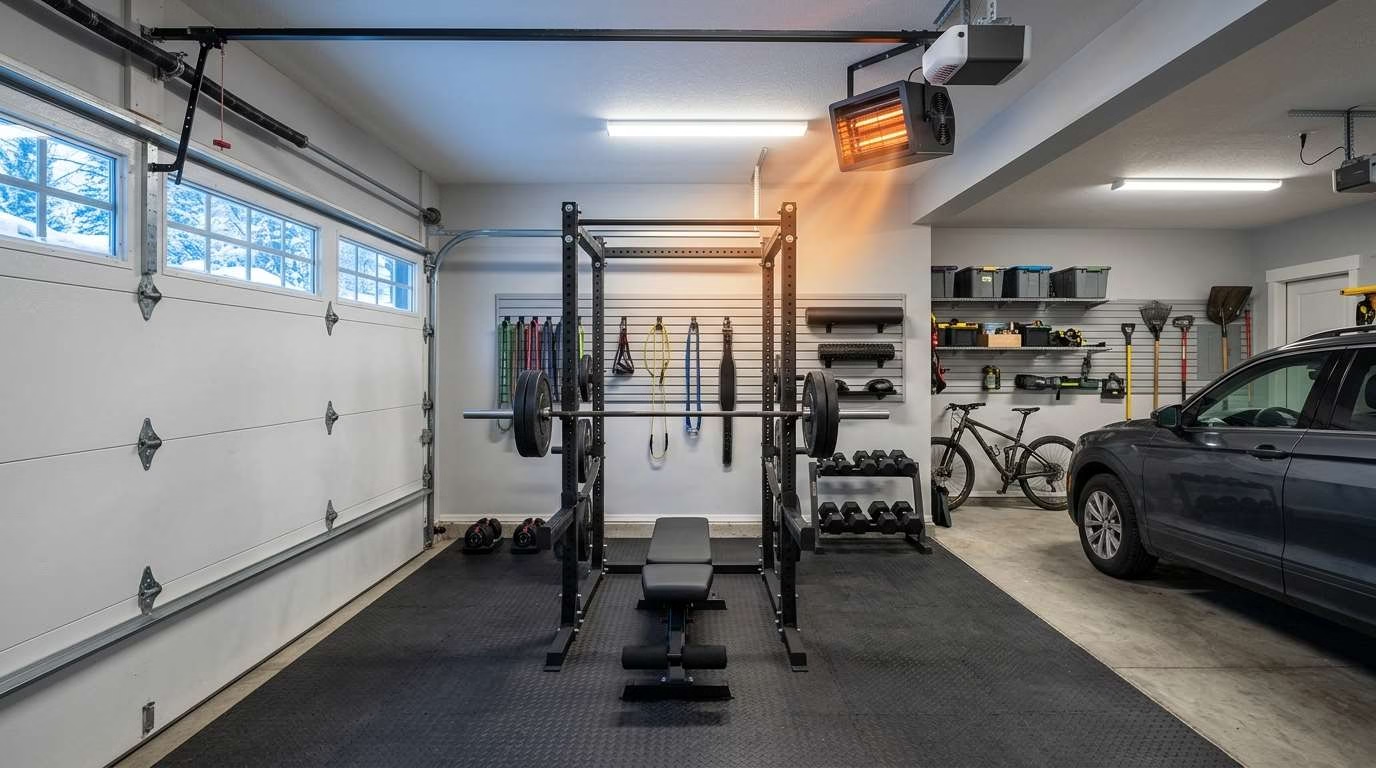
A cold garage can drain your will to train. It can also leave your bar, bench, and weights painfully cold.
The best garage heater for home gym use is the Dyna-Glo EG7500DH. It offers enough power to heat many one-car and two-car gyms. Its ceiling mount also keeps it clear of your workout area.

However, it will not suit every setup. You may only need direct heat around your rack. You may also lack the wiring needed for a large electric heater.
This guide compares eight options for different spaces, climates, and budgets. You will also learn how to choose the right heater size.
Quick answer: Choose the Dyna-Glo EG7500DH for strong whole-room heat. Pick the Dr Infrared Heater DR-968 if you need a portable model. Choose the Presto HeatDish if you only want to warm yourself and your bar.
Best Garage Heaters for Home Gyms at a Glance
Treat coverage claims as rough guides. Insulation, ceiling height, drafts, and outdoor cold all affect results.
A 1,500W plug-in heater cannot match a hardwired 7,500W unit. It also cannot match a large gas heater. Pick based on your real heating goal, not the box claim.
The 8 Best Garage Heaters for a Home Gym
Each heater below solves a different problem. Some warm the whole room. Others focus heat on you and your gear.
1. Dyna-Glo EG7500DH: Best Overall Garage Heater for a Home Gym
The Dyna-Glo EG7500DH is a ceiling-mounted electric garage heater. It has 5,000W and 7,500W heat modes.
That power makes it a good match for many insulated garages. It works best when you need broad, steady heat.
The ceiling mount is also useful in a home gym. It keeps the unit away from plates, loose bands, and busy feet. You can aim the airflow toward your main workout zone.
Its controls include:
- A digital thermostat
- Multiple heat settings
- An eight-hour timer
- A remote control
- Adjustable airflow
- Fan-only operation
- Overheat protection
The remote matters more than it may seem. A ceiling heater often sits beyond easy reach. You can adjust this one without using a ladder.
It can also run as a fan during warmer months. It will not replace a strong cooling fan. Still, the feature adds some year-round use.
The main issue is power. This unit requires a 240V hardwired connection. It cannot plug into a normal wall outlet.
You may need a new circuit and breaker. That work adds cost, but it gives you far more heat.
Pros
- Strong whole-room heat
- Two power modes
- Ceiling mount saves floor space
- Remote and digital controls
- Adjustable airflow
- No fuel tanks or indoor exhaust
Cons
- Requires 240V power
- Hardwired installation
- Fan may be easy to hear
- Too powerful for some small gyms
Best for
This heater suits homeowners with an insulated one-car or two-car garage. It also works well for regular winter training.
Avoid if
Skip it if you rent or only have standard outlets. It may also be excessive for a mild climate.
Verdict
The Dyna-Glo offers the best mix of power and gym-friendly placement. It can heat more than the space beside your rack.
That makes it a strong long-term choice. Just plan for the wiring before you set your budget.
2. Comfort Zone CZ798: Best Budget Garage Gym Heater

The Comfort Zone CZ798 is a basic utility heater. It uses a normal 120V wall outlet.
You get two heat levels: 1,300W and 1,500W. It also has a fan setting and an adjustable thermostat.
Its metal case feels better suited to garage life than a thin plastic shell. A top handle makes it easy to move after it cools.
Basic safety features include:
- Tip-over shutoff
- Overheat protection
- A power light
- A stable metal frame
The CZ798 works best near your training area. Place it where warm air can reach you without crossing a walkway.
Do not expect it to heat a large, drafty garage. Its output is too low for that job. It is better for taking the edge off a small space.
You may get good results in a sealed one-car garage. You may also find it useful during mild winter weather.
Pros
- Low upfront cost
- No fixed installation
- Easy to carry and store
- Simple controls
- Two heat levels
- Built-in safety shutoffs
Cons
- Limited heat output
- Basic thermostat
- Uses floor space
- Weak in large, drafty garages
Best for
Choose it for a small, insulated gym or a mild winter. It also suits a tight budget.
Avoid if
Do not rely on it for a full two-car garage. It will also struggle with severe cold.
Verdict
The Comfort Zone CZ798 is a simple way to warm a small workout zone. It does not pretend to be a large heating system.
That honest role makes it useful. Keep your expectations tied to its 1,500W limit.
3. Dr Infrared Heater DR-968: Best Portable Electric Heater

The Dr Infrared Heater DR-968 combines two forms of heat. It uses infrared warmth and a fan to spread warm air.
Its maximum output is 1,500W. That is close to the limit for a normal household outlet.
The DR-968 adds more comfort features than a basic garage heater. These include:
- A digital thermostat
- High and low heat settings
- A remote control
- A timer
- Caster wheels
- Tip-over protection
- Overheat protection
- A washable filter
The wheels make it easy to reposition. You can move it near your rack, bike, or stretching mat.
Its fan is also fairly quiet. You should still hear your music, timer, or workout video.
This heater works best in an insulated garage. It can warm a compact space, but air leaks reduce its effect.
It is heavier than many small ceramic heaters. The cabinet shape also needs clear floor space.
Pros
- Easy to move
- Uses a standard outlet
- Remote and timer included
- Quiet fan
- Clear digital controls
- No gas or fuel storage
Cons
- Limited to 1,500W
- Bulky for a portable heater
- Poor fit for large garages
- Needs open floor space
Best for
It suits renters and small garage gyms. It also works for homeowners who cannot add a 240V circuit.
Avoid if
Choose something stronger for a large detached garage. The same applies to very cold, uninsulated spaces.
Verdict
The DR-968 is a polished plug-in heating option. Its controls make daily use simple.
It cannot defeat major drafts. Yet it works well in a small, sealed training space.
4. Presto HeatDish Plus Tilt: Best Heater for Warming the Workout Zone
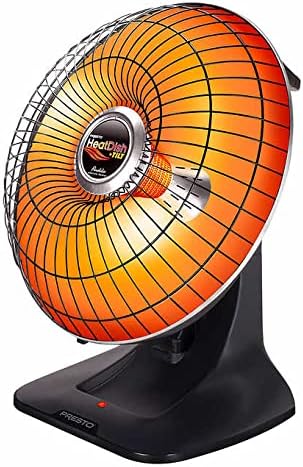
The Presto HeatDish takes a different path. It does not try to heat every cubic foot of air.
Instead, it aims radiant heat toward you. Radiant heat warms objects and people in its path.
That makes sense in a garage gym. You can point it toward your bench, bar, or lifting platform.
The 1,000W unit uses less power than most 1,500W space heaters. You can feel its warmth soon after turning it on.
Its main features include:
- A tilting heat dish
- Adjustable heat control
- Tip-over shutoff
- A warning buzzer
- A carry handle
- Built-in cord storage
The tilt helps you aim warmth at the right height. You can direct it toward your hands and bar before training.
Placement needs some thought. A bench or rack post can block radiant heat. Test a few safe positions before your workout.
Keep it clear of bands, mats, towels, and foam pads. These items can move during exercise.
Pros
- Fast, direct warmth
- Lower power use
- Easy to move
- Good for cold hands and bars
- Adjustable tilt
- Does not need to heat all the air
Cons
- Narrow heating zone
- Poor whole-room performance
- Objects can block the heat
- Needs careful floor placement
Best for
This heater is ideal for short lifting sessions. It also suits a drafty garage where room heat escapes fast.
Avoid if
Skip it if you want one steady temperature across the garage.
Verdict
The Presto HeatDish solves the problem many lifters feel most. It warms you and the steel you touch.
That can be smarter than heating an entire garage. You get fast comfort without a large fixed system.
5. De’Longhi TRLS0715EL: Best Quiet Garage Gym Heater

The De’Longhi TRLS0715EL is an oil-filled radiator. Electric power heats sealed oil inside the unit.
The oil then warms the metal body. That heat spreads into the room without a fan.
Its features include:
- Three heat settings
- A digital thermostat
- A 24-hour timer
- Anti-freeze mode
- Child lock
- Thermal shutoff
- Caster wheels
The lack of a fan makes it almost silent. It also avoids blowing dust across your mats and gear.
That makes it useful for yoga or mobility work. It also suits long, quiet training sessions.
However, it heats slowly. It may take a while to warm a cold garage.
The timer can help. You can set a schedule if the manual allows your planned use. Always follow the stated safety rules.
Pros
- Very quiet
- Steady, gentle warmth
- Does not stir up dust
- Useful timer
- Portable design
- Low-maintenance sealed oil
Cons
- Slow initial heat
- Weak for short workouts
- Limited to 1,500W
- Stays hot after use
Best for
It works well for yoga, stretching, and long indoor bike sessions. It also suits a sealed gym that holds heat.
Avoid if
Do not choose it for instant warmth. A fan or radiant heater responds much faster.
Verdict
The De’Longhi is best at keeping a room comfortable. It is less useful for warming a frozen garage in minutes.
Give it time, and it offers calm, steady heat. That makes it a good match for slower training styles.
6. MRCOOL DIY Mini-Split: Best Premium Garage-Gym Heating System
A mini-split is more than a heater. It can warm, cool, and dry the air.
The MRCOOL DIY line comes in several output sizes. The right size depends on your garage and local weather.
A typical setup has two parts:
- An indoor wall unit
- An outdoor condenser
The indoor unit spreads conditioned air. The outdoor part moves heat into or out of the garage.
This process often uses less power than electric resistance heat. Resistance heat turns electricity straight into warmth.
The mini-split also keeps your floor clear. That is useful in a gym with racks, benches, and storage.
You may also gain:
- Remote control
- Phone control
- Timer settings
- Cooling for summer
- Moisture control
- Adjustable fan speed
A mini-split makes the most sense for frequent use. The cost becomes harder to defend for one short workout each week.
Cold weather also matters. Not every heat pump keeps full output in deep cold. Choose a model rated for your local winter.
Correct size matters too. A unit that is too small may run without catching up. A unit that is too large may cycle too often.
Pros
- Heats and cools
- Helps control moisture
- Efficient for regular use
- Saves floor space
- Offers precise controls
- Makes the gym useful all year
Cons
- High upfront cost
- Needs electrical work
- Requires indoor and outdoor space
- Correct sizing can be hard
- Cold-weather performance varies
Best for
A mini-split suits a finished gym used several times per week. It is also ideal if summer heat causes problems.
Avoid if
Skip it for rare winter use. It may also be unsuitable for a rental.
Verdict
A mini-split is the bold long-term choice. It treats the garage like a real room, not a cold storage area.
You pay more at first. In return, you gain winter heat, summer cooling, and better moisture control.
7. Mr. Heater Big Maxx MHU50: Best Natural-Gas Garage Heater
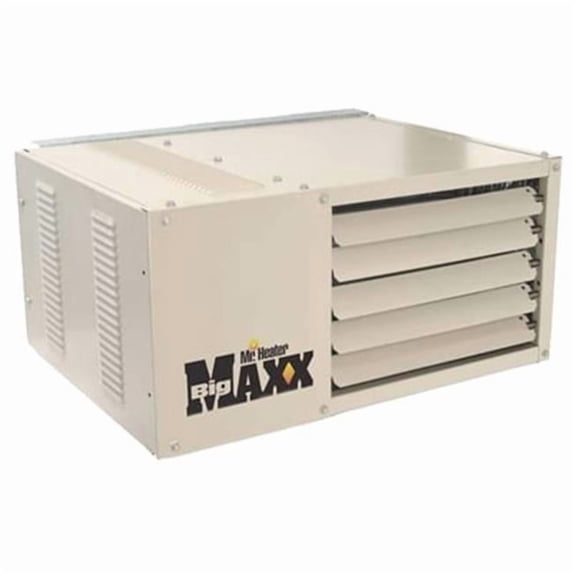
The Mr. Heater Big Maxx MHU50 is a fixed gas heater. It delivers up to 50,000 BTU.
BTU measures heat output. A higher number means more heating power.
The unit hangs from the ceiling. A built-in fan pushes warm air through the garage.
It can connect to a standard wall thermostat. That gives it a more familiar home-heating feel.
The Big Maxx requires:
- A suitable gas supply
- Electrical power for its controls and fan
- Correct exhaust venting
- Safe ceiling support
- Proper clearances
- Code-compliant installation
Its high output suits large garages and cold regions. It can also raise room temperature much faster than a small plug-in heater.
However, bigger is not always better. A 50,000-BTU heater may be too large for a small, sealed gym.
An oversized unit may heat the room too fast. It can then shut off before temperatures feel even.
Pros
- High heat output
- Fast whole-room heating
- Ceiling mount saves space
- Works with a thermostat
- Strong fit for cold climates
- No portable fuel tanks
Cons
- Requires a gas supply
- Needs correct venting
- Installation can cost more
- May be too large for small garages
- Uses a fan
Best for
This unit suits a large garage in a cold area. It makes more sense if your home already has natural gas.
Avoid if
Skip it for a compact gym or mild climate. It is also a poor fit for renters.
Verdict
The Big Maxx is a serious answer to severe cold. It can turn a large garage into a usable winter gym.
You need correct sizing and installation. This is not a portable heater you simply unpack and use.
8. Mr. Heater Big Buddy MH18B: Best Portable Propane Heater

The Mr. Heater Big Buddy MH18B is a portable propane heater. It has 4,000, 9,000, and 18,000-BTU settings.
That gives it far more heat than a standard plug-in unit. It can warm a small garage faster.
The heater includes:
- Three heat settings
- Low-oxygen shutoff
- Tip-over shutoff
- Two cylinder connections
- A carry handle
- Radiant heating panels
The Big Buddy can use small propane cylinders. It can also connect to a larger tank with the correct parts.
Propane adds extra concerns. Burning fuel can add moisture to the air. It also requires safe airflow.
Follow every ventilation and clearance rule in the manual. Use a working carbon monoxide alarm as added protection.
Never treat safety switches as a reason to ignore ventilation. They act as backups, not replacements for safe use.
Pros
- Strong portable output
- Fast radiant heat
- No 240V circuit needed
- Three heat settings
- Useful during some power outages
- Easy to move when cool
Cons
- Requires propane
- Adds moisture
- Needs safe ventilation
- Creates ongoing fuel costs
- Not for unattended use
Best for
The Big Buddy suits occasional use and backup heat. It also helps where electrical power is limited.
Avoid if
Choose another type for daily set-and-forget heating. Avoid it if you do not want fuel indoors.
Verdict
The Big Buddy offers strong portable heat. Yet its fuel rules add work and risk.
It can be useful with careful operation. An electric model is often simpler for daily gym use.
How We Chose the Best Garage Gym Heaters
A good garage gym heater needs more than a high output figure. It must fit the room, power supply, and workout style.
Heating Performance
We looked at heat output, speed, and spread. These factors decide how each heater feels during real use.
A radiant heater may feel warm at once. Yet it may not raise the room temperature much.
A forced-air heater works in another way. It warms air, then moves that air across the room.
Garage Size
Floor area gives you a useful starting point. However, room volume gives you a fuller picture.
A garage with a high ceiling holds more air. It may need more heat than a low room with the same floor area.
The number of garage doors also matters. Large doors often allow more air leaks.
Power and Fuel Requirements
Each energy source brings trade-offs.
- 120V electric: Simple, but limited in output
- 240V electric: Stronger, but needs special wiring
- Propane: Portable and powerful, but needs fuel and airflow
- Natural gas: Strong fixed heat, but needs gas and venting
- Heat pump: Efficient and flexible, but costs more upfront
The best option is one your garage can support safely.
Home-Gym Practicality
A heater can have great specs and still annoy you. Floor space, noise, and placement matter.
A ceiling unit stays away from moving bars and plates. A portable unit gives you more control over the heat zone.
Remote controls also help. They let you adjust a mounted heater between sets.
Safety
We gave more weight to models with clear safety features. These may include tip-over and overheat shutoffs.
Still, no device is risk-free. Placement and correct power use matter just as much.
Keep heaters clear of:
- Resistance bands
- Foam pads
- Towels
- Cardboard boxes
- Cleaning fluids
- Loose mats
- Wood dust
What Type of Heater Is Best for a Garage Gym?
The right heater type depends on what you want to warm. Start with that choice before comparing brands.
120V Electric Heaters
These heaters plug into a normal wall outlet. Most top out near 1,500W.
They work best for:
- Small insulated garages
- Mild cold
- Direct workout-zone heat
- Renters
- Short-term use
They are easy to set up. Yet they often disappoint users who expect full garage heat.
240V Electric Garage Heaters
A 240V heater can deliver far more heat. Many models mount on the wall or ceiling.
They suit:
- Insulated one-car garages
- Two-car garage gyms
- Frequent winter use
- Whole-room heating
- Permanent home setups
You need the correct circuit and breaker. An electrician can check whether your panel has enough capacity.
Infrared and Radiant Heaters
Radiant heaters warm people and objects in their path. They do not need to heat all the air first.
This makes them useful in drafty gyms. You can aim one toward your rack and bar.
Their weak point is reach. Step outside the heat path, and the warmth fades.
Oil-Filled Radiators
Oil-filled heaters offer quiet, steady warmth. They work best after a long warm-up.
They suit long sessions and gentle exercise. They also work well in rooms that hold heat.
Do not expect fast results in a frozen garage. A fan heater reacts much faster.
Propane Heaters
Propane heaters provide strong heat without a large electrical circuit. They can warm a garage fast.
However, they burn fuel inside your training space. That adds safety, airflow, and moisture concerns.
Use only a suitable model. Follow its manual without shortcuts.
Natural-Gas Heaters
A fixed natural-gas heater can heat a large garage with ease. It is a good fit for daily winter use.
Installation is more involved. You need a gas line, power, and correct venting.
The unit must also match the room. More output is not always more comfortable.
Mini-Split Heat Pumps
A mini-split offers heat, cooling, and moisture control. It is often the best long-term system for a finished gym.
It can cost more upfront. Yet it provides use in every season.
Choose a cold-weather model if winters are harsh. Get the correct size for your garage.
How to Choose the Right Heater for Your Garage Gym
A product list can only take you so far. Your garage should decide the final choice.
Measure the Garage
Measure the length and width first. Multiply them to find the floor area.
Then note:
- Ceiling height
- Garage-door size
- Number of windows
- Number of outside walls
- Attached or detached design
- Open stairs or storage lofts
A detached garage often loses heat faster. A tall ceiling also raises heating demand.
Check the Insulation
Look above, around, and under the garage door. Small gaps can leak a surprising amount of warm air.
Inspect:
- Wall insulation
- Ceiling insulation
- Garage-door panels
- Bottom door seal
- Side weather seals
- Window frames
- Service doors
If your space has no insulation, read this guide to the best garage heaters for an uninsulated garage.
Useful rule: Seal the room before adding more heat. A smaller heater can work better after you stop major drafts.
Decide What Needs to Be Warm
You have three basic goals.
- Warm yourself and the bar.
Choose a radiant or parabolic heater. - Warm one workout zone.
Choose a portable 120V heater. - Warm the whole garage.
Choose 240V electric, vented gas, or a mini-split.
Do not pay to heat unused storage space. A small warm zone may be all you need.
Inspect the Electrical Supply
Check the voltage and circuit before choosing an electric heater.
A 1,500W model draws a heavy load from a normal circuit. Other tools or devices may share that circuit.
Avoid extension cords and power strips. Plug portable heaters into a suitable wall outlet.
A larger electric heater needs 240V power. Have an electrician check the panel and wiring.
Consider Warm-Up Time
Your schedule changes what works.
A radiant model feels warm fast. A fan heater raises air temperature faster than an oil radiator.
A mini-split works well when it maintains a lower base temperature. A gas unit can recover heat fast after a door opens.
Short workouts favor quick direct heat. Long sessions give slower heaters more time.
Account for Noise
Noise can affect music, calls, and workout videos.
Oil-filled radiators have no fan. Radiant dishes are also fairly quiet.
Forced-air models create more sound. Large portable fuel heaters can be much louder.
Think Beyond Winter
Your garage may also become hot and humid. That can make summer training just as hard.
Moisture may also harm steel gear. Good airflow and humidity control can help limit rust.
A mini-split addresses all three needs:
- Winter heat
- Summer cooling
- Moisture control
Organized storage also keeps gear away from heaters. See these ideas for heavy-duty garage storage cabinets and heavy-duty garage storage shelves.
What Size Heater Does a Garage Gym Need?
There is no perfect size based on floor area alone. Climate and insulation can change the answer.
Use this table as a starting point.
| Garage situation | Practical starting point |
|---|---|
| Small insulated workout corner | 1,000W to 1,500W targeted heater |
| Insulated one-car garage | 1,500W zone heat or a sized 240V unit |
| Insulated two-car garage | About 5,000W to 7,500W electric heat |
| Large garage in a cold climate | Sized gas heater or cold-climate mini-split |
| Uninsulated garage | Seal and insulate before final sizing |
Your needed output depends on:
- Outdoor winter temperature
- Desired room temperature
- Ceiling height
- Wall and ceiling insulation
- Garage-door leaks
- Window area
- Door opening frequency
A heat-loss calculation gives a better answer. It estimates how fast warmth escapes the room.
Use a full calculation for fixed gas heaters and mini-splits. Incorrect size can reduce comfort and waste money.
Best Heater by Garage-Gym Situation
A fast match can help narrow your options.
Best Heater for an Uninsulated Garage Gym
Targeted radiant heat often makes the most sense. It warms you instead of leaky air.
Seal the largest gaps first. Then decide if whole-room heat is still worth the cost.
For more options, see the guide to heating an uninsulated garage.
Best Heater for a Small Garage Gym
The Dr Infrared DR-968 works well for general heat. The Presto HeatDish offers faster direct warmth.
Choose the Comfort Zone CZ798 if cost matters most. Keep expectations realistic in deep cold.
Best Heater for a Two-Car Garage Gym
The Dyna-Glo EG7500DH suits many insulated two-car garages. Its ceiling mount also protects floor space.
For severe cold, consider a sized gas heater. A mini-split works well for year-round use.
Best Heater for a Rental Garage
Choose a portable electric model. It should need no wall holes, gas work, or new wiring.
Look for:
- Tip-over shutoff
- Overheat protection
- A stable base
- Easy storage
- Simple controls
Check your rental rules before use. Some properties limit portable heaters.
Best Heater for Early-Morning Workouts
A timer or remote can make early sessions easier. Yet not every heater supports unattended preheating.
Use only approved controls. Do not connect a high-draw heater to a basic smart plug.
A fixed thermostat system is often safer and simpler. Follow the heater manual at all times.
Best Heater for Warming a Barbell
A radiant dish works well for this task. Point it toward the bar before your warm-up.
Keep safe space around the heater. Do not place bands or pads in its heat path.
The bar should feel comfortable, not hot. Move the heater if one spot gets too warm.
Garage Gym Heater Safety Tips
A garage contains more hazards than a living room. You may have fuel, paint, wood dust, and loose gear nearby.
Use these basic steps:
- Follow all stated clearance rules.
- Keep heaters away from rubber mats.
- Move bands and towels out of the heat path.
- Plug portable heaters into a wall outlet.
- Do not use an extension cord.
- Keep air vents clear.
- Never leave a portable heater unattended.
- Use working smoke alarms.
- Use a carbon monoxide alarm near fuel heaters.
- Follow all ventilation rules.
- Keep propane cylinders as directed.
- Let heaters cool before moving them.
- Protect fixed heaters from bars and plates.
- Use qualified help for gas and electrical work.
Check your outlet during the first few uses. Stop if the plug or outlet becomes hot.
A warm plug can signal a loose or poor connection. Do not ignore it.
How to Make a Garage Gym Warmer Without Buying a Bigger Heater
More heat is not always the best fix. Reducing heat loss can cost less and work better.
Insulate the Garage Door
The garage door may be the room’s largest cold surface. Insulated panels can reduce that effect.
Use a kit made for your door type. Added weight may affect the springs and balance.
Do not cover moving parts or safety labels. Test the door after any change.
Seal Air Gaps
Check the bottom seal in daylight. Visible light often shows where cold air enters.
You can also inspect:
- Door corners
- Side seals
- Window frames
- Service doors
- Wall joints
- Cable openings
Replace worn seals before winter. Seal only where it is safe to do so.
Warm the Workout Zone, Not the Entire Garage
Move your rack away from the main door. That area often has the worst drafts.
A safe divider can reduce the space you need to heat. Keep it well away from any heater.
You can also group your bench, bike, and mat in one zone. This makes direct heat more useful.
Use Rubber Flooring Carefully
Rubber flooring adds a layer between you and cold concrete. That can improve comfort during floor work.
It does not provide true room insulation. It also needs safe clearance from heaters.
Do not let thick mats block air intake. Check for heat damage during early use.
Store the Barbell in a Warmer Area
This simple idea can change winter training. A freezing steel bar often feels worse than the cold air.
If space allows, store the bar inside your home. Use a rack that protects walls and floors.
You then need less heat at workout time. Your hands will thank you during the first set.
Start with a Dynamic Warm-Up
Room heat cannot replace a proper warm-up. Start with slow movement and add effort in stages.
Good options include:
- Easy cycling
- Bodyweight squats
- Arm circles
- Light rows
- Empty-bar movements
- Low-impact step-ups
Avoid rushing into heavy sets. Cold muscles and stiff joints need more time.
Frequently Asked Questions
What is the best type of heater for a garage gym?
A 240V forced-air heater works well for whole-room heating. A radiant heater is better for one workout zone.
Choose based on what you need warm. Your insulation and power supply also matter.
Can a 1,500W heater warm a garage gym?
It can warm a small, insulated garage or a nearby zone. It may struggle in a large or drafty space.
Most standard wall-outlet heaters share this output limit. Changing brands does not create much more raw heat.
Is an infrared heater good for a garage gym?
Yes, especially for short workouts. It warms you and nearby equipment directly.
It is less effective for even room heat. Objects can also block the warmth.
Is it safe to use a propane heater in a garage gym?
It can be safe only when used as directed. The model must suit the space and use.
Follow clearance and airflow rules. Use a carbon monoxide alarm and never leave it unattended.
How many BTUs do I need for a garage gym?
You cannot get a sound answer from floor size alone. Insulation, drafts, climate, and ceiling height all change the need.
Use a heat-loss calculation for a fixed system. This is especially important for gas heaters and mini-splits.
Should I heat the whole garage or only the workout area?
Heat only the workout area for short, focused sessions. This often costs less and feels warm faster.
Whole-room heat makes sense for long or daily use. It also helps if several people train together.
Are oil-filled heaters suitable for garage gyms?
Yes, if the garage is sealed and you allow time. They provide quiet and steady warmth.
They are poor at fast heating. Use a timer only as the manual allows.
Can I use a smart plug with a garage heater?
Only use controls approved for the heater’s load and purpose. Many common smart plugs are not suitable.
Never use one as a shortcut around safe wiring. A built-in timer or fixed thermostat is a better choice.
How long should I preheat my garage gym?
Warm-up time varies by heater and weather. A radiant model feels warm in moments, while an oil radiator takes longer.
Start by testing the heater while you remain present. Note how long your space takes to feel comfortable.
Will a mini-split work in a cold garage?
Yes, if you choose a model built for your winter climate. Output can drop as outdoor temperatures fall.
Insulation also affects performance. Size the system for cold conditions, not only floor area.
Final Verdict
The best garage heater for home gym use depends on your heating goal.
- Choose the Dyna-Glo EG7500DH for strong whole-room electric heat.
- Choose the Dr Infrared Heater DR-968 for portable plug-in warmth.
- Choose the Presto HeatDish Plus Tilt for direct heat near your rack.
- Choose a MRCOOL DIY Mini-Split for year-round comfort.
- Choose the Big Maxx MHU50 for a large garage in severe cold.
Do not start with the heater brand. Start with your room, wiring, and workout style.
A small radiant heater may beat a large system for short lifting sessions. A permanent heater makes more sense for daily use. Either way, sealing drafts will make almost any heater work better.