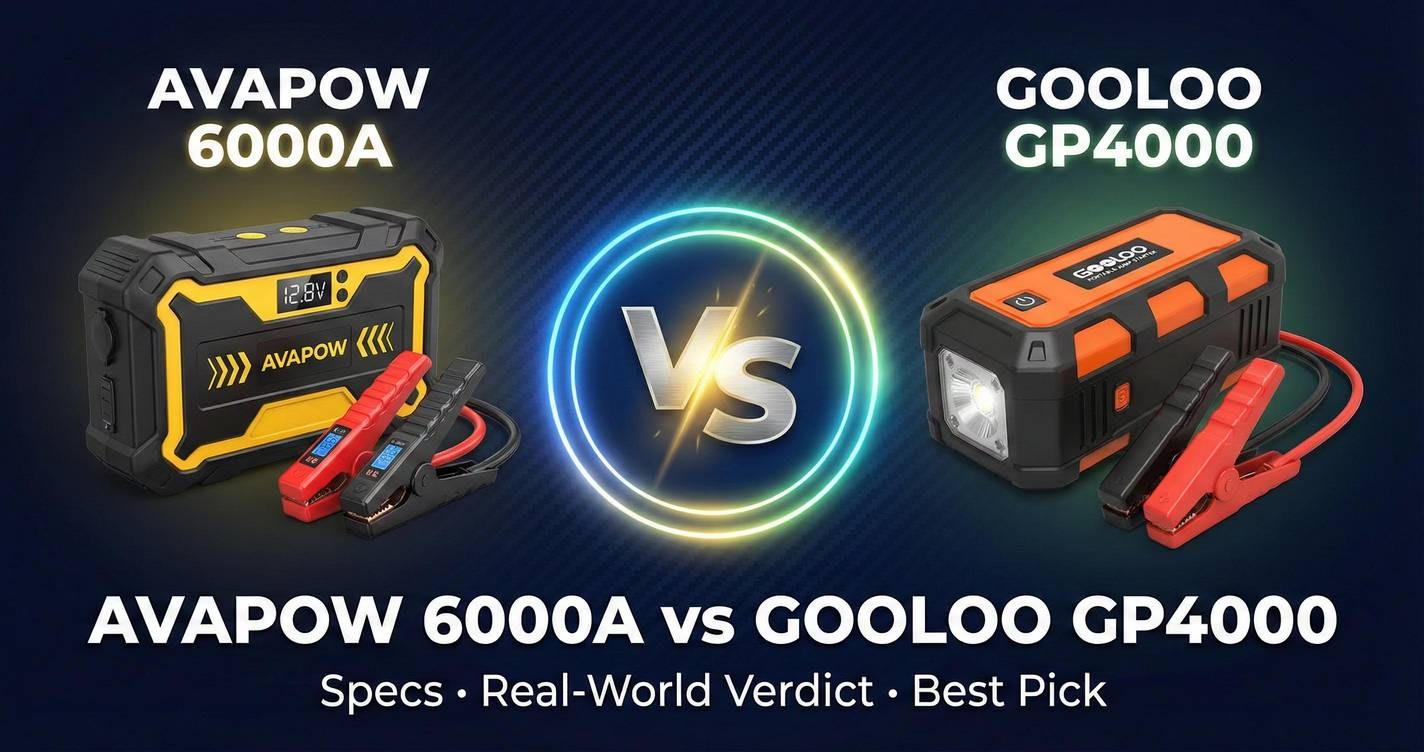
Portable jump starters look the same until you actually need one. Then the differences get loud. Cable behavior. How it reacts to a deeply dead battery. How fast it recharges. Whether it’s still alive after sitting in your trunk for months.
This comparison is built for that moment.
You’re here for one reason: which one should you buy—Avapow 6000A or Gooloo GP4000? Let’s make the choice simple, honest, and practical.
🔋 At A Glance Jump Starter Showdown
AVAPOW 6000A vs GOOLOO GP4000 — Specs, Features & Real User Feedback
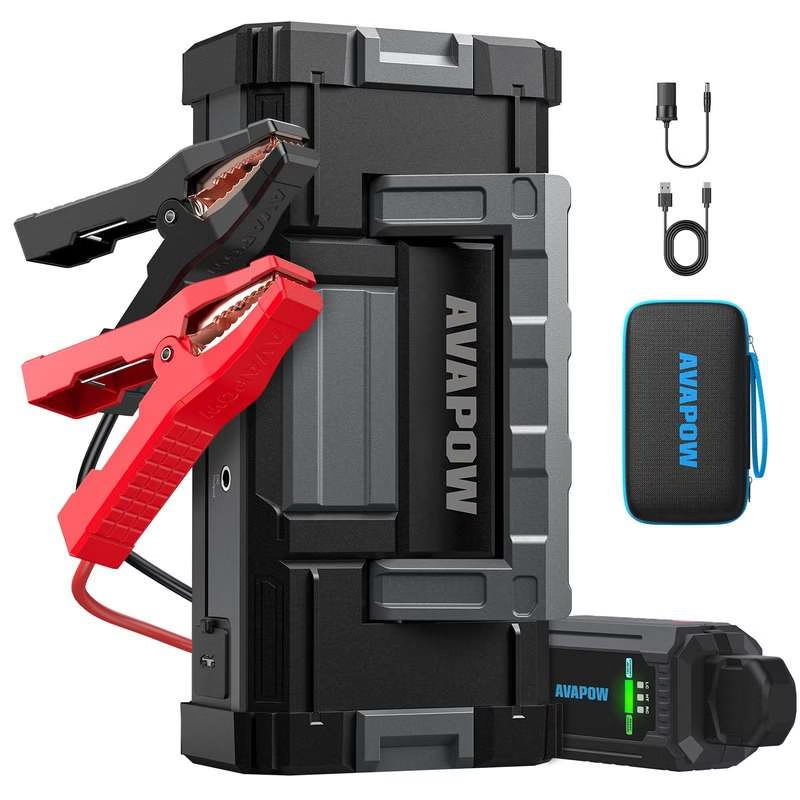
AVAPOW 6000A
Model A68 — 6000A Peak Current
- Highest peak amps in class
- Large diesel engines (up to 12L)
- Force-start dead batteries
- Heavy-duty emergency use
- Bulkier and heavier
- Unit-to-unit variance reported
- No IP rating specified
- Heat sensitive storage
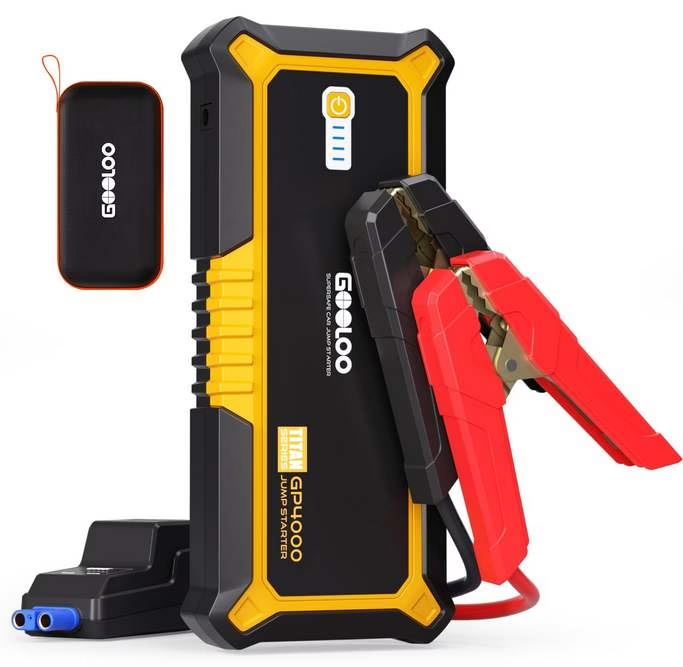
GOOLOO GP4000
Titan Series — 4000A Peak Current
- Higher capacity (99.2Wh)
- More compact & portable
- 15V DC output versatility
- Proven reliability (skoolie tested)
- Lower peak amps (4000A)
- Requires maintenance charging
- No wall charger included
- May struggle with 12L+ diesels
🎯 Which One Should You Choose?
Choose AVAPOW 6000A If…
You need maximum power for large diesel engines (up to 12L), want the highest peak amps available, and don’t mind the extra bulk for emergency heavy-duty use.
MAX POWERChoose GOOLOO GP4000 If…
You want a more portable unit with higher energy capacity (99.2Wh), need 15V DC output for accessories, and prefer a proven track record with large vehicle owners.
BEST VALUEQuick Verdict (Read This If You’re in a Hurry)
Here’s the truth. Most people don’t need “the biggest number.” They need the one that will behave correctly when the battery is low, and still be charged months later.
Choose Avapow 6000A if:
- You want maximum claimed jump headroom for larger gas engines.
- You prefer a straightforward port layout with a 12V/10A accessory output.
- You want the psychological comfort of a bigger peak rating.
Choose Gooloo GP4000 if:
- You want a compact jump starter with a clearly stated 99.2Wh battery rating.
- You like having a 15V/10A (150W max) DC port for certain accessories.
- You want a unit with very clear “BOOST button logic” in the manual.
If you’re still unsure, don’t overthink it. Use this simple rule:
Big engine anxiety? Avapow.
Everyday reliability + compact utility? Gooloo.
Now let’s earn that decision.
Key Specifications (Side-by-Side)
⚡ AVAPOW 6000A vs GOOLOO GP4000
AVAPOW 6000A
Model A68
- ⚡ Claimed Peak Current6000A MAX POWER
- 🔌 USB OutputsUSB1: 5V/2.4A
USB2: 5V/3A, 9V/2A, 12V/1.5A - 🔋 USB-C InputUp to 5V/3A
(supports 9V/2A, 12V/1.5A) - 🚗 DC Output12V/10A
- ⏱️ Charging Time~6 hours (Type-C 5V/3A)
- 🌡️ Operating Range14°F to 140°F
(-10°C to 60°C) - 🚀 Force StartBOOST function on smart clamps for extremely low battery voltage
GOOLOO GP4000
Titan Series
- ⚡ Claimed Peak Current4000A
- 🔋 Battery Rating99.2Wh TRANSPARENT
- 🔌 USB-C In/Out15W (5V/3A)
- 📱 USB OutputsQC profiles: 5V/2.4A, 9V/2A, 12V/1.5A
+ 5V/2.1A standard - 🚗 DC Output15V/10A (up to 150W max)
12–16.8V range - ⏱️ Charging Time6–8 hours (5V/3A)
- 🌡️ Operating Range-4°F to 140°F
(-20°C to 60°C) COLDER CLIMATE - 🚀 Low Voltage StartBOOST button on smart cable
What Matters More Than Peak Amps (This Is Where People Get Tricked)
Peak amps are a marketing flex. They’re not a standardized promise of how your engine will crank at 6 a.m. in the rain.
What actually decides the experience is:
- How the clamps behave on low voltage
- How quickly the unit recharges
- Whether it survives storage
- How many attempts you realistically get
- Whether it’s “idiot-resistant” when stress is high
Let’s break that down in plain language.
Jump Performance: Realistic Expectations
Normal dead battery vs “murdered” battery
There are two types of dead batteries.
Type A: Normal dead
You left the light on. Battery is low, but not destroyed. These jump starters usually shine here.
Type B: Murdered dead
The battery was drained down to the floor. Or it’s old and failing internally. Or it has a dead cell. This is where jump starters start acting weird.
On a murdered battery, you often see things like:
- The unit refuses to arm (no ready light).
- The unit arms, you crank, it clicks off to protect itself.
- The car starts… then dies when the jump starter disengages.
That last one confuses people. They think the jump starter failed. Often the real issue is the vehicle battery has so little reserve that when the jump pack stops pushing, the vehicle electronics sag and shut down.
Avapow 6000A in this reality
Avapow leans into one big promise: a huge surge rating plus a force-start approach. In practice, that can be helpful when you’re trying to overcome a stubborn crank.
But here’s the catch. If your battery is truly cooked, extra surge doesn’t magically fix internal failure. It just gives you more chances to get one start, then you still need to address the battery.
Gooloo GP4000 in this reality
GP4000 is more transparent about its battery size (99.2Wh), and the manual’s BOOST logic is straightforward. It’s designed to handle low voltage by letting you press BOOST and start within a short window.
Same truth applies: if the car battery is beyond saving, the GP4000 can get you started, but it can’t turn a ruined battery into a healthy one.
My blunt rule
If you’re buying a jump starter to compensate for a weak battery you refuse to replace, stop.
Replace the battery. Then use a jump starter as insurance.
That’s how you win long-term.
Battery Capacity & Power Bank Use (The Part You’ll Use More Often Than You Think)
Most owners use a jump starter as a power bank more times than they use it to jump a car. Phones. Tablets. GPS. Dash cams. A small fan while camping. Emergency lights.
So usability matters.
Gooloo GP4000: the advantage of clarity
The GP4000’s 99.2Wh rating gives you a better mental model. You can roughly estimate how many device charges you’ll get, and you can compare it to other power banks.
It also helps set expectations. You know it’s not a tiny “phone-charger pretending to jump a truck.” It’s a real battery pack.
Avapow 6000A: strong utility, less standardized transparency
Avapow focuses more on peak output marketing. You still get practical power-bank capability:
- Two USB ports (including fast-charge profiles)
- USB‑C input for charging
- 12V/10A DC output
For most people, that’s plenty.
But if you care about comparing battery size apples-to-apples, Gooloo makes that easier.
Port practicality
Both are useful as emergency chargers. The difference is how you plan to use the DC output.
Ports, Charging Speed & Convenience (The Daily Experience)
USB‑C input: both are easy to top up
Both units support USB‑C charging. That’s a big win. No weird barrel plugs. No special cable drama.
But not all USB‑C is equal.
GP4000 USB‑C is 15W (5V/3A).
Avapow supports up to 5V/3A input and also lists higher voltage input profiles.
What does that mean in real life?
- With a basic 5V phone charger, both will charge, but it’ll take time.
- With a stronger adapter (and the right cable), you’ll reduce downtime.
- Neither is a “charge in 30 minutes” device. Plan on hours, not minutes.
DC output difference: 12V vs 15V behavior
This is one of the clearest separation points.
- Avapow DC output: 12V/10A
- Gooloo DC output: 15V/10A (and documentation references a range and max watt limit)
If you plan to run 12V accessories that are sensitive to voltage, Avapow’s 12V output is simpler and more predictable.
If you plan to run certain accessories that can accept 12–16.8V input and want extra headroom, GP4000’s 15V/10A can be useful.
Most casual users won’t care. But camping and roadside gear people will.
“Wall charger not included” reality
In many bundles, you’re not getting a dedicated wall charger. You’re expected to use your own. That’s not a deal-breaker. But it does change the experience.
If you buy either unit, do yourself a favor:
- Use a quality charger.
- Use a quality cable.
- Test recharge time during your return window.
That’s how you avoid owning a “works great… until it doesn’t” brick.
Safety Systems & Clamp Behavior (Where Trust Is Built)
Both brands push safety. That’s normal. The clamp cable is basically a small brain:
- reverse polarity warnings
- short circuit protection
- temperature protection
- timeout behaviors
- anti-spark logic
These protections are good. But they can feel like “failure” if you don’t know what’s happening.
What “smart clamp” confusion looks like
You connect clamps. The unit lights up. But it won’t go ready.
Common causes:
- The jump starter itself is too low.
- The clamp plug isn’t fully seated.
- Battery terminals are dirty or corroded.
- Battery voltage is extremely low and needs BOOST.
- The vehicle battery is damaged internally.
Avapow: force-start emphasis
Avapow’s clamp design and manual flow emphasize using BOOST/force-start when the battery is too low to pass safety checks. That can be the difference between “it won’t work” and “oh, it works.”
Gooloo: very explicit indicator logic
GP4000 documentation is clear about what each light means:
- green solid = good connection, start
- red solid + beep = reverse polarity, fix it
- green blinking = voltage too low, press BOOST
- no lights = battery may be damaged, try BOOST after confirming connections
That clarity reduces panic errors.
A simple habit that prevents 80% of failures
Before you ever need it, practice once.
Not a full jump. Just:
- plug in clamps
- connect to a battery
- observe the indicator logic
- disconnect
Ten minutes now saves you chaos later.
Reliability Audit (The Part Most Reviews Skip)
Let’s talk about how jump starters actually die.
They rarely die heroically. They die quietly.
Failure pattern #1: “It won’t charge”
Usually one of three things:
- bad cable
- bad adapter
- damaged port or internal battery deterioration
Fix: swap chargers and cables first. If it still won’t charge reliably, return it. Don’t negotiate with a safety tool.
Failure pattern #2: “It shows power but won’t jump”
Often caused by:
- pack not sufficiently charged under load
- clamps not seated
- dirty terminals
- battery too low and needs BOOST
- battery is internally damaged
This is why return-window testing matters.
Failure pattern #3: “It works once, then drops fast”
This can happen when:
- the internal battery is weak
- the unit was stored at extreme heat
- the unit sat fully drained too long
Failure pattern #4: clamp cable failure
Smart clamp cables contain electronics. If they fail, the unit may still power devices but refuse to jump.
This is a common weakness across the entire category. It’s not unique to Avapow or Gooloo.
Storage reality: heat is the silent killer
If you leave any lithium jump starter in a hot vehicle year-round, you shorten its life.
If you want maximum lifespan:
- store it in a moderate environment when possible
- or at least keep it out of direct sun and heat traps
- recharge every few months even if unused
Avapow commonly suggests recharging every 3–6 months when unused.
Gooloo guidance often leans toward every 2–3 months.
In other words: treat it like emergency equipment. Not a toy you forget.
Real User Reports (What People Actually Experience)
This is where the most useful patterns show up.
What users praise about Avapow 6000A
- It starts vehicles quickly when the battery isn’t destroyed.
- The kit feels complete: case, clamps, cables, adapter.
- The light is genuinely useful at night.
- People like the idea of 6000A peak headroom.
What users complain about Avapow 6000A
- Some units don’t become “ready” to jump.
- Some report charging issues or inconsistent behavior.
- A minority claim it failed in an emergency.
What this usually signals:
- unit-to-unit variance
- user unfamiliarity with BOOST behavior
- or a vehicle battery that’s too far gone
What users praise about Gooloo GP4000
- Strong real-world performance for its class.
- Clear indicator behavior and BOOST handling.
- Compact size for the claimed capability.
- Useful as a power bank and for small accessories via DC output.
What users complain about Gooloo GP4000
- Some people run into “starts then dies” situations when the vehicle battery is severely depleted.
- Some long-term owners complain about port or charging failures after extended use.
- Like all lithium packs, storage and maintenance matter.
The pattern that matters
Across both: most “failures” are either
- a deeply dead/ruined vehicle battery,
- the user not using BOOST/force-start correctly,
- or poor charging setup and storage habits.
So the purchase decision should include your lifestyle:
- Do you maintain your gear?
- Do you keep it charged?
- Do you store it sensibly?
If yes, both can serve you well.
Head-to-Head: The Battleground Categories
1) Starting power headroom
If you want the biggest “paper advantage,” Avapow wins. 6000A is a huge claimed number. It’s built to project confidence. And for larger gas engines, that psychological cushion matters.
But remember: headroom is only useful if the clamps behave correctly and the unit is charged.
2) Battery size transparency
Gooloo wins here with a clearly stated 99.2Wh rating. It’s easier to compare. Easier to plan around. Easier to trust on the power-bank side.
3) DC accessory output usefulness
This depends on your use case.
- Want a clean 12V outlet for typical car accessories? Avapow’s 12V/10A is simpler.
- Want a 15V/10A port with a stated watt ceiling? GP4000 can be a better fit for certain gear that tolerates that range.
4) Ease of understanding under stress
Gooloo’s indicator/BOOST logic is extremely straightforward. That matters when you’re tired, it’s dark, and you just want the car to start.
Avapow is also usable, but in the real world, “simple, explicit indicator behavior” wins more emergencies.
5) Storage and long-term readiness
Both are lithium. Both need periodic top-ups.
If you’re disciplined, either one works.
If you’re not disciplined, buy the one you’re more likely to actually keep charged. That usually means:
- the one you like using as a power bank
- the one that’s easier to recharge with what you already own
- the one you’re not afraid to test monthly
Pros and Cons (Decision-Only, No Fluff)
⚡ AVAPOW 6000A (A68)
Complete Pros & Cons Breakdown
Pros
- Massive claimed peak output for maximum perceived headroom
- Two USB outputs with a fast-charge profile
- USB‑C charging input is convenient
- 12V/10A DC output for car accessories
- Force-start/BOOST approach for low-voltage situations
- Useful emergency light modes
Cons
- Peak amps are marketing; real cranking depends on conditions and battery health
- Some buyers report readiness/charging inconsistency (common in this category)
- Bigger physical footprint and weight can vary by listing/bundle
- Like all lithium packs, trunk heat can shorten lifespan quickly
Bottom Line: The AVAPOW 6000A offers impressive peak power specs and versatile charging options, but treat the 6000A rating as marketing headroom rather than guaranteed performance. Perfect for those who want maximum claimed power, but remember to store it properly and test before emergencies.
🔋 GOOLOO GP4000
Complete Pros & Cons Breakdown
Pros
- Clearly stated 99.2Wh battery rating makes comparisons easier
- USB‑C in/out 15W keeps charging simple
- QC USB profiles plus a standard USB output
- 15V/10A DC port with stated watt ceiling for accessory use
- Very explicit clamp indicator logic and BOOST behavior
- Compact size and manageable weight for the class
Cons
- Lower claimed peak rating than Avapow (which matters to some buyers)
- “Starts then dies” can still happen if the vehicle battery is severely depleted (often a car battery issue, not the pack)
- Wall charger often not included; your adapter quality matters
- Like all lithium units, storage discipline is non-negotiable
Bottom Line: The GOOLOO GP4000 offers transparent specs and practical portability with its 99.2Wh capacity and versatile 15V DC output. While the 4000A peak is lower than competitors, the clear indicator system and compact design make it a reliable choice for most vehicles—just remember to maintain proper charging habits.
Who Should Buy Which? (Use-Case Picks)
Choose Avapow 6000A if…
You’re the type who wants maximum margin. You might own a bigger gas engine. You might just hate the feeling of “barely enough.”
You want to open the trunk and feel confident.
Buy it if:
- You prioritize peak jump headroom.
- You want a straightforward 12V/10A DC output.
- You’re okay with a bigger unit and will maintain it.
Choose Gooloo GP4000 if…
You want a compact unit with a clearly stated battery rating. You want clean indicator logic. You want something that’s easy to compare and easy to live with.
Buy it if:
- You like spec transparency (99.2Wh is a big deal).
- You want a 15V/10A DC port for certain accessories.
- You want a “no drama” interface and predictable behavior.
How to Validate Your Pick (Return-Window Checklist)
Do this once. Then you can actually trust your purchase.
1) Full charge test
- Charge to full.
- Note how long it takes with your charger and cable.
- If it behaves weird, don’t wait months. Return it.
2) Clamp logic test (no need to jump)
- Connect clamps to a healthy car battery.
- Confirm it goes “ready” correctly.
- Confirm reverse polarity warning works (without actually reversing; just observe behavior when disconnected/connected properly).
3) Output test
- Plug in your phone to each USB port.
- Confirm fast-charge port actually charges faster (if your phone supports it).
- Test the DC output with a small accessory you already own (within limits).
4) Storage test
- Leave it for 2–3 weeks.
- Check battery level again.
- Excessive self-discharge is a red flag.
This checklist filters out weak units early.
FAQ (Fast Answers)
Is Avapow 6000A stronger than Gooloo GP4000?
On paper, yes—6000A vs 4000A claimed peak. In practice, both can start most 12V vehicles when the car battery is not destroyed. The bigger difference is how they behave under low voltage and how well you maintain them.
Which is better for a completely dead battery?
Both rely on a BOOST/force-start method. The pack can help you start, but if the vehicle battery is severely depleted or damaged, you may still need to recharge/replace the car battery afterward.
Can either start a diesel reliably?
They’re marketed for large engines, but diesel starting is brutally dependent on temperature, battery health, glow plug load, and vehicle condition. If you own a large diesel and want certainty, you should consider stepping into heavier-duty solutions. For most personal diesels in good condition, either can work.
Why does the car start and then die?
Because the vehicle battery has almost no reserve. When the jump starter disengages, voltage drops and the electronics shut down. The fix is charging the battery properly or replacing it.
How often should I recharge these if I don’t use them?
Every few months. Set a calendar reminder. This is emergency gear. Treat it like emergency gear.
Can I charge a laptop with these?
Most laptops require USB‑C PD at higher wattage than these units provide. These are primarily phone/tablet power banks plus jump starters.
Final Verdict (No Fluff)
If you want maximum claimed jump headroom and a simple 12V accessory output, Avapow 6000A is the confidence pick. It’s the “bigger hammer” approach. Buy it if that margin helps you sleep.
If you want a compact unit with a clearly stated battery rating, very clear clamp behavior, and a defined DC port spec, Gooloo GP4000 is the smarter everyday choice. It’s the “balanced tool you’ll actually keep ready” pick.
My recommendation for most buyers?
GOOLOO GP4000—because spec clarity and predictable behavior beat marketing numbers in real emergencies.
But if your anxiety is engine size and you want the biggest cushion possible?
AVAPOW 6000A—and commit to keeping it charged.
Either way, don’t skip the return-window tests. That’s how you turn a purchase into trust.