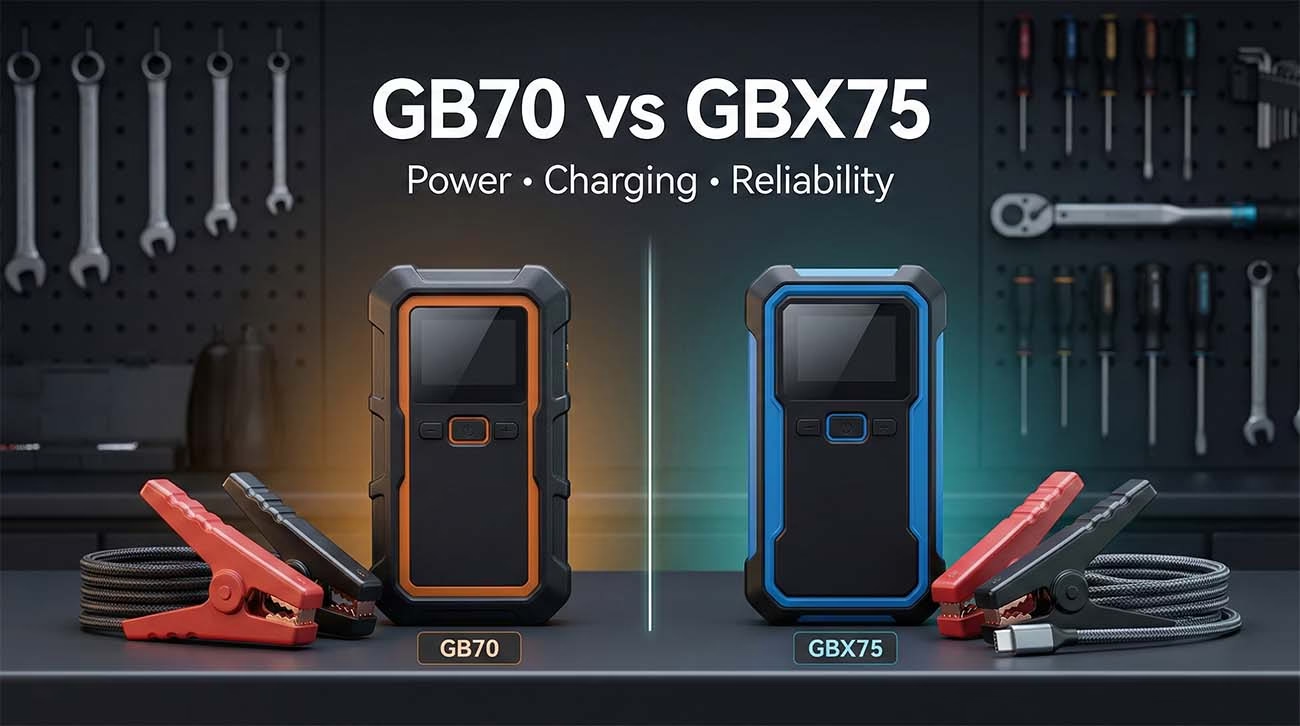
If you’re searching noco gb70 vs gbx75, you’re not debating “which one can jump a car.” Both can. You’re deciding which one fits your reality: the size of engines you deal with, how often you actually need a jump, and how much you care about charging speed and modern ports.
Here’s the truth: most jump starters fail you in only a few ways—insufficient starting punch when the battery is truly dead, slow/finicky charging when you try to keep it topped up, and long-term reliability issues that don’t show up on day one. This comparison focuses on those three failure points first, then everything else.
One sentence verdict preview:
- Choose GBX75 if you value fast USB‑C charging and the “newer platform” convenience. Choose GB70 if you want a proven, simpler unit and you’re okay with slower recharging.
(Brand note: NOCO produces both units in the Boost lineup; everything below compares the two models as products, not hype.)
Quick comparison snapshot (at-a-glance)
NOCO Boost GB70
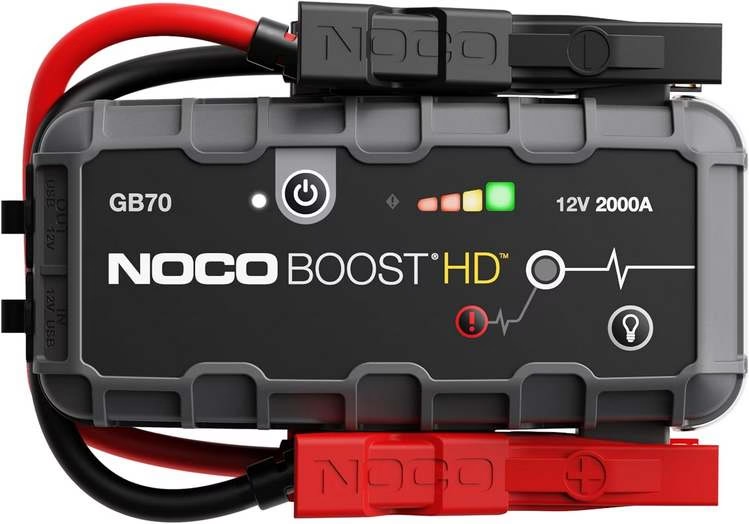
Key Specifications
- Peak Current: 2000A
- Gas Engines: Up to 8.0L
- Diesel Engines: Up to 6.0L
- Recharge Time: ~6 hours
- Weight: 5.0 lbs
- Water Resistance: IP65
Pros
- Excellent value for price
- Reliable jump starts (40+ per charge)
- Proven track record in market
- Strong safety features
- Higher customer rating
Cons
- Slower recharge time
- Heavier than GBX75
- Charging issues reported
- No USB-C fast charging
- Shorter cables
NOCO Boost X GBX75
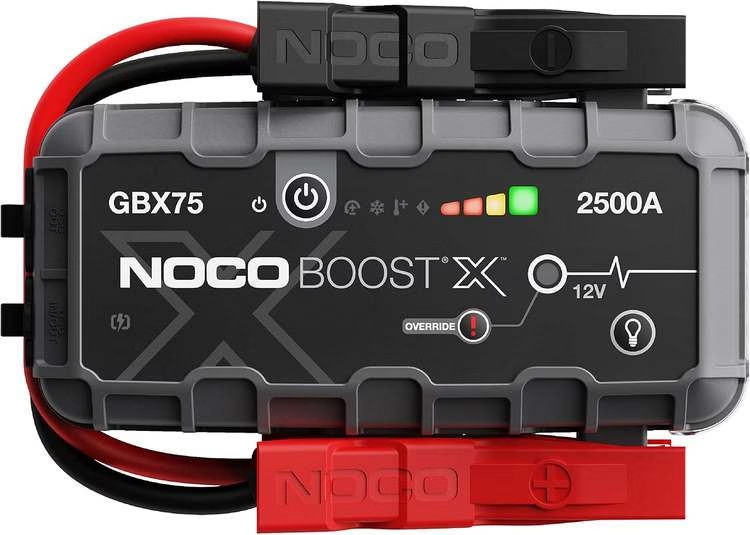
Key Specifications
- Peak Current: 2500A
- Gas Engines: Up to 8.5L
- Diesel Engines: Up to 6.5L
- Recharge Time: ~1.8 hours
- Weight: 3.8 lbs
- Water Resistance: IP65
Pros
- Higher peak current (2500A)
- USB-C PD fast charging
- 5-minute emergency charge
- Lighter weight (3.8 lbs)
- 60W power bank capability
Cons
- Higher price point
- More charging issues reported
- Shorter warranty period
- Less proven reliability
- Slightly lower ratings
Final Verdict
Both models are excellent portable jump starters, but the right choice depends on your specific needs. The GB70 offers better value and proven reliability for most standard vehicles, while the GBX75 provides faster charging and higher power capacity for larger engines at a premium price. If you drive a heavy-duty diesel or frequently need to jump-start large vehicles, the GBX75’s extra power may be worth the investment. For everyday use in standard vehicles, the GB70 delivers exceptional performance at a more affordable price point.
One-line takeaway: GBX75 is the “modern fast-charge” pick; GB70 is the “slower-charge but widely used” pick.
Detailed spec comparison (what matters, what doesn’t, and where buyers get fooled)
1) Power & starting capability (peak amps + engine ratings)
On paper, the difference is straightforward:
- GB70: 2000A peak; rated up to 8.0L gas and 6.0L diesel.
- GBX75: 2500A peak; rated up to 8.5L gas and 6.5L diesel.
What that means in practice:
- The extra peak current and slightly higher engine rating on GBX75 is mostly about margin—more tolerance for cold weather, tired batteries, and bigger displacement engines that crank harder.
- If you’re jumping typical small-to-mid gas cars, either is usually enough. The “need” starts showing up when you deal with larger engines, cold starts, or batteries that are truly flat, not “a little weak.”
Hard truth: engine displacement ratings are helpful, but they don’t tell the whole story. A smaller engine with a bad battery, corrosion, thick cold oil, or an electrical drain can behave worse than a larger engine in ideal conditions. So treat the ratings as a baseline, not a guarantee.
2) Battery chemistry & capacity (why it affects repeat jumps)
Both units are lithium-based jump starters. The core buyer mistake is assuming “peak amps” tells you how many times it can jump. It doesn’t.
What you actually care about:
- Energy capacity (watt-hours) and the unit’s ability to deliver high current repeatedly without overheating or voltage sag.
- Real-world jump count depends on temperature, how dead the vehicle battery is, and how long you crank.
From the provided data:
- GBX75 is referenced as roughly ~74Wh / 5000mAh (as listed in some spec sources).
- GB70 has a claimed “up to ~40 starts,” but exact watt-hours aren’t confirmed here.
Practical interpretation:
- If you want repeatable performance across many attempts (fleet use, helping others, roadside work), you want both capacity and thermal management—and you want a charging method that keeps it ready.
3) Charging options & recharge times (this is where GBX75 separates)
Charging is where many buyers either love or regret their pick.
- GB70: commonly stated around ~6 hours to recharge (depends heavily on the charger and method). This typically signals an older, slower charging approach.
- GBX75: ~1.7–1.8 hours with USB‑C PD, plus the “5‑minute charge ready” concept.
What it means:
- If you’re organized and charge at home, GB70’s slower charging is tolerable.
- If you’re not organized (most people aren’t), faster charging is what turns a jump starter from “I own one” into “it’s actually ready when needed.”
Also, fast charging changes behavior:
- You can top up the GBX75 from the same high-power USB‑C gear you already use (laptop/phone ecosystem).
- That reduces friction, so it’s more likely to be charged when your battery dies.
4) USB / power bank features (useful or gimmick?)
Both can act as power sources, but GBX75’s 60W USB‑C PD is a real step up. 60W is meaningful because it can support:
- Faster phone charging
- Many tablets
- Some laptops (depending on the laptop’s power requirements)
GB70 can still be useful as a basic power bank, but without confirmed USB‑C PD specs here, treat it as more “emergency phone charge” than a serious multi-device power solution.
5) Build, size, weight (the “will I actually carry it?” factor)
- GB70: ~5.0 lb
- GBX75: ~3.8 lb (with clamps)
That difference matters more than people admit. A lighter kit is:
- Easier to move between vehicles
- More likely to be kept in a convenient spot
- Less annoying when you’re already stressed (dead battery situations are rarely calm)
Both are listed as IP65, which is a good real-world durability baseline for dust and water spray.
6) Safety features (what protects you from mistakes)
Both emphasize safety protections like:
- Spark resistance
- Reverse polarity protection
In real use, reverse polarity protection is a double-edged sword:
- It protects you from doing something dumb fast.
- It can also trigger errors if clamps aren’t making good contact or the battery is in a weird state.
This matters because “it wouldn’t jump” is sometimes:
- A contact issue
- A protection system refusing to engage
- A battery so dead the unit won’t detect proper voltage without a manual override mode (varies by model and conditions)
7) Accessories & box contents (small stuff that becomes big stuff)
Typical inclusions:
- The unit
- Jumper clamps
- Charging cable
What you should check before buying:
- Whether a high-power wall charger is included (often it is not)
- Cable length and clamp ergonomics (complaints exist about cable length in reviews)
- Whether printed instructions are included (some buyers complain they are not)
Real-world performance & reliability (what owners actually report)
Methodology (simple and honest)
This section synthesizes two kinds of feedback:
- Aggregate retailer ratings (many buyers, but often shallow feedback)
- Forum-style complaints/praise (fewer people, but more detailed and problem-focused)
Neither is perfect. Retail ratings skew positive because many buyers only test once. Forums skew negative because people post when something breaks. The truth is usually in the overlap: recurring themes, not one-off stories.
GB70 — common praise patterns
What people consistently like:
- Strong “it just works” jump performance for typical use.
- Peace of mind: it’s small enough to store and forget until needed.
- Safety features reduce the fear factor for non-experts.
Where it gets messy:
- Charging complaints show up in informal discussions: slow charging, not reaching full charge, stopping mid-charge.
- Some users report reverse polarity errors even when they believe the clamps are correct.
How to interpret that:
- Charging complaints can be caused by the unit, the cable, the power source, or user expectations. Without standardized testing, you treat it as a risk flag, not a conviction.
- Reverse polarity errors are often a contact quality problem (dirty terminals, clamp placement) but can also be a finicky detection system.
GBX75 — common praise patterns
What people consistently like:
- USB‑C PD fast charging is the headline benefit.
- The idea of quick top-ups (including “charge a few minutes, get a jump”) is the difference between “dead in the trunk” and “ready.”
Where it gets messy:
- Multiple informal reports mention:
- Units that won’t charge properly
- Weird behavior after deep discharge
- Heat or power-management oddities
- Some community sentiment suggests the GBX line has more “charging drama” than older generations (not a quantified statistic, but a repeated theme in discussions).
How to interpret that:
- Newer, faster charging platforms can introduce more failure points: PD negotiation, port strain, and controller behavior under edge cases.
- That doesn’t prove it’s unreliable. It means: test early, test periodically, and don’t store it at 0%.
What you should do with anecdotal reliability complaints
Use them to make your setup smarter:
- Test immediately after buying.
- Do a recharge cycle and confirm it reaches full.
- Try a controlled jump on a partially discharged battery (not your worst-case emergency).
- Store it properly and top up on a schedule.
Bottom line:
- If you want “set-and-forget,” you still need a reminder. Lithium packs neglected for a year can disappoint you regardless of model.
Use cases: noco gb70 vs gbx75- which model is right for you?
Everyday driver (one vehicle, occasional emergency)
- Best pick: GB70
Why: You’re unlikely to need rapid recharge. You need a reliable emergency tool that you’ll hopefully never use.
Bigger engines (larger gas or mid-size diesel within rated limits)
- Best pick: GBX75
Why: Extra peak current and higher engine rating buys margin. This is where “paper specs” are most likely to matter.
Roadside helper / family fixer (you jump multiple cars per month)
- Best pick: GBX75
Why: Fast recharge changes everything when you use it often.
Tech-heavy user (you want it as a serious power bank too)
- Best pick: GBX75
Why: 60W USB‑C PD is not a gimmick; it’s actually useful.
Minimalist (you hate fiddly charging setups)
- Lean pick: GBX75
Why: If it charges with your existing USB‑C ecosystem, you’ll keep it topped up.
Hands-on comparison checklist (how to test your unit in 20 minutes)
20-minute test checklist (do this before you rely on it)
- Inspect clamps and cable strain points. Look for loose pivots, thin insulation, or sharp bends near connectors.
- Full charge once. Use a known-good power source and confirm the unit reaches “full” normally.
- Unplug and wait 30 minutes. Then re-check the charge indicator. Sudden drop = warning sign.
- Do a short power-bank test. Charge a phone for 5–10 minutes; confirm stable output.
- Controlled jump test (if safe to do so). Use a vehicle with a mildly weak battery, connect clamps cleanly, and confirm it starts quickly.
- Post-jump check. Feel for excessive heat at the unit and connector area. Mild warmth is normal; hot-to-touch is not.
- Recharge again. Confirm it accepts charge normally after use.
Pricing, value & what to do if you’re on the fence
Prices move constantly, and you should not buy either based on a “typical price” someone quoted months ago.
Instead, decide value based on your usage:
- If you’ll use it rarely, GB70 often represents better practical value because you’re not paying for fast-charge convenience you won’t use.
- If you’ll use it often or you want it to stay topped up with minimal effort, GBX75’s fast charging can be worth more than the spec bump.
If you’re considering alternatives, don’t shop by inflated “amps” alone. Use this filter:
- Confirm engine rating (gas/diesel) from an authoritative listing
- Confirm charging method and real recharge time
- Confirm IP rating if you store it in harsh conditions
- Confirm warranty terms in writing
- Confirm clamp quality and cable thickness (thin cables = voltage drop)
FAQ (clear answers, no pretending)
1) Can GB70 start a diesel truck?
It’s rated up to 6.0L diesel. If your diesel is larger than that (common in some pickups), you’re outside the stated rating and GBX75 is the safer pick on paper.
2) Is GBX75 worth it over GB70?
Worth it if you care about USB‑C PD fast charging, faster readiness, and more margin on tougher starts. If you’ll charge at home and mostly want emergency coverage, GB70 can be the smarter spend.
3) How fast does GBX75 recharge?
The typical claim is about 1.7–1.8 hours with a compatible USB‑C PD charger. If you use a weak charger, it will take longer—fast charging requires a charger that can deliver it.
4) How many jump starts per charge can you expect?
GB70 is commonly claimed up to ~40 under ideal conditions, but real-world numbers vary wildly with temperature and how dead the battery is. GBX75’s exact “starts per charge” is not confirmed here; assume similar variability and focus more on your worst-case scenario than marketing claims.
5) Does reverse polarity protection ever cause problems?
Yes. Protection systems can throw errors when clamp contact is poor, terminals are dirty, or the vehicle battery is at an odd voltage state. Clean contact and correct placement reduce false errors.
6) Which one is better for cold weather?
On paper, GBX75 has more margin (higher peak current). In practice, both lithium jump starters can lose performance in extreme cold if stored cold. The best move: store indoors or warm it before use.
7) Can these be used as everyday power banks?
GBX75 is far more convincing for this because 60W USB‑C PD can power more devices more effectively. GB70 is better treated as an emergency phone top-up unless you’ve confirmed its output suits your gear.
8) What’s the biggest “buyer regret” with jump starters?
Not testing them and not keeping them charged. The second biggest is buying too small for your hardest-starting vehicle.
Conclusion & recommendation
If you want the cleanest decision:
- Buy GBX75 if you value fast USB‑C charging, want more starting margin, and are more likely to keep it ready because it fits your modern charging setup. It’s also the better pick if you jump bigger engines within the stated limits or you help others regularly.
- Buy GB70 if you want a solid 2000A-class jump starter for occasional emergencies and you can live with slower recharge behavior. It’s a practical choice for typical cars and light-duty use where you’ll charge it at home and leave it stored.
The only wrong move is buying either one and never testing it. A jump starter that isn’t charged is just dead weight.