
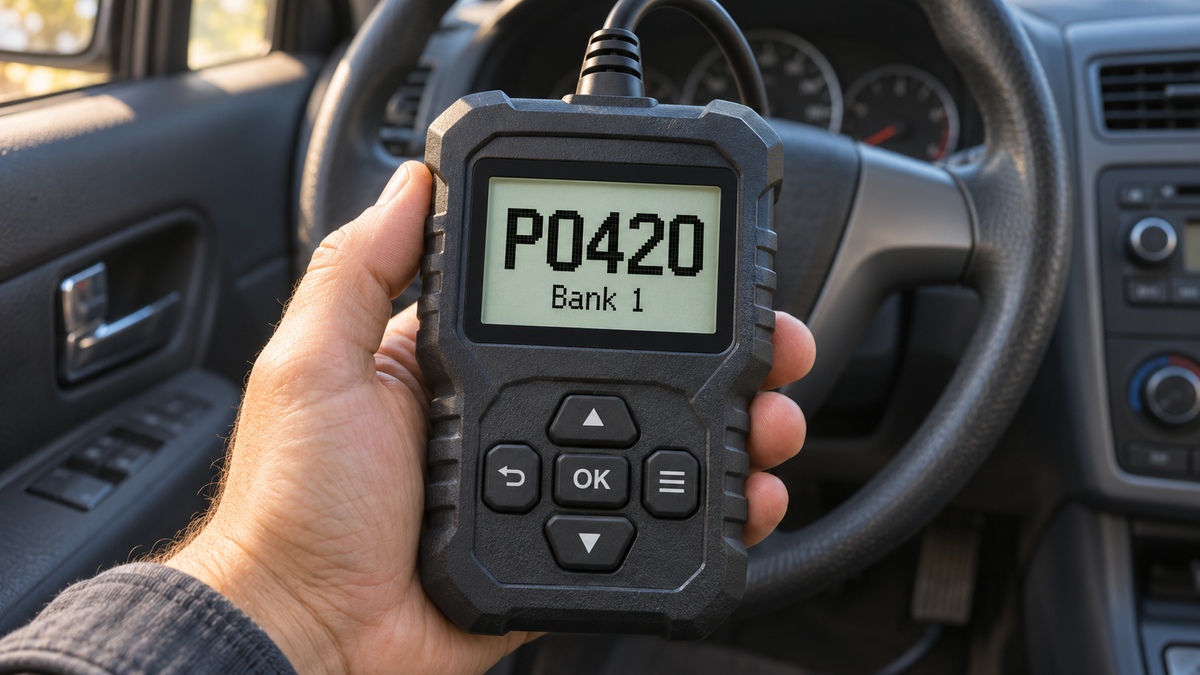
How to fix P0420 code: the 60-second answer
If you’re looking up how to fix P0420 code before an emissions test, save the scan first. P0420 means your car found low catalyst efficiency on Bank 1, the side with cylinder 1. A good first move is to check for other codes, an exhaust leak, and warranty coverage. Buy a converter only once a test shows you need one.
A steady light and a car that feels normal usually leave time for a short trip to a shop. If the light flashes, the engine shakes, or you lose power, pull over safely and call for help. Don’t clear the code on the way. That can erase clues and reset the tests your car needs for inspection.
| First decision | Typical U.S. cost |
|---|---|
| Check coverage by VIN | Free |
| Have a shop test the fault | $125–$183 |
| Replace a confirmed failed converter | $2,280–$2,480 across types |
These are U.S. estimates checked November 17, 2026. Your engine, state, and local labor rate can change the bill. Ask what the diagnostic fee covers before you book.
As an Amazon Associate, I earn from qualifying purchases. If you buy through an affiliate link, I may earn a small commission at no extra cost to you.
P0420 catalyst system efficiency below threshold Bank 1: what does it mean?
Find Bank 1 without guessing left or right.
Think of Bank 1 as a cylinder address. Look up cylinder 1 for your year and engine. On a V-shaped engine, the bank can face the radiator or the firewall. On an inline engine, the cylinders usually share one bank.
The P0420 engine code points to the catalyst test for that bank. P0430 is the matching code for Bank 2. If you see P0420 and P0430 at the same time, tell the shop about both. A fuel problem can affect both sides, so two codes alone don’t justify buying two converters.
What the two sensors tell the computer.
Follow the path of the exhaust. It passes the front sensor, flows through the converter, then reaches the rear sensor. The front sensor helps the engine set the fuel mix. Inside the converter, a thin coating helps turn harmful gases into less harmful ones.
A working catalyst can store and release oxygen. Once the engine is warm and certain driving conditions are met, your car tests that ability. The computer uses sensor data to judge whether the converter still does its job.
Why a graph alone can mislead you.
On some cars, a rear sensor that closely tracks the front one can point to a weak converter. But a leak can change the reading. A wideband sensor [measures a broad air-fuel range] also gives a different signal from an older oxygen sensor.
Ask which test fits your engine. Also ask what problem the test measures. A converter can flow freely and still clean exhaust poorly. A test for blocked flow answers a different question.
Can you drive with P0420 today? Check these signs first
Steady light, car feels normal.
If the light stays steady and the car runs smoothly, arrange a check soon. A short, gentle trip for diagnosis is usually reasonable. No scan code can tell you how many miles are safe. The way your car feels matters more than the distance.
Flashing light, shaking, or sudden loss of power.
Ease off the gas and get out of traffic. Stop in a safe place, switch off the engine, and call for roadside help. A misfire [a cylinder fails to burn fuel] can send raw fuel into the exhaust. That can overheat the converter.
Tell the shop if the light flashed earlier, even if it now looks steady. Note whether it happened on a hill, at idle, or under load. That detail can help the shop find a fault that comes and goes.
Sulfur smell, excess heat, or fumes.
A rotten-egg smell alone can’t tell you the converter is clogged. A sharp loss of power with intense heat calls for a safe stop. Keep the hot exhaust away from dry grass. A shop can measure exhaust back pressure [pressure caused by restricted flow].
If exhaust fumes enter the cabin, pull over safely, shut down, and get everyone into fresh air. Arrange a tow. Don’t keep driving with the windows open to see if the smell fades.
How to fix P0420 without replacing catalytic converter: start with these checks
Use the steps that fit your scan. You don’t need to pay for each one. If a repair solves the fault and the car passes its catalyst test, stop there.
| Step and evidence | Cost to plan for | Lasting result? |
|---|---|---|
| 0. VIN matches coverage | Free to check | Depends on covered repair |
| 1. Scan shows an engine fault | Free with a borrowed tool or $125–$183 for shop diagnosis | Retest after fixing the cause |
| 2. Leak test finds a gap | Manifold gasket example $417–$596 | Yes if sealing it solves the fault |
| 3. Sensor fails its response test | $440–$523 installed | Yes if sensor caused the fault |
| 4. Factory update matches old software | Free if covered. Historical average $108 in 2024 | Yes for a false failure |
| 5. Mild deposits suspected | $28.99 for one bottle | Unproven |
| 6. Catalyst fails the factory test | Universal estimate $400–$900 | Can last with correct fit and healthy engine |
| 7. Failed unit needs direct replacement | Aftermarket $700–$1,600. OEM $1,800–$4,000+ | Can last once the cause is fixed |
Rung 0 — Check warranty and bulletins before spending
Write down your vehicle identification number [VIN], current mileage, and original in-service date. On covered U.S. light-duty vehicles, the federal emissions warranty covers a defective original converter for eight years or 80,000 miles, whichever comes first. Buying the car used does not restart the clock.
Call a dealer and ask them to check the VIN for coverage. Ask about recalls and technical service bulletins [factory guidance for a known fault]. A bulletin can describe a fix even when you must pay for it. Ask who pays for the test if the dealer finds another cause.
If you drive a Subaru, use the model-by-model P0420 guide to see which bulletins or campaigns to ask about.
Your own lookup costs nothing. A covered repair can also cost you nothing. Get the answer before an outside shop removes the original part.
If you drive a Chevy, check GM’s P0420 bulletins and coverage by model before you pay for parts.
Rung 1 — Save the scan and fix engine faults first
With the car parked, save the codes exactly as shown. Include their status. A pending code means the car has seen signs of a fault. Open freeze-frame data [snapshot from when the fault set]. Save engine speed, road speed, temperature, and fuel readings if shown.
Next, check for P0300 or a code tied to one cylinder. If the engine missed under load, a smooth idle today won’t rule it out. Ask the shop to check misfire counts and test the suspect cylinder before quoting plugs, a coil, or an injector.
Fuel trims [changes to the fuel mix] add another clue. Positive trim means the computer adds fuel. Negative trim means it takes fuel away. A large correction needs context. The technician can compare idle with higher speed and test for air leaks or fuel faults as needed.
Record oil top-ups, falling coolant levels, and recent engine work alongside the scan. Save a second scan after the repair. That gives you two records to compare if the light comes back.
A borrowed scanner can make this first check free. If you need your own, the Autel AutoLink AL519 reads live data, freeze-frame, and inspection readiness on supported cars. A basic code reader may give you the code and little else. Shop diagnosis runs about $125–$183. Repair work costs extra.
Fixing a proven engine fault may solve P0420 for good. Run the catalyst test again. If the misfire damaged the converter before you caught it, the car may still need both repairs.
If the light first appeared after engine work, use the post-repair P0420 checklist while you still have the scan.
If your scan also shows P0300 after a plug change, track down the misfire first.
Rung 2 — Find and seal an exhaust leak
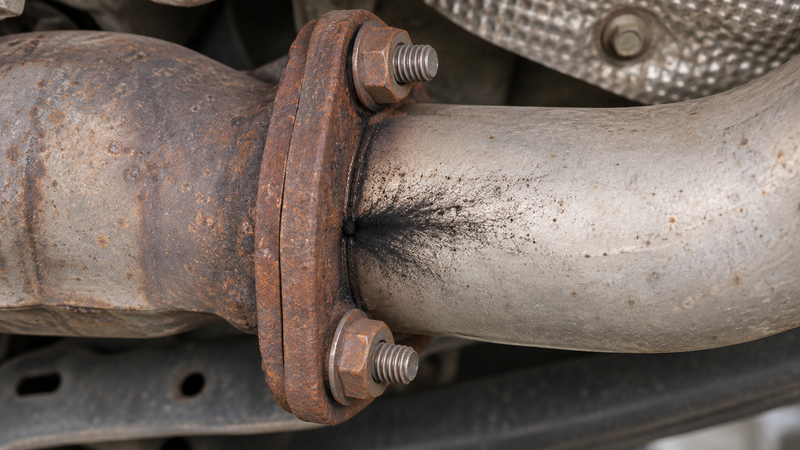
Let the exhaust cool. From a safe spot, look for black soot at the manifold, pipe joints, flex pipe, and sensor mounts. Note any tick you heard at a cold start. Air entering near the sensors can skew the reading even when the leak sounds small.
Have the shop pinpoint the gap with a smoke or low-pressure leak test. Ask them to show you where it leaks. A flange gasket and a cracked manifold are different jobs. So are a clean bolt and one that snaps during removal.
A visual check costs nothing. A U.S. manifold gasket estimate is $417–$596 installed. Most of that is labor. Other leaks need their own quote. If you need to get underneath, use rated stands, wheel chocks, and eye protection. Never get under a car held by a jack alone.
A sealed leak can be a lasting fix. Ask for a leak check after the work, then let the car run its catalyst test.
Rung 3 — Replace an oxygen sensor only after it fails a test
Start with the bank, the sensor position, and the reason it failed. Ask the technician to check the plug, wires, and sensor heater circuit. Damaged wires can make a good sensor look bad. A rear sensor can also report bad exhaust correctly.
The shop can check how the sensor responds to a controlled change in the fuel mix. Ask what it should have shown and what it actually did. P0420 by itself gives you neither answer.
Budget about $440–$523 installed as a national estimate. If the sensor failed and you have safe access, a slotted oxygen-sensor socket lets the wire pass through the tool. Leave a seized sensor to a shop. Damaged threads can turn a small job into pipe work.
A tested sensor fault can have a lasting fix. Recheck its response and the catalyst test before you consider a converter.
Rung 4 — Check for a matching software update
Your powertrain control module [engine control computer] uses software to judge the catalyst. Some cars have a known fault in that test. Ask the shop to match your engine and current software version to the factory bulletin.
Honda bulletin 22-040 covers the 2014–2016 CR-Z. It calls for a software update and a test drive before a decision on the warm-up converter. GM bulletin 19-NA-057 covers certain 2013–2015 Buick Encore and Chevrolet Trax models. It calls for other checks first and, where needed, an update to both the engine and transmission computers.
A covered update may be free. A U.S. average from 2024 was about $108. Ask for today’s installed quote and the before-and-after software IDs. A correct update can solve a false failure for good. It can’t mend a damaged core.
Rung 5 — Decide whether to skip the cleaner gamble
One bottle checked in November 2026 cost $28.99. There’s no scan reading that tells you it will work. If your test is this week, a bill for a bottle buys you no proof that the car is ready.
Skip it if you have a misfire, a leak, or loss of power. If you still consider it for mild deposits, read the limits below. A lasting repair from a cleaner is unproven.
Rung 6 — Price a legal universal weld-in converter
If the engine runs well, the exhaust is sealed, and the right factory test still fails, ask about replacement options. A universal unit needs pipe work to fit. Check that the installer has matched the part to your engine, emissions label, and state rules.
A U.S. guide range is $400–$900 for replacement. Ask whether the quote includes welding, fittings, and a leak check. The cheapest part on a shelf may cost more to fit than a bolt-on part. Pipe size alone won’t tell you if the converter is legal for your car.
A correctly matched unit can last once the cause is fixed. A poor match can bring P0420 back. Get the exact part number and warranty terms in writing.
Rung 7 — Compare direct-fit aftermarket and OEM quotes
A direct-fit converter bolts into the original mounting points. OEM means original equipment manufacturer [the carmaker’s original part]. Indicative U.S. replacement ranges are $700–$1,600 for direct-fit aftermarket and $1,800–$4,000 or more for OEM. These ranges are estimates, not separate national averages.
Ask for the Bank 1 part number, installed total, and parts and labor warranty. Check if the quote includes a manifold or several converters in one assembly. Ask why the old one failed. An engine that burns oil or runs rich can damage the replacement too.
| State | What to check before buying |
|---|---|
| California | Match the aftermarket part’s CARB approval to your vehicle. |
| New York | The CARB aftermarket rule covers all model years of on-road gasoline light- and medium-duty vehicles. |
| Colorado | Match the approved application. State guidance calls for OEM during the applicable emissions performance warranty. |
| Maine | Check model year and emissions label. Exceptions include pre-2001 and federally certified vehicles. |
Look at the underhood emissions label before ordering. Where a California approval is required, ask for the Executive Order number [approval for listed vehicle applications]. Have the installer match your exact vehicle to that listing.
Can you fix P0420 cheap and permanently?
When the cheapest fix can last.
Suppose the shop finds a leak ahead of the rear sensor. It seals the joint, checks it again, and the car passes the catalyst test. You have a good reason to keep the original converter. The same logic applies to a proven wiring fault or a covered software fix.
When a converter quote makes sense.
If the coating is worn out or the core has melted, a lasting fix requires a compliant replacement. Ask the shop which test showed the converter failed. If the answer is just a code printout, pay for diagnosis before you approve parts.
Repair or sell a high-mileage car?
Compare the full repair bill with the cost of getting another usable car. Include the cause of the damage, any serious rust, and other work due soon. A well-kept car with one failed converter is a different choice from one that also burns oil each week.
Get an itemized quote before you decide. Compare it with what you could actually buy in your area, including taxes and fees. Mileage alone won’t settle the question.
Do catalytic converter cleaners actually work for P0420?
What a bottle might do.
Mild deposits are the case people have in mind when they try a cleaner. There’s no reliable way to predict a lasting result from the code. If the car runs well and testing has ruled out other faults, you can weigh the small purchase against that uncertainty.
What it cannot repair.
A liquid can’t join a broken core, rebuild melted passages, or replace a worn catalyst coating. It won’t fix the source of oil or coolant entering the exhaust. Those faults need repair even if the light goes out for a while.
Why the light can return.
Check the scan after a tank of fuel. If the catalyst monitor still reads incomplete, the car hasn’t finished judging the converter. If P0420 comes back once the test runs, save that result. A second bottle gives you less useful information than a proper test.
If the light came back after a treatment, here’s how long to wait and what to test next.
Four P0420 shortcuts that waste money or break the law
Tighten the gas cap. A loose cap can set a fuel-vapor leak code. If you also have P0420, check the two faults separately.
Clear the light before the test. Clearing wipes useful scan data and resets readiness. A blank code screen right after a reset tells you very little.
Fit a spacer or remove the converter. Using an O2 spacer or defouler to fool the monitor on a road car is illegal emissions tampering. Deleting the converter is illegal too. Neither repairs the fault.
Try an “Italian tune-up.” Hard acceleration won’t rebuild a worn core. Follow the factory drive cycle only when the car runs safely. Never push a car with a flashing light.
After the fix: how to tell whether you’re ready for emissions
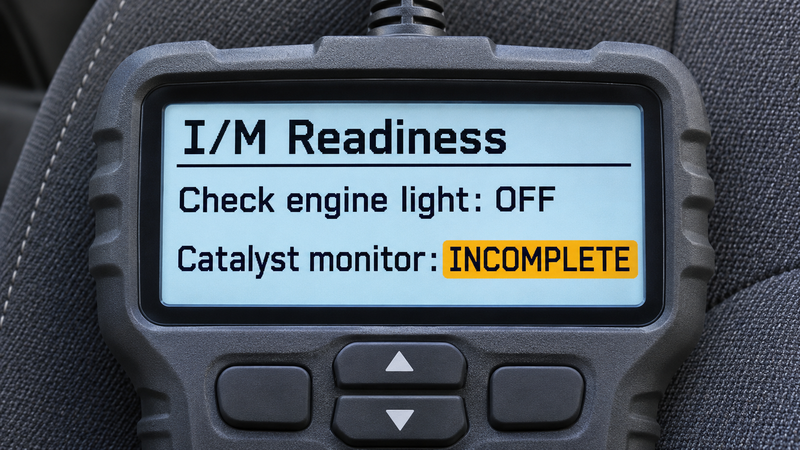
Read three things on the scanner.
First, check the warning light status with the engine running. The normal bulb check before the engine starts is separate. Next, open inspection readiness and find the catalyst monitor [the car’s built-in catalyst test]. Last, read pending, confirmed, and permanent codes.
“Complete” means the test ran. Check for a returning fault as well. If the light is off but P0420 is pending again, save the scan and call the shop before paying for a retest.
Follow the drive cycle for your car.
A drive cycle is a set of conditions the car needs to run a test. These can include a cold start, warm engine, and time at a steady speed. Use the instructions for your year and engine. Follow them only where traffic and speed limits allow.
If the test stays incomplete, ask what condition is missing. For instance, check whether the engine reaches its required temperature or another code blocks the test. There’s no single distance that works for every car. If the code returns on a highway exit, see how slowing down can help the catalyst monitor finish.
What Mode $06 adds.
Mode $06 [onboard test results] can show the measured result and its allowed limit. Ask the shop to identify the Bank 1 catalyst test for your engine. A raw number without its units, limit, or test ID won’t tell you which part to buy.
If your inspection is this week.
Call the local program with your model year and fuel type. Ask which incomplete monitors it allows and how it treats permanent codes. A commanded-on check-engine light fails an applicable OBD emissions check. Too many incomplete monitors can leave the station unable to complete the test.
California has a specific rule for certain retained permanent codes. Its program can disregard one after both 15 warm-up cycles and 200 miles since the last clear, subject to its rules. That doesn’t erase the code or excuse an active fault. If your deadline is close, ask the program about its retest or extension process.
P0420 questions drivers ask before paying for repairs
Can I drive with P0420, and for how long?
If the light is steady and the car feels normal, a short trip for diagnosis is usually reasonable. No fixed number of miles is safe for every fault. If the light flashes, the car shakes, or it loses power, stop safely and arrange help.
Will P0420 clear itself?
It can. If the fault stops and the car passes its checks, the light can go out on its own. Save the scan before it changes. A light that goes out between trips gives you less certainty than a completed test with no returning fault.
Will my car pass emissions with P0420?
Check whether the computer still commands the light on. An active emissions fault that commands the light on fails an applicable OBD test. An old code with the light off is a different case. The station also checks readiness under your local rules.
Can I clear the code right before the test?
Clearing it resets readiness and can erase the snapshot your technician needs. Your car then has to run its tests again. Read the readiness screen before you book. Leave the stored evidence in place.
Why does my scanner still say “permanent” after the repair?
Your car keeps that record until it verifies the fix under the required conditions. A scanner and a battery disconnect can’t force it away. Ask the shop whether the relevant test has passed and whether any fresh code has appeared.
Is a used catalytic converter legal?
Don’t assume a salvage part is legal because it fits. Federal policy sets testing and labeling conditions for qualifying used original parts. Some states prohibit used converters. Ask the installer to document legal eligibility before you spend money on one.
Is my converter covered by warranty?
Check the VIN, mileage, and original in-service date with the dealer. The federal limit for a covered original converter on an eligible vehicle is eight years or 80,000 miles, whichever comes first. Ask whether any separate state or manufacturer coverage applies.
What if P0420 comes back after a new converter?
Contact the installer before buying another part. Bring the invoice and the fresh scan. Ask them to check the part application, new joints, sensor wiring, software, and any oil or fuel fault that could damage the unit. Have them review the repair warranty too. Take this post-replacement P0420 checklist to the installer.
What if it comes back after an oxygen sensor change?
Find out which sensor was replaced and what test it failed. Ask the shop to check its wiring and signal, then look for exhaust leaks. A new sensor can read a weak catalyst correctly. That alone gives you no reason to replace the other sensor. Here’s how to check the new oxygen sensor and its wiring.
Bottom line: what to do before you approve the repair
If you’re deciding how to fix P0420 code with a test date close, take two photos today. Save the code screen and the readiness screen. Then call with your VIN and ask whether a warranty or bulletin fits your car.
Before you approve a converter, ask one question: “What test showed my Bank 1 converter failed?” After the work, ask to see the completed catalyst test and the new code scan. Those two records help you decide whether to pay for an inspection or take the car back to the shop.