
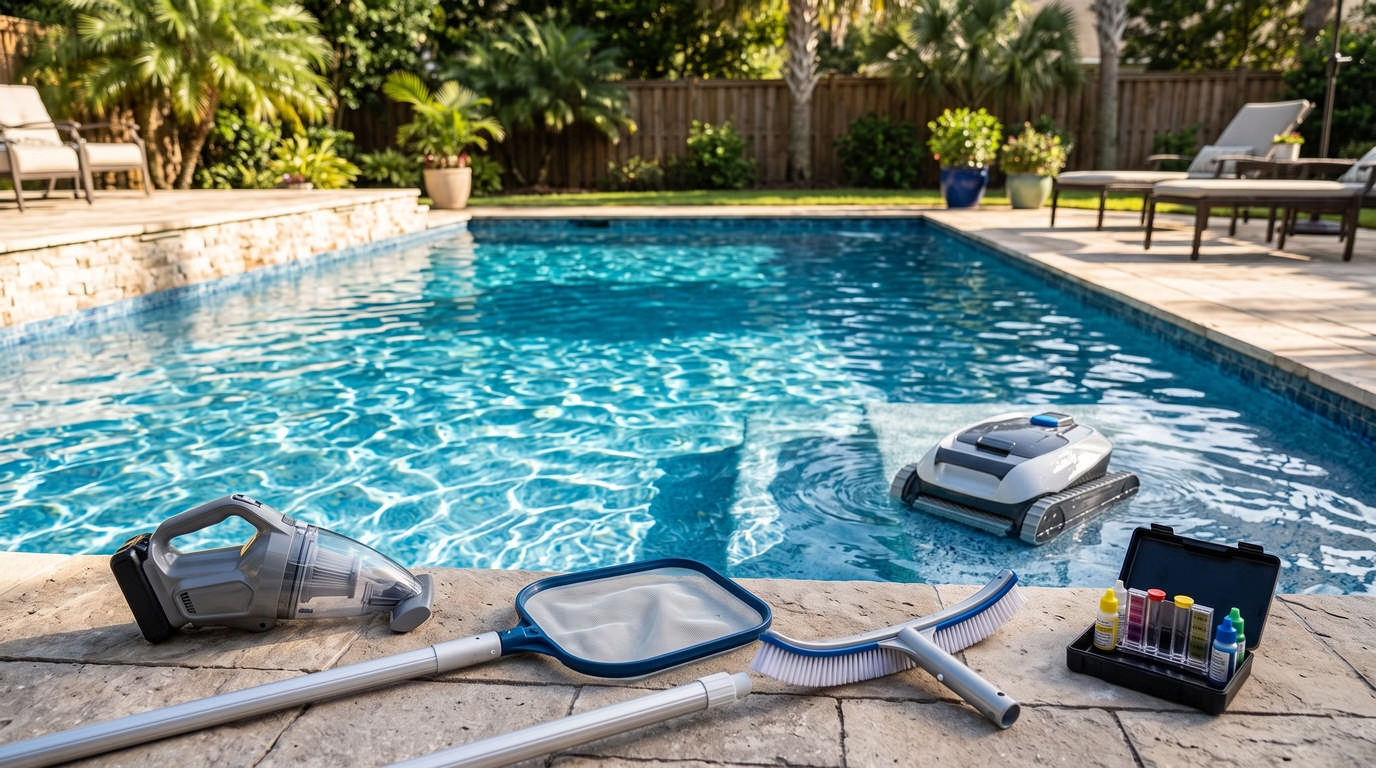
The best pool cleaning products solve clear problems. A skimmer catches leaves. A brush lifts stuck dirt. A good test kit helps you treat the water without guessing.
This guide covers ten useful pool products. You will find options for dirt, algae, cloudy water, leaves, and oily buildup. There are also two robotic cleaners for owners who want less hands-on work.
Affiliate disclosure: This roundup draws from thousands of owner reviews, forum posts, and buyer talks. The goal is to show how these products hold up after real use. Some links on this page are Amazon affiliate links. If you make a purchase, I may earn a small fee. Your price stays the same.
Quick Comparison Table
| Product | Best for | Pool type | How it works | Main benefit | Main drawback |
|---|---|---|---|---|---|
| Aiper Scuba S1 | Cordless whole-pool cleaning | Inground and some above-ground pools | Automatic | No power cord or hose | Must be charged |
| Aiper Seagull SE | Small flat pools | Above-ground and flat-bottom pools | Automatic | Simple and budget-friendly | Does not clean walls |
| ProTuff Pool Net | Leaves and large debris | Most pools | Manual | Strong frame and deep net | Needs a separate pole |
| ProTuff Pool Brush | Walls, steps, and corners | Most pools | Manual | Curved ends reach tight spots | Brush type must match your pool |
| Pool Blaster Max | Fast spot cleaning | Most pools | Cordless manual vacuum | Keeps dirt out of the main filter | You must guide it |
| Taylor K-2006 | Water testing | Chlorine pools | Drop-based test kit | Gives detailed test results | Takes time to learn |
| HTH Shock Advanced | Dull or troubled water | Most chlorine pools | Chemical treatment | Easy single-use bags | Not needed for every routine |
| Clorox Pool&Spa Super Water Clarifier | Mild cloudy water | Most pools | Chemical treatment | Helps filters catch fine debris | Cannot fix poor water balance |
| Polyquat 60 Algaecide | Algae prevention | Most pool surfaces | Chemical treatment | Metal-free formula | Not a cure for a green pool |
| Orenda CV-600 Enzyme | Oil and waterline buildup | Most pools | Enzyme treatment | Breaks down organic waste | Adds an ongoing cost |
Prices and formulas may change. Check the label and seller details before buying.
1. Best Overall Robotic Pool Cleaner: Aiper Scuba Series
The Aiper Scuba S1 is a solid fit for busy pool owners. You drop it in, choose a mode, and let it clean.
It uses tracks instead of small wheels. This helps it grip slopes and pool walls. It can clean the floor, walls, and waterline in supported pools.
The current model is made for pools up to 1,600 square feet. It has a listed run time of up to 180 minutes. Its 3.5-liter basket holds leaves, sand, and other debris.
Best for: You want cordless cleaning without a hose.
Not ideal for: You want unlimited run time or easy battery replacement.
What it cleans
- Loose dirt on the pool floor
- Sand and small debris
- Leaves that fit through the inlet
- Dirt on walls
- Some buildup near the waterline
What owners tend to like
You do not need to connect it to the pool pump. There is also no cord across the deck.
The top basket is easy to reach. After each cycle, you lift it out and rinse it.
The cordless design also works well in odd pool shapes. There is no cable to wrap around steps or ladders.
Where it may fall short
The robot may not clean every step or narrow ledge. Sharp corners can also hold dirt after a cycle.
You must recharge it between full runs. Once the battery ages, repair costs may matter more.
Heavy leaf loads can fill the basket fast. You may need to skim first during fall.
Pros
- Cordless design
- Cleans floors and walls
- Multiple cleaning modes
- Large top-load basket
- Fine filter option
- Works without your pool pump
Cons
- Costs more than manual tools
- Needs three to four hours to charge
- May miss steps and tight corners
- Heavy to lift when full of water
- Long-term battery life is hard to predict
Buying advice
Measure your pool before you buy. Check the total floor area, length, depth, and wall shape.
The Scuba S1 makes the most sense for regular upkeep. It does not replace water tests, brushing, or chemical care.
Want to compare more robots? See our roundup of the best cordless robot pool cleaners.
Check Price on Official Site2. Best Budget Robotic Cleaner: Aiper Seagull Series
The Aiper Seagull SE is a simpler cordless robot. It works best in small pools with flat floors.
You press one button and place it in the water. It moves across the floor and collects loose dirt.
This model does not offer the wall coverage of the Scuba S1. That limit matters. Do not buy it for a sloped inground pool without checking compatibility.
Best for: Small above-ground pools with flat floors.
Not ideal for: Deep pools, steep slopes, walls, or waterlines.
What it cleans
- Loose floor dirt
- Small leaves
- Bugs
- Sand
- Light debris
Why choose it over the Scuba S1?
The main reason is price. You pay for basic floor cleaning, not advanced pool coverage.
It is also smaller and easier to lift. That can help if you find large robots hard to handle.
Important limits
The Seagull SE does not scrub pool walls. It will not clean your waterline either.
It can also struggle with deep wrinkles in a vinyl liner. Large drain covers may block its path.
Expect to brush the walls by hand. You may also need a small vacuum for steps and corners.
Pros
- Lower cost than full-pool robots
- No cord or hose
- Light and easy to carry
- Fast setup
- Good for routine floor debris
Cons
- Floor-only cleaning
- Best on flat surfaces
- Small debris tray
- Needs frequent charging
- Not a good match for complex pools
Buying advice
Choose this model only if your pool suits it. Check the floor shape and pool depth first.
Do not pay less now if the cleaner cannot cross your pool. The right fit matters more than the lowest price.
Have an above-ground pool? Our guide to the best robotic pool cleaners for above-ground pools covers flat-floor models in more depth.
Check Price on Official Site3. Best Pool Skimmer Net: ProTuff Leaf Rake

Robots clean below the surface. They do not always catch floating leaves before those leaves sink.
The ProTuff Pool Net Leaf Skimmer Rake gives you a quick fix. Its deep bag holds more debris than a flat skimmer.
Pool owners often praise ProTuff nets for their strong build. Users also like the angled front edge for floor debris.
Best for: Leaves, bugs, seed pods, and storm debris.
Not ideal for: Very fine pollen without a fine-mesh version.
Features that matter
- A firm frame that does not bend
- A deep bag for large leaf loads
- A sloped front edge
- A net that empties with little effort
- A standard pole connection
How to choose the right net
Choose a deep rake for large leaves. Pick a flat, fine-mesh net for bugs and pollen.
A large net holds more. Yet it can feel heavy when full.
A smaller net is easier to guide. It may be better for fast daily use.
Pros
- Strong frame
- Large debris capacity
- Useful on the surface and floor
- Replaceable net on some models
- Fits many common pool poles
Cons
- A deep net feels heavy when full
- Fine dirt may pass through
- Pole may be sold on its own
- Costs more than a basic net
4. Best Pool Brush: ProTuff Curved Wall Brush

Even a good robot may miss steps and corners. A pool brush reaches those areas.
The ProTuff curved pool brush has angled ends. These ends help you brush walls, curves, and tight spots.
Best for: Weekly wall, floor, step, and corner care.
Not ideal for: Pools that need a different brush material.
Match the brush to your pool
Pool surfaces are not all the same. A safe brush for plaster may harm a vinyl liner. Use this simple guide:
- Vinyl liner: Soft nylon bristles
- Fiberglass: Soft nylon bristles
- Painted pool: Soft nylon bristles
- Plaster: Nylon or approved mixed bristles
- Tile: A brush made for pool tile
Avoid metal bristles unless your pool maker allows them. They can tear liners and mark soft surfaces.
How to get better results
Brush from the top down. Push loose dirt toward the main drain.
Give steps and corners extra care. These spots have weak water flow and often collect dirt.
Brush before running your robot. The cleaner can then catch the loose debris.
Pros
- Curved ends reach corners
- Wide head covers more area
- Helps stop surface buildup
- Pairs with standard poles
- Useful even if you own a robot
Cons
- Needs manual effort
- Pole may not be included
- The wrong bristles may harm a pool
- Wide heads can feel hard to push
5. Best Manual Pool Vacuum: Pool Blaster Max

Some dirt needs fast, direct cleaning. You may not want to run a robot for one dirty step.
The Pool Blaster Max is a cordless hand-guided vacuum. You attach it to a pool pole and guide it over dirty areas.
Forum users often mention it for spots that pool robots miss. They also like that its filter holds debris outside the main pool system.
Best for: Steps, corners, sand, and quick spot cleaning.
Not ideal for: Fully cleaning a very large pool by hand.
Why it fills a useful gap
A robotic cleaner may miss a shelf. A hose vacuum can take time to set up. The Pool Blaster Max sits between those two tools.
It starts fast and does not need a pool hose. It also keeps collected dirt away from the main filter.
That helps when you clean up sand, pet hair, or small debris.
What to know before buying
The filter type affects what it catches. Standard bags may let very fine silt pass. Look for a fine filter bag if dust is your main issue.
Clean the bag after each use.
Battery care also matters. Store the unit as directed and keep the charging port dry.
Pros
- Cordless
- Fast setup
- Good for steps and corners
- Does not use the pool pump
- Useful beside a robotic cleaner
Cons
- You must guide it
- Fine silt may need a better filter bag
- Battery will wear with use
- Not ideal for large whole-pool jobs
6. Best Pool Water Test Kit: Taylor K-2006

Clear water begins with good test results. If your numbers are wrong, each chemical dose becomes a guess.
The Taylor K-2006 is a drop-based test kit. It checks free chlorine, used chlorine, pH, alkalinity, calcium, and stabilizer.
Its chlorine test uses a count-the-drops method. This gives a clear result without matching two close colors.
Best for: Pool owners who want detailed home testing.
Not ideal for: Anyone who wants a ten-second test strip.
What the kit tests
- Free chlorine: Chlorine that can still sanitize
- Combined chlorine: Chlorine that has reacted with waste
- pH: How acidic or basic the water is
- Total alkalinity: Helps keep pH steady
- Calcium hardness: The amount of dissolved calcium
- Cyanuric acid: Stabilizer that shields chlorine from sunlight
Why it beats quick strips
Test strips are fast. Yet small color gaps can be hard to read.
A drop kit takes longer. In return, you get a more exact view of your water.
That can help you avoid random chemical use. You can treat the problem shown by the test.
Downsides to consider
The kit has a learning curve. Your first few tests may feel slow.
Reagents also expire. Store them in a cool, dry place and replace them as needed.
The standard K-2006 uses smaller reagent bottles. The K-2006C may offer better value if you test often.
Pros
- Tests the main water factors
- Clear chlorine test
- Replaceable reagents
- Useful for problem solving
- Reduces guesswork
Cons
- Costs more than strips
- Takes longer to use
- Small bottles may run out fast
- Needs safe, cool storage
7. Best Pool Shock: HTH Shock Advanced

Pool shock raises the sanitizer level for a set task. It may help after heavy rain, high swimmer use, or a water problem.
HTH Shock Advanced comes in measured bags. That makes storage and dosing easier for many owners.
Still, shock is not a weekly need for every pool. Your test results should guide its use.
Best for: Pool owners who want pre-measured shock treatment.
Not ideal for: Owners who add chemicals without testing first.
Check the active ingredient
The front label does not tell the whole story. Read the active ingredient before you buy. Common shock types include:
- Calcium hypochlorite: Adds chlorine and calcium
- Dichlor: Adds chlorine and stabilizer
- Non-chlorine shock: Oxidizes waste without chlorine
Each type changes the water in a different way. The best choice depends on your current test results.
Safe use matters
Follow the exact label for your pool size. Never mix pool chemicals. Add each product on its own.
Keep chemicals dry and in their original tubs.
Do not use a guessed dose from a blog post. Product strength and pool size can differ.
Pros
- Pre-measured bags
- Easy to store
- Useful after certain water events
- Widely sold
- Multiple formula choices
Cons
- Some types raise calcium
- Some types raise stabilizer
- Not a fix for poor filtration
- Wrong use can harm water balance
8. Best Pool Clarifier: Clorox Pool&Spa Super Water Clarifier

Tiny bits of dirt may pass through a pool filter. A clarifier groups them together so the filter can catch them.
Clorox Pool&Spa Super Water Clarifier is made for mild cloudy water. It can help if your chemistry and filter are already in good shape.
Best for: Light cloudiness caused by fine debris.
Not ideal for: Green water, dead algae, or a broken filter.
What a clarifier can do
Clarifier can help with:
- Fine dust
- Pollen
- Small floating bits
- Mild haze after heavy pool use
It does not kill algae. It also will not correct bad pH or low chlorine.
Check the cause first
Test the water before adding clarifier. Then inspect the filter and water flow.
A dirty filter may need cleaning. A weak pump may need service.
If the pool is green, treat the algae problem first. Adding more clarifier may only waste money.
Pros
- Easy to add
- Helps filters catch fine debris
- Useful for mild haze
- Works with many pool types
- A small bottle can last many uses
Cons
- Easy to overuse
- Cannot sanitize water
- Does not fix algae
- May not help a badly cloudy pool
9. Best Algae Treatment: Polyquat 60 Algaecide

Here is the key point: most algaecides help prevent algae. They do not cure a green pool on their own.
If you need an algaecide, choose one marked Polyquat 60. This is a non-metal formula used for algae control and pool closing.
Pool-care forums often favor Polyquat 60 for limited preventive use. They warn that normal doses will not clear an active algae bloom.
Best for: Algae prevention and some pool-closing plans.
Not ideal for: Clearing an active green pool by itself.
Why the formula matters
Some algaecides contain copper. Copper can stain pool surfaces and affect hair color.
Other low-cost formulas may cause foam. This can be a problem in pools with water features.
Polyquat 60 avoids metal. It also tends to foam less than some basic formulas.
If your pool is already green
Start with a proper water test. Check chlorine, pH, and stabilizer. You will likely need to:
- Remove large debris.
- Check and adjust the water.
- Brush all pool surfaces.
- Use the correct chlorine process.
- Run and clean the filter.
- Vacuum dead algae.
Do not pour in several treatments at once. More chemicals do not always mean faster results.
Pros
- Metal-free formula
- Useful for prevention
- Low-foam design
- Can help during pool closing
- Safe for many surfaces when used as labeled
Cons
- Does not replace chlorine
- Will not clean a green pool alone
- Adds an extra cost
- May not be needed for normal care
10. Best Preventive Cleaner: Orenda CV-600 Enzyme

Sunscreen, lotion, sweat, and body oil enter your pool. These can form a dull line at the water’s edge.
Orenda CV-600 uses enzymes to break down organic waste. Enzymes are proteins that help split waste into smaller parts.
Best for: Pools with heavy swimmer use or oily waterlines.
Not ideal for: Replacing chlorine, brushing, or filtration.
Where enzymes help
You may find an enzyme product useful if you notice:
- Oily water
- A dark waterline ring
- Heavy sunscreen use
- Frequent pool parties
- Organic waste near the surface
An enzyme may reduce how fast oily film returns. You will still need to wipe and brush the waterline.
What enzymes cannot do
They do not kill germs. They do not replace chlorine. They also cannot correct high pH or poor water flow.
Treat enzymes as support, not core pool care.
Pros
- Helps break down oils
- May reduce waterline buildup
- Useful in busy pools
- Supports the filter
- Easy routine dose
Cons
- Ongoing cost
- Not needed in every pool
- Does not sanitize
- Results may take time
- Cannot replace manual cleaning
Buyer’s Guide: How to Choose Pool Cleaning Products
A long shelf of pool products can feel confusing. Start with the problem you can see. Then test the water before adding chemicals.
This keeps your routine simple and reduces waste.
Match the Product to the Problem
Floating leaves and bugs
Use a skimmer net first. Remove debris before it sinks.
A deep leaf rake works well after storms. A fine flat net is better for bugs and pollen.
Dirt on the pool floor
Use a vacuum or robotic cleaner. A robot suits routine whole-pool work.
A cordless hand vacuum suits steps, corners, and small messes.
Algae on the walls
Brush the surface and test the water. Fix the sanitizer level based on the test.
An algaecide should not be your first answer. It does not replace chlorine or brushing.
Cloudy water
Check these areas:
- Chlorine level
- pH
- Filter pressure
- Pump run time
- Filter condition
- Water flow
Use clarifier only after these areas look right.
Oils at the waterline
Wipe the waterline and brush the surface. An enzyme can help break down new organic waste.
You may need more care after parties or heavy sunscreen use.
Frequent whole-pool cleaning
A robotic cleaner can cut your hands-on work. It is most useful when the model fits your pool.
Keep a brush and skimmer nearby. Robots still miss some steps, ledges, and corners.
Check Your Pool Type
A good product for one pool may fail in another. Before you buy, check the points below.
Above-ground or inground
Some small robots work only on flat above-ground pools. They may fail on slopes or deep drains.
Full-size robots often cost more. Yet they can cover walls and larger floors.
Pool surface
Check whether the tool suits:
- Vinyl
- Fiberglass
- Plaster
- Concrete
- Tile
- Painted surfaces
This matters most for brushes and wheeled cleaners.
Pool shape
Steps, drains, tanning ledges, and sharp corners can trap a robot. Look for owner feedback from pools shaped like yours.
A robot that works in a plain rectangle may act differently in a curved pool.
Pool size
Check both pool length and floor area. Do not rely on gallons alone.
For cordless units, compare pool size with battery run time. The robot needs enough time to finish its route.
Consider Ongoing Costs
The purchase price is only the first cost. Plan for:
- Replacement filters
- Filter bags
- Robot brushes
- Batteries
- Test reagents
- Chemical refills
- New nets
- Replacement poles
- Repairs after warranty
Corded robots avoid battery charging. Cordless robots remove cable trouble but add battery wear.
A drop test kit also needs new reagents. Yet good test results may reduce unneeded chemical use.
Separate Convenience From Cleaning Performance
A cordless cleaner is easy to place in the pool. That does not prove it will clean well. Compare these points before buying:
Debris capacity
A small basket may work for sand. It may fill fast under trees.
Fine-particle filtration
Some filters catch leaves but pass fine dust. Check whether a fine filter is included.
Wall coverage
“Wall climbing” does not always mean full waterline cleaning. Read the exact coverage list.
Run time
Long run time can help in large pools. Yet route planning also affects the final result.
Retrieval
Cordless robots should be easy to remove. Check the weight after water fills the unit.
Care needs
You may need to rinse the filter after each cycle. Corded models also need dry cable storage.
A good cleaner saves work. It should not replace one task with several new ones.
Frequently Asked Questions
What pool cleaning products do I really need?
Most owners need five basic items:
- A water test kit
- A skimmer net
- A pool brush
- A vacuum
- The correct sanitizer
A robotic cleaner is optional. It can save effort, but it does not replace the basics.
Are robotic pool cleaners worth it?
They can be worth it if you clean often. They are also helpful for large floors and walls.
Your pool must match the robot. Check its size, slope, steps, and surface before buying.
Not sure about power type? Our corded vs cordless robotic pool cleaner comparison explains the trade-offs.
Can a robotic cleaner replace brushing?
Not fully. Robots may miss corners, steps, ledges, and small waterline spots.
Brush those areas by hand. You should also brush any visible buildup.
What is the best product for cleaning a green pool?
A single bottled product is rarely the full answer. Start with a reliable water test.
Then remove debris, brush the surfaces, correct the water, and run the filter. Maintain the proper sanitizer level during the cleanup.
What removes dirt from the bottom of a pool?
Use one of these tools:
- Robotic pool cleaner
- Manual hose vacuum
- Cordless pool vacuum
- Leaf rake for large floor debris
The best choice depends on the dirt. Fine dust needs a finer filter than large leaves.
How often should a pool be cleaned?
Skim as soon as you see floating debris. Brush and vacuum based on pool use and local conditions.
Pools near trees may need daily skimming. Covered pools may need far less.
Test the water on a steady schedule. Test more often during heat, storms, or heavy use.
What pool cleaning products are safe for vinyl liners?
Use soft nylon brushes and tools with smooth edges. Avoid sharp frames and harsh metal bristles.
Check each chemical and tool label. Make sure it lists vinyl pools as a safe use.
Do cordless pool cleaners work on walls?
Some do. Many budget models clean only the floor.
Check the exact model details. Look for clear floor, wall, and waterline coverage.
Can I use a robotic cleaner after adding pool chemicals?
Check both product labels first. Some treatments need time to spread or settle.
Do not place the robot in highly concentrated chemicals. Wait until the water reaches the safe range listed by the makers.
Final Thoughts
The best pool cleaning products should match your pool and its main mess. You do not need every bottle or tool on this list.
Start with a strong test kit, net, brush, and vacuum. Those four items cover most routine work. Add chemicals only when your water test shows a clear need.
If manual floor cleaning takes too much time, consider a robot. The Aiper Scuba S1 offers cordless floor and wall cleaning. The Seagull SE is the simpler pick for small, flat pools.
For an inground pool with walls and a waterline to clean, see our guide to the best robotic pool cleaners for inground pools.
Keep one rule in mind: buy for your pool, not the product label. A well-matched tool will serve you better than a long list of unused treatments.