
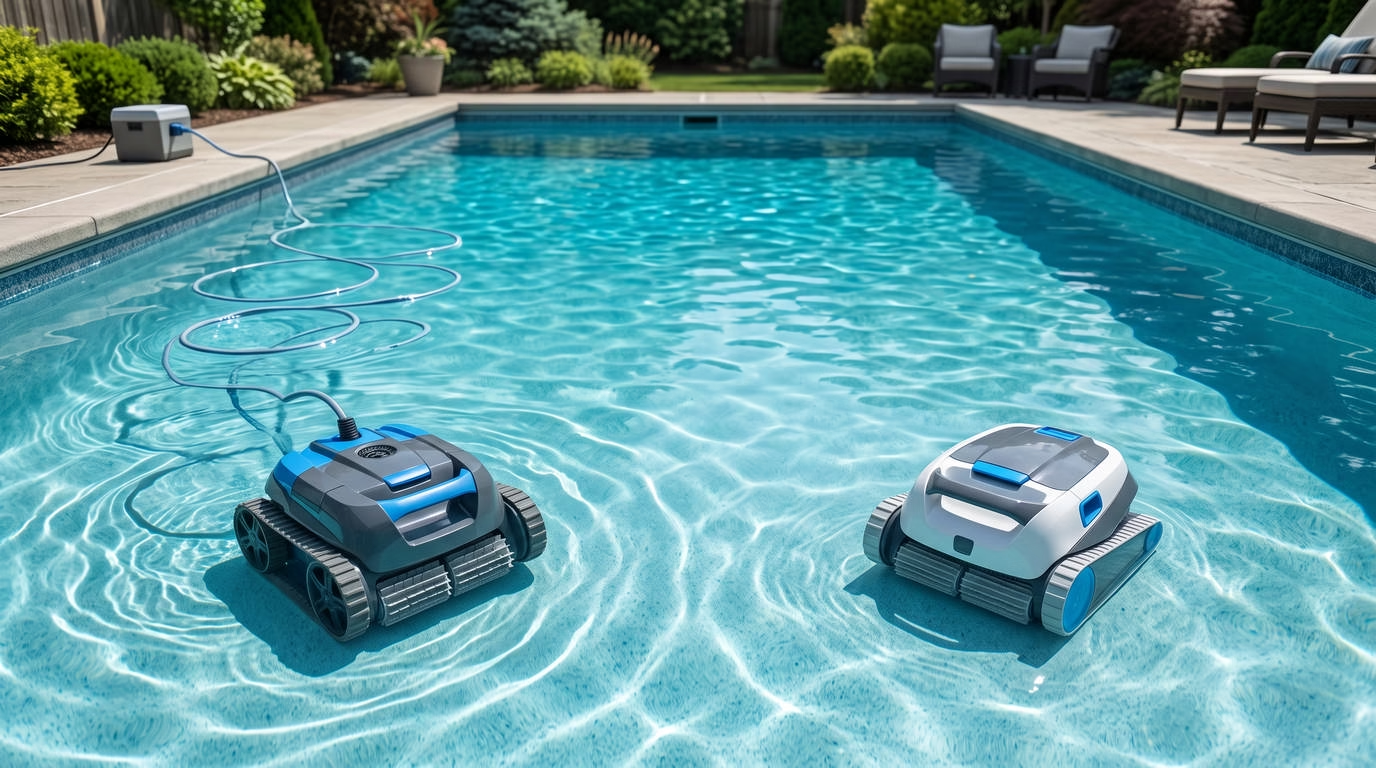
You searched for a robotic pool cleaner with cord. That makes sense. You may want steady power and long cleaning cycles. Or corded models may be the only type you know.
Here is the short answer. Corded cleaners still work best for some large pools. They also suit owners who never want to charge a battery. Cordless cleaners fit most average pools. They are easier to set up, store, and retrieve.
Neither design wins every time. The right choice depends on your pool and cleaning habits.
Affiliate disclosure: This page contains affiliate links, including Amazon and Aiper links. If you buy through one, I may earn a small commission at no extra cost to you.
At a Glance: Corded vs Cordless
| Feature | Corded cleaner | Cordless cleaner |
|---|---|---|
| Power source | Poolside outlet and power unit | Rechargeable battery |
| Runtime | Continuous during its set cycle | Limited by charge and mode |
| Setup | More parts and cable handling | Charge, select a mode, and place |
| Main benefit | Steady power | No cable |
| Main drawback | Cord tangles and storage | Charging and battery wear |
| Best fit | Very large or complex pools | Most small and medium pools |
| Long-term concern | Cable and power unit wear | Battery replacement |
| Simple verdict | Best for nonstop power | Best for ease and freedom |
Corded or Cordless: Why Power Type Matters
Buying a pool robot sounds simple until you compare power types.
A corded pool robot cleaner receives power from the pool deck. It can run without waiting for a battery to charge. That makes it appealing for large pools and long cleaning jobs.
A cordless robot carries its own battery. You do not need a power cable near the water. You charge it, place it in the pool, and let it work.
That freedom comes with a clear trade-off. The robot can only run as long as its battery allows. A small model may run for about 90 minutes. Larger models can work for several hours.
Quick Answer
Choose a corded cleaner if:
- Your pool is very large.
- One cycle may not cover the full pool.
- You have a safe outlet near the pool.
- You want steady power without charging.
Choose a cordless cleaner if:
- Your pool is small or medium in size.
- You dislike cable knots.
- You want fast setup and simple storage.
- A normal battery cycle can cover your pool.
How Corded and Cordless Robotic Pool Cleaners Work
Both types move through the pool on their own. They scrub surfaces and pull debris into a filter. The key difference is how they get power.
Corded Pool Robot Cleaner
A corded model connects to a power unit on the pool deck. That unit connects to an outlet. A long floating cable then supplies power to the robot.
The robot can clean during a set one, two, or three-hour cycle. Some models also support a weekly cleaning plan.
Its power does not depend on a battery. Yet that does not mean it runs all day. Most machines stop when the selected cycle ends.
The cable must be long enough for the full pool. You also need space for the power unit. It must stay dry and sit at a safe distance from the water.
Cordless Robotic Pool Cleaner
A cordless unit stores power in a rechargeable lithium-ion battery. You charge the cleaner outside the pool. Then you choose a mode and place it in the water.
Runtime depends on several things:
- Battery size
- Cleaning mode
- Pump strength
- Pool shape
- Water temperature
- Filter condition
- Amount of debris
More demanding modes use more power. Wall and waterline cleaning often drain a battery faster than floor cleaning.
The Case for a Corded Robotic Pool Cleaner
Cordless models have improved fast. Still, a corded cleaner has real benefits.
Steady Power Is the Main Advantage
A corded machine does not need to store enough power for the full job. It draws power through its cable.
That gives you consistent access to power during the cleaning cycle. You do not need to stop and recharge between back-to-back cycles.
This can help after:
- A storm drops leaves into the pool.
- Sand covers the floor.
- The pool has not been cleaned for weeks.
- A single cycle misses part of the pool.
- You need several deep-cleaning runs.
You can clean the filter, reset the cleaner, and run it again. There is no long wait for a new charge.
It Can Suit Large and Complex Pools
Very large pools take more time to cover. Irregular pools can also slow a robot down.
Curves, deep ends, drains, steps, and ledges may force extra turns. A robot may revisit one area while missing another. More runtime gives it another chance to finish the job.
Some corded cleaners also use strong pumps and large filters. They can be a good match for pools with frequent leaf fall or heavy dirt.
Still, check coverage before buying. A power cord cannot fix poor traction or weak route planning.
There Is No Battery to Replace
Rechargeable batteries wear down over time. A corded robot avoids that issue.
You may still need to replace:
- Brushes
- Tracks
- Filters
- Cable parts
- The power unit
- Small drive parts
Yet there is no large battery pack losing capacity each season. For frequent use, that may offer better long-term value.
Who Should Still Buy a Robotic Pool Cleaner Corded?
A robotic pool cleaner corded model may suit you if:
- Your pool is larger than most home pools.
- You often run two cycles in one day.
- Heavy debris is common.
- You have a safe and easy power setup.
- You do not mind handling a cable.
- You plan to keep the cleaner for many years.
- You prefer proven corded designs.
A good cord swivel can reduce twists. It cannot remove the cable. You must still uncoil, place, retrieve, and store it.
One corded option to compare is the Dolphin Quantum.

The Downsides of a Robotic Pool Cleaner With Cord
The cord solves the runtime issue. It also creates most of the daily hassle.
Cord Tangling Is the Biggest Complaint
A floating cable can twist as the robot turns. Over time, loops may form.
A swivel helps the cable rotate. Clean route planning can also reduce sharp turns. Neither feature can promise zero tangles.
A twisted cable may:
- Limit how far the robot can travel.
- Pull it away from a wall.
- Stop it from reaching the deep end.
- Make removal harder.
- Form a messy coil during storage.
The risk grows when too much cable sits in the pool. Only release the length your cleaner needs.
Setup Takes More Work
A robotic pool cleaner with cord needs more than the robot itself.
You must place the power unit in a safe spot. You must reach a suitable outlet. You also need to spread the floating cable across the water.
The robot may struggle if the cable catches on:
- Ladders
- Handrails
- Raised drains
- Sharp corners
- Steps
- Sun shelves
- Pool toys
Remove loose items before each run. Keep swimmers out while the robot works.
The Cable Adds Bulk
A wet cable can be awkward to lift. It also takes time to coil without adding more twists.
Storage can become a problem in a small shed. A cart helps, but it adds cost and uses more space.
Never lift a corded robot by its power cable. Use its handle or retrieval system. Pulling on the cord can damage the seal or connection.
The Cord May Limit How You Use the Pool Area
A power unit, cable, and cart can crowd a small deck. You must pack everything away after cleaning.
This may not bother you if the robot stays on a set schedule. It feels less convenient if you want a quick cleaning before guests arrive.
If the cord is the thing you do not want, cordless has caught up more than you may think.
The Case for Cordless, Including the Battery Trade-Offs
Cordless cleaners remove the cable. That changes the full ownership experience.
Setup becomes faster. Storage gets easier. There is less gear around your pool.
Still, cordless does not mean compromise-free.
Runtime Reality Check
Many cordless cleaners run for about 60 to 180 minutes. Small floor-only robots often sit near the lower end. Larger wall-climbing models tend to run longer.
Runtime on the box is a best-case limit. Your real result may be shorter.
Heavy debris can fill the filter quickly. A blocked filter makes the pump work harder. Cold or hot conditions may also affect battery output.
You should leave some spare runtime when matching a cleaner to your pool. Do not buy a model that only just meets your expected cleaning time.
Recent Models Can Run Longer
The Aiper Seagull SE is rated for up to 90 minutes. It cleans the floor and parks near the wall after its cycle or when power runs low. Its listed charge time is about two and a half hours.
The 2026 Aiper Scuba S1 is rated for up to 180 minutes in normal use. Its enhanced Eco mode can reach up to 270 minutes. The listed charge time is three to four hours.
The Aiper Scuba S1 Pro offers up to 180 minutes. It covers floors, walls, and the waterline. It is designed for pools up to 2,150 square feet.
Premium cleaners can run much longer in certain modes. The Aiper Scuba X1 Pro Max lists up to five hours for floor cleaning. Surface-only cleaning can reach ten hours. Those figures describe different jobs, not ten hours of full-pool scrubbing.
That detail matters. Always compare the same cleaning mode.
Performance Can Change as the Battery Drains
Battery-powered machines must manage the energy they have left. Some may lower power near the end of a cycle.
Even if pump power stays steady, movement may slow. A full filter can make the change feel worse.
You can reduce this problem by:
- Starting with a full charge.
- Cleaning the filter after each cycle.
- Choosing the right mode.
- Removing large debris first.
- Running the cleaner more often.
- Keeping the charging contacts clean.
Corded cleaners have an edge here. Their power does not depend on stored charge.
Batteries Lose Capacity Over Time
All rechargeable batteries age. Their runtime falls after repeated use and charging.
Heat can speed up that wear. Poor storage can also shorten useful life. Do not leave the robot baking in direct sun.
Before buying, check:
- Battery warranty
- Full product warranty
- Battery replacement cost
- Whether owners can replace it
- Local repair options
- Expected repair time
Battery replacement is the largest predictable cordless cost. A cheap cleaner may become waste if the battery cannot be serviced.
Charging Takes Hours
A cleaning cycle may last two or three hours. Charging can take just as long, or longer.
This matters when you need two full cycles in one day. A corded machine can start again at once. A cordless robot may sit out the next cycle.
Build a simple habit:
- Remove the robot after cleaning.
- Drain all trapped water.
- Rinse and empty the filter.
- Dry the charging area.
- Charge it in a cool, dry place.
- Unplug it after the charge completes.
Charging Safety Matters
Lithium-ion batteries hold a lot of energy. Damage, heat, or a failed charger can cause a problem.
Use the charger made for your model. Do not use a damaged cable or plug. Never charge the unit while its charging port is wet.
Stop using it if you notice:
- A swollen case
- A sharp chemical smell
- Heat beyond normal warmth
- Smoke
- Cracks near the battery
- Water inside the charge port
Choose a cleaner from a known company. Look for clear safety testing, support, and warranty terms.
Cordless Models Are Easier to Handle
The daily benefits are simple:
- No floating cord
- No poolside power unit
- Less deck clutter
- Faster setup
- Easier storage
- Fewer cable knots
Many Aiper cleaners park near a wall when their cycle ends. Some newer models return to the waterline or support app-based retrieval. The exact system varies by model.
Check the robot’s wet weight too. Even a light robot feels much heavier while full of water.
Compare current Aiper modelsCorded vs Cordless Comparison Table
| Buying factor | Corded | Cordless | Winner |
|---|---|---|---|
| Runtime | Runs through set cycles without charging | Limited by battery and mode | Corded |
| Power consistency | Steady wall power | May vary by charge and mode | Corded |
| Setup | Requires cable and power unit | Charge and place in pool | Cordless |
| Cord tangling | Possible | No power cord | Cordless |
| Storage | Cable and power unit add bulk | Fewer loose parts | Cordless |
| Small pool fit | Often more gear than needed | Simple and compact | Cordless |
| Very large pool fit | Easy to run again at once | Needs enough battery capacity | Corded |
| Battery replacement | No battery | Battery will age | Corded |
| Upfront cost | Wide price range | Wide price range | Tie |
| Poolside electrical setup | Needs a safe outlet and power unit near the pool | No poolside outlet needed | Cordless |
| Quick cleaning | More setup | Fast drop-in use | Cordless |
| Back-to-back cycles | No charge wait | Charging may delay the next run | Corded |
Which One Should You Choose?
Start with your pool. Do not start with the brand.
Measure its length and width. Note the surface type, slope, steps, and ledges. Then think about the debris you see each week.
Choose Corded If:
- You have a very large pool.
- Cleaning often takes several cycles.
- Your pool collects heavy leaves or sand.
- You want to avoid battery replacement.
- You have a safe outlet nearby.
- Cable storage does not bother you.
- You value steady power over fast setup.
A corded model can also suit a holiday rental. It may need several cleaning runs between guests.
Choose Cordless If:
- Your pool is small or medium.
- You hate cable management.
- You want quick setup.
- Storage space is limited.
- You clean on a regular schedule.
- One charge can cover the full pool.
- You are willing to care for a battery.
A cordless robot also makes sense if your deck has no easy outlet. It keeps a power unit and long cable off the pool edge.
Ready to compare cordless models? Start with our roundup of the best cordless robot pool cleaners.
Matching Pool to Model
Smaller or Above-Ground Pools
A floor-only model may be enough. The Aiper Seagull SE fits this role.
This model offers about 90 minutes of runtime. It covers pools around 850 square feet. It does not provide full wall and waterline cleaning.
Shopping for an above-ground pool? Our guide to the best robotic pool cleaners for above-ground pools covers both corded and cordless models.
Medium Inground Pools
Look at the Aiper Scuba S1 or Scuba S1 Pro class. Their 180-minute standard runtime can cover many home cleaning cycles.
Focus on coverage, not runtime alone. Check whether the model cleans floors, walls, steps, and the waterline.
A 180-minute floor-only robot is not equal to a 180-minute full-pool robot.
Our guide to the best robotic pool cleaners for inground pools compares six Aiper models by pool surface, size, and slope.
Larger Pools or Heavy Debris
Longer-runtime models offer more room for error. The Aiper Scuba X1 line is aimed at stronger cleaning and broader coverage.
The premium Scuba X1 Pro Max covers floors, walls, the waterline, raised areas, and the water surface. Its stated floor runtime reaches five hours.
You should also compare other brands. The Dolphin Nautilus EON 120d covers floors, walls, steps, ledges, corners, and the waterline. Its selectable cycles run for 1.5, 2, or 2.5 hours.
The Beatbot Sora 30 offers up to five hours. It also targets walls, the waterline, and shallow platforms.
These rivals may cost more. Yet they deserve a look if your pool has hard-to-clean ledges or high debris loads.
FAQ
Is a Robotic Pool Cleaner With a Cord Better Than Cordless?
Not for every pool.
A robotic pool cleaner with cord is better for nonstop access to power. It also handles back-to-back cycles without a charge break.
Cordless is better for easy setup and storage. It also removes the risk of a tangled power cable.
How Long Does a Cordless Pool Robot Run on One Charge?
Entry-level models may run for 60 to 90 minutes. Many mid-range models run for 150 to 180 minutes.
Some premium units reach several hours. Check the cleaning mode tied to each claim. Floor-only and Eco figures may not match full-pool runtime.
Do Corded Pool Robot Cleaners Tangle?
They can. A swivel may reduce twists, but it cannot remove every knot.
Use only the cable length you need. Straighten the cable after each run. Let it warm in the sun before coiling if it feels stiff.
How Long Do Cordless Pool Cleaner Batteries Last?
There is no fixed answer. Use, heat, charge cycles, and storage all affect battery life.
Expect runtime to fall over time. Check the battery warranty and replacement cost before buying.
Are Cordless Robotic Pool Cleaners Safe to Charge?
They can be safe when used as directed.
Charge the cleaner in a dry, shaded, and airy place. Use the supplied charger. Make sure the charge port is dry.
Do not charge a damaged or swollen battery.
Can I Leave My Cordless Robot in the Pool?
Remove it after the cleaning cycle unless the manual says otherwise.
Long exposure to pool chemicals can wear seals and plastic parts. Leaving the robot in the pool can also shorten battery life.
Removal gives you a chance to empty the filter. It also helps the cleaner dry before charging.
Steady Power or Total Freedom?
A corded cleaner gives you steady power. A cordless cleaner gives you freedom from the cable.
Choose a robotic pool cleaner with cord if your pool needs long or repeated cycles. Choose cordless if easy setup matters more than unlimited runtime.
If you are leaning cordless, compare current Aiper models against your pool size. Check the cleaning zones, charge time, wet weight, warranty, and battery terms. Do not buy based on runtime alone.
Compare current Aiper models