
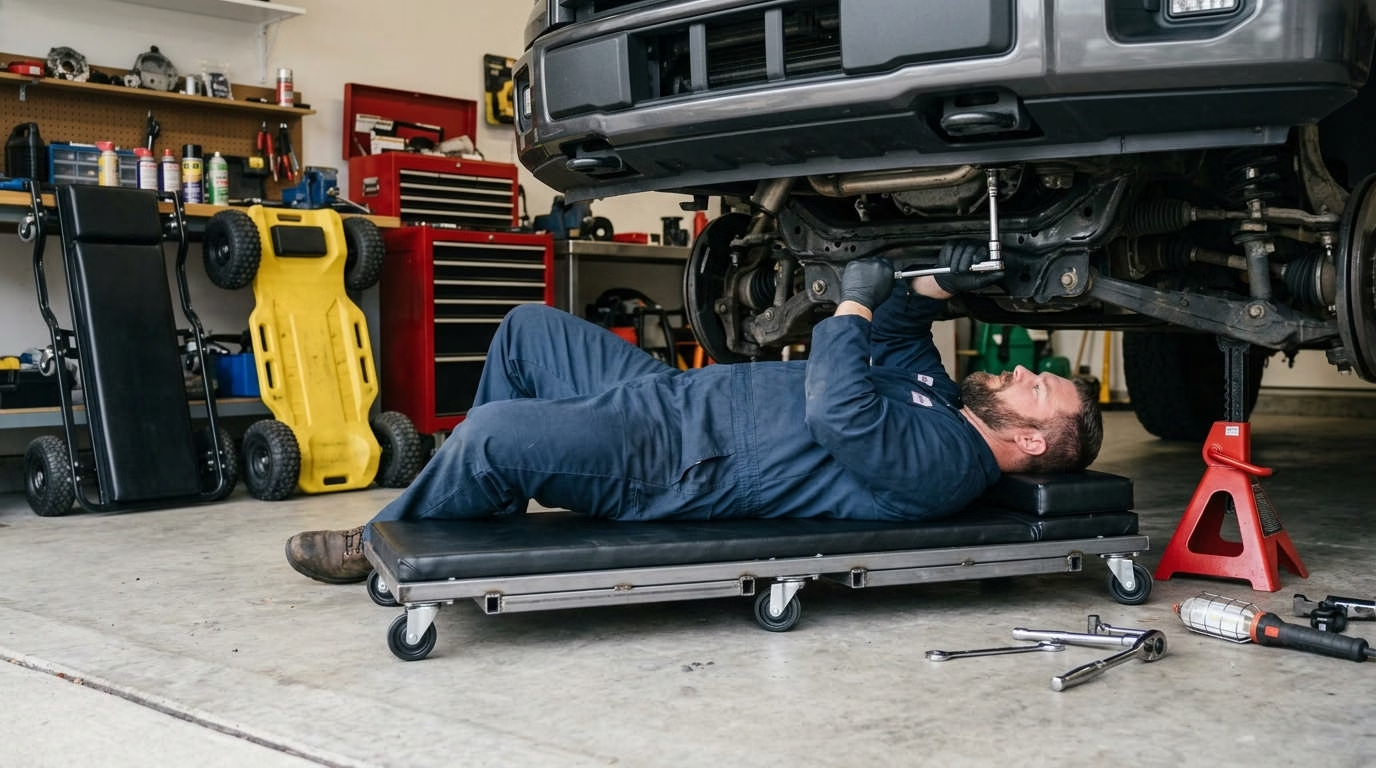
Research disclosure: I reviewed a large body of customer feedback, mechanic discussions, product documents, and buyer comments before ranking these picks. The goal was to reflect how owners describe long-term use, not repeat claims from product pages. However, these creepers were not physically load-tested for this article.
The best automotive creeper for big guys should do more than hold your weight. It must provide enough shoulder room, support a longer torso, and stay stable as you move.
The Pro-Lift C-6048 offers the best overall balance. It has a 48-inch body, 23-inch listed width, and 440-pound stated capacity. However, the right choice may change if you need a wider pad, stronger steel frame, or larger wheels.
This guide compares six researched products. Each one offers a clear benefit for big or tall users.
Why Most Creepers Do Not Fit Big or Tall Users Well
Many common creepers are only 38 to 40 inches long. Their narrow decks may also crowd your shoulders and upper arms.
A high load rating does not fix these problems. A creeper may hold your weight yet still feel short, cramped, or hard to roll.
Caster design matters too. Small wheels can catch on grit, floor seams, cords, and cracks. This issue often gets worse under a heavier load.
Getting on and off can also be a challenge. A very low deck gives you more room beneath the vehicle. Yet it may place more strain on your knees, hips, and core.
This guide looks past the basic “heavy-duty” label. Each creeper is judged by:
- Published width and length
- Usable body space, where known
- Manufacturer-stated weight capacity
- Frame or body construction
- Wheel size and caster placement
- Ground clearance
- Head, neck, and torso support
- Stability and ease of movement
- Feedback from owners and mechanics
Most brands do not publish usable shoulder width. Therefore, a 25-inch overall width may not give you 25 inches of body space.
Keep that point in mind as you compare these six options.
Quick Comparison: The Best Automotive Creepers for Big Guys
All capacity figures below come from the manufacturer or seller. They are not results from independent load tests.
| Product | Published width | Length | Stated capacity | Type & material | Caster setup | Best for | Main limitation |
|---|---|---|---|---|---|---|---|
| 23 in nominal | 48 in | 440 lb | Molded HDPE plastic | Six 3″ swivel casters | Best overall & tall users | Usable shoulder width not listed | |
| 25 in overall | 44 in | 400 lb | Padded steel frame | Six 3″ swivel casters | Broad users who want padding | Actual pad width not listed | |
| 20 in bed | 44 in | 500 lb | Padded tubular steel | Six 3″ industrial casters | Heavier users & frame strength | Expensive; only 20″ at the bed | |
| 21.25 in overall | 40 in | 400 lb | Padded wide-body deck | Four 5″ casters | Torso room & rough floors | Short for very tall users | |
| 25.5 in overall | 45.5 in | 300 lb | Molded copolymer body | Four 5.125″ wheels | Stability & proven shop use | Lowest stated capacity | |
| ~23 in | ~41 in | 400 lb | Molded HDPE body | Two 7″ wheels + one 3″ caster | Driveways & uneven floors | Large wheels raise working height |
This page contains Amazon affiliate links. If you buy through them, I may earn a small commission at no additional cost to you.
Important: Overall width may include wheels, frame rails, or raised sides. It should not be read as actual shoulder room.
The 6 Best Automotive Creepers for Big Guys
Each creeper below solves a different problem.
Some focus on length. Others offer more width, a stronger frame, or larger wheels. No single model will fit every large body shape or every garage.
1. Pro-Lift C-6048: Best Overall Automotive Creeper for Big Guys
Product overview
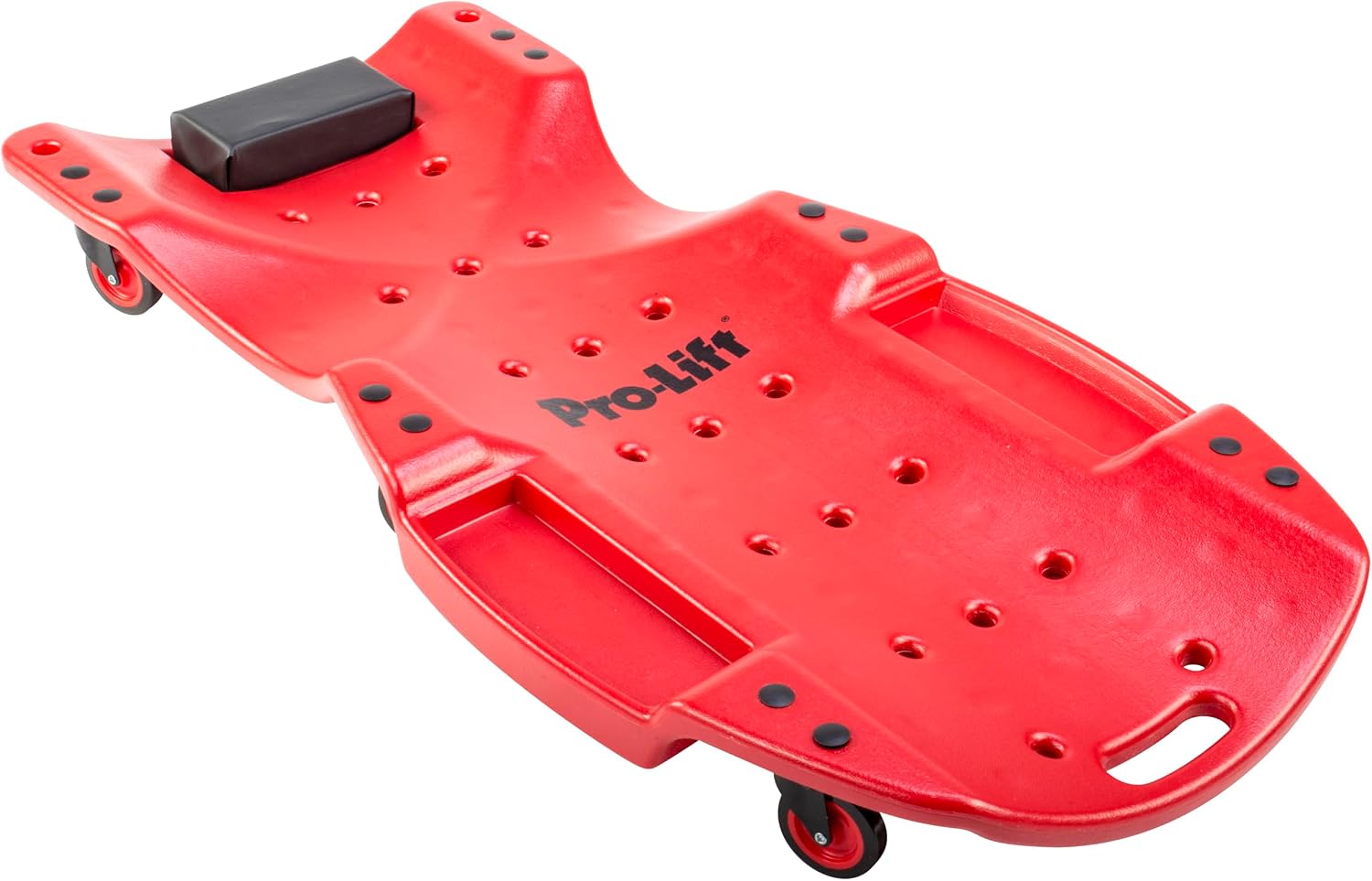
The Pro-Lift C-6048 is the strongest all-around option in this group. It combines more length with a higher stated capacity and a fairly wide molded body.
It is best suited to a tall or moderately heavy user. It also makes sense if you want a common six-caster design.
The C-6048 earned the top spot for three reasons:
- Its body is listed at 48 inches long.
- Its nominal width is 23 inches.
- Its manufacturer-stated load limit is 440 pounds.
Few conventional molded creepers combine all three.
Size and fit for big or tall users
The 48-inch body gives your upper back and torso more support. That can matter if shorter creepers leave your hips or shoulders in the wrong place.
Its 23-inch width also sounds roomy. However, that number does not confirm the space between its molded sides.
The body includes side trays and raised contours. These features may reduce the room available for your arms and shoulders.
Still, the C-6048 has a clear length advantage. It should be a better starting point for a tall user than a standard 38-inch creeper.
Your height alone does not tell the full story. Torso length, shoulder width, and headrest position also affect fit.
Weight capacity and evidence
Pro-Lift states that the C-6048 can support 440 pounds.
That rating is useful for screening options. It is not proof that the deck will feel firm and easy to roll at that exact load.
No controlled, independent 440-pound test was found during this research. There is also no published figure for deck flex.
You should leave some room below the stated limit. Work clothes, items in your pockets, and downward force from a stuck fastener can add stress.
Stability, casters and construction
The body uses one-piece blow-molded HDPE plastic. HDPE is a dense plastic that resists many common shop fluids.
Six 3-inch swivel casters support the deck. Their placement helps spread your weight across the body.
The larger wheels may roll better than small 2-inch casters. They can also raise your body farther from the floor.
That tradeoff matters beneath a low car. An extra inch of height can reduce your room near an exhaust, crossmember, or floor pan.
No clear independent data shows how much the body flexes near its limit. The 440-pound figure remains a manufacturer rating.
Comfort and everyday usability
A padded headrest supports your neck. The molded body also gives you a shaped surface instead of a flat plastic board.
Two side trays can hold small parts or hand tools. A built-in handle makes the creeper easier to carry and store.
The plastic surface wipes clean after oil or grease spills. That is a practical benefit over cloth padding.
The longer body may help during long jobs. However, molded contours can feel restrictive if they do not match your build.
Getting on should be simple on a clean, level floor. Sit down with care, then lower your upper body onto the deck. Avoid dropping your full weight onto one end.
Pros for big and tall users
- 48-inch nominal body length
- 23-inch listed width
- 440-pound manufacturer-stated capacity
- Six 3-inch swivel casters
- Padded headrest
- Easy-to-clean molded body
- Built-in tool trays and carry handle
Cons for big and tall users
- Actual shoulder space is not published
- The 440-pound rating lacks independent proof
- Molded sides may restrict broad shoulders
- Three-inch casters add working height
- No published deck-flex figure
Best for
Tall and moderately heavy users who want a balanced mix of length, capacity, and easy cleaning.
Key limitation
The 23-inch width is a product measurement. It is not proof of 23 inches of usable shoulder room.
2. Northern Tool XL Series: Best Extra-Wide Padded Creeper
Product overview
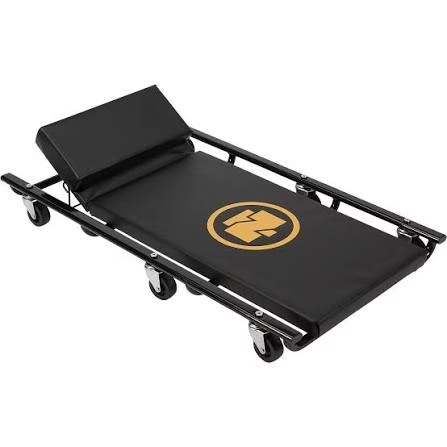
The Northern Tool XL Series takes a different path. It uses a padded steel frame instead of a shaped plastic shell.
Its listed size is 44 inches long and 25 inches wide. That makes it one of the broadest products in this six-creeper comparison.
It is best suited to broad users who prefer a flat pad. The thick foam may also reduce pressure on your shoulders and back.
Size and fit for bigger users
Northern Tool lists the creeper at 25 inches wide overall.
That is promising, but it is not a pad measurement. The steel frame and caster mounts may use part of that width.
The flat layout may still feel less cramped than a molded body. There are fewer raised plastic contours around your torso.
At 44 inches long, it should support more of your body than a basic 36-inch creeper. However, it remains four inches shorter than the Pro-Lift C-6048.
Tall users should check where the head pad, shoulders, hips, and knees will land. A long frame does not always mean a long usable cushion.
Weight capacity and evidence
The listed capacity is 400 pounds.
This gives heavier users more margin than a standard 300-pound creeper. Yet no independent load test was found for this model.
A steel frame may sound stronger than plastic. Frame material alone does not prove how the caster mounts or joints perform near the limit.
There is also no published flex data. Treat the rating as a stated limit, not a comfort score.
Stability and construction
The creeper uses a steel frame with six 3-inch swivel casters.
Its broad footprint may help it feel planted. However, stability also depends on caster position and how you get onto the pad.
Six wheels help spread the load. The 3-inch size should handle clean concrete and minor floor seams.
Deep cracks and loose hardware may still stop them. Keep the floor clear before you slide beneath a vehicle.
The padded frame may sit higher than a thin molded deck. Check the total deck height if your vehicle has limited space.
Comfort and usability
The main comfort feature is its thick foam padding. This can spread pressure across your back and shoulders.
A flat surface may fit more body shapes than a narrow molded channel. It also gives your arms more freedom if the pad is wide enough.
Padding has a few costs. Vinyl or fabric can trap heat during long jobs. It may also take more work to clean after a fluid spill.
A wide steel creeper is harder to carry than a light plastic model. You will also need more wall or floor space for storage.
Getting onto the flat end may feel natural. Still, do not assume its broad size prevents tipping. Lower your weight onto it in a smooth, controlled way.
Pros
- 25-inch published overall width
- 44-inch length
- Thick padded surface
- 400-pound stated capacity
- Flat support area
- Six 3-inch casters
- Fewer hard body contours than molded designs
Cons
- Actual cushion width is not published
- No independent 400-pound test was found
- Padding may trap heat
- Upholstery needs more care after spills
- Large frame takes more storage space
Best for
Broad-shouldered users who want a spacious padded surface instead of molded plastic.
Key limitation
The 25-inch figure includes the complete creeper. The usable pad could be narrower.
3. ShopSol 3010005: Best High-Capacity Steel-Frame Creeper
Product overview

The ShopSol 3010005 puts frame construction first. It uses welded one-inch steel tubing and industrial caster hardware.
ShopSol lists a 500-pound capacity. That is the highest stated rating among these six products.
The product also has a useful measurement that most brands omit. Its padded bed is listed as 20 inches wide.
This makes the comparison more honest. You know the width of the support area, not just the space across the wheels.
Size and fit
The ShopSol measures 44 inches long. Its padded bed is 20 inches wide.
A 20-inch bed offers more room than many narrow budget creepers. Yet it may still feel tight if your shoulders are very broad.
Measure your shoulders while lying in a natural working pose. Keep your arms where you would hold a ratchet or wrench.
Do not compare the bed width only with your chest. Your shoulders and upper arms often need more room.
The raised head area also uses part of the total length. A tall user should check where the hips and shoulders will sit.
Weight capacity and evidence
ShopSol calls its 500-pound rating a “real load” capacity. The company also links the rating to its frame design.
That wording is stronger than a vague heavy-duty label. Still, it remains a manufacturer claim.
No public, independent creeper test was found to confirm the full rating. Do not describe the product as independently tested to 500 pounds.
The frame details add confidence. They do not show how the pad or casters will feel during daily work at that load.
Stability and construction
The frame uses welded one-inch steel tubing. ShopSol also states that the caster flanges are welded into the frame.
That detail matters. Weak caster holes can loosen, round out, or wobble over time.
The creeper uses six 3-inch industrial casters. They are placed beneath a 44-inch frame to spread your weight.
ShopSol lists 1.5 inches of ground clearance. This helps the creeper pass over small floor seams and minor debris.
Ground clearance should not be confused with deck height. The padded bed and frame still add height beneath your body.
No deflection figure is published. In plain terms, you do not know how far the frame bends at full load.
Comfort and usability
The 20-inch bed is padded and covered in vinyl. It also has a raised, shaped headrest.
This layout may feel better during long repair work. It spreads pressure across your back instead of using hard molded ribs.
The steel frame makes the ShopSol heavier than a basic plastic creeper. Carrying it across a garage may take more effort.
Its low position gives you more working room. The same low position may make standing up harder if you have knee or hip limits.
A stable support point nearby can help you move down to floor level. Never use the vehicle itself as support unless it is secure.
Pros
- Highest stated capacity in the group
- Published 20-inch bed width
- 44-inch overall length
- Welded tubular steel frame
- Reinforced caster mounting design
- Six 3-inch industrial casters
- 1.5-inch stated ground clearance
- Padded body and head support
Cons
- Higher price than most basic creepers
- A 20-inch bed may still pinch broad shoulders
- Heavy and less easy to store
- No public independent 500-pound load test
- No published flex measurement
Best for
Heavier users who place frame design and stated capacity above low weight and low price.
Key limitation
Its 500-pound rating comes from the manufacturer. Also, a 20-inch bed may not suit every broad user.
4. Traxion WideBody 1-100: Best Wide-Body Design With Large Casters
Product overview

The Traxion WideBody 1-100 focuses on body shape and wheel size. It uses a broad contoured deck with four 5-inch casters.
The deck aims to reduce pinch points near your torso. That can help if narrow frame rails press against your sides.
This model suits broad users who work on imperfect concrete. It is less suited to very tall users who need maximum deck length.
Size and fit
Traxion lists the creeper at 40 inches long and 21.25 inches wide.
That width is for the full product. The brand does not give a separate shoulder or torso measurement.
Its shaped center may provide useful space around your upper body. Yet molded curves can fit one person and crowd another.
At 40 inches, this creeper is shorter than several picks above. Tall users may find that their lower torso or hips extend past the supported area.
The built-in lumbar shape may support your lower back. It may also place your body in a set position.
Weight capacity and evidence
Traxion states a 400-pound weight capacity.
No separate load test was found during the research. There is also no clear flex figure for the deck.
The rating tells you the claimed upper limit. It does not show how easily the creeper rolls with 350 or 400 pounds on it.
Caster bearings, wheel material, and floor quality all affect rolling effort.
Stability and construction
Four 5-inch casters sit outside the central deck. This creates a wide stance around your body.
Large wheels can cross floor gaps, cords, and small debris more easily. They are less likely to stop at every rough patch.
The creeper has 2 inches of stated ground clearance. That helps the wheels pass obstacles.
The tradeoff is body height. Large wheels may place you closer to the underside of the vehicle.
Four casters also create a different feel from a six-caster design. The wide layout may feel stable, but fewer support points can change how the deck carries weight.
No independent data confirms deck flex at the stated limit.
Comfort and usability
The deck includes padding and lower-back support. Its drop shape aims to avoid hard pinch points around your torso.
This design may feel more open than a steel frame with narrow side rails. Your body still needs to match the contours.
Large wheels make movement easier on rough floors. They may also help if a heavy load causes small casters to drag.
Getting on from the end should be done with care. The raised wheel areas can affect where you place your hands and hips.
The 40-inch size makes storage easier than a 48-inch creeper. It also limits support for long torsos.
Pros
- Wide-body deck shape
- Fewer torso pinch points
- Four large 5-inch casters
- 400-pound stated capacity
- Padded surface
- Built-in lower-back support
- Better rough-floor movement than small casters
Cons
- Only 40 inches long
- Usable deck width is not published
- Large casters increase working height
- Four-wheel layout may feel different from six casters
- No independent load or flex test
Best for
Broad users who value large wheels and an open torso area more than maximum body length.
Key limitation
Its 40-inch length could feel short if you have a long torso or tall frame.
5. The Bone 6031: Best for Stability and Mechanic Feedback
Product overview

The Bone 6031 looks very different from a common shop creeper. Your body sits low between four large wheels.
This shape gives it a wide stance and a low center. It also avoids small swivel casters.
The Bone has the strongest mechanic discussion behind it in this group. Owners often mention stability, long life, and easier travel over rough shop floors.
There is one major catch. Its stated capacity is only 300 pounds.
Size and fit
The Bone measures 45.5 inches long and 25.5 inches wide overall.
The width includes the large wheel areas. The central body channel is much narrower than 25.5 inches.
The maker does not publish usable shoulder width. This makes personal fit harder to judge.
Its 45.5-inch length is helpful for tall users. It is longer than standard 38 to 40-inch models.
The curved center may hold your body in place. Some users will like that support. Very broad users may find the same shape restrictive.
Weight capacity and evidence
The manufacturer rates The Bone for 300 pounds.
That is the lowest stated limit in this comparison. A heavy-looking body does not change the published rating.
Do not choose it if your body weight exceeds that limit. You should also account for anything else that may rest on the creeper.
Mechanic discussions provide useful signs of long-term strength. Some owners report hard shop use without the body sagging.
Those comments are personal reports. They are not controlled tests.
One heavy-truck discussion also raised concern about placing both a mechanic and a heavy part on the deck. This is a fair concern with any creeper.
Stability and construction
The body uses a one-piece molded copolymer. Its four wheels measure about 5.125 inches.
Your body sits between the wheels rather than above a tall frame. This helps keep the center of mass low.
The broad wheel placement may also reduce side tipping. Owner feedback often highlights this stable feel.
Large wheels can pass over cords, cracks, grates, and small floor obstacles. This makes The Bone useful in busy shops.
The listed ground clearance is about 1.75 inches. Actual body height still depends on the molded center and your weight.
The design has no middle casters. Some buyers worry that the long center might bow. Relevant owner feedback is positive, but no formal flex result is available.
Comfort and usability
The one-piece body has no thick padded headrest. Comfort comes from its shape rather than foam.
This makes cleanup simple. Oil and dirt can be wiped from the molded surface.
The curved deck can collect fluids near your back. Owners have raised this issue in shop discussions.
The wide stance may help as you get on and off. The low center can still make standing up hard if you have limited mobility.
Large wheels make rolling easier on rough concrete. They also reduce the sudden stops common with tiny casters.
Pros
- Strong mechanic and owner feedback
- 45.5-inch overall length
- Wide, stable wheel placement
- Four large 5.125-inch wheels
- One-piece molded body
- Easy to clean
- Good movement across rough shop floors
- Low central body position
Cons
- Only a 300-pound stated limit
- Central body width is not published
- No padded headrest
- Molded channel may restrict broad users
- Fluids can collect in the center
- Higher price than many plastic creepers
Best for
Large or tall users below 300 pounds who value stability, long life, and rough-floor movement.
Key limitation
The design looks large and strong, but its published limit remains 300 pounds.
6. Creepex FastBack Pro: Best All-Terrain Creeper
Product overview

The Creepex FastBack Pro targets rough shop floors and driveway work. It uses two large 7-inch wheels and one smaller front caster.
You can also change its ground clearance. One setting keeps you lower. The other helps on rough ground.
This creeper suits a larger user who struggles with small caster wheels. Its main strength is mobility, not maximum length.
Size and fit
Retail product data lists the FastBack Pro at about 41 inches long and 23 inches wide.
Do not confuse those dimensions with its shipping box. Product and package measurements are not the same.
The 23-inch width does not confirm shoulder room. Wheel areas and molded sides may use part of that space.
At about 41 inches long, it sits near the shorter end of this group. A very tall user may want more torso support.
Its molded shape may feel supportive for some bodies. Others may prefer a flat padded deck.
Weight capacity and evidence
Retail information gives the FastBack Pro a 400-pound capacity.
The manufacturer describes its body as heavy-duty HDPE. However, capacity details are less clear on some manufacturer materials.
That mismatch should make you cautious. It does not mean the rating is false, but the evidence is less direct.
No independent 400-pound load test was found. There is also no published deck-flex result.
Stability and construction
The FastBack Pro uses a three-wheel setup.
Two 7-inch wheels sit toward the rear. A 3-inch twin-axis caster controls the front.
Large rear wheels can roll over cracks and rough concrete. The front caster helps you steer beneath a vehicle.
A three-wheel base cannot rock between four uneven points. However, it can feel different as you enter, turn, or shift your body.
The adjustable clearance adds useful choice. Use the low setting when space is tight. Use the raised setting for rough ground.
The higher setting reduces the space between your body and the vehicle. Check that tradeoff before starting work.
Comfort and usability
The FastBack Pro includes a soft headrest and molded tool trays. It also has work lights and small-parts storage.
The large wheels reduce the effort needed to cross rough patches. This can be a major benefit under a heavier user.
Its molded surface should be easy to clean. The shaped body may help keep you centered.
The large wheels take more storage space than common swivel casters. They also make the full creeper taller.
Take care as you lower yourself onto the three-wheel platform. Keep the front caster straight and the floor clear.
Pros
- Two large 7-inch wheels
- Adjustable ground clearance
- 400-pound stated retail rating
- Molded HDPE body
- Soft headrest
- Built-in tool trays
- Work lights and small-parts storage
- Better suited to cracked concrete and driveways
Cons
- About 41 inches long
- Usable shoulder width is not published
- Capacity details are clearer through retailers
- Three-wheel handling may take time to learn
- High setting reduces under-car space
- No independent load test was found
Best for
Larger users who work on rough concrete, floor seams, or outdoor driveways.
Key limitation
Its large wheels improve travel but raise your body. The 400-pound rating also lacks independent proof.
How to Choose an Automotive Creeper for Big Guys
A good rating is only the first filter. Body fit and floor conditions matter just as much.
Use the points below before making your choice.
Width: Measure the Space Your Body Actually Uses
Overall width is often misleading.
A product listed at 25 inches wide may include:
- Wheels
- Steel frame rails
- Raised plastic edges
- Tool trays
- Caster mounts
What you need is usable shoulder width. This is the narrowest supported space near your shoulders and upper arms.
Measure your shoulders while lying in a natural pose. Place your arms where you would hold a tool.
Add a little room for:
- Work clothes
- Arm movement
- Reaching toward fasteners
- Turning your upper body
- Sliding on and off the deck
A flat pad may use its width better than a deep molded shell. However, a shaped shell can help keep you centered.
If the usable width is missing, contact the maker. Do not assume the overall width equals body room.
Length: Tall Users Need Supported Body Length
Advertisements often focus on total length. That number may include a handle, wheel housing, or raised headrest.
Your torso length is more useful than your total height.
Check where these body parts will land:
- Back of your head
- Shoulders
- Lower back
- Hips
- Upper legs
Your feet do not need to stay on the creeper. In fact, leaving them on the floor can help you move.
The problem starts when the headrest pushes your head forward. A short deck can also place the end beneath your lower back.
The Pro-Lift C-6048 has the longest conventional body here. Its 48-inch length gives tall users a better starting point.
Still, a 48-inch deck will not fit every tall person. Torso length and headrest shape remain important.
Weight Capacity: Rating Is Not the Same as Proof
A weight rating tells you the maker’s stated limit. It does not tell you how the creeper feels near that limit.
A highly rated creeper may still:
- Flex beneath your lower back
- Roll slowly under load
- Strain its caster mounts
- Feel narrow or unstable
- Wear faster near its limit
Leave some room between your body weight and the stated capacity. There is no single margin that fits every product.
Think about added force too. Pulling hard on a frozen bolt can push more weight onto one area.
Tools or parts may also rest on your body or the creeper. Do not place a transmission, axle, or other heavy part on a personal creeper.
Independent load tests would be ideal. They are rare in this product group.
Frame Strength and Flex
Creepers use several body types:
- Tubular steel frames
- Blow-molded plastic shells
- One-piece molded decks
- Padded drop-deck frames
None is always best.
A steel frame can spread weight well. Its joints and caster mounts still need sound design.
A molded plastic shell can be light and easy to clean. Thin areas may flex under a concentrated load.
Caster mounts deserve special attention. They often take more stress than the center deck.
Look for:
- Welded caster plates
- Metal wheel bushings
- Replaceable caster hardware
- Thick molded ribs
- Wide wheel placement
- Clear warranty terms
Brands rarely publish flex data. Be wary of claims that a deck “will never bend” unless a test supports them.
Caster Configuration and Clearance
More wheels can spread your weight across more points. Wheel count does not tell the full story.
A good caster also needs:
- Strong bearings
- Firm mounting hardware
- Enough wheel diameter
- Oil-resistant materials
- Space to swivel freely
Small wheels keep the creeper low. They also catch on grit and cracks more easily.
Large wheels cross obstacles with less effort. They raise your working position beneath the vehicle.
Four-wheel designs often use large wheels and a wide stance. Six-caster designs place smaller wheels along the body.
The best setup depends on your floor:
- Smooth indoor concrete: Small swivel casters can work well.
- Cracked shop floor: Larger wheels are easier to move.
- Outdoor driveway: Consider an all-terrain design.
- Very low vehicle: Favor a lower total deck height.
The creeper also needs enough space beneath its frame. Low parts can scrape on floor seams or cords.
Padding and Body Support
Padding can reduce pressure on your shoulders, spine, and hips.
More foam is not always better. Very soft padding may let your body sink and feel less stable.
Padded creepers may also:
- Hold heat
- Absorb odors
- Be harder to clean
- Tear near frame edges
- Flatten with long use
Molded decks wipe clean quickly. Their hard curves may create pressure points.
Head support matters during long jobs. A high headrest can strain your neck by pushing your chin forward.
Your goal is even support. The creeper should not force all your weight onto your shoulders or hips.
Ground Clearance and Working Height
Ground clearance and working height are different.
Ground clearance is the space below the creeper’s frame. It helps the creeper pass over cords and floor seams.
Working height is how far the deck lifts your body from the floor. This reduces your room beneath the vehicle.
Large wheels tend to improve ground clearance. They also raise your chest, face, and arms closer to the vehicle.
Before using any creeper, confirm that the vehicle has enough safe clearance. A proper floor jack and jack stands may be needed.
If you still need lifting gear, this comparison of the best floor jacks discussed by owners explains key differences between popular Daytona and Arcan models.
Never rely on a hydraulic jack alone while you work beneath a vehicle.
Getting Onto and Off the Creeper
A very low creeper can be hard to use if you have limited knee, hip, or core strength.
Look at the shape of the entry end. Raised wheels, narrow frames, and steep headrests can affect how you sit down.
Use these basic steps:
- Park on a level, clean floor.
- Clear tools, cords, and loose hardware.
- Keep the creeper straight.
- Sit down in a controlled way.
- Lower your upper body onto the deck.
- Keep your hands away from caster pinch points.
Do not drop onto one end. A sudden load can strain the deck and caster mounts.
To get up, roll clear of the vehicle first. Turn onto your side if that feels easier, then rise in a controlled way.
How We Evaluated These 6 Creepers
This comparison focuses on fit for large and tall users. It does not rank products by capacity alone.
What the comparison considers
Each product was assessed using nine factors:
- Published width
- Published length
- Manufacturer-stated capacity
- Frame or shell construction
- Caster layout and wheel size
- Padding and body support
- Relevant owner and mechanic feedback
- Suitability for larger or taller users
- Quality of available product details
A product needed a clear reason to appear. A vague heavy-duty label was not enough.
Evidence labels used in the article
Different evidence types answer different questions. They should not be mixed together.
Manufacturer specification
This includes details published by the brand, such as:
- Length
- Width
- Weight capacity
- Frame material
- Wheel size
- Ground clearance
These details are useful. They remain manufacturer claims unless someone else verifies them.
Independent testing
Independent testing uses a clear method outside the brand.
It could measure:
- Deck flex
- Caster drag
- Frame movement
- Stability
- Performance at full load
No common independent load test covered all six products. For that reason, this article does not call any model “400-pound tested.”
User or mechanic report
Customer reviews and mechanic discussions can show common patterns.
They may reveal:
- Weak caster mounts
- Hard-to-clean surfaces
- Poor movement over cracks
- Long-term cushion wear
- Deck sag
- Stability during daily use
These reports are useful, but they remain personal experiences. They do not prove a capacity rating.
Editorial assessment
An editorial assessment compares known details.
Examples include:
- Best overall balance
- Best published bed width
- Best frame details
- Best option for rough floors
- Better choice for tall users
These labels come from product comparison. They do not mean each creeper was physically tested here.
What was not evaluated
This article did not perform:
- Physical load testing
- Long-term garage testing
- Measured caster drag
- Deck deflection testing
- Controlled entry and exit tests
- Direct comfort testing across several body types
Usable shoulder width was also unavailable for most models.
Comfort can vary a lot. Two people with the same weight may have different shoulder width, torso length, and mobility.
Which Automotive Creeper Is Best for You?
Your best match depends on why common creepers fail for you.
Use these short picks to narrow the list.
Best overall for big and tall users: Pro-Lift C-6048
Choose the Pro-Lift if you want a balance of length, width, and stated capacity.
Its 48-inch body makes it the strongest tall-user choice. The 440-pound rating also gives it more capacity than most basic plastic creepers.
Best for very heavy users: ShopSol 3010005
The ShopSol has the highest manufacturer-stated rating at 500 pounds.
Its welded tubular frame and detailed caster mounts also give it the strongest construction case.
The 20-inch bed remains an important fit limit. Measure your shoulders before treating it as a wide creeper.
Best for tall users: Pro-Lift C-6048
The C-6048 has a 48-inch nominal body.
That gives a long torso more support than the 40-inch Traxion or roughly 41-inch Creepex.
Check the headrest position as well. Total length alone does not confirm comfort.
Best extra-wide padded option: Northern Tool XL Series
The Northern Tool XL has a listed overall width of 25 inches.
It also uses a flat padded surface. That may feel less restrictive than a deep molded body.
The actual cushion width is not published. Treat 25 inches as the full product width.
Best for large casters and torso room: Traxion WideBody
The Traxion pairs a shaped wide deck with four 5-inch casters.
It makes sense if small wheels catch on your shop floor. Its no-pinch body shape may also give your torso more freedom.
The short 40-inch deck is its main drawback for tall users.
Best for established mechanic feedback: The Bone 6031
The Bone has a long history of mechanic and shop discussion.
Its large wheels and low central body help it cross rough floors. Its wide stance also supports a stable feel.
Stay below its 300-pound published limit. It should not be treated as a high-capacity pick.
Best for driveway or rough-floor work: Creepex FastBack Pro
The FastBack Pro is the most surface-focused option.
Its 7-inch rear wheels and adjustable clearance help on cracks and uneven concrete.
Choose it only if the added working height leaves enough room beneath your vehicle.
Frequently Asked Questions
What is the best automotive creeper for a heavy person?
The Pro-Lift C-6048 is the strongest balanced option. It combines a 48-inch body with a 440-pound stated capacity.
The ShopSol 3010005 is the better capacity-focused choice. It has a 500-pound stated limit and a welded steel frame.
Your shoulder width and mobility still matter. Capacity alone does not prove that either product will fit your body.
How wide should an automotive creeper be for a big guy?
There is no perfect width for every large user.
Measure your shoulders while lying in a working pose. Then add room for your arms and clothing.
Try to find usable deck width. Overall width can include wheels, frames, and tool trays.
Is overall creeper width the same as usable shoulder width?
No. Overall width measures the full product.
The supported body area may be several inches narrower. Raised sides and wheel housings can take away shoulder room.
Only treat a figure as usable width if the maker clearly labels it as bed, deck, or cushion width.
What capacity should a 300-pound person look for?
Look for a rating above your body weight. This gives you room for clothing, movement, and added force during work.
There is no single safety margin for every creeper. Construction quality and caster design also matter.
A 400-pound rating may be a useful starting point for a 300-pound user. It does not guarantee good fit or low flex.
Is a 400 lb automotive creeper suitable for a 300 lb person?
It may be, but check more than the rating.
You still need enough shoulder space, torso length, and floor clearance. The caster layout must also move well under your weight.
The rating should come from a known brand or seller with clear product details.
What is the best automotive creeper for tall people?
The Pro-Lift C-6048 is the leading tall-user option in this group. Its body is listed at 48 inches long.
The Bone 6031 is also long at 45.5 inches. However, it has a lower 300-pound rating.
Your torso length matters more than your full standing height.
Are extra-wide creepers more stable?
A wide stance can improve stability. It is not the only factor.
Wheel placement, frame stiffness, body height, and caster movement all affect the result.
A wide creeper can still tip if you drop your weight onto one edge.
Are large caster wheels better for heavier mechanics?
Large wheels often roll more easily over cracks, seams, and cords.
This can help under a heavier load. Small casters tend to stop more easily on grit.
Large wheels also raise your body. That reduces working room beneath the vehicle.
Does a higher weight capacity mean less creeper flex?
Not always.
A rating does not tell you how much the center bends. Frame shape, material thickness, and caster placement all affect flex.
Look for clear construction details. Published deflection tests are better, but they are rare.
Is a padded creeper better for a big person?
Padding can spread pressure across your back and shoulders. It may improve comfort during long jobs.
However, soft foam can trap heat and lose shape. Upholstery is also harder to clean.
A shaped plastic deck may feel better if it matches your body.
How do you get onto a low-profile creeper safely?
Start on a clean and level floor. Keep the creeper straight and clear of tools.
Sit down with control, then lower your upper body. Do not drop onto the end.
Roll fully out from beneath the vehicle before standing up.
Should a large mechanic choose a steel or plastic creeper?
A steel frame often provides clear support points and firm padding. It can also be heavy.
A molded plastic body is lighter and easier to clean. Its shape may feel less roomy around broad shoulders.
Choose based on fit and construction, not material alone.
Final Verdict: Choosing the Best Automotive Creeper for a Big Guy
The best automotive creeper for big guys depends on your body and floor.
The Pro-Lift C-6048 offers the best overall mix. Its 48-inch body and 440-pound stated capacity cover the most needs.
Choose the ShopSol 3010005 if frame details and stated capacity come first. Pick the Northern Tool XL if you prefer a broad padded platform.
The Traxion WideBody suits rough floors and broad torsos. The Bone 6031 offers strong shop feedback for users below 300 pounds. The Creepex FastBack Pro is the specialist pick for cracked concrete and driveway work.
Do not judge any creeper by capacity alone. Check the width, body length, caster height, stability, and support.
Most importantly, look for usable body space. That is the measurement many product pages leave out.