
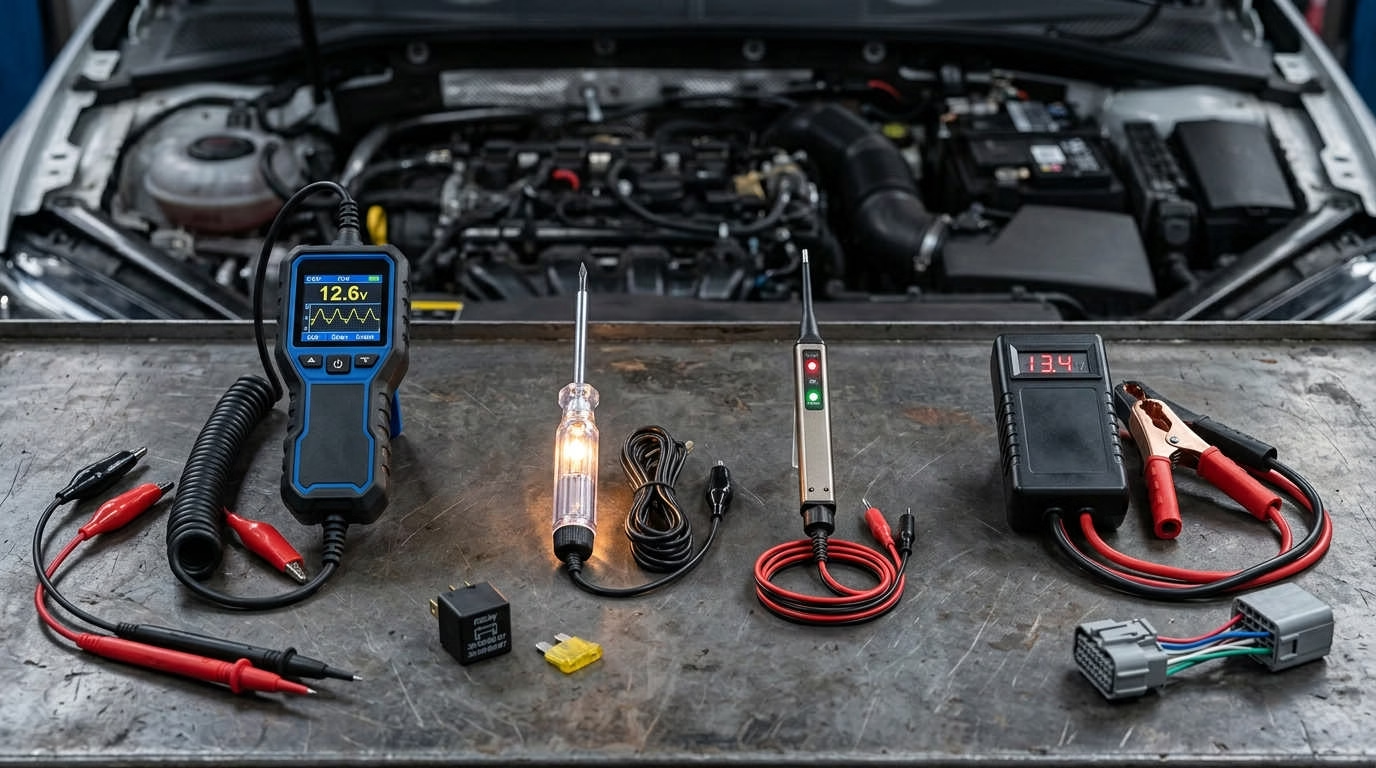
Before I ranked these tools, I reviewed a large mix of owner feedback, buyer reports, and technician discussions. The final picks reflect how these testers perform in real electrical work, not just what their product pages promise.
The best automotive circuit tester depends on the fault you need to find. A test light can check a fuse or lamp feed. A logic probe can detect a fast signal. A powered tester can run a motor or relay. A load tester can expose hidden resistance.
Those tools are not interchangeable.
For most users, the Power Probe PP4 is the best all-around choice. The OTC 3633 is better if you need a simple test light. For voltage-drop testing, the Electronic Specialties LOADpro is the strongest focused option.
This guide explains what each tester can prove, where it falls short, and how to use it safely.
Quick Comparison of the Best Automotive Circuit Testers
| Product | Best For | Tester Type | Passive/Powered | Voltage-Drop Testing | Key Strength | Main Limitation |
|---|---|---|---|---|---|---|
| Best Overall | Digital powered circuit tester | Passive and powered | Good with a live load | Wide range of useful test modes | More complex than many DIY users need | |
| Best Power Probe Alternative | Powered circuit tester | Passive and powered | Moderate | Selectable 3V, 5V, and 12/24V output | Test-load value was not clearly verified | |
| Best Automotive Test Light | Incandescent test light | Passive with bulb load | Basic visual check | Long cord and a useful small load | No voltage display | |
| Best Logic Probe | High-impedance signal probe | Passive probe | Poor | Detects power, ground, and pulses | Cannot prove current capacity | |
| Best Load Tester | Digital test light with load button | Passive with active load | Very good | Shows voltage under an 800 mA load | Load mode is unsafe for some circuits | |
| Best Budget | Incandescent test light | Passive with bulb load | Basic visual check | Simple, tough, and low cost | Limited to low-voltage 12V testing | |
| Best Professional | Powered tester with trace display | Passive and powered | Good with a live load | Shows and records changing signals | Costly, with mixed app feedback | |
| Best for Voltage-Drop Testing | Load-test leads for a multimeter | Passive with active load | Excellent within its load range | Exposes resistance hidden by an open-circuit test | Requires a separate multimeter |
This page contains Amazon affiliate links. If you buy through them, I may earn a small commission at no additional cost to you.
A voltage reading does not always prove that a circuit works. Some testers place a load on the wiring. Others draw almost no current.
That difference matters when you are chasing corrosion or a weak ground.
Powered means the tool can apply power or ground. It does not mean you can safely power every wire.
How We Selected These Automotive Electrical Testers
A long feature list does not make a circuit tester useful. The tool must help you answer a clear diagnostic question.
The eight picks were judged on:
- Real use in cars, trucks, and trailers.
- Feedback from technicians and vehicle owners.
- Test accuracy and repeatable results.
- Cable length and probe access.
- Build quality and strain relief.
- Ability to identify power and ground.
- Usefulness for load and voltage-drop tests.
- Protection against shorts and overloads.
- Safety around modern vehicle electronics.
- Value for DIY and professional use.
Manufacturer details helped verify voltage ranges, cable lengths, load values, and breaker functions. Owner feedback helped reveal weak points that a spec sheet may miss.
The most important distinction is simple:
Checking voltage is not the same as proving current flow.
A corroded wire may show 12 volts on a digital meter. Yet that same wire may fail as soon as a lamp or motor draws current.
A good tester must answer the question you are actually asking.
1. Power Probe PP4: Best Overall Automotive Circuit Tester

The Power Probe PP4 covers more daily electrical jobs than any other tester here. It measures voltage and resistance. It also checks frequency, pulse width, and injector activity.
Most importantly, it can apply battery power or ground. That lets you activate a suitable component and see whether it responds.
Who it is best for
The PP4 fits:
- Professional mechanics.
- Advanced DIY users.
- People who work on frequent electrical faults.
- Anyone who needs a long lead across a vehicle.
- Users who want one tester for measurement and activation.
It may be excessive for basic fuse and lighting checks. A simple test light can handle those jobs for far less.
What type of circuit testing it performs
The PP4 can perform:
- DC and AC voltage checks.
- Resistance tests.
- Continuity checks.
- Frequency measurement.
- Pulse-width tests.
- Fuel injector checks.
- Module-driver tests.
- Power-feed checks.
- Direct component activation.
That range makes it far more than a powered test light. However, it is not a full oscilloscope.
Features that matter in automotive diagnosis
The 23-foot cable is one of its best features. You connect the tool to the battery, then carry known power and ground through most vehicles.
The color display shows actual voltage. You do not need to judge a bulb’s brightness.
An 8-amp thermal breaker protects the powered output. It resets after an overload. That protection reduces the risk from a short, but it cannot fix a poor test choice.
The PP4 also has a low-current passive input. In passive mode, it places very little demand on the circuit.
Important strengths
The PP4 can replace several basic tools during quick checks.
You can use it to:
- Confirm power at a connector.
- Check whether a ground path exists.
- Run an isolated motor.
- Operate a relay or solenoid.
- Check injector activity.
- Carry power to the rear of a vehicle.
- Compare battery voltage with circuit voltage.
It is especially handy on trailers and body wiring. You do not need to hunt for a clean ground near each test point.
Important weaknesses
The PP4 has more modes than many users need. Menus can also slow you down during a simple fuse check.
It can display voltage through a weak connection. That is normal for a low-load voltage tester. You still need a real load to prove the wire can carry current.
Some owners prefer simpler Power Probe models for daily work. There are also individual reports of units failing after a drop. That does not prove a broad build flaw, but it is worth noting.
Real-world user feedback to discuss
Technicians often praise three things:
- The long cable.
- The known battery ground.
- The fast power and ground switch.
Many owners say the tool becomes a regular part of their electrical work. It can save time on lights, pumps, trailer wiring, and relays.
The main complaints focus on cost and complexity. Some people rarely use its advanced modes. Others prefer a basic test light for fast fuse checks.
Powered or passive?
The PP4 works in both ways.
It is passive while reading voltage or checking signals. It becomes active when you press the switch to apply power or ground.
That switch changes the circuit. Treat it as a component control, not a general test button.
Voltage-drop usefulness
The PP4 can monitor voltage while a component operates. That makes it useful for finding a weak feed or ground.
Its own feed test uses a light load. It may not expose every high-resistance fault.
For a stronger test, use:
- The actual component.
- A suitable bulb.
- The Lisle 28800.
- LOADpro leads.
- A multimeter across the suspect connection.
Safety considerations
Never press the power switch until you know the wire’s job.
Avoid applying power or ground to:
- CAN or LIN data wires.
- Airbag circuits.
- Sensor signals.
- Five-volt reference wires.
- Unknown ECU or PCM pins.
- Module-controlled outputs that remain connected.
Whenever possible, disconnect the component before direct activation. Check the wiring diagram first.
A breaker protects against excess current. It does not protect a module from voltage applied to the wrong pin.
Problems it is best suited to diagnose
The PP4 works well for:
- Bad relays.
- Failed solenoids.
- Inoperative lamps.
- Window motor faults.
- Door-lock problems.
- Pumps and fans.
- Trailer wiring.
- Missing power or ground.
- Basic injector and driver checks.
It is also good for separating a component fault from a wiring fault. If an isolated motor runs with direct power, the fault may be elsewhere.
Check PriceWho should choose another tester
Choose a simpler tool if you only test:
- Fuses.
- Lights.
- Trailer plugs.
- Basic 12V switches.
Choose a dedicated load tester if hidden resistance is your main concern. Use an oscilloscope for fast waveforms and network faults.
For more help reading sensor and engine data, see this guide to how to read OBD2 live data and fuel trims.
2. Innova 5420 PowerCheck: Best Power Probe Alternative

The Innova 5420 brings powered testing to a simpler package. It can apply 3V, 5V, or 12/24V to a suitable circuit or part.
That voltage choice is useful. Yet it also demands care. A 5V wire is not always safe to power with an outside 5V source.
Who it is best for
The Innova fits:
- DIY mechanics who want powered testing.
- Users working on body electrical faults.
- People who test isolated relays and motors.
- Owners who need a long cable.
- Buyers who do not need every PP4 mode.
Its 20-foot lead can reach most areas of a car or truck.
What type of circuit testing it performs
The Innova can help with:
- Voltage checks.
- Ground checks.
- Continuity testing.
- Fuse tests.
- Relay tests.
- Component activation.
- Battery voltage checks.
- Applying selected power or ground.
It is strongest as an activation tool. It is less suited to advanced signal analysis.
Features that matter
Key features include:
- Selectable 3V, 5V, and 12/24V output.
- A 20-foot cable.
- A backlit voltage display.
- Positive and negative lights.
- A swivel head.
- Internal circuit protection.
- A high-impedance measurement input.
The swivel body can help in tight spaces. You can position the display without twisting your wrist.
Important strengths
The main strength is controlled voltage choice. You are not limited to full battery voltage.
That can help during bench tests on parts designed for a known lower voltage. It also gives you a known power and ground source across the vehicle.
The display shows more detail than a plain test light. The tool can also save setup time versus loose jumper wires.
Important weaknesses
The supported output current was not clearly verified during research. The public details also lacked a full breaker trip chart.
That missing detail makes it harder to judge which motors or solenoids it can safely run.
It also lacks the PP4’s wider signal and injector modes. Long-term professional feedback is more limited.
Real-world user feedback to discuss
Owners report using the Innova on:
- Damaged truck harnesses.
- Window circuits.
- Accessory wiring.
- Relays and switches.
- General body faults.
The common positive theme is value. Users like getting powered-test functions without moving to a high-end unit.
Most feedback comes from retail buyers. There is less evidence from years of daily shop use.
Powered or passive?
The Innova is passive during normal voltage checks. It becomes active when it applies selected power or ground.
Its high input resistance protects passive measurements from drawing much current. That does not make its active output safe for every circuit.
Voltage-drop usefulness
The Innova can show voltage while a component operates. This works best when the component itself supplies the load.
It is not a dedicated dynamic load tester. No clear internal test-load value was verified.
If you suspect hidden corrosion, use the actual component or a known load. Then watch how voltage changes.
Safety considerations
Confirm the expected voltage before selecting an output.
Do not apply 3V or 5V merely because a wire carries a similar reading. It may be a module signal rather than a power feed.
Avoid active output on:
- CAN and LIN circuits.
- Airbag wiring.
- Sensor output wires.
- Unknown control-module pins.
- Reference-voltage circuits.
- Connected module drivers.
Whenever possible, isolate the part before powering it.
Problems it is best suited to diagnose
The Innova works well on:
- Fans.
- Pumps.
- Lamps.
- Relays.
- Small motors.
- Solenoids.
- Broken body wiring.
- Missing power or ground.
- Isolated component bench tests.
It can quickly tell you whether a properly isolated part responds to power.
Check PriceWho should choose another tester
Choose the PP4 if you need:
- Frequency measurement.
- Pulse-width testing.
- Injector modes.
- Wider signal analysis.
Choose the Lisle 28800 or LOADpro for a defined load test. Beginners may be safer with a passive test light and multimeter.
3. OTC 3633 Mini-Coil Cord Circuit Tester: Best Automotive Test Light

The OTC 3633 is a traditional incandescent test light. Its bulb draws a small amount of current from the circuit.
That load is the reason many technicians still use this basic tool. It can reveal a weak feed that lights a low-current LED with ease.
Who it is best for
The OTC suits:
- Professional mechanics.
- Home mechanics.
- Trailer and lighting work.
- Conventional 6V and 12V circuits.
- Users who want a long test lead.
It is a strong companion to a multimeter. It should not replace one.
What type of circuit testing it performs
Use it for:
- Power checks.
- Ground checks.
- Fuse tests.
- Switch checks.
- Basic open-circuit searches.
- Visual loaded-circuit checks.
It does not measure exact voltage.
Features that matter
The OTC uses a replaceable incandescent bulb. Its slim probe helps reach connector backs and fuse contacts.
The long coiled lead is a major benefit. It works well around trucks and trailers.
Other useful details include:
- Insulated probe shaft.
- Strong ground clip.
- Molded strain relief.
- Threaded accessory tip.
- Bright red bulb.
Important strengths
An incandescent bulb gives you more than a yes-or-no voltage check.
A bright bulb suggests the circuit can supply some current. A dim bulb may point to low voltage or excessive resistance.
The long lead also lets you connect directly to the battery. This gives you a known reference point during testing.
Important weaknesses
Brightness is subjective. Sunlight can make the bulb hard to judge.
The tool cannot tell you whether the probe sees 12.6V, 10V, or 7V. It also cannot prove that a circuit can support a high-current motor.
Most importantly, the bulb may draw too much current for sensitive wires.
Real-world user feedback to discuss
Technicians often name the OTC 3633 as a preferred filament test light. Its cable length gets frequent praise.
Users also value the small load from its bulb. It can expose faults that a low-current LED misses.
However, experienced users still keep other tools. They switch to a multimeter or logic probe for sensitive electronic circuits.
Powered or passive?
The OTC is passive. It cannot inject power through a switch.
Its bulb does place a load between the probe and clip. That load is small, but it still matters on low-current circuits.
Voltage-drop usefulness
The OTC can flag a likely voltage-drop problem.
For example:
- A bright bulb suggests a usable feed.
- A dim bulb suggests a weak feed or ground.
- No light suggests an open path or wrong connection.
It cannot measure the drop in volts. You need a meter for that.
Safety considerations
Do not use an incandescent test light on:
- CAN or LIN wiring.
- Airbag circuits.
- ECU signal outputs.
- Sensor signal wires.
- Unknown 5V circuits.
- Low-current module drivers.
Back-probe connectors where possible. If you must pierce a wire, seal the hole after testing.
Problems it is best suited to diagnose
The OTC is ideal for:
- Headlamp and tail-lamp feeds.
- Interior lighting.
- Trailer wiring.
- Fuse-box checks.
- Conventional switches.
- Relay power feeds.
- Chassis grounds.
- Open wires in normal 12V circuits.
Who should choose another tester
Choose a digital tester if you need an exact voltage.
Choose the OTC 3631 for low-current pulse checks. Pick a powered probe if you need to activate a part.
Use a load tester when you need a known current draw and a numerical result.
4. OTC 3631 Heavy-Duty Logic Probe Tester: Best Logic Probe

The OTC 3631 is a high-impedance logic probe. That means it draws very little current from the circuit.
It can show power, ground, and fast switching. It cannot prove that a wire can carry a useful load.
Who it is best for
This probe fits technicians who check:
- Injector pulses.
- Sensor switching.
- Solenoid commands.
- Tach signals.
- Cam and crank activity.
- Low-current electronic circuits.
It works best in skilled hands. You must know what its lights can and cannot prove.
What type of circuit testing it performs
The OTC 3631 can indicate:
- A high-voltage state.
- A low or ground state.
- A changing signal.
- Pulse activity.
- Basic sensor output activity.
- The presence of serial activity.
It cannot decode serial data.
Features that matter
The probe covers 3V to 26V. Red and green lights show voltage states.
It also has:
- A high-impedance input.
- A 12-foot twin-clip lead.
- Separate battery power and ground clips.
- A slim insulated probe.
- A molded strain relief.
The battery clips power the tool’s lights. They do not send battery power through the probe tip.
Important strengths
The tool loads a signal far less than an incandescent lamp. That makes it better for many electronic checks.
It also responds more clearly to pulses than a slow digital meter. You can quickly see whether a signal changes.
That can help you decide whether to move to a scope or inspect another part of the circuit.
Important weaknesses
The lights do not show exact voltage. They also do not reveal waveform shape.
The probe cannot measure:
- Signal size with precision.
- Duty cycle.
- Frequency as a number.
- Timing between signals.
- Network message content.
- Circuit current capacity.
A flashing light only proves that some activity exists.
Real-world user feedback to discuss
Technician views are mixed.
Some people like logic probes for fast pulse checks. Others see little benefit over a low-current LED tester.
One concern appears often: a high-impedance probe can show voltage through a poor connection. The signal may appear present even though the circuit cannot support a load.
That is not a flaw. It is a limit of this test method.
Powered or passive?
The tool’s electronics connect to battery power and ground. The probe tip remains a passive input.
It does not apply battery power to the point you touch.
Voltage-drop usefulness
The OTC 3631 is poor for voltage-drop testing.
Its input draws very little current. That allows it to detect a voltage through weak or corroded wiring.
Use a multimeter and a proper load if you need to test wire strength.
Safety considerations
OTC describes this model as suitable for computer circuits and airbag-safe. That label does not replace the vehicle’s service steps.
Never probe an SRS connector simply because a tool claims low current. Follow the maker’s test process.
On CAN wiring, this probe may show activity. It cannot confirm:
- Correct bus voltage.
- Proper resistance.
- Clean wave shape.
- Valid messages.
Avoid piercing twisted or shielded wires.
Problems it is best suited to diagnose
The OTC logic probe helps answer questions such as:
- Is the injector command pulsing?
- Is a Hall sensor switching?
- Is a solenoid receiving a command?
- Is a digital signal active?
- Is the wire held high or low?
Those are useful first checks. They are not full signal tests.
Check PriceWho should choose another tester
Choose a load tester for:
- Corroded wires.
- Weak power feeds.
- Poor grounds.
Choose a multimeter for exact voltage. Use a scope for waveform shape and timing.
A basic test light is better for fuses and normal lamp circuits.
5. Lisle 28800 Digital Test Light With Load Tester: Best Load Tester
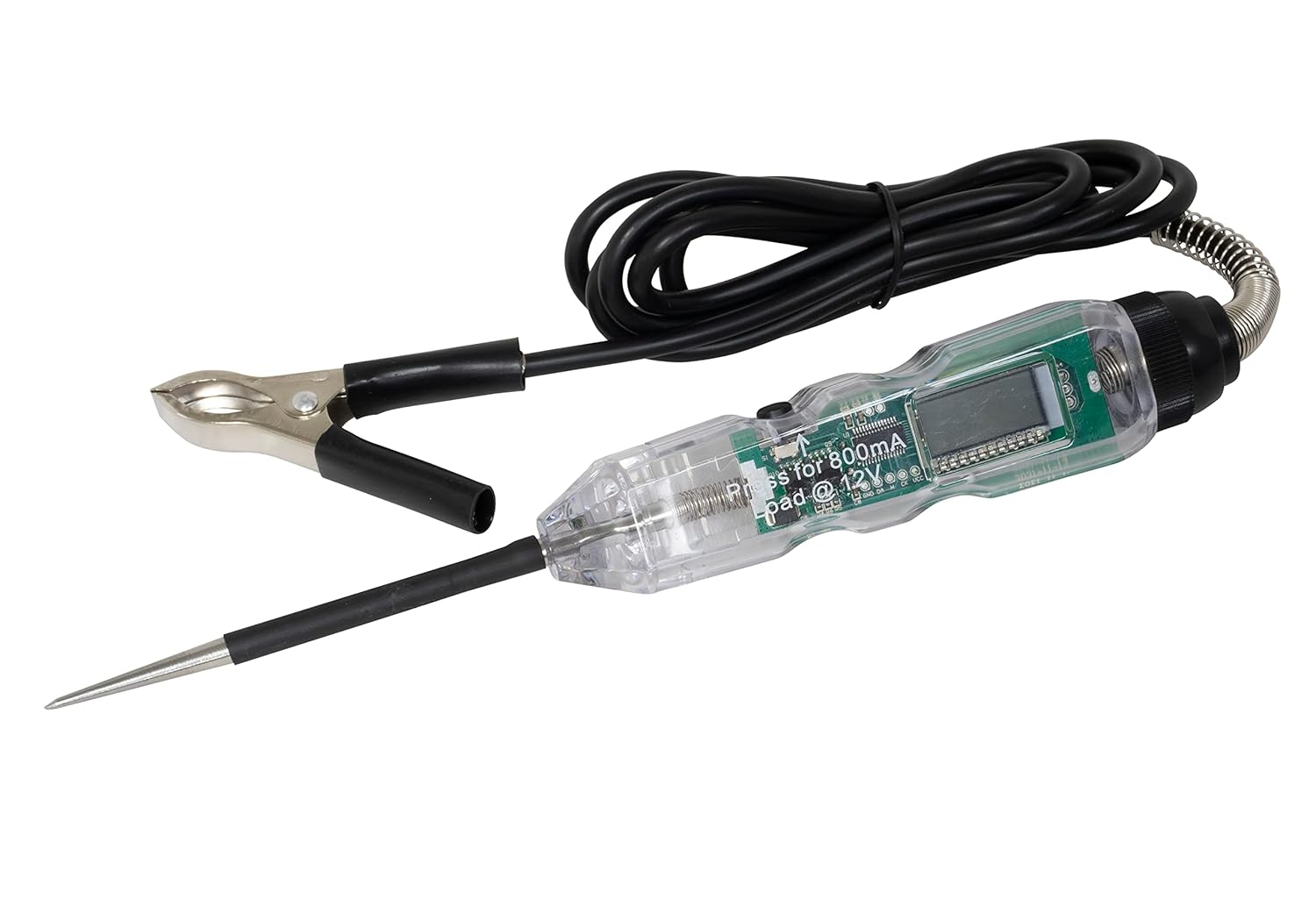
The Lisle 28800 combines a voltage display with a load button. It can show open-circuit voltage, then apply about 800 mA at 12V.
This helps expose resistance that a normal meter may miss.
Who it is best for
The Lisle suits:
- Technicians who need quick loaded checks.
- DIY users who understand circuit loads.
- People chasing corrosion.
- Users testing power feeds and grounds.
- Anyone who wants a numerical result.
It is faster than setting up a meter and a separate bulb for many small circuits.
What type of circuit testing it performs
The Lisle can perform:
- DC voltage checks.
- Polarity checks.
- Loaded power-feed tests.
- Loaded ground checks.
- Quick voltage-drop screening.
Its rated measurement range is 3V to 30V DC.
Features that matter
The button applies about 800 mA at 12V. That is enough to reveal many weak wires and terminals.
The display shows voltage before and during the load. A large fall points to added resistance.
It also has:
- A 48-inch cord.
- A heavy alligator clamp.
- Dual-polarity operation.
- Handheld one-button control.
Important strengths
The Lisle turns a common two-step test into one quick check.
You can:
- Read the unloaded voltage.
- Press the load button.
- Watch for voltage collapse.
This is much more useful than seeing 12V with no load. It can quickly uncover a poor connector or weak ground.
Important weaknesses
An 800 mA load cannot copy every component.
It is far below the draw of:
- A starter.
- A blower motor.
- A radiator fan.
- A rear defroster.
- A heated seat.
A circuit can pass the Lisle test and still fail under a larger load.
Some left-handed users may also find the screen direction awkward.
Real-world user feedback to discuss
Technicians describe the Lisle as fast and useful for quick checks. It works well when you need more proof than an open-circuit reading.
Users also note that it does not replace every load tool. Many professionals keep bulbs with different current draws.
The Lisle is best viewed as a compact 800 mA tester. It is not a universal load bank.
Powered or passive?
The Lisle is passive during a normal voltage reading.
Pressing the button adds a resistive load. It does not send battery power into the circuit like a Power Probe.
That difference is important. The button tests current flow rather than activating a part.
Voltage-drop usefulness
The Lisle is very useful for small and medium power feeds.
It can expose:
- Corroded terminals.
- Loose connections.
- Weak grounds.
- Damaged wire strands.
- Poor crimps.
- Faulty splices.
It works best when 800 mA is safe and meaningful for the circuit.
Safety considerations
Lisle states two clear limits:
- Do not use the load mode on computer circuits.
- Do not use the tool on airbag circuits.
Do not press its load button on:
- CAN or LIN wires.
- ECU outputs.
- Sensor signals.
- Reference-voltage circuits.
- Unknown module wiring.
Check the diagram first. Make sure the circuit can support the test load.
Problems it is best suited to diagnose
The Lisle works well for:
- Weak lighting feeds.
- Corroded plugs.
- Poor body grounds.
- Relay output wiring.
- Accessory circuits.
- Window and lock wiring.
- Circuits that fail only when connected.
Who should choose another tester
Choose a logic probe for changing signals. Use a powered probe to run an isolated part.
For starter cables, use the starter as the load. Measure the voltage drop with a multimeter.
Use the LOADpro if you already own a good meter and prefer separate leads.
6. Lisle 28400 Heavy-Duty Circuit Tester: Best Budget Automotive Circuit Tester

The Lisle 28400 keeps things simple. It is a reinforced incandescent tester for low-voltage 12V circuits.
It costs far less than a digital tester. Yet it can still answer many basic questions.
Who it is best for
The Lisle fits:
- Beginners.
- DIY vehicle owners.
- Students.
- Technicians who need a backup light.
- People working on older 12V systems.
It is a sensible first tester when paired with a multimeter.
What type of circuit testing it performs
Use it for:
- Fuse checks.
- Power checks.
- Basic ground checks.
- Switch testing.
- Lamp circuit tests.
- Simple open-circuit searches.
Its bulb also places a small load on the wire.
Features that matter
The Lisle has:
- A replaceable bulb.
- A reinforced probe.
- A reinforced handle.
- A 49-inch cord.
- A strong clip.
- A strain-relief spring.
Those simple parts tend to stand up well to normal garage use.
Important strengths
The tool is easy to understand. If the bulb lights, current has passed through it.
Brightness also provides a clue. A weak glow may point to a bad connection or low supply voltage.
The bulb is replaceable. You do not need to discard the whole tester after a lamp failure.
Important weaknesses
The Lisle does not show exact voltage or polarity.
Its lead is also shorter than the OTC 3633 cable. Some users find the clip or spring stiff.
The bulb may be hard to see in full daylight. Most importantly, it is not suitable for sensitive signal circuits.
Real-world user feedback to discuss
Owners often praise the build quality and simple design. Some report replacing much older Lisle lights after years of use.
Common complaints include:
- A stiff ground clip.
- A springy cord end.
- A dim-looking bulb outside.
Those issues do not erase its value. They show why a low-cost tool still has limits.
Powered or passive?
The Lisle is passive. It cannot apply power or ground by command.
Its incandescent bulb still draws current. That is useful on normal power feeds but risky on low-current outputs.
Voltage-drop usefulness
The Lisle can give a rough visual clue.
A dim bulb may mean:
- Low supply voltage.
- Corroded wiring.
- A poor ground.
- Resistance in a switch or connector.
Use a multimeter to measure the actual loss.
Safety considerations
Do not use it on:
- Airbag wiring.
- CAN or LIN lines.
- ECU signal circuits.
- Sensor outputs.
- Low-current module drivers.
- Unknown 5V wiring.
If you do not know what a wire does, identify it before testing.
Problems it is best suited to diagnose
The Lisle works best for:
- Blown fuses.
- Dead lamps.
- Trailer lights.
- Simple switches.
- Relay feeds.
- Chassis grounds.
- Open wires in basic 12V circuits.
Who should choose another tester
Choose another tool if you work on:
- 24V systems.
- Digital signals.
- Module networks.
- Sensor wiring.
- High-resistance faults needing exact numbers.
The OTC 3633 offers more reach. The Lisle 28800 adds a display and a known load.
7. Power Probe Maestro: Best Professional Automotive Circuit Tester

The Maestro combines powered testing with trace-style signal viewing. It can show a changing voltage as a line instead of only a number.
That can help with slow signals and intermittent faults. It still does not replace a full automotive scope.
Who it is best for
The Maestro fits:
- Professional technicians.
- Busy electrical diagnostic shops.
- Users who record test results.
- Mechanics who check changing signals.
- People comfortable with advanced test modes.
It is not a smart choice if you only check fuses and lamps.
What type of circuit testing it performs
The Maestro offers:
- DC voltage tests.
- AC voltage tests.
- True RMS readings [usable AC value].
- Peak-to-peak readings.
- Frequency tests.
- Duty-cycle checks.
- Resistance tests.
- Fuel-injector checks.
- Trace-style signal viewing.
- Component power and ground.
It can also connect with a companion app.
Features that matter
Key features include:
- A color display.
- Trace mode.
- Bluetooth connection.
- Signal recording.
- An 8-amp thermal breaker.
- A low-current passive input.
- IP54 housing [dust and splash resistance].
- Support for 12V and 24V systems.
Trace mode adds context to changing readings. A moving line can be easier to judge than fast numbers.
Important strengths
The Maestro is useful when a value changes over time.
Possible uses include:
- Watching alternator ripple.
- Checking a slow sensor sweep.
- Observing duty-cycle control.
- Logging an intermittent voltage loss.
- Recording test results.
- Activating a known component.
It can reduce the need to set up a scope for basic signal checks.
Important weaknesses
The Maestro costs more than the PP4. Many users may never need its trace or app features.
Its app has mixed user feedback. Connection problems appear often enough to consider.
Trace mode also has limits. It cannot match a scope for fast sample speed, several channels, or detailed waveform tests.
Real-world user feedback to discuss
Experienced technicians report that the trace can help when a full scope feels excessive. A larger phone or tablet screen may also improve readability.
Other users prefer simpler Power Probe models. They value faster setup over extra functions.
The app is the weakest part of the package. Buy into this tool type only if you would use the display and recording options.
Powered or passive?
The Maestro works passively in its meter and trace modes.
It becomes active when you apply battery power or ground. That output can run a suitable isolated part.
The low-current passive input does not make the power switch safe on unknown wiring.
Voltage-drop usefulness
The Maestro is good at watching voltage while a circuit operates.
Its trace can help show:
- A short drop.
- A changing ground fault.
- Voltage movement during harness flex.
- A supply that fails after warming up.
Its internal feed test uses a light load. Use the real component or a larger known load when needed.
Safety considerations
Do not treat trace mode as proof that a CAN signal is healthy. A clean-looking line on a handheld display may hide fast faults.
Before applying power or ground, verify:
- Wire function.
- Correct voltage.
- Correct polarity.
- Expected current.
- Module connection state.
Use a scan tool to command computer-controlled parts when that is the safer test path.
Avoid active output on airbag, data, sensor, and unknown module circuits.
Problems it is best suited to diagnose
The Maestro can help with:
- Intermittent voltage faults.
- Alternator ripple screening.
- Injector activity.
- Duty-cycle circuits.
- Pumps and motors.
- Relays and solenoids.
- Power and ground loss.
- Tests that need a saved trace.
Who should choose another tester
Choose the PP4 if you do not need app support or trace recording.
Choose a scope for:
- Fast glitches.
- Network signals.
- Several signals at once.
- Precise timing checks.
Choose a simple test light for routine fuses and lamps. Use LOADpro for controlled voltage-drop work.
8. Electronic Specialties 180 LOADpro: Best for Voltage-Drop Testing

LOADpro replaces normal multimeter leads with a lead set and load button. At 12V, it applies about half an amp.
That load can reveal a wire that looks good until current starts to flow.
Who it is best for
LOADpro fits:
- Technicians who own a good multimeter.
- DIY users learning voltage-drop tests.
- People chasing poor grounds.
- Anyone finding hidden corrosion.
- Users testing connectors and wire repairs.
It is a focused tool. It does not activate parts or read digital signals.
What type of circuit testing it performs
LOADpro helps with:
- Loaded voltage checks.
- Power-side testing.
- Ground-side testing.
- High-resistance fault detection.
- Open-circuit checks.
- Wiring and connector tests.
It supports circuits up to 28.5V.
Features that matter
The leads provide:
- About a 0.5-amp load at 12V.
- A push-button load.
- Standard meter plugs.
- A 60-inch lead assembly.
- SteadyPin probe tips.
- A ground extension.
The SteadyPin tip has a small recess. It can sit more firmly on a male terminal.
Important strengths
LOADpro can expose a false-good voltage reading in seconds.
You may see 12V at a lamp plug with no bulb attached. Press the LOADpro button, and that voltage may fall close to zero.
That result points to high resistance in the feed or ground. You can then test smaller circuit sections.
Important weaknesses
You need a separate multimeter.
The half-amp load is also too small for some circuits. A starter cable may pass this test and still fail under starter current.
The lead set can feel bulky. A simple bulb can also provide a useful load for less money.
The main benefit is convenience and a clear meter reading.
Real-world user feedback to discuss
Users report finding feeds that showed normal voltage without a load. Once LOADpro was pressed, the reading collapsed.
A low-beam circuit is one reported example. The unloaded meter reading looked normal, but the wire could not carry the test current.
Other technicians note that a bulb can do similar work. LOADpro packages the load and meter leads into one setup.
Users have also reported sparks or unwanted activation after poor connections. Those events show why you must understand the current path.
Powered or passive?
LOADpro works like normal meter leads until you press its button.
The button adds a resistive load. It does not send battery power into the part as a powered probe does.
Even so, the load changes the circuit. Use it with care.
Voltage-drop usefulness
LOADpro is the strongest focused voltage-drop tool on this list.
It works well for:
- Connector tests.
- Disconnected power feeds.
- Ground-path checks.
- Corroded terminals.
- Weak wires.
- Harness movement tests.
A circuit that passes a half-amp test may still fail at 20 amps. Match the test to the real load.
Safety considerations
Know what lies between both probe points before pressing the button.
Avoid using LOADpro on:
- CAN or LIN wiring.
- Airbag circuits.
- Sensor signals.
- Module outputs.
- Unknown electronic wires.
- Any circuit that cannot support half an amp.
The button may create a current path that activates a relay or starter control. Keep sparks away from fuel vapors and charging batteries.
Problems it is best suited to diagnose
LOADpro works well for:
- Corroded terminals.
- Broken wire strands.
- Loose grounds.
- Poor crimps.
- Weak power feeds.
- Bad splices.
- Circuits that fail only when connected.
- Resistance that changes as you move the harness.
Who should choose another tester
Choose a powered probe if you need to run a part.
Choose a logic probe for pulse activity. Use a larger load for high-current cables.
Beginners without a multimeter may find the Lisle 28800 easier.
These four tool types answer different questions. Choose the test method before choosing the product.
Traditional incandescent test light
What it tests
An incandescent test light checks whether current can pass through a small bulb.
It can help confirm:
- Basic power.
- Basic ground.
- Fuse output.
- Switch output.
- Some current capacity.
Its bulb places more load on the circuit than a digital meter.
What it cannot reliably tell you
A test light cannot show:
- Exact voltage.
- Exact voltage drop.
- Signal frequency.
- Digital data.
- High-current capacity.
A bright lamp does not prove that a starter cable is good.
When it is enough
A test light is often enough for:
- Fuses.
- Lamps.
- Trailer wiring.
- Basic switches.
- Relay feeds.
- Simple chassis grounds.
The OTC 3633 and Lisle 28400 cover this role.
High-impedance logic probe
What it tests
A logic probe detects:
- High voltage.
- Low voltage.
- Ground.
- Pulse activity.
- Changing digital states.
It draws very little current, so it disturbs the signal less.
What it cannot reliably tell you
A logic probe cannot prove a power feed is strong.
It also cannot show:
- Exact wave shape.
- Correct signal size.
- Message data.
- Precise timing.
- Current capacity.
A flashing light means activity exists. It does not prove that activity is correct.
When it is more appropriate
Use a logic probe for:
- Injector pulse checks.
- Hall sensor signals.
- Cam and crank activity.
- Tach signals.
- Low-current control wires.
The OTC 3631 is the dedicated logic probe in this guide.
Power Probe-style powered tester
What it tests
A powered tester can read a circuit like a voltmeter. It can also send power or ground to a suitable part.
Depending on the model, it may test:
- Voltage.
- Resistance.
- Signals.
- Frequency.
- Pulse width.
- Injector activity.
- Component response.
What it cannot automatically tell you
A powered tester cannot decide whether a wire is safe to power.
It also cannot always tell you:
- Whether the module command is correct.
- Whether a digital network is healthy.
- Whether a feed can carry full component current.
- Whether a signal has the right waveform.
You must still understand the circuit.
When it saves time
A powered probe helps when you need to:
- Run an isolated motor.
- Trigger a relay.
- Test a lamp.
- Power a pump.
- Carry battery ground to the rear.
- Separate a bad part from bad wiring.
The PP4, Innova 5420, and Maestro fill this role.
When it creates risk
Risk rises when:
- The wire is unknown.
- The module stays connected.
- The wrong voltage is selected.
- A signal wire is mistaken for a feed.
- The circuit belongs to SRS or a data network.
Never use the power switch as a way to identify an unknown wire.
Dedicated load tester
What it tests
A load tester checks whether the circuit keeps its voltage while current flows.
This helps find:
- Corrosion.
- Weak crimps.
- Poor grounds.
- Loose terminals.
- Broken wire strands.
- Burned contacts.
The Lisle 28800 and LOADpro provide known test loads.
What it cannot automatically tell you
A load tester cannot tell you whether its load matches the real part.
It also may not locate the fault at once. You still must test smaller sections.
A half-amp test cannot prove a 20-amp feed.
When it is more useful than a standard test light
Use a dedicated load tester when:
- You need a numerical reading.
- Open-circuit voltage appears normal.
- The fault points to high resistance.
- Bulb brightness is too vague.
- You need a repeatable test.
LED test lights: where they fit
An LED test light draws far less current than a bulb tester. That makes it safer for some low-current checks.
The drawback is the same low current draw. An LED may light through a weak path that cannot run the component.
Use an LED or logic probe to detect a state. Use a suitable load to prove circuit strength.
Automotive Circuit Tester Safety: What You Should Never Test Carelessly
Electrical testers do not damage parts merely by existing. Problems start when the wrong test changes the circuit.
Your first step should be identifying the wire.
Start with the circuit, not the tool
Before testing, determine whether the wire is:
- A power feed.
- A ground.
- A module output.
- A sensor signal.
- A reference-voltage wire.
- A data line.
Use a wiring diagram before you:
- Apply battery power.
- Apply ground.
- Connect an incandescent bulb.
- Press a load button.
- Measure resistance.
The safest tester still gives poor results when used on the wrong pin.
Airbag and SRS circuits
Airbag systems need special care. SRS means supplemental restraint system.
Do not use a normal incandescent test light on SRS wiring. Do not apply power or ground with a powered probe.
Follow the vehicle maker’s steps. Those steps may include:
- Disconnecting the battery.
- Waiting for stored power to drain.
- Using approved simulator loads.
- Testing from a specific connector.
- Avoiding certain terminals.
OTC describes the 3631 as airbag-safe. That does not give blanket permission to probe every SRS wire.
Lisle states that the 28800 should not be used on airbags.
CAN-bus and communication circuits
CAN is the network that lets vehicle computers share data.
Do not send power or ground into CAN High or CAN Low. The same rule applies to LIN and other data lines.
A logic probe may show activity. It cannot prove:
- The messages are valid.
- Both lines have the right voltage.
- Bus resistance is correct.
- The waveform is clean.
- Network timing is correct.
Network diagnosis may need a scan tool, meter, scope, or breakout lead.
Avoid piercing twisted-pair wires. Twisting helps protect the data signal.
ECU, PCM, and control-module circuits
An ECU or PCM connector can contain many wire types.
They may include:
- Battery power.
- Ignition power.
- Ground.
- Sensor input.
- Driver output.
- Reference voltage.
- Data lines.
Never apply battery voltage merely because a wire passes through a module connector.
If you need to run a component, isolate it first when the test process requires that. A scan tool may offer a safer way to command it.
Sensor and reference-voltage circuits
Many sensors use a 5V reference, a ground, and a signal wire.
Use a high-impedance meter for these checks. A logic probe may help if the test process allows it.
Do not apply a load to a sensor wire without clear service steps. Do not assume an outside 5V supply is safe because the wire normally reads 5V.
The module may be controlling or watching that line.
Passive testing vs. actively powering a circuit
Passive testing
Passive testing observes the circuit’s existing state.
Examples include:
- Reading voltage.
- Detecting a pulse.
- Measuring a signal.
- Checking resistance on an unpowered circuit.
Passive tests usually pose less risk. Your probe can still short two nearby pins, though.
Active power or ground injection
Active testing changes the circuit.
It may:
- Start a motor.
- Trigger a relay.
- Open a valve.
- Run a pump.
- Back-feed a module.
- Move a part without warning.
Confirm voltage, polarity, current, and module state first.
Active loading
A load button does not always power a part. It draws current to test the wiring.
That load can still harm a low-current output. Only use it on a circuit that can support the set current.
When a multimeter is safer or more appropriate
Use a high-quality multimeter for:
- Sensor reference voltage.
- Module inputs.
- Precise voltage-drop tests.
- Battery voltage.
- Charging-system checks.
- Resistance on isolated wiring.
- Low-current electronic work.
A meter’s high input resistance draws very little current. That is useful around sensitive circuits.
However, it may show full voltage through corrosion. Add a safe load when you need to test current flow.
Tool capability vs. misuse vs. manufacturer warning
Keep these three ideas separate.
- Tool capability: The PP4 can apply battery power.
- Misuse risk: Applying that power to a CAN wire may cause a fault.
- Confirmed warning: Lisle says not to load computer or airbag circuits with the 28800.
A feature is not a promise of safe use on every circuit. The operator must choose the right test.
How to Test Voltage Drop With an Automotive Circuit Tester
Voltage-drop testing is one of the best ways to find hidden resistance. Unlike a continuity test, it checks the circuit while current flows.
What voltage drop means
Every working load uses voltage. That is normal.
A fault causes voltage to be lost where it should not be lost. Common fault points include:
- Corroded terminals.
- Loose connectors.
- Broken wire strands.
- Weak grounds.
- Poor crimps.
- Burned relay contacts.
- Rusted mounting points.
- Damaged fuse-box terminals.
You measure the difference in voltage across the unwanted resistance.
Why the circuit must be under load
Resistance creates a larger voltage loss as current rises.
With no load, a corroded wire may show 12V. A digital meter draws so little current that the weak wire can support the test.
Connect a motor or lamp, and voltage may collapse. The real part demands far more current.
That is why loaded tests often find faults that continuity tests miss.
Method 1: Test voltage drop with the actual component operating
Using the real component gives the circuit its normal load.
Power-side test
- Set your meter to DC volts.
- Place one lead on battery positive.
- Place the other on the component’s positive terminal.
- Turn the component on.
- Read the voltage lost through the positive path.
- Move the leads along the circuit to narrow the fault.
A high reading means too much voltage is being lost between the two test points.
Ground-side test
- Keep the component operating.
- Place one lead on the component ground.
- Place the other on battery negative.
- Read the voltage loss through the ground path.
- Test each ground connection as needed.
A poor ground can produce the same symptoms as a weak power feed.
There is no single pass number for every circuit. Use the vehicle’s service limit when available.
Method 2: Test a disconnected feed with a dedicated load tool
A dedicated load is useful when the normal part is unplugged.
Use this process:
- Confirm the circuit can support the test load.
- Measure voltage with no load.
- Apply the Lisle or LOADpro load.
- Watch how far voltage falls.
- Compare the result with source voltage.
- Test smaller wire sections if voltage collapses.
Do not use this method on sensitive outputs or data lines.
Interpreting excessive voltage drop
A high power-side drop may point to:
- A weak fuse connection.
- Burned relay contacts.
- A bad switch.
- Corroded terminals.
- A damaged wire.
- A poor splice.
A high ground-side drop may point to:
- Rust under a ground lug.
- A loose bolt.
- A broken ground strap.
- A weak terminal crimp.
- Corrosion inside a connector.
If both sides test well, inspect the part itself. Also verify its control signal and mechanical load.
Common causes of voltage drop
Common causes include:
- Moisture in connectors.
- Green copper corrosion.
- Heat-damaged terminals.
- Loose battery clamps.
- Broken strands under intact insulation.
- Poor aftermarket crimps.
- Undersized repair wire.
- Burned relay contacts.
- Rusted body grounds.
- Loose fuse-box terminals.
Some faults change as the harness moves. Watch the meter while gently flexing the wire.
How the eight testers compare for voltage-drop work
- LOADpro 180: Best for a numerical load test with a meter.
- Lisle 28800: Best self-contained loaded-voltage tester.
- Power Probe PP4: Good while the real component runs.
- Power Probe Maestro: Good for recording changing voltage.
- OTC 3633: Useful bright-or-dim visual check.
- Lisle 28400: Basic visual screening.
- Innova 5420: Useful while activating a known part.
- OTC 3631: Poor for voltage drop due to low current draw.
When a dedicated load tester is preferable
A dedicated load tester works well when:
- The part is disconnected.
- Open-circuit voltage looks normal.
- Corrosion is likely.
- You need a known test current.
- The normal load is hard to run.
- You need a clear number.
When a dedicated tester is not enough
Small load tools cannot prove high-current circuits.
Use the actual working load for:
- Starter cables.
- Alternator output wiring.
- Blower motor feeds.
- Cooling fan circuits.
- Heated glass.
- Heated seats.
- Electric steering feeds.
Measure voltage while the system carries its normal current.
Which Automotive Circuit Tester Do You Need?
Start with the fault, not the product name.
If you only need to check whether power is present
Use the Lisle 28400 for basic 12V wiring. Choose the OTC 3633 if you need more reach.
Use the PP4 or Innova when you need an exact voltage reading.
Do not use an incandescent light on an unknown module wire.
If you need to verify a ground
For a normal chassis ground, connect a test light to battery positive. Probe the ground point.
A bright light suggests a usable path. A meter gives a more exact result.
Use the Lisle 28800 or LOADpro when their load is safe. Do not trust a continuity beep as final proof.
If you need to find an open circuit
Start with a wiring diagram. Check voltage at the source, then move along the circuit.
Useful choices include:
- Power Probe PP4.
- Innova 5420.
- OTC 3633.
- Lisle 28400.
The point where voltage disappears often sits near the open connection.
If you need to find a high-resistance connection
Use the LOADpro or Lisle 28800 first.
You can also use an incandescent test light for a quick visual check. The PP4 and Maestro work well while the actual part runs.
Do not use the OTC 3631 to prove current capacity.
If you need to test a circuit under load
Use:
- Lisle 28800 for an 800 mA test.
- LOADpro for about a 500 mA test.
- OTC 3633 for a small bulb load.
- Lisle 28400 for basic screening.
For high-current circuits, use the real component as the load.
If you need to check changing or digital signals
Use the OTC 3631 for a fast activity check.
Choose the PP4 for frequency and pulse-width readings. Use the Maestro for trace-style viewing.
A proper scope is better for detailed wave shape and timing.
If you need to troubleshoot an intermittent fault
Move the harness while watching:
- The PP4 display.
- The Maestro trace.
- A multimeter fitted with LOADpro.
- Voltage across the suspect connector.
Use a scope for very fast faults. Do not keep applying power to an unknown module circuit.
If you need to diagnose lighting problems
Use an incandescent test light for basic lamp power and ground.
Choose:
- OTC 3633 for long reach.
- Lisle 28400 for low cost.
- Lisle 28800 for suspected corrosion.
- LOADpro for numerical loaded tests.
- PP4 or Innova for isolated lamp activation.
Lighting faults often come from poor grounds and hot connectors.
If you need to test relays and fuses
A test light is often the fastest fuse tool. Check both fuse test points with the circuit on.
Use the PP4 or Innova to activate an isolated relay. Confirm coil voltage and switched output.
A fuse can pass continuity yet have a poor terminal connection. Test it under load when needed.
When the fault points to a relay itself rather than the wiring, a dedicated relay tester can help. Tools that apply a real contact load and cycle the relay repeatedly are better at catching intermittent failures than a simple click check. See our guide to the best automotive relay testers for options that screen weak contacts under load.
If you need to troubleshoot starter or charging circuits
Use a multimeter for precise cable voltage drop.
The starter creates the test load during cranking. The alternator creates the load during charging.
A PP4 or Maestro can monitor remote voltage. Do not rely on a half-amp load to prove a starter cable.
A current clamp can add useful current data.
If you are working around sensitive electronics
Start with a high-impedance multimeter.
Use the OTC 3631 for pulse or state checks where approved. Avoid incandescent bulbs on low-current signals.
Never use power or load switches on unknown module wires. Service data should guide the test.
What to Look for in an Automotive Circuit Tester
The best tester for you should match the circuits you work on most.
1. Tester type
Ask what you need to learn:
- Is voltage present?
- Can the wire carry current?
- Is a signal switching?
- Will the part run with known power?
- How much voltage is being lost?
No single tester answers all five questions equally well.
2. Voltage range
Match the tester to the vehicle and circuit.
Common systems include:
- 6V classic vehicles.
- 12V passenger cars.
- 24V trucks.
- 3V and 5V electronic circuits.
The Lisle 28400 is for low-voltage 12V work. The OTC 3631 spans 3V to 26V.
The Lisle 28800 reads 3V to 30V DC. The PP4 and Maestro support common 12V and 24V vehicle systems.
3. Probe design
Look for:
- An insulated shaft.
- Replaceable tips.
- Back-probe access.
- A secure clip.
- Strong strain relief.
- Safe terminal contact.
The LOADpro SteadyPin tip sits on male terminals. That can reduce slipping.
Avoid piercing wires unless no better test point exists.
4. Cable length
Long cables help with:
- Tail lamps.
- Trailer sockets.
- Fuel pumps.
- Truck beds.
- Rear door wiring.
The PP4 has a 23-foot cable. The Innova has a 20-foot lead.
The OTC 3633 also offers long reach through its coiled lead. Longer cables add weight and storage bulk.
5. Display and readability
Choose the display style that fits your work.
- Bulb: Fast but subjective.
- LED lights: Clear state or polarity.
- Digital screen: Exact voltage.
- Trace screen: Shows changes over time.
A screen adds detail. A bulb is often faster for simple checks.
6. Polarity indication
Polarity lights can help identify positive and negative states.
They are useful on:
- Ground-controlled circuits.
- Reversible motors.
- Solenoid controls.
- Mixed power and ground tests.
Polarity lights do not prove current capacity.
7. Continuity testing
Continuity helps locate a fully open wire. Test only with the circuit safely unpowered.
A beep does not prove a strong connection. Many meters beep through resistance that would stop a working motor.
Follow continuity with a loaded test.
8. Load-testing capability
Find out whether the tester loads the circuit and by how much.
Examples include:
- An incandescent bulb with a small load.
- LOADpro at about 0.5 amp on 12V.
- Lisle 28800 at about 0.8 amp on 12V.
- PP4 and Maestro with a lighter feed test.
Match the load to the wire and component.
9. Voltage-drop capability
Do not confuse three different tests:
- Reading voltage at a point.
- Reading voltage while current flows.
- Measuring loss across one part of the path.
The third test is the most precise. A multimeter works well for it.
10. Power and ground injection
Power injection can save time on isolated parts.
It works well for:
- Motors.
- Lamps.
- Pumps.
- Relays.
- Solenoids.
It carries more risk near modules, sensors, data lines, and airbag systems.
11. Circuit protection
Look for:
- A replaceable fuse.
- A thermal breaker.
- Automatic reset.
- Clear current limits.
- Short-circuit protection.
A breaker limits excess current. It cannot make an incorrect test harmless.
12. Durability
Check:
- Cable insulation.
- Probe mounting.
- Ground clip quality.
- Strain relief.
- Housing strength.
- Resistance to dirt and fluids.
Simple test lights have fewer electronic parts. Digital tools give more data but need more care.
13. Ease of use
Consider:
- One-handed control.
- Screen direction.
- Menu speed.
- Cable storage.
- Probe reach.
- Setup time.
- Need for a phone app.
- Need for a separate meter.
A basic tool used well can beat a complex tool used poorly.
14. Vehicle compatibility
Check:
- System voltage.
- Circuit type.
- Module involvement.
- Expected current.
- Service warnings.
- Tool limits.
“Works on modern vehicles” never means “safe on every wire.”
15. DIY budget vs. professional requirements
Good DIY starting combination
Start with:
- Lisle 28400 or OTC 3633.
- A reliable digital multimeter.
- A wiring diagram.
That setup covers many common faults.
Advanced DIY combination
A useful advanced kit could include:
- Innova 5420.
- Lisle 28800 or LOADpro.
- Digital multimeter.
- Back-probe pins.
- Fused jumper leads.
This adds component activation and loaded testing.
Professional combination
A professional kit may include:
- PP4 or Maestro.
- Incandescent test light.
- LOADpro or several lamp loads.
- Digital multimeter.
- Scan tool.
- Automotive oscilloscope.
- Current clamp.
These tools support different test methods. Owning one does not remove the need for the others.
Frequently Asked Questions
1. What is the best automotive circuit tester?
The Power Probe PP4 is the best overall choice for varied electrical work. It measures voltage and signals, then powers suitable components.
It is not best for every task. Choose the OTC 3633 for basic test-light work. Use LOADpro for focused voltage-drop testing.
2. What is the difference between a test light and a circuit tester?
A test light is one type of circuit tester.
A traditional test light uses a bulb to show power or ground. More advanced circuit testers may display voltage, check signals, add a test load, or apply power.
Each design answers a different electrical question.
3. Is a Power Probe better than a test light?
A Power Probe is more versatile. It is not always better.
A powered probe shows voltage and can run a suitable part. A test light is faster, simpler, and adds a small bulb load.
Many technicians use both.
4. Can an automotive circuit tester test voltage drop?
Yes, but the method varies.
A test light gives a rough brightness clue. The PP4 and Maestro can watch voltage while a part runs.
The Lisle 28800 and LOADpro apply known loads. A multimeter remains best for measuring the loss across a specific cable or connection.
5. Can you use a Power Probe on a CAN-bus circuit?
Do not use its power or ground switch on CAN wires.
Passive checks should follow the vehicle’s service process. A Power Probe cannot decode CAN data or prove waveform quality.
Use a scan tool, multimeter, or scope as directed.
6. Can you use a test light on an airbag circuit?
Do not use a normal incandescent test light on airbag wiring.
SRS circuits require the vehicle maker’s test process. Use only the approved tool and connection points.
Lisle also states that the 28800 should not be used on airbags.
7. What tool is best for finding an automotive electrical short?
The right tool depends on the type of short.
A short to ground may need:
- A wiring diagram.
- A fused jumper.
- A current-limited breaker.
- A multimeter.
- A current clamp.
- A short-circuit tracer.
The eight tools here can help find power loss and unwanted grounds. None solves every short by itself.
8. What is the best circuit tester for professional mechanics?
The Power Probe Maestro offers the widest professional features. Its trace and recording tools help with changing signals.
The PP4 may offer better value if you do not need app-based graphing. Professionals should still keep a meter, test light, load tool, scan tool, and scope.
9. Do I need a multimeter if I have a circuit tester?
In most cases, yes.
A multimeter is better for:
- Exact voltage.
- Voltage drop across a connection.
- Sensor circuits.
- Resistance.
- Battery checks.
- Charging tests.
- Low-current electronics.
Test lights and powered probes add speed. They do not replace every meter function.
10. Why does a circuit show 12 volts but fail when the component is connected?
The circuit may have high resistance.
A weak connection can pass enough current for a digital meter. It cannot supply the larger current needed by a lamp or motor.
Test the circuit under load. Check connectors, splices, grounds, relay contacts, and damaged wires.
Final Verdict: Which Automotive Circuit Tester Should You Buy?
Best single-tool choice
The Power Probe PP4 is the best all-around automotive circuit tester.
It combines voltage checks, signal tests, long reach, and component activation. It suits users who understand circuit diagrams and active testing.
Best simple test light
The OTC 3633 is the strongest traditional test light here.
Its long lead and incandescent bulb make it useful for fuses, lights, grounds, and trailer wiring.
Best budget choice
The Lisle 28400 offers strong value for basic 12V work.
It is simple, repairable, and useful for common lighting and fuse faults.
Best low-current signal tester
The OTC 3631 is the best choice for quick pulse and logic checks.
Use it for changing signals, not for proving current flow.
Best powered tester for value
The Innova 5420 provides selectable output and long reach.
It fits careful DIY users who need to activate known, isolated parts.
Best self-contained load tester
The Lisle 28800 combines a voltage display with an 800 mA load.
It is a fast way to expose poor feeds and grounds on suitable circuits.
Best professional option
The Power Probe Maestro offers trace viewing, signal recording, and powered testing.
It makes sense for technicians who will use those extra features. The PP4 remains simpler for general work.
Best dedicated voltage-drop tool
The Electronic Specialties 180 LOADpro is the best focused choice for loaded voltage tests.
It works with your multimeter and reveals resistance hidden by an open-circuit reading.
Closing takeaway
Choose the tester based on the question you need to answer:
- Is voltage present? Use a test light or meter.
- Can the wire carry current? Apply a safe load.
- Is the signal switching? Use a logic probe or scope.
- Will the part run? Use a powered probe on a known circuit.
- Where is voltage being lost? Measure the drop under load.
The best automotive electrical setup uses several matching tools. A test light, powered probe, logic probe, and load tester each reveal a different part of the fault.