
Research disclosure: Before ranking these tools, I compared manufacturer specifications with owner reviews, mechanic discussions, and independent evaluations. The picks below reflect patterns in real-world feedback, not just product-page claims. However, this is a research-led comparison. It does not claim hands-on testing.
The best automotive relay tester should do more than make a relay click. A weak relay may switch during a basic bench test, then fail under load, heat, or vibration.
For most 12V automotive work, the Electronic Specialties ESI-194 Super Relay Buddy stands out. It applies a verified load of more than 7 amps and cycles the relay 10 times. That gives it a better chance of finding weak contacts and uneven operation.
The other four tools serve different needs. Some support 24V relays. One helps you test the full vehicle circuit. Others focus on price, portability, or added battery tests.
Best Automotive Relay Testers at a Glance
Prices can change by seller and availability. Check the exact model, socket layout, and included adapters before ordering.
Relay Tester Comparison
Side-by-side breakdown of the top 5 relay testers for automotive diagnostics
Compare Features |  Electronic Specialties ESI-194 Super Relay Buddy
Best Overall
View on Amazon |  Lisle 69300 Master Relay & Fused Circuit Test Kit
Professional Pick
View on Amazon |  Electronic Specialties ESI-193 Relay Buddy 12/24 Pro Kit
12V & 24V
View on Amazon |  Performance Tool W3009
Cordless
View on Amazon.sg |  KONNWEI KW371
Battery + Relay
View on Amazon |
|---|---|---|---|---|---|
| Best For | Best overall dedicated tester | Professional circuit diagnosis | Mixed 12V and 24V work | Portable cordless testing | Battery and relay testing |
| Relay Coverage | Common 4-pin and 5-pin automotive relays | Eight relay jumpers plus loose terminal leads | Five common relay groups | Common 4-pin and 5-pin relays | Three common socket types for 4-pin and 5-pin relays |
| Voltage | 12V | Depends on circuit & meter setup | 12V and 24V | 12V | 12V and 24V |
| Testing Capability | 7+ amp contact load, voltage-drop check, 10 cycles | Live voltage, current, continuity, and voltage-drop checks | Repeated cycling, coil & contact checks, fault codes | Coil & switching checks with pass/fail lights | Cyclic relay checks plus battery & charging tests |
| Adapter Requirements | Fixed built-in sockets | Eight jumpers included; multimeter required | Five adapters included; optional Maxi adapter | Built-in sockets | Built-in sockets |
| Key Limitation | Some unusual layouts will not fit | No automatic pass or fail result | Test-load current is not clearly stated | No verified high-current load test | Limited long-term evidence |
This page contains Amazon affiliate links. If you buy through them, I may earn a small commission at no additional cost to you.
The table points to one key lesson. These tools are not direct equals.
The ESI-194 is a dedicated loaded tester. The Lisle 69300 is an access and measurement kit. The W3009 is a fast screening tool. The ESI-193 adds 24V support, while the KW371 combines several test functions.
How We Evaluated These Automotive Relay Testers
This comparison uses four main types of evidence:
- Manufacturer specifications for voltage, sockets, adapters, and test functions
- Independent reviews for setup, speed, and known limitations
- Mechanic discussions for sound diagnostic methods
- Owner feedback for ease of use, portability, and build quality
A large review count did not guarantee a high rank. A product can have many good ratings yet perform only a basic contact check.
The test method carried more weight. I looked for clear answers to these questions:
- Does the tool apply a stated load?
- Does it cycle the relay more than once?
- Which relay shapes and pin layouts fit?
- Does it work with 12V, 24V, or both?
- Are adapters included?
- Can it test the vehicle circuit?
- What problems do owners and technicians report?
- Are important specifications missing?
The evidence is not equal across all five products.
The ESI-194 has a clear test-load claim and a detailed professional review. The W3009 has broad customer feedback, but less detail about test current. The KW371 is newer, so its long-term record is still thin.
The Lisle 69300 is different. It does not make an automatic judgment for you. Its value comes from giving you safe access to relay and fuse circuits with a multimeter.
What Does an Automotive Relay Tester Actually Do?
An automotive relay acts like an electric switch. A small control current turns on a larger circuit.
For example, a low-current signal may switch power to a:
- Fuel pump
- Cooling fan
- Starter solenoid
- Horn
- Blower motor
- Air-conditioning clutch
- Heated window
- Auxiliary light
Most standard relays contain a coil and a set of contacts. When voltage reaches the coil, it creates a magnetic field. That field pulls the contacts into a new position.
A basic automotive relay tester energizes the coil. It then checks whether the contacts change state.
Depending on the model, the tester may check:
- Whether the coil has an open circuit
- Whether the relay switches
- Whether the contacts open and close
- Whether a 5-pin relay changes both contact paths
- Whether the relay works over several cycles
- Whether the contacts have too much voltage loss
- Whether the relay passes under an electrical load
The final two checks matter most for weak relays.
A basic tester may use very little current. That can confirm movement, but it may not reveal worn contact surfaces. A loaded tester sends more current through the closed contacts. It then looks for poor current flow or excess voltage drop.
A relay tester also has clear limits. Testing the removed relay does not confirm that the car’s circuit works.
A separate fault may exist in the:
- Relay socket
- Power feed
- Ground path
- Control wire
- Fuse box
- Engine control module
- Motor, pump, or other powered part
Think of a dedicated tester as a relay screening tool. It can tell you much about the relay itself. It cannot always tell you why the full circuit failed.
Why Intermittent Relay Failures Are Hard to Diagnose
A dead relay is often easy to find. An intermittent relay is not.
The relay may work when it is cold. It may fail after the engine bay heats up. It may also work on your bench but stop working under a higher current.
Common causes include:
- Pitted contact surfaces
- Carbon buildup
- Weak internal springs
- A damaged coil winding
- Heat-related expansion
- Vibration
- Loose internal joints
- High resistance at the contacts
Some faults appear only once every few cycles. This is why a one-time click test can give false confidence.
Say a fuel-pump relay works nine times and fails once. A single bench test may catch one of the nine good cycles. The car may still stall without warning.
Repeated cycling improves the test. It gives the relay more chances to show uneven action.
The ESI-194 runs a 10-cycle sequence. The ESI-193 also cycles compatible relays several times. The KW371 describes automatic cyclic operation, though its exact cycle count needs verification.
Load also matters. Contact damage may be hard to see with a tiny meter current. Once several amps pass through the contacts, resistance can cause a larger voltage loss.
That loss may lead to:
- Slow motor speed
- Weak fuel-pump output
- Dim lights
- A clutch that will not engage
- Relay heating
- Random circuit dropouts
- Burned sockets
No relay tester can recreate every fault. Bench conditions may not match heat, moisture, vibration, or current in the car.
Still, repeated cycles and a real contact load provide a better screen than one click.
Relay Click Tests, Continuity Tests and Load Tests Are Not the Same
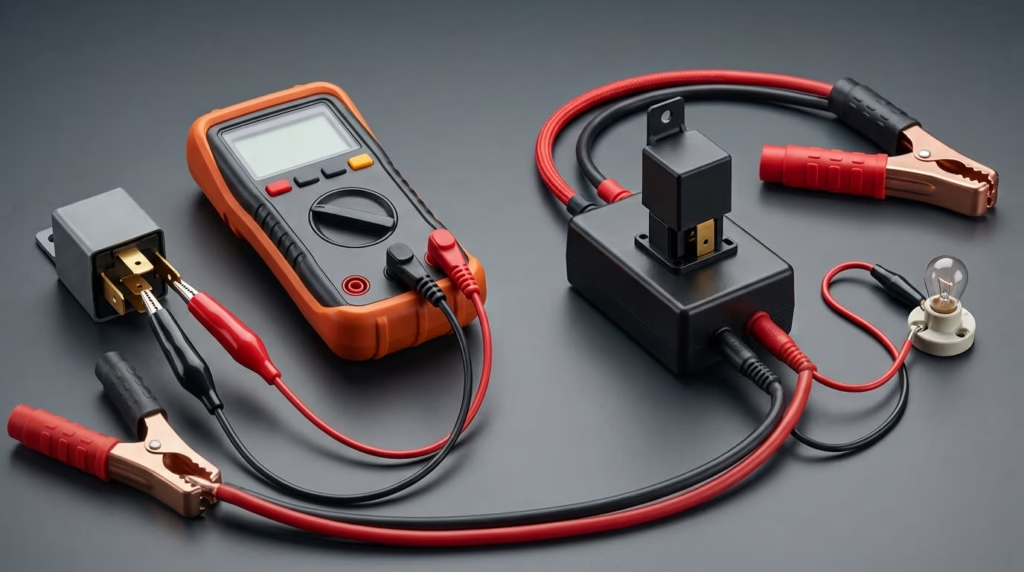
These three checks answer different questions. Treating them as equal can lead to a wrong diagnosis.
What an Audible Click Confirms
A click suggests the coil created enough force to move the relay arm.
That is useful, but limited.
A clicking relay may still have:
- Burned contacts
- High contact resistance
- Weak internal pressure
- An uneven contact surface
- A fault that appears after several cycles
The click does not tell you how much current can pass. It also does not prove that the contacts closed cleanly.
You should treat it as an early clue, not a final result.
What Relay Continuity Testing Confirms
Continuity testing checks whether an electrical path exists.
With a multimeter, you can check the relay coil for an open circuit. You can also see whether the switched contacts change when you power the coil.
A common test works like this:
- Identify the coil terminals.
- Measure coil resistance.
- Apply the correct voltage to the coil.
- Check continuity across the switched terminals.
- Remove coil power.
- Confirm that the contacts return to rest.
This test can find a fully open coil or contacts that never close. It can also help confirm normally open and normally closed paths.
However, a meter uses very little current during a continuity check. A thin damaged patch on the contacts may still pass that current.
The same contacts may struggle to run a fan, pump, motor, or clutch.
What Relay Load Testing Adds
Relay load testing sends useful current through the closed contacts.
This can reveal resistance that a simple continuity test misses. The tester may judge this by measuring voltage loss across the relay.
The ESI-194 has the clearest load specification in this group. It applies more than 7 amps and looks for excess voltage drop.
Its yellow warning is also useful. A relay may still work but show enough resistance to deserve caution.
The word “load” needs care. Some product pages use it without giving a current figure. Without a stated test current, you cannot assume two tools apply the same stress.
A 7-amp test is also not the same as the relay’s full rated load. Many automotive relays control far more current. Yet it gives you more useful evidence than a near-zero-current continuity check.
For the best diagnosis, combine the relay test with an in-circuit voltage-drop test. That verifies performance in the vehicle’s real wiring.
What to Look for in the Best Automotive Relay Tester
The right tool depends on your vehicles and skill level. Price alone gives you little help.
Start with the test method. Then check voltage, pin layout, adapters, and power source.
Verified Load-Testing Capability
Look for a clear test-load figure.
Useful product details may include:
- Test current in amps
- Voltage-drop measurement
- Contact-resistance limits
- A pass-with-caution result
- Automatic cycle count
“Tests the contacts” is not enough. That phrase may only mean the tool checks whether they open and close.
The ESI-194 states a load above 7 amps. It also checks for excess voltage loss.
The available information does not confirm the same load for the ESI-193, W3009, or KW371. Those tools may check contact switching, but their exact test current needs verification.
The Lisle 69300 does not create an automatic load test. It gives you access to the circuit. You then use a multimeter and the working load to measure voltage drop.
For a fuel pump or cooling fan circuit, that live test can reveal problems a removed-relay test cannot.
Automatic Cycling and Intermittent-Failure Usefulness
A relay can pass once and fail on the next try. Automatic cycling helps screen for this problem.
The ESI-194 performs 10 cycles. It watches the relay throughout the sequence.
The ESI-193 also repeats the test and checks for steady results. The available material does not state the same load used by the ESI-194.
The KW371 describes a repeated open-and-close test. Its exact cycle count is not clear.
No repeated-cycle specification was confirmed for the W3009. Treat it as a fast pass or fail screening device.
With the Lisle 69300, you control the test. You can switch the relay many times while watching the meter. This takes more work, but it gives you control over the setup.
Repeated action does not guarantee a fault will appear. A relay that fails only at high heat may pass 10 cold cycles.
Four-Pin and Five-Pin Relay Compatibility
A four-pin relay has four terminals. That does not mean it fits every four-pin tester.
Relay designs vary by:
- Blade width
- Blade spacing
- Terminal angle
- Body size
- Contact layout
- Coil polarity
- Internal diode or resistor
- Normally open or closed design
Common pin numbers include:
- 85 and 86: Coil terminals
- 30: Power input
- 87: Normally open output
- 87a: Normally closed output
These numbers are common, but the physical position can change.
Some BMW and MINI relays show why this matters. A relay may look like a normal four-pin design. Yet its coil and contact blades may sit in different places.
A fixed socket cannot adjust to every layout. Forcing the relay into the wrong holes may damage the tool or relay.
The ESI-193 handles several common relay groups through adapters. These include Bosch-style, Mini 280, Micro-style, and shielded layouts.
The Lisle 69300 offers the most flexible connection method. If a molded jumper does not fit, loose terminal leads may provide access.
Always check the diagram printed on the relay. Match the terminal numbers with the tester instructions.
12V Versus 24V Relay Testing
Most passenger cars use a 12V electrical system. Many motorcycles, vans, and light trucks also use 12V.
You are more likely to find 24V circuits on:
- Heavy trucks
- Buses
- Farm equipment
- Construction equipment
- Some boats
- Fleet vehicles
- Industrial engines
A 12V tester should not be assumed safe or useful for a 24V relay.
The five products divide as follows:
- ESI-194: 12V relays
- ESI-193: 12V and 24V relays
- Performance Tool W3009: 12V relays
- KONNWEI KW371: 12V and 24V relay testing
- Lisle 69300: Passive test-access kit
The Lisle needs extra explanation. It is not a powered electronic tester with a fixed voltage setting. Your safe range depends on the relay, circuit, meter, leads, and test method.
If you only maintain passenger cars, 24V support may add little value. If you service trucks or equipment, it can be a key feature.
Adapters, Expandability and Hidden Costs
A lower tool price can hide added costs.
Before comparing prices, check what comes in the case. Look for:
- Relay adapters
- Jumper leads
- Fused leads
- Extension cables
- Battery clips
- A storage case
- Replacement sockets
- Required batteries
- A required multimeter
The ESI-193 includes five adapters. They expand its support across several common relay shapes.
A separate Maxi-relay adapter may be available. That adapter can add four-pin Maxi support, but it raises the total cost.
The Lisle 69300 includes eight molded relay jumpers. It also has loose terminal leads, extensions, a switch, and fuse options. However, you still need a suitable multimeter.
The W3009 and KW371 use built-in sockets. This keeps setup simple. It also limits their ability to handle an odd pin layout.
Check the price of optional parts before you choose. Also confirm that the adapter works with your exact tester model.
Ease of Use and Result Detail
A simple green or red light is easy to read.
That can be ideal for a home mechanic. You plug in the relay, run the test, and get a quick result.
However, simple results hide detail.
A red light may not tell you whether the problem is:
- An open coil
- Contacts that will not close
- The wrong pin layout
- High contact resistance
- An unsupported relay design
The ESI-193 adds three fault-code patterns. These provide more direction than a plain red light.
The ESI-194 uses three result colors:
- Green for pass
- Red for fail
- Yellow for pass with caution
The yellow result can flag some voltage loss without calling the relay fully dead.
The Lisle kit gives you the most data. You can see exact meter readings. The tradeoff is time and skill.
Portability and Power Source
Think about where you will use the tester.
The W3009 runs on four AA batteries. You do not need a car battery nearby. That makes it useful at a workbench, salvage yard, or roadside stop.
The ESI-194 and ESI-193 use battery power from the vehicle. Their clamps add setup time, but you do not need to track internal battery condition.
The KW371 also connects to a vehicle battery. It uses that power for relay and battery-system checks.
The Lisle kit needs a meter and a circuit or power source. Its case is portable, but the full setup takes more room.
For a glovebox or small mobile kit, the W3009 is the easiest choice. For shop use, power-source convenience matters less.
Durability, Warranty and Replacement Support
Socket wear can affect a relay tester over time.
Repeated insertion may loosen the contacts. Dirt, oil, and bent blades can make matters worse.
Inspect these areas before use:
- Socket grip
- Cable strain relief
- Battery clamps
- Battery cover
- Selector switch
- Test button
- Case hinges
- Adapter pins
Detailed W3009 owners often describe a solid feel. That is useful feedback, but it does not prove years of service life.
The KW371 is still a newer product. Its long-term cable, screen, and socket life remains less clear.
The ESI and Lisle tools cost more. Their parts and adapter systems may appeal more to working shops. Still, you should check current warranty terms before purchase.
Do not treat a hard case as proof of tool strength. A good case protects the tool, but it says little about its internal parts.
The 5 Best Automotive Relay Testers
Each product below solves a different problem. The best choice depends on the depth of diagnosis you need.
1. Electronic Specialties ESI-194 Super Relay Buddy: Best Overall
The ESI-194 Super Relay Buddy earns the top position for one main reason. Its test method is clearly defined.
It applies a load above 7 amps to the relay contacts. It then checks for excessive voltage drop. It also runs the relay through 10 cycles.
That combination gives it more diagnostic value than a simple click tester.
Key specifications
- 12V relay testing
- 4-pin and 5-pin selection
- More than 7 amps of test load
- Automatic 10-cycle test
- Green, red, and yellow result lights
- Built-in sockets for common relay types
- Vehicle-battery power
The manufacturer currently describes support for seven relay types. Some older sales pages mention six. Check the current model and socket image before ordering.
Supported relay configurations
The tester supports several common 12V automotive relay layouts. It accepts both 4-pin and 5-pin designs when the blade pattern matches.
That last part matters. The ESI-194 does not support every relay with four or five pins.
Some BMW and MINI relays use an unusual blade arrangement. They may look normal from the outside, yet place the coil and switched terminals in different positions.
The built-in sockets cannot adjust for those layouts.
Testing capabilities
The ESI-194 checks more than coil movement.
Its test includes:
- Coil activation
- Contact switching
- Repeated cycling
- Contact loading
- Voltage-drop screening
- Pass, fail, or caution result
A yellow light means the relay passed with caution. This points to some voltage loss across the contacts.
That feature can help you spot a worn relay before it becomes a complete failure. However, the tool does not provide an exact voltage-drop reading.
Intermittent-failure usefulness
The ESI-194 offers the strongest intermittent-failure screen in this group.
Its 10-cycle routine can catch a relay that does not switch each time. The 7-plus-amp load can also reveal contact weakness.
One professional use case involved a relay that failed after its first cycle. A one-time check could have missed that behavior.
Still, this tester cannot recreate every condition. A heat-related failure may not appear during a short cold test.
Strengths
- Documented contact load
- Repeated automatic cycles
- Fast test process
- Clear warning for voltage drop
- No need to arrange loose jumper wires
- Better fault screening than a click test
Limitations
- Works with 12V relays only
- High cost for one main task
- Fixed sockets limit compatibility
- Does not test the relay socket
- Does not show exact meter values
- Cannot recreate all heat and vibration faults
Best use case
The ESI-194 best suits technicians and serious DIY mechanics.
It makes sense when you test common 12V relays often. It is also useful when a circuit has a random fault that may point to weak relay contacts.
For one vehicle and rare use, its price may be hard to justify.
Value for money
The ESI-194 costs much more than a basic tester. Its value comes from speed and its stated load.
You are not just paying for a green light. You are paying for a repeated, loaded check that is harder to set up by hand.
It offers less value if most of your relays use unusual layouts. In that case, a flexible jumper kit may serve you better.
2. Lisle 69300 Master Relay & Fused Circuit Test Kit: Best for Professional Diagnosis
The Lisle 69300 is not a normal automatic relay tester.
It does not accept a relay, run a preset check, and show a red or green light. Instead, it gives you safe access to relay and fuse circuits.
That makes it more flexible. It also demands more skill.
Key specifications
The kit includes:
- Eight relay test jumpers
- Multimeter connection leads
- Terminal test leads
- Extension leads
- An inline switch
- A fuse-holder lead
- Power access options
- Relay puller pliers
- A storage case
You need a multimeter to make full use of the kit.
Supported relay configurations
The eight shaped jumpers fit many popular relay sockets. They let you access the circuit while keeping the relay connected.
If one of those jumpers does not fit, the loose terminal leads can help with other layouts.
This makes the kit useful for some:
- Volkswagen relays
- BMW relays
- European pin layouts
- Less common blade positions
- Circuits not covered by a molded socket
You still need to read the circuit diagram. The extra leads create access, not automatic protection from a wrong connection.
Voltage compatibility
The Lisle 69300 does not have a fixed 12V or 24V electronic setting.
It is a passive lead and jumper system. Your safe test range depends on:
- The circuit voltage
- Relay specifications
- Lead ratings
- Fuse choice
- Meter rating
- Test setup
Do not read this as unlimited voltage support. Use it only within the limits of the vehicle, relay, meter, and leads.
Testing capabilities
A skilled user can perform a broad set of checks:
- Measure power at the relay
- Check the ground path
- View the control signal
- Measure voltage drop
- Check current where safe
- Bypass a relay with a fused path
- Test the socket under load
- Watch relay behavior in the live circuit
These checks can tell you whether the relay is the true cause.
For example, a relay may pass on the bench. The Lisle kit may then reveal a weak socket terminal that loses voltage under load.
Intermittent-failure usefulness
The Lisle kit does not run an automatic cycle.
You control each step. You can switch the relay many times while watching voltage or current.
This can work well for intermittent faults. You can also test the system while it is hot and operating.
The result depends on your test plan. The kit does not make the judgment for you.
Strengths
- Tests more than the removed relay
- Supports live-circuit diagnosis
- Works with many unusual layouts
- Allows exact meter readings
- Reduces the need to pierce wires
- Includes fused and switched connections
Limitations
- No automatic pass or fail result
- Requires a good multimeter
- Has a steeper learning curve
- Costs more than basic testers
- Takes longer to set up
- Incorrect connections can damage a circuit
Best use case
The Lisle 69300 suits professional technicians and skilled home mechanics.
It is a strong fit if you work on many makes. It is also useful for European vehicles and unusual relay layouts.
Choose it when you want to know why the circuit failed, not just whether a loose relay switches.
Value for money
The high price may not suit rare DIY work. You also need to include the cost of a reliable meter.
For a busy shop, the value is easier to see. The kit can help with relays, fuses, sockets, power feeds, and grounds.
That wider use makes it more than a relay checker.
3. Electronic Specialties ESI-193 Relay Buddy 12/24 Pro Kit: Best for 12V and 24V Fleets
The ESI-193 Relay Buddy Pro Kit covers a gap left by many consumer tools. It tests both 12V and 24V relays.
It also includes five adapters for several common relay groups.
This makes it useful for mixed fleets. Think cars, trucks, boats, farm machines, and heavy equipment.
Key specifications
- 12V and 24V relay support
- 4-pin and 5-pin setting
- Five relay adapters
- Repeated relay cycling
- Green pass light
- Red fail light
- Three fault-code patterns
- Molded storage case
- Vehicle-battery power
An optional adapter can add support for certain 4-pin Maxi relays.
Supported relay configurations
The included adapters cover common versions of:
- Bosch-style relays
- Shielded Bosch-style relays
- Mini 280 relays
- Shielded Mini 280 relays
- Micro-style relays
- Shielded Micro-style relays
- Shielded 5-pin relays
- Mini 4-pin relays
That is broader than the coverage offered by many basic two-socket tools.
It is not universal. Check the blade shape, position, and diagram before use.
Testing capabilities
The ESI-193 checks:
- Relay-coil action
- Contact switching
- Repeated operating results
- 4-pin and 5-pin behavior
- Some likely failure types through flash codes
It runs the relay several times and watches for a steady result.
The information available does not confirm the same 7-plus-amp load used by the ESI-194. Do not treat the two test methods as equal.
Intermittent-failure usefulness
The repeated test gives the ESI-193 an edge over a single-cycle tool.
A relay that misses one cycle may fail the test. This makes the tool useful for uneven mechanical action.
However, its exact contact-test current is not clear. That limits how much you can conclude about high-resistance contacts.
For a suspected load-related fault, confirm the result with a voltage-drop test.
Strengths
- Works with 12V and 24V relays
- Includes five adapters
- Covers several common relay sizes
- Checks repeated operation
- Provides fault-code patterns
- Comes in a storage case
Limitations
- High price
- Needs a vehicle battery
- Not every relay fits
- Optional adapters add cost
- Test-load current needs verification
- Long-term user feedback is limited
Best use case
The ESI-193 makes the most sense for mixed fleets.
It can serve:
- Truck workshops
- Farm-equipment owners
- Marine technicians
- Mobile mechanics
- RV service shops
- Heavy-equipment fleets
If you only test 12V passenger-car relays, the ESI-194’s stated load may offer more useful fault screening.
Value for money
This kit earns its value through voltage range and adapter coverage.
A home mechanic with one 12V car may not need those extras. A shop that sees both 12V and 24V equipment can put them to work.
Before buying, compare your common relay shapes with the included adapters.
4. Performance Tool W3009: Best Portable Cordless Relay Tester
The Performance Tool W3009 focuses on speed and ease.
It runs on four AA batteries. You do not need a vehicle battery or loose jumper wires.
That makes it a handy screening tool for common 12V relays.
Key specifications
- 12V relay testing
- Common 4-pin and 5-pin support
- Green pass light
- Red fail light
- Four AA batteries included
- Self-contained design
- Coil and switching-contact checks
The tester is often listed as model 3009 or W3009. Confirm the model number before ordering.
Supported relay configurations
The W3009 accepts common 4-pin and 5-pin automotive relays.
That does not mean every relay with four or five blades will fit.
Check:
- Blade size
- Blade position
- Relay diagram
- Coil-terminal placement
- Contact-terminal placement
The built-in sockets cannot adjust for an odd layout.
Testing capabilities
The W3009 checks for:
- An open coil
- Contact switching
- Basic relay action
- A pass or fail condition
The tool does not provide fault codes or meter values.
No clear high-current load specification was found. It should not be described as equal to the ESI-194’s 7-plus-amp test.
Intermittent-failure usefulness
Use the W3009 for fast screening.
It can tell you whether a common 12V relay appears to switch. However, there is no confirmed automatic cycle count.
A relay that passes may still fail under heat or load. If symptoms are random, repeat the test and check the live circuit with a meter.
Strengths
- No external power source needed
- Fast setup
- Clear result lights
- Lower price
- Easy for beginners
- Portable design
- Batteries come with the tool
Limitations
- 12V only
- No stated heavy load
- No fault-code detail
- No exact measurements
- Fixed socket layouts
- Cannot check the vehicle circuit
Best use case
The W3009 is a good fit for:
- Home garages
- Mobile tool bags
- Salvage-yard checks
- Emergency kits
- Fast relay sorting
- People who dislike loose test wires
Its simple design is also helpful if you rarely perform electrical work.
Value for money
The W3009 offers good value for convenience.
You get a self-powered tool and a clear pass or fail result. Owner feedback often praises the simple setup and solid feel.
Some detailed reviews were recent or encouraged by a promotion. That makes them less useful for judging long-term life.
Treat the W3009 as a quick screen, not a full relay lab.
5. KONNWEI KW371: Best Battery-and-Relay Combination Tool
The KONNWEI KW371 combines two tool types.
It checks automotive relays, but it also tests batteries, starting systems, and charging systems.
This may suit you if a dedicated relay tester feels too limited.
Key specifications
- 12V and 24V relay testing
- 4-pin and 5-pin setting
- Three common relay socket types
- Automatic cyclic relay operation
- Color screen
- 6V, 12V, and 24V battery checks
- Cranking-system test
- Charging-system test
- Battery-clamp power
The battery function supports several common battery types. Always select the correct type before testing.
Supported relay configurations
The KW371 uses built-in sockets for three common relay forms. It supports 4-pin and 5-pin electromechanical relays that match those sockets.
It does not fit every relay in those pin counts.
Unusual European layouts, wide blades, and manufacturer-specific designs may require another method.
Testing capabilities
For relays, the KW371 checks:
- Coil action
- Contact switching
- Repeated opening and closing
- 4-pin or 5-pin operation
- 12V or 24V relay systems
It also provides:
- Battery-health results
- Battery-voltage readings
- Starting-voltage checks
- Charging-system checks
- Screen-based test guidance
The available specifications do not state the current sent through the relay contacts. Do not assume it matches the ESI-194’s loaded test.
Intermittent-failure usefulness
Automatic cyclic action may reveal a relay that switches unevenly.
That is more useful than a single manual click. Yet it does not prove the relay can carry a high working current.
A relay that passes the KW371 may still need a live voltage-drop check.
The model is also new. There is not enough long-term field evidence to judge how well it holds up under daily shop use.
Strengths
- Combines relay and battery tests
- Supports 12V and 24V relays
- Covers several battery voltages
- Has a clear display
- No internal batteries needed
- Strong feature set for the price
Limitations
- Limited long-term history
- Unknown relay-contact test current
- Fixed socket layouts
- Most detailed feedback comes from marketplaces
- More complex than a simple LED tester
- Battery clamps add bulk
Best use case
The KW371 best suits:
- Multi-vehicle homes
- Small repair shops
- Boat and RV owners
- Truck owners
- Users who also need battery checks
- People building a compact diagnostic kit
It makes less sense if you already own a good battery analyzer.
Value for money
The KW371 offers the broadest feature list for its typical price.
That does not make it the strongest relay tester. Its value depends on whether you will use the battery, starter, and charging functions.
For frequent professional relay testing, an established dedicated tool may be the safer choice. For mixed home use, the added functions may be useful.
Which Automotive Relay Tester Should You Buy?
Start with the problem you need to solve.
Do not choose by the longest feature list. Choose by voltage, relay layout, and test method.
Choose the ESI-194 if Load Testing Is the Priority
The ESI-194 is the clearest choice for loaded 12V testing.
Its 7-plus-amp load and 10-cycle routine add real diagnostic depth. It can catch faults that a basic click test may miss.
Choose it if you:
- Work mainly on 12V vehicles
- Test standard relays often
- Need fast results
- Want better contact-fault screening
- Deal with intermittent electrical faults
Check the socket layout first. It will not fit every European or unusual relay.
Choose the Lisle 69300 if You Need to Diagnose the Whole Circuit
The Lisle kit is better when the relay may not be the true fault.
It helps you test the socket, power feed, ground path, and working circuit. It also handles unusual layouts better than fixed-socket testers.
Choose it if you:
- Perform professional electrical work
- Already own a good multimeter
- Work on many vehicle brands
- Need live voltage-drop data
- Deal with European relay layouts
Expect more setup and a steeper learning curve.
Choose the ESI-193 if You Work on 24V Equipment
The ESI-193 covers both 12V and 24V systems.
Its adapter kit also supports several common relay styles.
Choose it if you service:
- Heavy trucks
- Agricultural machines
- Construction equipment
- Boats
- RVs
- Mixed vehicle fleets
If 24V support is not needed, compare its value with the loaded ESI-194.
Choose the W3009 for Fast Cordless Screening
The W3009 is the easiest tool to carry and set up.
Its AA batteries let you test relays away from the vehicle.
Choose it if you want:
- Low setup time
- Simple pass or fail results
- A portable relay checker
- A lower entry price
- A tool for common 12V relays
Use a multimeter when a fault remains unclear.
Choose the KW371 if You Also Need Battery Diagnostics
The KW371 combines relay and battery-system checks.
It can reduce the number of tools in a small kit.
Choose it if you need:
- 12V and 24V relay support
- Battery-health tests
- Starting-system checks
- Charging-system checks
- A screen with guided results
Its relay-load specification and long-term life need more evidence.
How to Use an Automotive Relay Tester Safely
A relay tester is easy to misuse if you skip the relay diagram.
Take a minute to confirm the layout. That small step can prevent tool and circuit damage.
Step 1: Read the Relay Diagram
Look for the printed diagram on the relay body.
Common terminal numbers include:
- 85 and 86: Coil
- 30: Main power input
- 87: Normally open output
- 87a: Normally closed output
“Normally open” means the path stays open with the coil off. “Normally closed” means the path stays connected until the coil turns on.
Some relays place a diode across the coil. A diode controls current direction.
Polarity matters with these relays. Reversing power may create a short path through the diode.
Step 2: Confirm System Voltage
Read the voltage printed on the relay.
Use a tester rated for that voltage. Do not put a 24V relay into a 12V-only tester unless the maker allows it.
A wrong voltage can cause:
- A false result
- Weak coil action
- Too much coil current
- Tool damage
- Relay damage
When using a passive jumper kit, the circuit voltage still matters.
Step 3: Match the Physical and Electrical Pin Layout
Count the pins, but do not stop there.
Compare each blade with the tester socket. Then match the terminal numbers.
Check:
- Blade position
- Blade width
- Blade direction
- Coil location
- Contact location
- 87 and 87a positions
Never force the relay into the tester. If it does not slide in with light pressure, stop.
Use the right adapter or a safe lead setup.
Step 4: Connect the Tester to Its Approved Power Source
Follow the tool’s instructions.
Typical power methods include:
- Vehicle-battery clamps
- Internal AA batteries
- Power through battery-test leads
- A controlled bench supply
- A live vehicle circuit
Keep the battery clamps from touching each other. Check polarity before starting.
If you use manual leads, add a suitable fuse near the power source.
Step 5: Run the Full Test Sequence
Let the tester finish its complete routine.
Do not pull the relay out while the tool is cycling it. Watch all result lights or screen messages.
Record any:
- Pass result
- Fail result
- Caution light
- Flash code
- Unusual sound
- Uneven operation
- Relay heating
If the tester allows a second test, repeat the test after a short wait. A different result may point to an intermittent fault.
Step 6: Confirm Borderline or Unexpected Results
Do not replace parts based on a strange result alone.
First, check that:
- The relay fits the socket
- The voltage setting is correct
- The battery connection is sound
- The relay diagram matches
- The adapter is correct
- The tester has enough power
Then confirm the fault with another method. You can use a known-good matching relay or a multimeter.
A live voltage-drop test often provides the best final proof.
Keep clear of parts that may start moving. A relay test can turn on a fan, pump, motor, or clutch without warning.
Never apply power to an unknown control-module wire. You could damage an electronic driver inside the module.
When You Still Need a Multimeter
A relay tester saves time. It does not replace a multimeter.
You still need a meter to test the rest of the circuit.
Use it to check:
- Relay-coil resistance
- Battery voltage
- Power at the socket
- Ground quality
- Control voltage
- Contact voltage drop
- Wiring continuity
- Fuse voltage
- Normally closed contacts
- Unusual relay layouts
A relay may pass outside the vehicle while the circuit still fails.
Common vehicle-side faults include:
- Corroded socket terminals
- Loose terminal grip
- Burned fuse-box contacts
- Weak grounds
- Broken control wires
- Missing module commands
- Low battery voltage
- High motor current
A voltage-drop test is often more useful than a simple continuity test.
For example, place the meter leads across the closed contact path. Run the circuit under its normal load. The meter then shows how much voltage the relay and connection lose.
A high reading points to resistance. That resistance may sit inside the relay, at the socket, or along the wiring.
The multimeter also helps with odd relay designs. Loose leads let you follow the diagram without depending on a molded socket.
Relay faults can overlap with engine-running problems. A weak fuel-pump supply may cause hesitation, low fuel pressure, or lean operation.
If the relay circuit tests correctly, the next step may involve interpreting OBD2 live data and fuel trims. That can help you separate an electrical supply fault from an air, fuel, or sensor problem.
A good relay tester speeds up one part of the job. Your meter helps you finish it.
When the socket, power feed, or ground path is the real problem, a circuit tester or load tool becomes essential. Power probes, test lights, and dedicated voltage-drop testers can prove whether the wiring can carry current once the relay has been ruled out. For a full comparison of those tools, see our guide to the best automotive circuit testers.
Common Mistakes When Testing Automotive Relays
Small testing errors can create false results. Some can also damage the circuit.
Assuming a Click Means the Relay Is Good
A click only tells you that the moving part acted.
It does not tell you how well the contacts carry current. A burned relay can still make a clean sound.
Confirm contact action and voltage drop.
Checking Continuity Without Applying a Load
Continuity mode uses very little current.
A worn contact surface may pass that test. The same relay may lose voltage when it powers a motor.
Use a stated load test or check voltage drop in the live circuit.
Assuming Every Four-Pin Relay Uses the Same Layout
Four blades do not ensure a match.
The blade positions and terminal roles may differ. Always read the diagram.
This is a common problem with fixed-socket testers.
Ignoring a Diode-Protected Coil
Some relays contain a suppression diode. It helps control the voltage spike when the coil turns off.
That diode makes coil polarity important.
Check for a diode symbol on the relay diagram. Connect 85 and 86 as shown.
Testing Only Once
An intermittent relay may pass nine times and fail once.
Run the full automatic sequence. Repeat manual checks when the fault is random.
If possible, test the relay hot and cold.
Testing the Relay but Not the Socket
A good relay cannot fix a burned socket.
Inspect the socket for:
- Dark plastic
- Melted areas
- Green corrosion
- Loose terminals
- Spread contacts
- Heat marks
Check terminal grip. A loose socket can create heat and voltage loss.
Replacing the Relay Without Checking Current Draw
A motor or pump may draw too much current.
That extra load can burn relay contacts and melt the socket. A new relay may fail again.
Check the powered part and compare its current with service data.
Applying Power to an Unknown Circuit
Do not send battery power into a wire just because it sits near a relay.
That wire may lead to a control module. Direct power can damage the module’s internal driver.
Use a wiring diagram. Add a fuse to manual power leads.
Using a 12V Tester on a 24V Relay
Voltage ratings are not suggestions.
A 12V tester may not energize a 24V coil correctly. A poor result does not prove the relay is bad.
Use a tester rated for the relay voltage.
Swapping Relays That Are Not Truly Identical
Relay swapping can be a useful quick check. Both parts must match.
Compare:
- Part number
- Voltage
- Pin diagram
- Current rating
- Diode or resistor symbol
- Contact arrangement
Two relays may fit the same socket yet work in different ways.
Frequently Asked Questions About Automotive Relay Testers
What is the best automotive relay tester?
The ESI-194 Super Relay Buddy is the strongest overall dedicated option in this group. It applies a verified load above 7 amps and cycles a compatible 12V relay 10 times.
The Lisle 69300 is better for full-circuit diagnosis. The ESI-193 is more suitable for mixed 12V and 24V work.
Can a relay click and still be bad?
Yes. A click shows that the coil moved the relay arm.
It does not prove that the contacts can carry normal current. Burned or resistive contacts may click while causing voltage loss.
Will a relay tester find an intermittent relay failure?
Some testers improve your chances.
Repeated cycling can expose uneven switching. A loaded test may also reveal weak contacts.
No bench tester can guarantee detection. Heat, vibration, moisture, and real circuit current may affect the fault.
What is the difference between a relay tester and a multimeter?
A relay tester automates coil and contact checks. It may give a simple pass or fail result.
A multimeter provides actual voltage, resistance, and voltage-drop readings. It can also test the vehicle socket and wiring.
Can a 12V relay tester test a 24V relay?
Only use it if the tester is rated for 24V relays.
The ESI-193 and KW371 support 12V and 24V relay testing. The ESI-194 and W3009 are specified for 12V relays.
Are all four-pin automotive relays wired the same?
No. Many use common terminal numbers, but blade positions can differ.
Some also contain a diode or resistor. Always check the diagram and physical layout before testing.
Can a five-pin relay tester test a four-pin relay?
It can if it has a compatible 4-pin setting and socket.
Do not assume that leaving one hole empty will work. The four active terminals must sit in the correct positions.
How do you test relay contacts under load?
Use a tester with a stated contact load. You can also measure voltage drop while the closed contacts carry current.
For a live test, connect the meter across the contact path. Then operate the circuit under normal load.
Do I need adapters for an automotive relay tester?
That depends on the relay shape.
The ESI-193 includes five adapters. The Lisle 69300 includes eight molded jumpers and loose terminal leads.
Fixed-socket testers need a direct physical match.
Can a relay pass a bench test but fail in the vehicle?
Yes. The relay may fail under heat, vibration, or higher current.
The fault may also sit in the socket, wiring, ground, or powered part. A live voltage-drop test can help locate it.
Is swapping relays a reliable test?
It can be a useful first check if the two relays are exact matches.
Compare the part number, pin layout, voltage, current rating, and internal diagram. Do not swap relays based on shape alone.
What causes an automotive relay to fail repeatedly?
Common causes include:
- High current draw
- Loose socket terminals
- Heat
- Moisture
- Vibration
- The wrong relay rating
- A poor replacement part
Check the circuit and powered device before installing another relay.
Final Recommendation
The best automotive relay tester depends on how deep you need to go.
The ESI-194 Super Relay Buddy is the best overall dedicated tester here. Its stated 7-plus-amp load and 10-cycle test give it a clear technical advantage for common 12V relays.
The Lisle 69300 is the better diagnostic system. It helps you test the relay, socket, wiring, and live circuit. Choose it if you have the skill and a good multimeter.
For 12V and 24V fleets, the ESI-193 Relay Buddy Pro Kit offers useful voltage range and adapter coverage. The Performance Tool W3009 is easier to carry and use. The KONNWEI KW371 adds battery and charging tests at a lower total cost.
Before choosing, check three things:
- The relay’s voltage
- Its exact pin layout
- Whether the tester applies a real load
That last point matters most. A relay that clicks can still be bad. The right tester should help you find weak contact performance, not just mechanical movement.