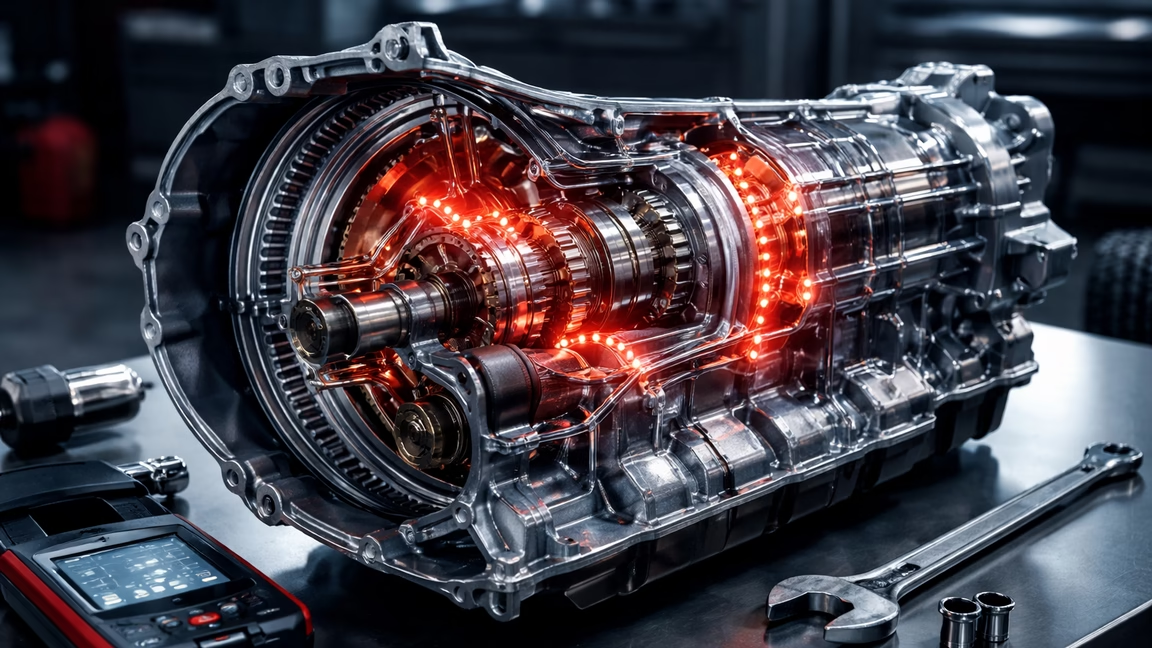
Introduction: The Heartbeat of Your Vehicle
You are driving down a quiet road when you feel it. A sudden jerk, a strange thud, or a high-pitched whine comes from under the floorboards. Your heart sinks. You know that sound. It is the sound of your transmission struggling to do its job.
Think of your transmission as the heartbeat of your car. It is the complex bridge that carries power from the engine to the wheels. When it works, your ride feels smooth and effortless. When it fails, your car becomes a very expensive paperweight.
Most drivers dread the word “transmission.” They see images of greasy workshops and four-digit repair bills. But here is a secret: most transmission issues start small. If you catch them early, you can save your car and your bank account. In this guide, we will peel back the mystery. We will show you why these problems happen and how you can spot them before they leave you stranded.
The “Red Alert” Symptoms: Is Your Car Crying for Help?
Your car does not have a voice, but it talks to you through feel, sound, and smell. Ignoring these signs is like ignoring a fever. The longer you wait, the worse the “infection” gets. Look out for these red flags immediately.
Slipping Gears
Have you ever pressed the gas and heard the engine rev up, but the car barely moved? That is called slipping. It feels like the car is struggling to find its footing. This often happens because the transmission cannot hold the gear firmly. It is a major warning sign that something is slipping inside the system.
Rough or Jarring Shifting
A healthy car should shift gears so smoothly you barely notice it. If your car “clunks” or “jerks” when you move from Park to Drive, take note. For those driving a manual, you might feel a harsh grinding sensation. These “hard shifts” are your car’s way of saying the internal parts are clashing instead of sliding.
The Red Puddle on the Driveway
Check your parking spot. Do you see a bright red or pink fluid? That is transmission fluid. Unlike oil, your transmission does not “consume” fluid. If the level is low, you have a leak. Even a tiny drip can lead to total failure because that fluid provides the pressure needed to change gears.
The Smell of Burnt Toast
If you get out of your car and smell something sweet but burnt, you have a problem. This usually means your transmission fluid is overheating. When the fluid gets too hot, it stops lubricating and starts “cooking” the internal parts. If you smell it, your transmission is likely already in distress.
Delayed Engagement
You shift into “Drive,” but nothing happens for a second or two. Then, the car finally “catches” and moves forward. This delay is often a sign of low fluid pressure or a failing pump. It is a small annoyance that quickly turns into a big repair if you ignore it.
What Actually Causes These Problems? A Deep Dive
Most people think a broken transmission means the whole thing is junk. That is rarely the case. Usually, one small part fails and causes a chain reaction. Let’s look at the three main culprits.
1. Fluid: The Lifeblood of the System
Your transmission relies on fluid for two things: lubrication and pressure. Without enough fluid, the metal parts grind together. Without enough pressure, the car cannot shift gears.
The “Strawberry Milkshake” and Other Signs
Fluid tells a story. You can learn a lot just by looking at its color. Use this guide to check your own fluid.
| Fluid Color | Condition | Action Needed |
| Bright Red | Healthy and Clean | None. You are good to go! |
| Light Brown | Slightly Old | Plan a fluid change soon. |
| Dark Brown/Black | Burnt and Oxidized | Change it now to avoid damage. |
| Pink/Milky | Contaminated with Coolant | Stop driving. This is a “Code Red.” |
Using the Wrong Fluid
Not all fluids are the same. Some cars use CVT fluid. Others need standard ATF. Using the wrong one is like putting diesel in a gas engine. It will ruin the internal seals almost instantly. Always check your owner’s manual before adding a single drop.
2. Mechanical Wear and Tear
Even with perfect fluid, parts eventually wear out. Your car has thousands of miles of shifting under its belt.
- Worn Clutch Packs: In an automatic, these small plates use friction to change gears. Over time, they lose their “grip.” This is why your car might slip.
- Torque Converter Issues: This part sits between the engine and the transmission. If its bearings fail, you will hear a loud whining or grinding sound.
- Broken Gears: This usually happens if you drive very aggressively. Slamming the car into gear or towing a heavy load can snap the metal teeth.
3. Electrical and Sensor Failures
Modern cars are basically computers on wheels. Sometimes the gears are fine, but the “brain” is confused.
- Failed Shift Solenoids: These are tiny electronic gates. They open and close to let fluid flow into the right gears. If one burns out, your car might get stuck in one gear.
- Bad Speed Sensors: Your car needs to know how fast it is going to shift correctly. If the sensor sends the wrong data, the transmission will shift at the wrong time.
- Wiring Problems: Mice love to chew on car wires. A single frayed wire can cause your dashboard to light up like a Christmas tree.
Manual vs. Automatic vs. CVT: Which One Are You Driving?
Every transmission type has its own “personality quirks.” Knowing which one you have helps you narrow down the problem.
| Feature | Manual Issues | Automatic Issues | CVT Issues |
| Primary Failure | Worn Synchronizers | Overheating | Belt/Pulley Slippage |
| Common Symptom | Difficulty getting into gear | Gear hunting/Slipping | Loud “droning” noise |
| DIY Difficulty | Moderate (Clutch work) | High (Hydraulics) | Very High (Electronics) |
Manual Transmissions
These are the simplest. Most problems come from the clutch. If you smell something burning while shifting, your clutch is likely worn out. If you hear grinding, the parts that help gears match speeds are probably failing.
Automatic Transmissions
These are much more complex. They use hydraulic pressure to do the work for you. Most issues here are related to heat or old fluid. If an automatic fails, it usually starts with slipping or “hunting” for the right gear.
CVT (Continuously Variable Transmission)
These are common in modern, fuel-efficient cars. CVTs don’t have traditional gears. Instead, they use a belt and pulley system. If a CVT fails, you will often hear a loud, constant “droning” sound. They are very sensitive to fluid quality and can be expensive to fix.
Your DIY Solution: How to Troubleshoot at Home
You do not need to be a pro to check your car. Many fixes are simple and cheap. Use this step-by-step guide to find the truth.
Step 1: The Dipstick Test
This is the easiest step. Find the transmission dipstick. It is usually bright yellow or red. Pull it out while the engine is warm.
Check the level. Is it low? Add a little fluid. Look at the color on a white cloth. If it smells like burnt toast, the fluid is dead. If it looks like a pink milkshake, stop right there. That means water or coolant is inside. Do not drive the car.
Step 2: Use an OBD-II Scanner
Modern cars have a brain. You can talk to it. Buy a cheap OBD-II scanner. Plug it into the port under your dash.
Scan for codes starting with the letter “P.” If you see “P0700,” the car is telling you exactly what is wrong. It might be a bad sensor or a stuck valve. Knowing this code saves you from being lied to at a shop.
Step 3: Check Your Battery
This sounds strange, right? But it is true. Modern gearboxes are electronic. If your battery is weak, the “brain” gets confused. It might shift hard or skip gears.
Clean your battery terminals with a wire brush. Make sure the cables are tight. Sometimes a five-dollar cleaning job fixes a thousand-dollar problem.
Step 4: Reset the Computer
Cars “learn” how you drive. Sometimes they learn bad habits. You can reset this memory. Unplug your battery for thirty minutes. This clears the computer’s mind. When you plug it back in, the car starts fresh. This often fixes small “ghost” shifts.
When to Call a Pro
Some jobs are too big for a driveway. You need to know when to quit. If you see these signs, take the car to a shop you trust.
- Metal Shavings: If you drop the fluid pan and see “glitter,” the metal gears are grinding away. This is serious.
- Limp Mode: This is when the car stays in one gear to protect itself. It is a “safety net” for the engine.
- Total Loss of Power: If the engine revs but the car does not move at all, something inside has snapped.
How to Keep Your Transmission Healthy
You want your car to last. You want to avoid the shop. Follow these simple rules to keep your gears happy.
Change the Fluid Often
Do not wait for a problem. Change your fluid every 40,000 miles. It is the best way to prevent heat damage. Think of it like changing the oil in your engine.
Add a Cooler
Heat is the enemy. If you tow heavy loads, your transmission gets hot. Buy an external cooler. It is a small radiator that keeps the fluid chilled. It can double the life of your car.
Stop Before You Shift
This is a bad habit many people have. Do not shift from Reverse to Drive while the car is rolling. This puts a massive strain on the gears. Come to a full stop first. Your car will thank you.
Conclusion
Transmission problems are scary. They feel like the end of the road. But now you know the truth. Many issues come down to fluid or simple sensors.
Start with the basics. Check your fluid. Scan for codes. Be kind to your gears. Most of the time, a little care goes a long way. You have the power to keep your car running smooth for years to come.