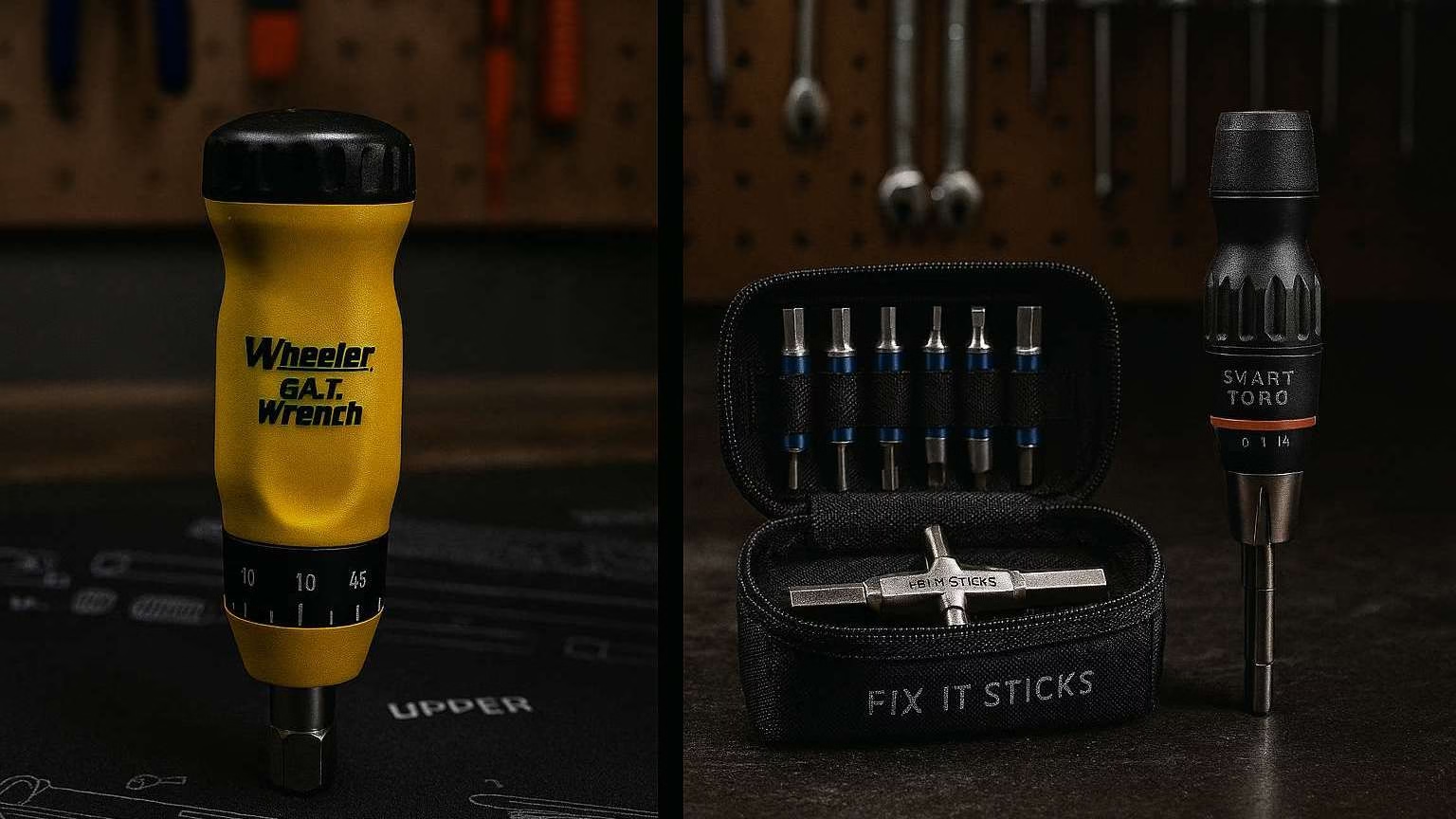
If you are still tightening optic mounts by “feel,” you are either crushing your $2,000 scope tube or leaving it loose enough to walk off zero after ten shots. You need a torque driver.
For the last decade, the Wheeler FAT Wrench has been the default choice. It’s the “Toyota Camry” of the gun world—cheap, plasticky, and omnipresent. But in 2026, newer competitors like Real Avid and Fix It Sticks are challenging the throne with better ergonomics and “field-proven” designs.
I analyzed 12 months of debates from r/LongRange and r/Gunsmithing to settle this once and for all. Do you stick with the budget king, or is the premium upgrade actually worth the cash?
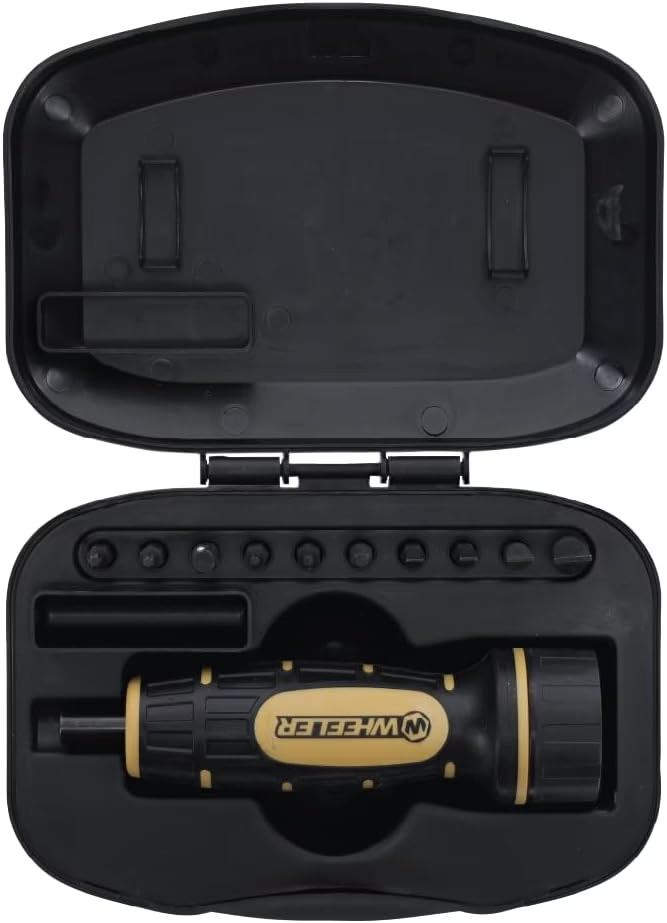
Wheeler FAT Wrench (Analog)
The Brutal Verdict: Buy if you mount one scope a year and want to save cash. Just remember to reset the spring to zero, or it loses accuracy.
Check Price on Amazon →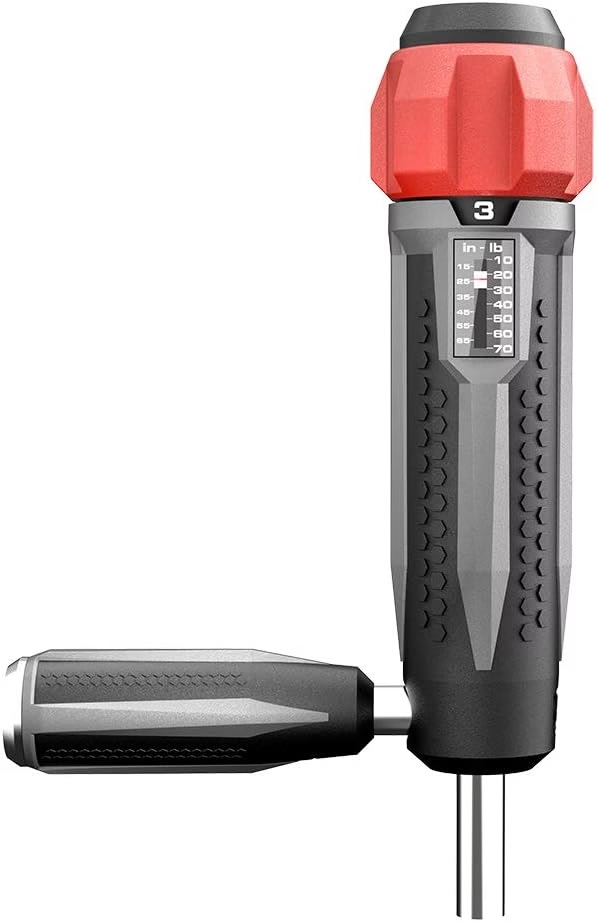
Real Avid Smart Torq
The Brutal Verdict: Buy if you hate guessing. The 1 in-lb clicks and rubber grip are far superior to Wheeler’s slippery plastic.
Check Price on Amazon →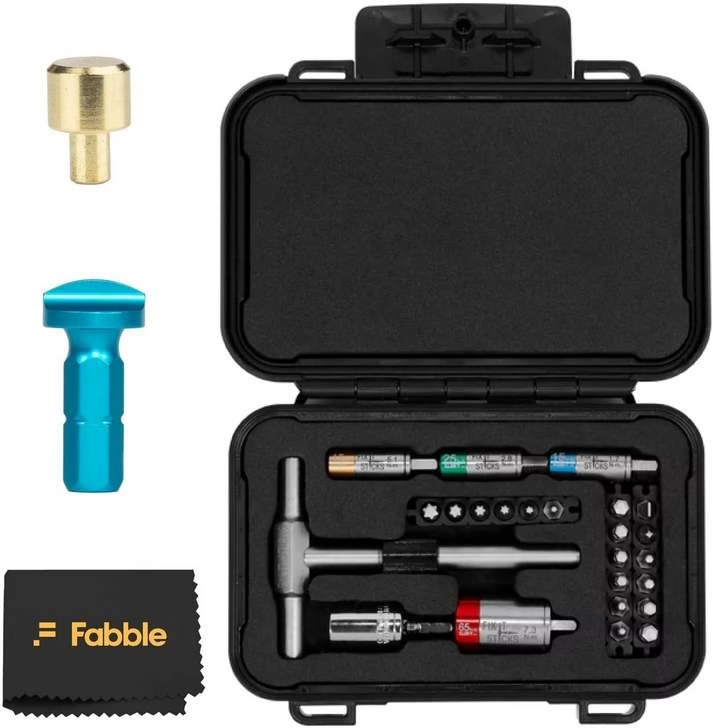
Fix It Sticks All-In-One
The Brutal Verdict: Buy if you own a $2,000+ scope. It’s the only tool here that is impossible to over-torque and travels in a range bag perfectly.
Check Price on Amazon →Wheeler Fat Wrench vs Real Avid vs Fix It Sticks (2026): what actually changes your results
If you’re searching wheeler fat wrench vs real avid or fat wrench vs fix it sticks, you’re probably trying to avoid two headaches: inconsistent torque and second-guessing your settings. This section helps you compare the feel, the workflow, and the confidence—without the noise.
How to compare in 60 seconds (the “buyer lens”)
The best choice isn’t “the most popular.” It’s the one that matches your routine. A clean setup, repeatable torque, and easy adjustments matter more than anything you’ll read in a spec list.
- Torque repeatability: does it land on your target consistently, or does it feel different every time?
- Adjustment speed: quick to dial in, quick to lock, quick to verify—especially mid-job.
- Feedback you trust: a clear click/stop matters. It reduces “one more tiny turn” mistakes.
- Carry + workflow: bench tool or field kit? That single detail often decides the winner.
Where the big comparisons usually land
People also ask wheeler fat wrench vs digital because they want certainty, not just speed. Digital can be satisfying. But “better” depends on whether you value a screen readout or a simple, no-fuss routine you can repeat under pressure.
Which one fits your job? A clean way to decide in 2026
These are the decision patterns behind searches like wheeler fat wrench vs and wheeler fat stix vs fat wrench. Read the row that sounds like your day-to-day. That’s usually the right answer.
If you’re mostly at a bench (repeatable setups, same torque values)
- Prioritize a comfortable handle and fast adjustment.
- Look for consistent feedback at the end of the turn—this is where mistakes happen.
- If you’re torn between systems, compare how quickly you can torque multiple fasteners without breaking rhythm.
If you travel with your kit (range bag, field work, tight spaces)
- Compact storage and bit organization become a bigger deal than you expect.
- This is why wheeler fat wrench vs fix it sticks comes up so often: portability changes everything.
- Choose the workflow that makes you least likely to skip torque because you’re “in a hurry.”
If you like digital readouts (you want numbers, not vibes)
- Searches for wheeler fat wrench vs digital usually mean one thing: you want certainty you can see.
- Digital is great when you trust the reading and keep your process consistent.
- Still, don’t let the screen distract you from the real goal—repeatable torque across every fastener.
If you’re comparing kits: wheeler fat stix vs fix it sticks
- Compare how the kit feels under pressure: set torque, swap bit, torque again—fast.
- Look at the “friction points” like storage, labeling, and how easy it is to keep everything together.
- This is the heart of wheeler fat stix vs fix it sticks debates: convenience you’ll actually use.
FAQ: the questions behind the 2026 comparisons
These quick answers reflect the real intent behind searches like wheeler fat wrench vs real avid, real avid vs wheeler torque wrench, and wheeler fat stix vs fix it sticks. Short. Clear. Useful.
Wheeler Fat Wrench vs Real Avid: what’s the simplest way to pick?
In most wheeler fat wrench vs real avid decisions, the winner is the tool that matches your routine. If you adjust torque often, prioritize quick setting changes and a clear end-of-torque signal. If you rarely change values, prioritize comfort and repeatability across multiple fasteners.
Shortcut: pick the one that you’ll actually use every time—because consistency beats “perfect” specs on paper.
Wheeler Fat Wrench vs Fix It Sticks: what usually decides it?
The wheeler fat wrench vs fix it sticks debate often comes down to workflow and portability. If you want a compact, modular setup you can carry anywhere, kit design matters. If you want a straightforward tool you grab and go, simplicity can feel faster.
That’s also why you’ll see fat wrench vs fix it sticks comparisons focus on “how it lives in your bag” as much as “how it turns a screw.”
Wheeler Fat Wrench vs digital: is digital automatically more accurate?
Not automatically. People searching wheeler fat wrench vs digital want a number they can see—and that can feel reassuring. But accuracy in real use still depends on consistent technique: steady pressure, proper bit seating, and stopping at the signal without “one more nudge.”
Best practice: choose the interface you trust, then keep your process identical every time.
Wheeler Fat Stix vs Fix It Sticks: are they solving the same problem?
Yes—the core goal is controlled torque in a compact format. The differences show up in how the system is organized, how fast you can switch bits, and how “complete” the kit feels for your typical job. That’s why wheeler fat stix vs fix it sticks threads usually read like “system preference,” not “night-and-day performance.”
Wheeler Fat Stix vs Fat Wrench: when does each make more sense?
If you prioritize a compact, packable approach, the kit style can be a better fit. If you prefer a single tool that feels familiar and straightforward, the classic approach can feel faster. That’s the real meaning behind wheeler fat stix vs fat wrench: kit workflow versus grab-and-go simplicity.
Real Avid vs Wheeler torque wrench: what should I compare first?
Start with your most common torque values and how often you change them. Then compare how clearly each tool signals “done.” In many real avid vs wheeler torque wrench choices, that end-of-torque feedback is what prevents over-torque and makes the tool feel trustworthy.
1. The Budget Standard: Wheeler FAT Wrench (Analog)
Wheeler FAT Wrench (Standard)
- Proven Utility: The most reviewed tool in gunsmithing.
- Complete Kit: Includes every bit you need.
- Price: Hard to beat for occasional use.
The “Old Reliable” that feels like a toy.
If you walk into any gunsmith’s garage, you will see a yellow Wheeler FAT Wrench sitting on the bench. It is the gold standard for entry-level torque drivers. It uses a simple clutch mechanism: you dial the knob to your desired inch-pounds (e.g., 20 in-lbs for ring screws), and when you tighten the screw, it “breaks” or clicks to let you know you’re done.
The “Consensus Strength” (Why it’s #1): It is cheap, and it works. Despite feeling cheap, tests consistently show it holds calibration reasonably well if cared for properly. It also comes with a massive set of bits that cover almost every action screw you’ll ever encounter.
The “Marketing vs. Reality” Gap: The biggest issue with the Wheeler is the internal spring. If you finish a job and forget to dial it back down to “zero,” the spring stays compressed. Over time, this weakens the spring. A wrench set to 20 in-lbs might actually only deliver 15 in-lbs after a year of bad storage. Also, the adjustment marks are thick and spaced in 5 inch-pound increments. Guessing “18 in-lbs” is a bit of a shot in the dark.
“The scale is hard to read and the plastic feel is terrible, but for $50 it does the job. Just don’t drop it.” — r/Gunsmithing User
The Verdict: Buy if you are a weekend shooter who mounts a scope once a year and wants to save money for ammo.
2. The Modern Contender: Real Avid Smart Torq
The “Wheeler Killer” with actual ergonomics.
Real Avid looked at the Wheeler, saw the complaints, and built the Smart Torq. It is functionally similar (a click-style handheld driver), but they fixed the user interface.
The “Consensus Strength” (Why it’s better): Users overwhelmingly prefer the grip. While the Wheeler feels like a block of slick plastic, the Real Avid has a rubberized, ergonomic handle. More importantly, the adjustment knob clicks in 1 inch-pound increments. You can confidently set 18 in-lbs without guessing between hash marks.
The “Marketing vs. Reality” Gap: It is still a spring-based system. The marketing claims “precision,” but you still have to follow the same maintenance rules as the Wheeler (dial to zero for storage). It also suffers from the same “click” vagueness at very low settings (below 15 in-lbs), where the break can be hard to feel.
The Verdict: The hobbyist gunsmith who wants a tool that feels professional and hates guessing between hash marks.
3. The Pro Choice: Fix It Sticks All-in-One
The “Buy Once, Cry Once” Travel King.
If you check the range bags of PRS (Precision Rifle Series) shooters, you won’t find a Wheeler. You will find Fix It Sticks. This kit is completely different. It doesn’t look like a screwdriver; it’s a modular T-Handle system.
The “Consensus Strength”: It is impossible to over-torque. The “All-in-One” driver works on a torsion principle (or uses individual torque limiters). There is no internal spring piston to wear out in the same way. The T-Handle design also gives you far better control, reducing the chance of slipping and gouging your screw heads.
The “Marketing vs. Reality” Gap: The “All-in-One” driver requires you to look at the scale while turning. With the Wheeler/Real Avid, you can close your eyes and wait for the “click.” With Fix It Sticks, you have to pay attention to the line. It is not “automatic” in the same way.
The Verdict: The serious shooter who travels to matches or wants a “field-capable” tool that fits in a pocket.
Analog Wrench Hacks: The “Parallax” Error
The Wheeler Fat Wrench uses a visual needle scale. If you look at it from the side, you will be off by 5 in-lbs.
4. Final Verdict: Which One Fits Your Job?
- Buy the Wheeler FAT Wrench if you are on a budget and only mount a scope once a year. It gets the job done for the lowest price.
- Buy the Real Avid Smart Torq if you hate the guesswork of the Wheeler. The 1 in-lb clicks and rubber grip are a massive quality-of-life upgrade.
- Buy the Fix It Sticks Bundle if you are a serious shooter who needs a portable, bombproof kit that won’t lose calibration in your range bag.
🔧 More Torque & Tool Guides
Building a precision rifle or fixing a truck? Don’t use the wrong driver. Here are our specific guides for every torque job.
The Master List
We tested 15+ drivers. See the full list of winners for every budget (Wheeler vs. Vortex vs. Wiha).
For Barrel Nuts & Trucks
Need 50+ ft-lbs? A screwdriver will snap. Here are the best 1/2-inch wrenches for heavy engine work.
Best for Electricians
Don’t strip your breakers. The best VDE insulated torque drivers for electrical panel safety.
Digital vs. Click Style
Is the battery hassle worth the precision? We tested the drift over time to see which lasts longer.