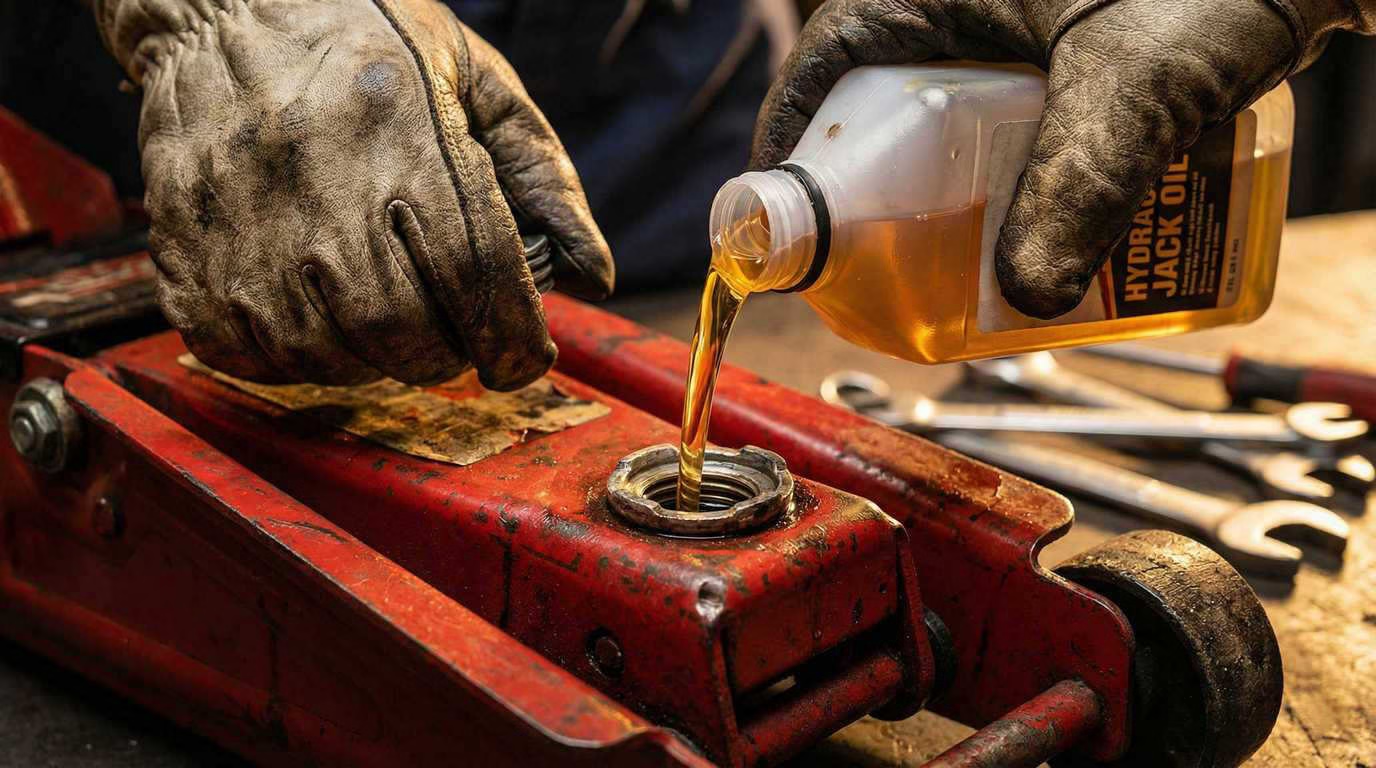
⚠️ CRITICAL WARNING: FORBIDDEN FLUIDS
STOP. Before you pour anything into your jack, read this.
- NEVER USE BRAKE FLUID: It contains alcohol that dissolves rubber O-rings. If you put brake fluid in your jack, the seals will swell and melt within 24 hours. The jack is then trash.
- NEVER USE MOTOR OIL: It contains detergents that cause foaming. Foamy oil = spongy lift.
- ONLY USE: Dedicated “Hydraulic Jack Oil” (AW32) or Automatic Transmission Fluid (ATF) in a pinch (if the manual allows).
Don’t throw it away.
I see it all the time. A guy brings a $250 floor jack to the scrap heap because “it only lifts halfway” or “it feels spongy.” He thinks the seals are blown.
90% of the time, the seals are fine. The problem is air.
Air compresses; oil does not. When air bubbles get trapped in your hydraulic lines, your pump wastes all its energy squishing air instead of lifting the car. It’s like trying to brake with air in your brake lines—mushy and useless.
Here is the 10-minute fix that costs $5 (the price of a bottle of oil).
Anatomy of the Jack: Find the Right Hole
Before we start, you need to identify two things. Do not mix them up, or you will ruin the calibration.
- The Fill Plug: This is what we want. It is usually a rubber bung (on cheaper jacks) or a flat-head screw located on the main cylindrical body of the jack (the oil reservoir).
- The “Do Not Touch” Valves: You will see other screws labeled “Overload Valve” or “Check Valve.” These often have tamper-proof heads or paint on them. Leave them alone. If you mess with the overload valve, your 3-ton jack might try to lift 5 tons and collapse.
Step-by-Step: How to Bleed Air (The Purge Procedure)
Safety First: NEVER service a jack while it is holding a load. The jack must be on the ground, empty.
This process forces trapped air bubbles out of the high-pressure cylinder and into the reservoir, where they can escape.
- Open the Release Valve: Turn the main handle counter-clockwise (lowering mode). The jack arm should be fully down.
- Remove the Fill Plug: Pop out the rubber bung or unscrew the fill plug. You might hear a hiss—that’s air escaping.
- The Rapid Pump: With the release valve still open and the fill plug removed, pump the handle quickly 10 to 15 times.
- Why this works: You are cycling fluid through the system without building pressure. This flushing action pushes air pockets out the open fill hole.
- Close & Test: Stop pumping. Close the release valve (turn handle clockwise). Pump the jack up. It should reach full height smoothly. If it’s still spongy, repeat the process.
How to Refill Oil: The “Goldilocks” Level
If bleeding didn’t fix it, you might be low on oil. But be careful—more is not better.
The Rule of Thumb: The oil level should be 1/8 inch to 1/4 inch below the fill hole when the jack is fully lowered.
- Too Low: The pump sucks air, and the jack won’t reach full height.
- Too High: The reservoir has no room for the oil when the ram retracts. Oil will spew out of the vent, making a mess on your garage floor.
Refill Procedure:
- Lower the jack completely.
- Remove the fill plug.
- Pour Hydraulic Jack Oil in slowly.
- Stop when the oil just covers the inner cylinder or is about 1/4 inch from the hole threads.
- Re-bleed the air (Steps 1-4 above) after refilling.
| Fluid Type | Safe for Jack? | The Foreman’s Verdict |
|---|---|---|
| Hydraulic Jack Oil | YES | Contains anti-rust and anti-foam additives. Cheap and correct. |
| ATF (Auto Trans Fluid) | Usually | Acceptable emergency substitute. Check manual first. |
| Motor Oil (5W-30) | NO | Too thick. Will foam up and cause “spongy” lifting. |
| Brake Fluid (DOT 3/4) | NEVER | Destroys seals instantly. Turns your jack into a paperweight. |
Troubleshooting: Why is it still sinking?
If you have bled the air and topped off the oil, but the jack still sinks under load:
- Symptom: Jack lifts but slowly drifts down.
- Cause: Release valve is not tight enough, or the internal O-rings are damaged.
- Fix: Crank the handle clockwise harder. If it still sinks, you need a seal rebuild kit. At that point, unless it’s a $500 pro jack, it’s often safer to replace it. (See our reviews for the Best Floor Jack for Home).
- Symptom: Jack won’t lift to full height.
- Cause: Low oil level.
- Fix: Add oil as described above.
🛠️ Quick Fix Checklist
- ✅ Release valve OPEN.
- ✅ Fill plug REMOVED.
- ✅ Pump handle 15x FAST.
- ✅ Top off oil (leave 1/4″ gap).
- ✅ Replace plug & Test.
Final Safety Reminder: A hydraulic jack is for lifting, not holding. Once that car is in the air, get it on stands immediately. (Read our guide on Best Jack Stands so you don’t become a statistic).