
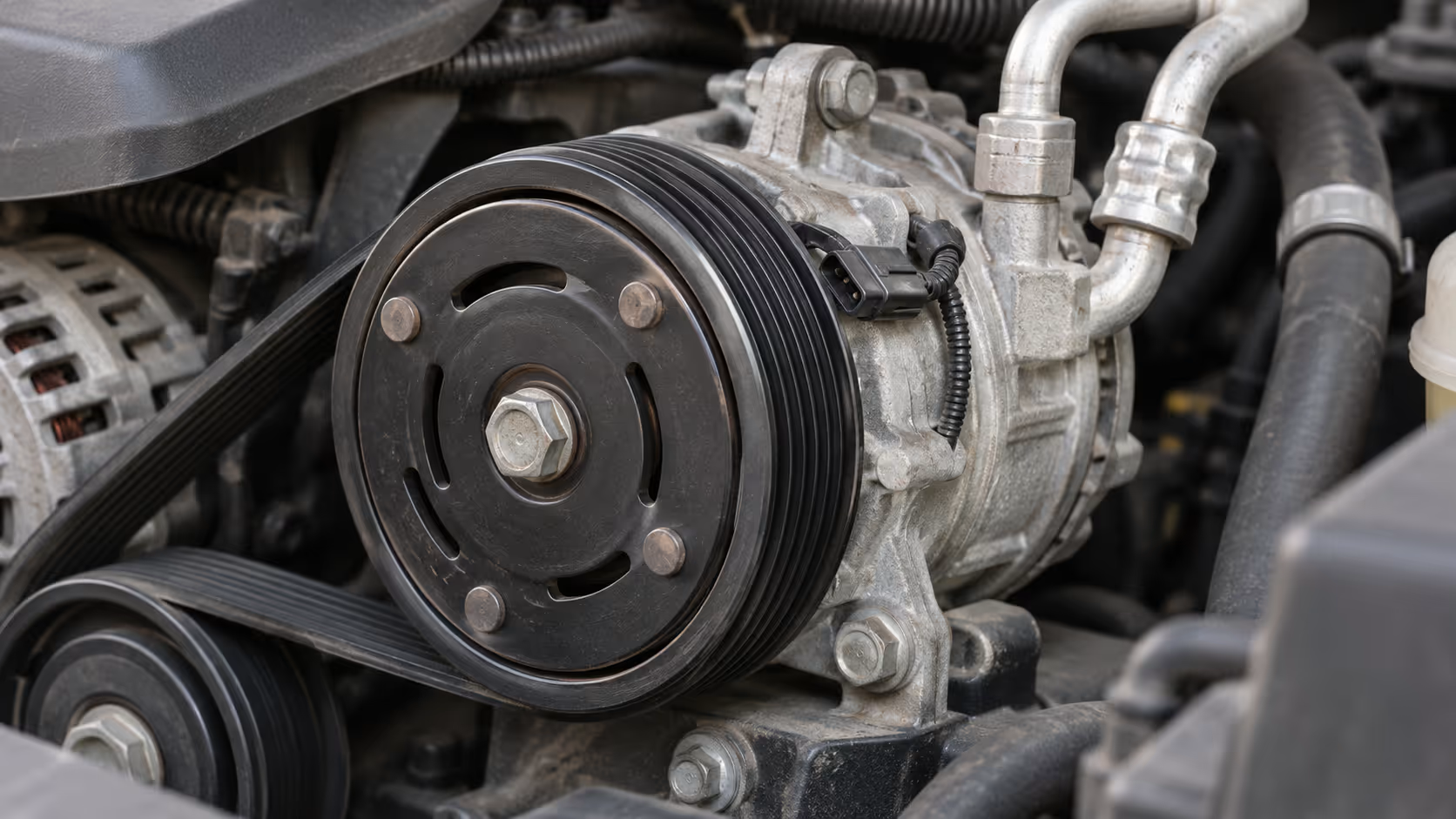
Car AC compressor clutch not engaging when you press the AC button? Start with the center of the pulley. On a car with a magnetic clutch, the outer rim can spin while the center stays still. A blown fuse, low refrigerant pressure, or a worn clutch can all leave you with warm air.
Car AC compressor clutch not engaging? Start here
Before you buy a part, check which compressor your car uses. If it has a clutch, the next question is simple. Did the car tell it to turn on?
Is the clutch staying off, or is the AC blowing warm for another reason?
Picture two parts at the belt end of the compressor. The belt runs around the outer rim. The flat plate inside that rim drives the compressor shaft when the clutch pulls in.
Watch from a safe distance. Keep your hands, hair, clothes, phone, and tools clear of the belt and fans. Skip this check if you need to reach down or get under a running car.
- The center stays still. On a warm day with AC requested, this gives you a reason to check the clutch command.
- The center turns, then stops. Some systems cycle as they cool. Note whether the vents stay cool or turn warm each time the plate stops.
- The center keeps turning, but the air stays warm. The clutch has engaged. A shop can check whether the compressor builds pressure and whether a stuck air-mix door sends heat to the vents.
How the AC clutch works and why the car may keep it off
When you press AC, the dash sends a request. The car checks inputs such as system pressure and temperature. If conditions allow, it sends power through the clutch circuit. A coil makes a magnetic field that pulls the center plate against the pulley.
That sequence explains why the dash light can come on while the plate sits still. For instance, a leak can let enough refrigerant escape to trip the low-pressure cutoff. On a cold day, some cars also block the request.
Check the compressor type for your year, engine, and model. A belt-driven clutchless unit can change its output without a plate clicking in. An electric compressor can run with the engine off. If your hybrid or EV has a high-voltage compressor, leave its cables and plugs to a trained technician.
Quick checks you can do before buying parts
- From the seat, set the temperature to cold, turn AC on, and raise the blower speed. If little air comes out, check the blower and airflow path first. Strong but warm airflow points you down a different path. If air comes out only at the highest fan setting, check why your blower motor only works on high.
- With the car shut down and the key away, look for a loose plug, rubbed wire, or damaged drive belt. Electric fans can start unexpectedly. Keep clear of the blades.
- Find the clutch fuse on the fuse-box lid or in your manual. Check the label carefully. The cabin blower may have its own fuse and still work when the clutch fuse blows.
If you see smoke, smell burning rubber, or hear a sustained belt squeal, shut down as soon as you can safely park. Arrange an inspection before running the engine again. A damaged shared belt can affect other parts your engine needs.
Step-by-step diagnosis, from the fuse to the compressor
Start with the fuse. If it checks out, split the job into two paths. When the car holds the clutch off, find out why. When it commands the clutch on, follow the power to the coil.
1. Check the clutch fuse and relay, if fitted
Switch the car off before you pull the fuse. If you know how to use a meter, check continuity across the removed fuse. A good fuse has a continuous path. A small break can be hard to see by eye.
Use only the listed fuse rating. If the new fuse blows, stop there. A wire touching metal or a shorted coil can blow the next one too. If the new fuse blows too, here’s how to trace the fault without wasting more fuses.
Check whether the car has a removable AC relay. If the manual allows a swap, use one with the same part number and pin layout. A click tells you the relay moved. Its contacts can still fail to carry enough current.
2. Find out whether the car is asking the clutch to engage
A scan tool that can read your car’s climate and engine controls helps here. A basic code reader may show no engine codes and still miss the AC data. Look for the AC request, clutch command, pressure reading, and stored faults.
- Request off with the button on. Check whether the climate controls see the button input and pass the request along.
- Request on, clutch command off. Look for a reason the car is holding it off. Start with pressure and temperature inputs.
- Clutch command on, plate still. The controller has asked for engagement. Check what reaches the clutch while the fault is present.
3. If the command is off, check why the system is protecting itself
Both low and high pressure can keep the clutch off. Low charge from a leak is one cause. At the other end, poor airflow through the condenser can let pressure climb. Tell the shop if cooling fades at idle and comes back at road speed. That clue makes the condenser fan worth checking.
A technician can compare the scan reading with gauge pressure under the same conditions. If they disagree, the technician checks the pressure sensor and its circuit. On a system with a simple pressure switch, the shop checks whether it changes state at the specified pressure.
Leave the pressure switch connected. Jumping it can force the compressor to run when the system needs it off. A recharge can’s single gauge cannot tell you how much refrigerant is in the car. Adding more can leave the charge too high and still leave the leak in place.
4. If the command is on, test power and ground at the clutch
A loose pin or green corrosion can pass enough current for a meter reading. The voltage can then drop as soon as the coil draws power. That’s why seeing battery voltage at an unplugged connector settles only part of the question.
A technician uses the correct wiring diagram and tests the circuit under load. A large drop on the feed side points toward the fuse connections, relay contacts, plug, or wiring. A drop on the return side points toward the ground path.
Leave live tests near the belt to a shop. Skip battery jump leads at the plug. Pin layouts and control circuits vary, even between engines in the same model.
5. With power and ground confirmed, check the coil, air gap, and compressor
With the power off and the coil unplugged, a technician checks its resistance against the spec for that compressor. An open coil has a break in its winding. If cooling quits only after a long drive, ask for the test while the unit is still hot. A cold test can miss the fault.
The air gap is the small space between the plate and pulley face. If it grows too wide, the coil may pull the plate in cold but fail once hot. With the engine off, the technician measures that gap with a feeler gauge. Any adjustment needs the maker’s spec.
A rough pulley bearing can make noise even with AC off because the belt still turns the pulley. If the plate grabs and the belt slips or squeals, shut down. The shop should check the pulley bearing and compressor shaft separately before quoting parts.
What each confirmed cause means for the repair
Use the test result to judge the quote. A pressure fault code, for example, gives the shop a place to start. It takes a pressure check and a circuit test to tell a bad sensor from a sensor reporting a real fault.
| Finding | What confirms it | Repair to discuss |
|---|---|---|
| Fuse blows again | Tests locate a short in the wire or coil | Fix the short, then fit the correct fuse. |
| Relay or wiring fault | Voltage drops across a connection under load | Replace the failed relay or repair the plug, wire, or ground. |
| Low charge | Charge check and leak test find a loss | Fix the leak and recharge by weight. |
| False pressure signal | Gauge and sensor disagree under the same conditions | Repair the circuit or replace the faulty sensor or switch. |
| Open coil or wide gap | Coil or gap falls outside its own spec | Replace the coil or clutch, or set the gap if the maker allows it. |
| Rough pulley or seized shaft | Separate pulley and shaft checks locate the drag | Service the pulley if available. A seized compressor needs replacement. |
| Control module fault | Inputs, power, grounds, and output wiring all pass the maker’s tests | Check service bulletins and confirm the failed module before replacement. |
What can you check yourself, and when should a mechanic take over?
You can record the settings, watch the plate from a safe spot, inspect an accessible plug, and check the fuse with the car off. If you can’t see the plate clearly, skip it. When you call the shop, tell them how long it takes for the air to turn warm and what brings the cooling back.
Leave live tests in tight spaces, repeat fuse failures, seized parts, and high-voltage systems to a qualified technician. Keep the refrigerant lines sealed. Escaping refrigerant can injure your eyes or freeze your skin. Never loosen a fitting to see if the system has pressure.
If someone has already used a recharge can, bring its label or a photo. Tell the shop how much went in, if you know. A shop can recover the charge, check for leaks, and refill by the weight on the vehicle label.
What does it cost to fix an AC clutch that won’t engage?
These U.S. shop estimates, checked in November 2026, cover separate services. Your car, ZIP code, refrigerant type, and access to the compressor affect the price. Taxes, fees, and related repairs can add to the bill.
| Service | Estimated cost | Ask what’s included |
|---|---|---|
| AC diagnosis | $122–$179 | Will the shop test while the fault is present? |
| AC recharge | $285–$369 | Does the price include leak detection? |
| Clutch replacement | $691–$826 | Can the shop service the clutch separately? |
| Compressor replacement | $1,081–$1,463 | Did the shaft seize or did only the clutch fail? |
Ask whether the shop credits the test fee toward the repair. For a clutch quote, check whether parts are sold on their own. For a full compressor quote, ask whether it includes refrigerant service. If the old unit shed metal inside the system, ask which other parts need service and why.
How to reduce repeat AC problems
If cooling fades again, note the outdoor temperature, your road speed, and how long you drove. Save the invoice with the leak location and parts used. Those details can help the next technician reproduce the fault.
Follow up on new belt noise, a damaged plug, or cooling that fades soon after a recharge. Refrigerant stays in a sealed circuit. Repeated top-offs can mask a leak and make the next diagnosis harder.
Frequently asked questions
Why does the AC pulley spin while the center stays still?
On a magnetic clutch, the belt turns the outer pulley whenever the engine runs. The center turns when the coil pulls it in. Check what the center does while the vents blow warm and the car is calling for AC.
Can low refrigerant keep the clutch from engaging?
Yes. If pressure falls below the car’s cutoff, the controls can hold the clutch off. A still plate alone can’t tell you the charge level. Ask for a pressure and leak check before buying refrigerant.
Why won’t the clutch engage if it has power?
Ask where and how the voltage was measured. If power drops under load, check the feed and ground. If both pass, the next checks are the coil and the gap at the plate.
Why does my AC work cold but quit when the engine warms up?
An excessive gap or a coil that opens when hot can cause this pattern. The best clue is the clutch command at the moment cooling stops. If the command goes away, check the pressure and temperature inputs before blaming the coil. If airflow also fades during the drive, try the AC thaw check for weak vent airflow once you’re parked.
Can I replace just the clutch?
Sometimes. The clutch must be available separately, and the compressor shaft must be sound. Ask how much labor each option takes on your engine. Access can change which repair makes sense.
What to do next if the clutch still won’t engage
Heading to the shop with “car AC compressor clutch not engaging” on your repair list? Add the detail that matters most, such as “cools for ten minutes, then the center plate stops.” Ask whether the clutch was commanded on and what the technician measured when it failed.
If the quote calls for a whole compressor, ask which test pointed to internal damage. If the fault is at the clutch, ask whether your car supports a clutch-only repair.