
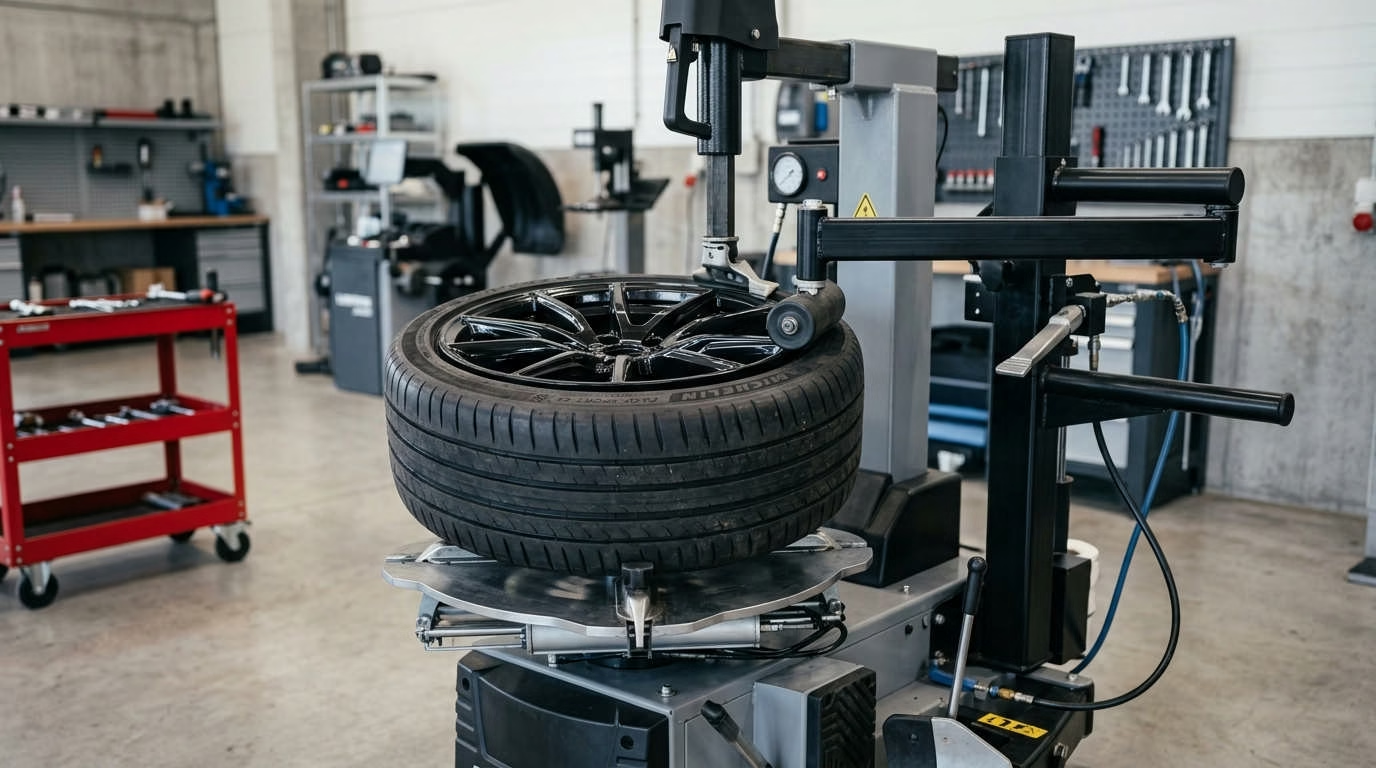
Before I ranked these machines, I reviewed thousands of owner comments, buyer discussions, and long-term use reports. The picks below reflect what people experience after real shop use, not what sounds best in an ad.
The best tire changer for low profile tires needs more than a strong motor. It must hold a stiff tire bead in the wheel’s drop center. It should also protect the rim and give you precise control.
The Hunter Revolution is the best overall choice for premium commercial work. The Ranger R980DP offers a better balance for smaller shops. For a home garage, the KATOOL KT-T830 brings useful dual assist arms at a much lower cost.
Low-profile tires have short, stiff sidewalls. They resist bending and leave little room for error. The wrong machine can scratch a wheel, tear a bead, or damage a tire-pressure sensor.
This guide covers seven machines for different budgets and workloads. It also explains what features matter, what to avoid, and how to use the equipment safely.
Quick Recommendations: The Best Low-Profile Tire Changers at a Glance
The table below gives you the short version. Prices and exact specifications may change by seller, voltage, and package.
Professional Tire Changers Comparison
Seven top-rated machines side by side. Swipe to explore every column.
| Product |  | 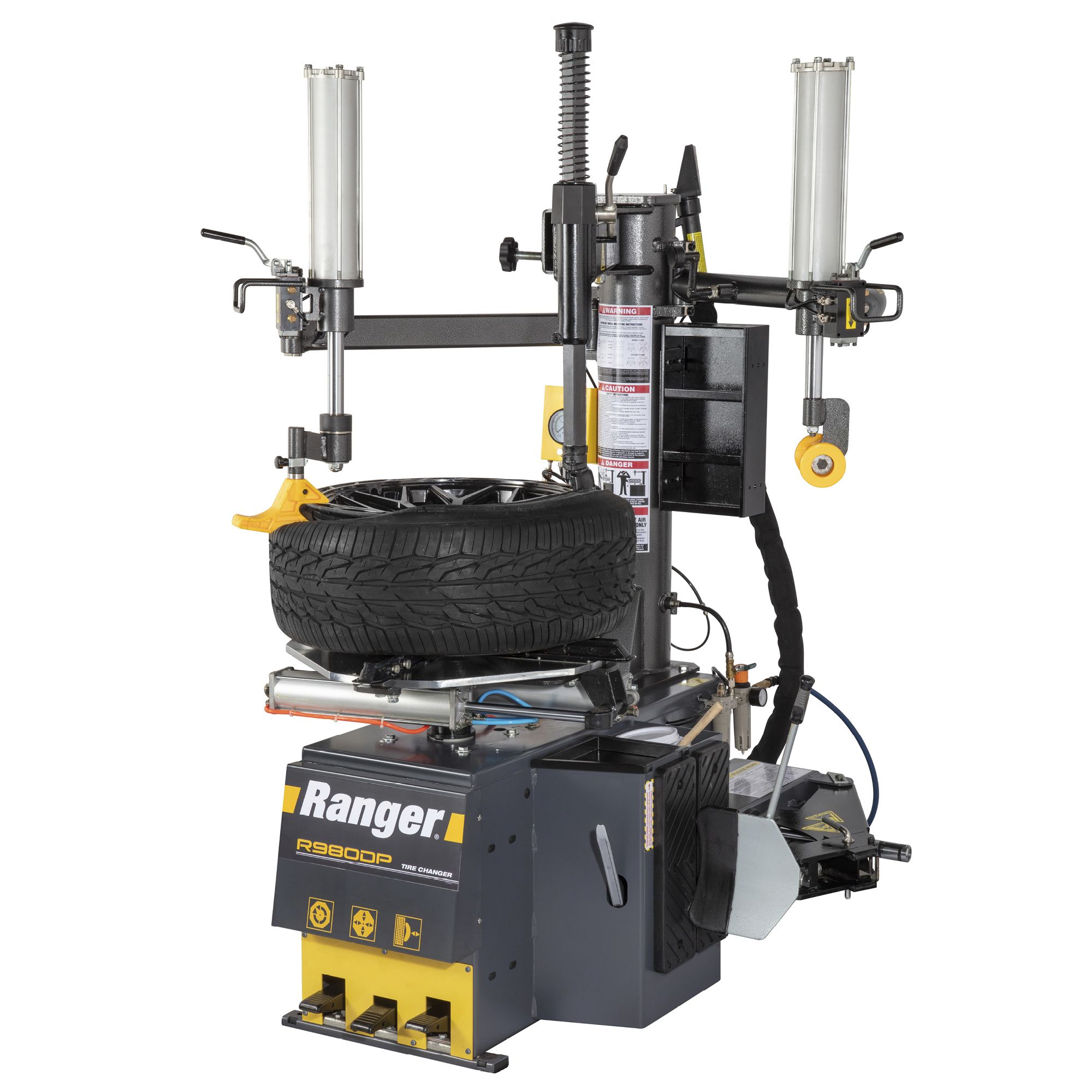 | 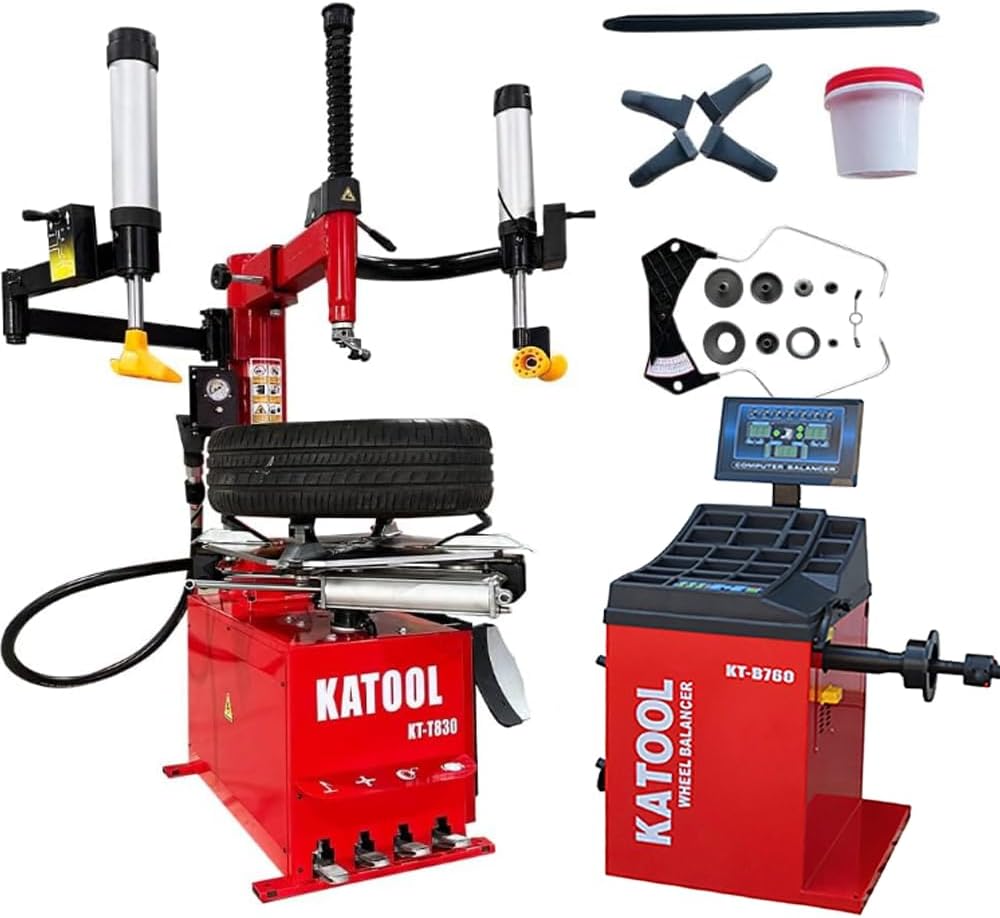 | 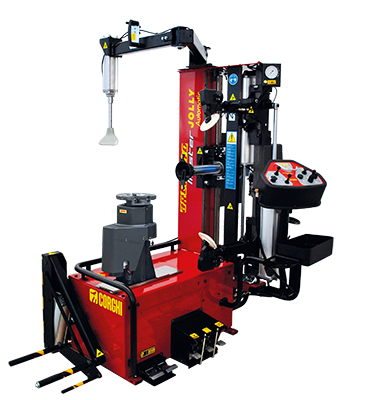 | 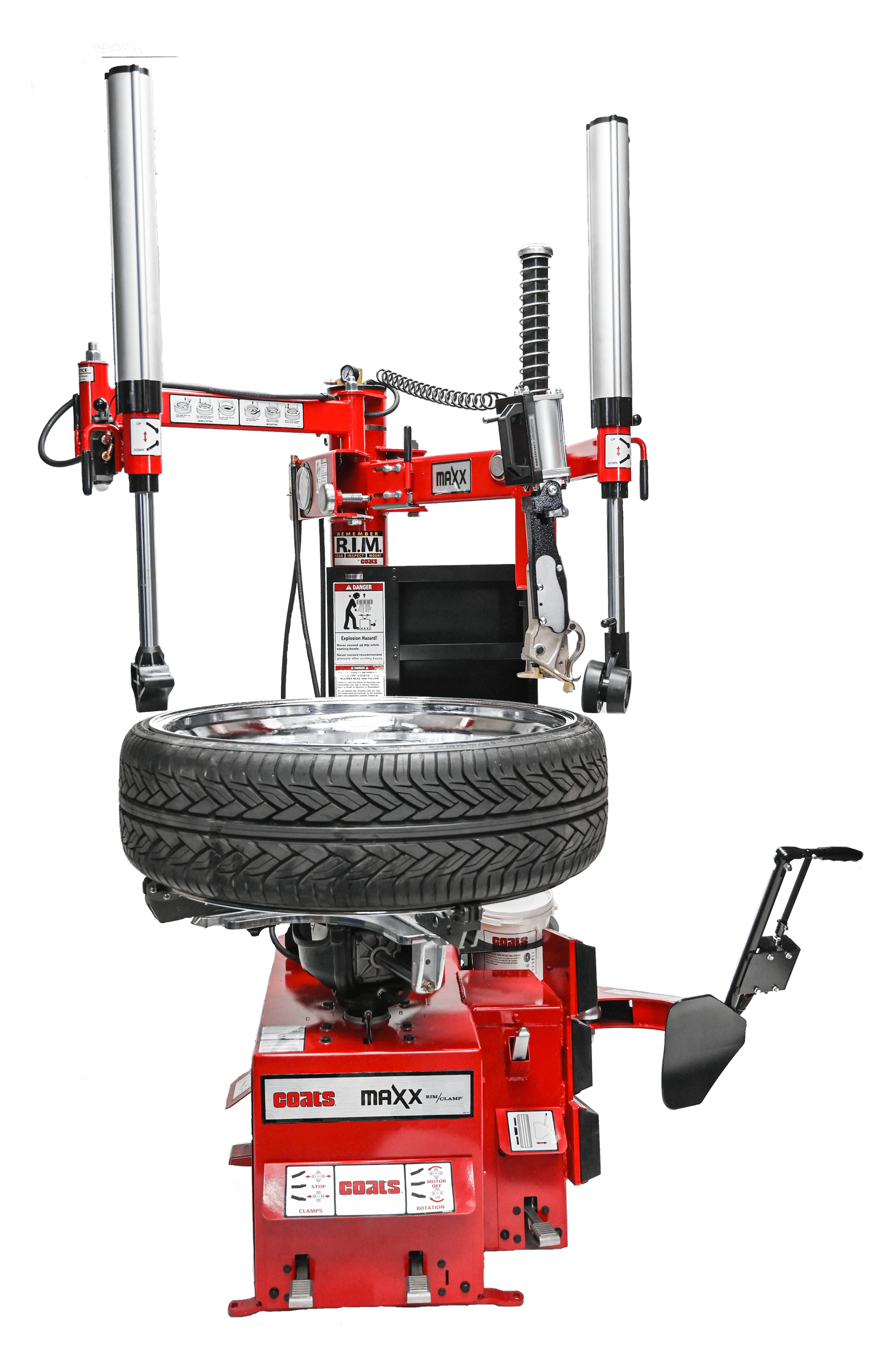 | 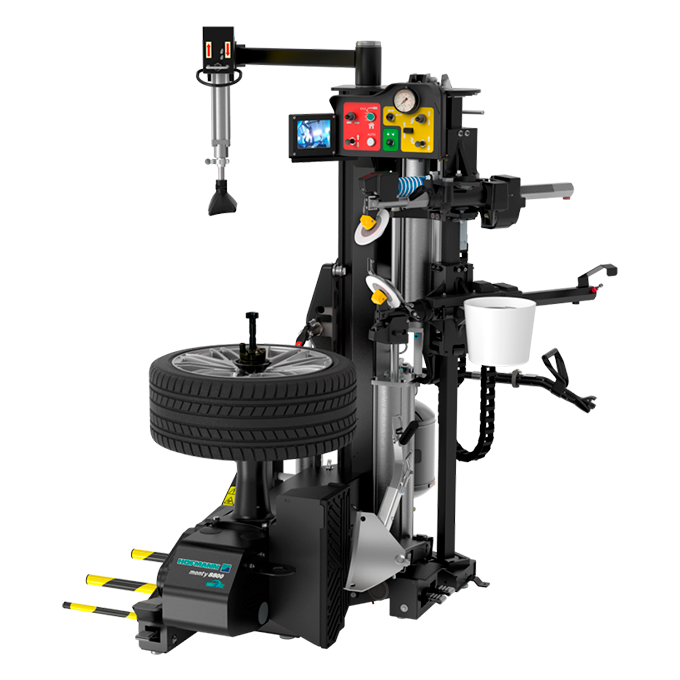 |  |
Name & Award |
Best Overall Hunter Revolution |
Best Mid-Priced Pro Ranger R980DP |
Best Budget Dual-Assist KATOOL KT-T830 |
Best No-Contact Premium Corghi Artiglio Master Jolly |
Best Traditional Workhorse Coats Maxx 90 |
Best High-Volume Mixed Hofmann Monty 8800 |
Best Small Shop Value Tuxedo TC-950-WPA |
Best For | Premium tire shops | Growing shops | Home and light shop use | Delicate wheels | Busy repair shops | Dealerships and large shops | Low-volume shops |
Design | Automated center clamp | Swing arm | Swing arm | Leverless center post | Rim clamp | Leverless center post | Swing arm |
Assist System | Guided bead tools | Dual assist towers | Dual assist arms | Dual bead discs | Roller and helper arm | Dual discs and bead pusher | Single press arm |
Price Tier | Very High | Upper Midrange | Budget | Very High | High | Very High | Midrange |
Limitation | Expensive and slower on basic tires | Not a true no-contact design | Support and finish may vary | Limited owner feedback in some regions | Needs good air care | Large, heavy, and complex | Short warranty and heavy freight |
| View Details | Check Price | Check Price | Check Price | Check Price | Check Price | Check Price | Check Price |
A simple way to narrow the list:
- Choose the Hunter Revolution for premium daily work.
- Choose the Corghi Master Jolly for delicate custom wheels.
- Choose the Coats Maxx 90 for a familiar shop workflow.
- Choose the Hofmann Monty 8800 for high-volume mixed work.
- Choose the Ranger R980DP for professional value.
- Choose the Tuxedo TC-950-WPA for a smaller shop.
- Choose the KATOOL KT-T830 for a serious home garage.
How We Selected the Best Tire Changers for Low-Profile Tires
A tire changer may work well on normal tires yet struggle with short sidewalls. That is why basic star ratings tell only part of the story.
I compared about 20 machines before choosing these seven. The wider list included premium leverless equipment, standard rim-clamp machines, low-cost imports, and manual changers.
The final ranking gives more weight to repeated owner experiences. It also considers repair support and long-term cost.
Our Product Evaluation Criteria
Each machine was judged on the factors below:
- Performance with stiff, low-profile sidewalls
- Control during mounting and removal
- Wheel and tire protection
- Assist-arm design
- Clamping strength
- Ease of setup and use
- Build quality
- Parts availability
- Repair and service options
- Air and power needs
- Value for the intended user
Motor power was not the main factor. A stronger motor can make damage happen faster if the bead sits in the wrong place.
The best machines control the bead first. They apply force only after the tire sits correctly.
Sources and Real-World Feedback Considered
The research included feedback from:
- Professional tire technicians
- Independent repair shop owners
- Motorsport users
- Home mechanics
- Vehicle-specific owner forums
- Tool communities
- Long-term equipment owners
- Verified retail buyers
- Independent equipment reviewers
Manufacturer details helped confirm sizes and power needs. They did not decide the rankings on their own.
Premium machines have more feedback from working shops. Budget models have more reports from home users. That difference affects the confidence levels in each review.
Important Limits of This Comparison
No tire changer can remove all risk.
Results depend on:
- Operator skill
- Machine setup
- Wheel shape
- Tire stiffness
- Tire age
- Sensor location
- Approved tire lubricant
- Air pressure and airflow
- Condition of plastic guards
- Regular machine care
A skilled person can get good results from a simple machine. A rushed person can damage a wheel with premium equipment.
You should practice on an old wheel first. Learn how the drop center works before handling an expensive rim.
Complete Product Comparison Table
The exact capacity may vary by model version. Always check the current manual before ordering.
Tire Changer Specs — Technical Comparison
Leverless capability, clamping method, assist tools, power needs, and more.
| Product | | | | | | | |
Product |
Premium Hunter Revolution |
Premium Corghi Master Jolly |
Pro Coats Maxx 90 |
Premium Hofmann Monty 8800 |
Mid-Range Ranger R980DP |
Value Tuxedo TC-950-WPA |
Budget KATOOL KT-T830 |
Leverless | Yes | Yes | Yes at bead lifter | Yes | No | No | No |
Clamp Style | Center clamp | Center post | Four-jaw rim clamp | Center post | Four-jaw rim clamp | Four-jaw rim clamp | Four-jaw rim clamp |
Low-Profile Aid | Automated guided process | Twin bead-breaker discs | RoboRoller and Robo-Arm | Dynamic discs and bead pusher | Dual pneumatic helpers | Single press arm | Dual assist arms |
Power Setup | Commercial supply | 220V class | 220V or air version | 230V class | 110V or 220V | 110 / 115V | 110V |
Wheel Lift | Available by setup | Package dependent | Optional | Standard | No standard lift | No | No |
Best Application | Premium performance tires | Delicate wheels and run-flats | Busy mixed-service shop | High-volume mixed work | Growing independent shop | Small professional shop | Home or light shop use |
Do not use capacity alone to choose. A machine may accept a 24-inch rim yet still struggle with a stiff 25-series tire.
The 7 Best Tire Changers for Low-Profile Tires
The ranking starts with premium commercial equipment. It ends with a lower-cost machine for light use.
That does not mean every shop needs the first product. Your best choice depends on use, wheel value, space, power, and budget.
1. Hunter Revolution: Best Overall
The Hunter Revolution stands out for difficult low-profile and run-flat tires. It uses a guided process instead of relying only on a tire bar and operator force.
This makes the workflow more repeatable. It can also reduce stress on both the tire and technician.
Key Specifications
- Automated or guided mounting process
- Center-clamp wheel holding
- Leverless bead handling
- Designed for run-flat and low-profile tires
- Commercial electrical and air requirements
- Large commercial footprint
- Premium equipment price
Why It Was Selected
The Revolution has strong support from performance-car owners and working technicians. It has handled wide, stiff tires that often challenge normal machines.
Its controlled process also helps shops train staff. Each technician follows a more fixed set of steps.
Real-World Advantages
- Low-profile performance: High confidence. It handles short, stiff sidewalls with less manual force.
- Wheel protection: High confidence. The process limits the need for exposed tire irons.
- Repeatability: High confidence. Guided steps reduce some variation between users.
- Reduced physical strain: Medium confidence. The machine handles more of the bead work.
Drawbacks and Common Complaints
- High cost: High confidence. This machine suits a business, not casual home use.
- Slower on simple tires: Medium confidence. A skilled technician may work faster on a basic machine.
- Calibration needs: Medium confidence. Shared shop machines may need checks and care.
- Training still matters: High confidence. Automation cannot fix careless setup.
Pros and Cons
| Pros | Cons |
|---|---|
| Excellent control with stiff tires | Very high purchase price |
| Good fit for premium wheels | Can be slower on normal tires |
| Less dependence on tire bars | Needs training and maintenance |
| Repeatable shop process | Large investment for low-volume work |
Best Suited For
Choose the Hunter if your shop handles:
- Run-flat tires each week
- Large performance wheels
- Premium customer vehicles
- Very short sidewalls
- High-cost custom wheels
It makes less sense for a home garage. The cost and service needs are too high for rare use.
2. Corghi Artiglio Master Jolly: Best No-Contact Premium Changer
The Corghi Master Jolly focuses on rim protection. Its working tools keep a fixed gap from the rim during correct use.
The machine uses two bead-breaking discs. These work from both sides and reduce harsh pulling on the bead.
Key Specifications
- Leverless mounting system
- Center-post wheel clamp
- Twin bead-breaker discs
- Electronic rim-size setting
- Two-speed operation
- Common rim range near 12 to 26 inches
- High-torque commercial drive
Why It Was Selected
This is a strong fit for expensive wheels. Painted, polished, forged, and custom rims leave little room for mistakes.
The Master Jolly also handles stiff sidewalls without a standard tire iron. That lowers one common source of rim marks.
Real-World Advantages
- Rim protection: High design confidence. The tool aims to avoid direct rim contact.
- Bead control: High confidence. Twin discs give the operator precise control.
- Run-flat performance: High confidence. The system was built for stiff tire shapes.
- Operator comfort: Medium confidence. Center clamping reduces repeated wheel movement.
Drawbacks and Common Complaints
- High price: High confidence. It sits in the premium commercial class.
- Training needs: Medium confidence. The controls differ from a basic swing-arm machine.
- Regional service access: Medium confidence. Local support may vary.
- Less owner feedback: High confidence. Public long-term reports are not as common.
Pros and Cons
| Pros | Cons |
|---|---|
| Very low rim-contact risk | Premium cost |
| Strong control over stiff beads | Needs skilled setup |
| Good for custom wheels | Local support may vary |
| Center-post clamping | More complex than basic machines |
Best Suited For
This machine fits:
- Exotic-car shops
- Wheel repair businesses
- High-end dealerships
- Custom wheel specialists
- Shops with strict damage rules
The Corghi may beat the Hunter for delicate rims. The Hunter has broader public feedback and a more guided process.
3. Coats Maxx 90: Best Traditional Commercial Workhorse
The Coats Maxx 90 blends a familiar layout with modern bead tools. It feels closer to a standard shop machine than the Hunter or Corghi.
Its leverless bead lifter removes the need for a normal tire iron. The helper arm and roller keep stiff beads in the drop center.
Key Specifications
- Leverless bead lifter
- RoboRoller bead depressor
- Articulating Robo-Arm
- Broad clamping range
- Dual bead-seating nozzles
- 220V two-speed option
- Optional wheel lift
Why It Was Selected
Coats has a long history in tire shops. Many older machines stay in use because their air systems can be repaired.
The Maxx 90 adds better low-profile control. It still keeps a workflow that experienced technicians know.
Real-World Advantages
- Helper performance: High confidence. The arm and roller control stiff sidewalls well.
- Mixed-use range: High confidence. It can handle small and large wheel jobs.
- Repair support: Medium to high confidence. Parts and service are easier to find.
- Familiar controls: High confidence. Shop staff face a smaller learning jump.
Drawbacks and Common Complaints
- High cost: High confidence. It remains a major shop investment.
- Air quality needs: High confidence. Wet air can damage seals and cylinders.
- Clamp contact risk: Medium confidence. Correct guards and setup still matter.
- Large feature set: Medium confidence. Small shops may not use its full capacity.
Pros and Cons
| Pros | Cons |
|---|---|
| Strong helper tools | Expensive |
| Familiar shop layout | Needs clean, dry air |
| Wide clamping range | Not fully isolated from the rim |
| Established service options | Heavy commercial machine |
Best Suited For
The Maxx 90 works well in:
- Busy tire stores
- General repair shops
- Mixed car and light-truck shops
- Shops replacing an older Coats machine
- Workplaces with trained tire staff
4. Hofmann Monty 8800: Best for High-Volume Mixed Tire Work
The Hofmann Monty 8800 combines several machines in one body. It has dynamic discs for low-profile tires and a side bead breaker for normal tires.
A camera shows the lower bead area. This gives the technician a better view during hard jobs.
Key Specifications
- Leverless powerMONT tool
- Center-post clamping
- Dynamic upper and lower discs
- Side bead breaker
- Lower-bead camera
- Pneumatic wheel lift
- Pneumatic bead pusher
- Automatic speed control
Why It Was Selected
Some premium machines focus mainly on performance tires. The Monty 8800 handles a wider daily mix.
That makes it useful for a dealership or large tire shop. One machine can cover basic tires, run-flats, and many light-truck jobs.
Real-World Advantages
- Mixed tire performance: High confidence. Two bead systems cover more wheel types.
- Operator comfort: High confidence. The lift reduces heavy wheel handling.
- Lower-bead view: High confidence. The camera helps with tool placement.
- Speed control: Medium to high confidence. It adjusts speed under load.
Drawbacks and Common Complaints
- High cost: High confidence.
- Large footprint: High confidence.
- Complex controls: Medium confidence.
- Limited independent owner volume: Medium confidence.
Pros and Cons
| Pros | Cons |
|---|---|
| Handles a wide tire mix | Very expensive |
| Includes a wheel lift | Large and heavy |
| Camera helps with lower bead | More systems to maintain |
| Strong low-profile tools | Too much machine for light use |
Best Suited For
Choose the Monty 8800 for:
- High-volume dealerships
- Large tire stores
- Shops with heavy wheel assemblies
- Mixed passenger and light-truck work
- Businesses focused on technician comfort
5. Ranger R980DP / R980DP-L: Best Mid-Priced Professional Changer
The Ranger R980DP closes the gap between low-cost imports and premium systems. Its dual helpers give it better bead control than basic swing-arm machines.
The 220V version offers more power. The R980DP-L uses 110V for shops without a 220V outlet.
Key Specifications
- Dual pneumatic assist towers
- Reversible turntable
- Drop-center helper
- Adjustable bead breaker
- Up to 30-inch clamping capacity
- 220V and 110V versions
- Professional swing-arm design
Why It Was Selected
The Ranger includes the features that matter most on low-profile tires. You get two helper systems, good capacity, and controlled rotation.
It costs less than the premium four. Yet it suits real daily shop work better than many budget imports.
Real-World Advantages
- Drop-center control: High confidence. The dual arms manage stiff beads well.
- Value: Medium to high confidence. It offers strong features for its price class.
- Voltage choice: High confidence. You can match it to your shop.
- Space use: Medium confidence. The swing arm fits closer to a wall.
Drawbacks and Common Complaints
- Mixed brand feedback: Medium confidence. Reports on older Ranger machines vary.
- High home-use cost: High confidence.
- Rim contact remains possible: High confidence.
- No full automated process: High confidence.
Pros and Cons
| Pros | Cons |
|---|---|
| Dual helper towers | Not leverless |
| 110V or 220V options | Needs careful rim protection |
| Good professional capacity | Older brand feedback is mixed |
| Costs less than premium units | Still costly for home use |
Best Suited For
The Ranger is a smart fit for:
- Growing repair shops
- Small tire stores
- Performance garages
- Mobile operations with enough space
- Shops moving up from basic equipment
6. Tuxedo TC-950-WPA: Best Value for a Small Professional Shop
The Tuxedo TC-950-WPA has one press arm rather than two. That arm still gives useful help with stiff sidewalls.
Its twin clamp cylinders hold the wheel firmly. Jaw-mounted air jets help seat difficult tire beads.
Key Specifications
- Single pneumatic press arm
- Four-jaw rim clamp
- Twin clamp cylinders
- Jaw-mounted bead blaster
- 110/115V motor
- Up to 47-inch tire diameter
- Up to 15-inch wheel width
- Air filter and regulator
Why It Was Selected
This machine provides the main features a small shop needs. It avoids the cost and complex controls of a premium changer.
The press arm adds real value. A basic machine without one can become tiring during repeated low-profile work.
Real-World Advantages
- Value: Medium to high confidence.
- Clamping force: Medium confidence.
- Low-profile support: Medium confidence.
- Everyday capacity: High confidence.
Drawbacks and Common Complaints
- Small review pool: High confidence.
- Single arm limits control: Medium confidence.
- Heavy freight: High confidence.
- Short warranty: High confidence.
Pros and Cons
| Pros | Cons |
|---|---|
| Useful press arm | Only one assist arm |
| Runs on common shop power | Very heavy delivery |
| Built-in bead blaster | Limited long-term feedback |
| Good size range | Modest warranty |
Delivery warning: This machine weighs hundreds of pounds. Confirm unloading needs before it ships.
Best Suited For
The Tuxedo works best for:
- Small repair shops
- Low-volume tire businesses
- Mobile service trucks with enough capacity
- Home shops with frequent work
- Buyers who cannot justify premium prices
7. KATOOL KT-T830 / KT-T830W: Best Budget Dual-Assist Changer
The KATOOL KT-T830 brings dual helpers into the budget class. That alone makes it more useful than many cheap powered changers.
It has enough size for common car wheels. It can also handle many wide, low-profile tires with good setup and technique.
Key Specifications
- Dual pneumatic assist arms
- 2-horsepower motor
- 110V power
- Bead-blaster system
- About 41-inch wheel diameter
- About 15-inch wheel width
- Common outside clamp range near 12 to 22 inches
- Operating air pressure near 116 to 145 psi
Why It Was Selected
The KATOOL gives home users the tools they need most. Dual helpers reduce the fight with stiff sidewalls.
It does not match premium build quality. Still, it can make sense if you are willing to set it up and maintain it.
Real-World Advantages
- Feature value: High confidence.
- Low-profile ability: Medium to high confidence.
- Home-shop fit: Medium confidence.
- Simple repair potential: Medium confidence.
Drawbacks and Common Complaints
- Long-term proof: Medium confidence.
- Quality may vary: Medium to high confidence.
- Seller support varies: Medium confidence.
- Setup takes time: Medium confidence.
Pros and Cons
| Pros | Cons |
|---|---|
| Dual helper arms | Finish can vary |
| Low entry price | May need small fixes |
| Runs on 110V | Limited service network |
| Good for light use | Not ideal for high-volume work |
Budget buyer warning: Include freight, air upgrades, fittings, guards, and setup time in your total cost.
Best Suited For
Choose the KATOOL for:
- A serious home garage
- Track-day tire swaps
- Several family vehicles
- Seasonal wheel changes
- Light side work
- Mechanically skilled owners
Which Tire Changer Should You Choose?
Your workload should lead the decision. Start with how often you change tires and how much the wheels cost.
Then check your space, power, air supply, and local service options.
Best Choice for a Premium or Performance Tire Shop
Choose the Hunter Revolution for a guided, repeatable process. It suits shops that handle stiff tires each day.
Choose the Corghi Master Jolly if rim contact is your top concern. It is a strong match for custom and high-cost wheels.
Best Choice for a Busy General Repair Shop
The Coats Maxx 90 offers a familiar commercial layout. Its helper system works well across many tire types.
The Hofmann Monty 8800 gives you more tools and a wheel lift. It makes sense for high volume and a wide tire mix.
Best Choice for a Growing Independent Shop
The Ranger R980DP offers the best middle path. It has dual helpers without the price of a top-tier automatic machine.
Choose 220V for faster commercial work. Choose the 110V version if electrical access is limited.
Best Choice for a Small or Low-Volume Professional Shop
The Tuxedo TC-950-WPA handles common shop work at a fair equipment cost. Its press arm is useful for short sidewalls.
It fits a small shop better than a complex premium machine. Just confirm freight and service details first.
Best Choice for a Serious Home Garage
The KATOOL KT-T830 gives you dual helpers and 110V power. It is easier to justify for personal use.
You should be ready to:
- Adjust the machine
- Replace small air parts
- Check every plastic guard
- Learn on cheap wheels
- Maintain the air system
A new XK 988 or Mayflower 988 may also work. A tested used Coats can be a better long-term choice.
Buying Guide: How to Choose a Tire Changer for Low-Profile Tires
The best tire changers for low-profile tires control the bead. They do not just spin the wheel with more force.
Use the points below to compare machines in a useful way.
Leverless vs Traditional Rim-Clamp Machines
A leverless changer removes or mounts the bead without a normal tire iron. This cuts one source of wheel scratches.
Traditional rim-clamp machines can still work well. They need good helpers, plastic guards, and careful setup.
Leverless machines often cost more. They may also need more training and service.
Why Assist Arms Matter for Low-Profile Tires
An assist arm pushes the sidewall down. This keeps the tire bead inside the wheel’s drop center.
The drop center is the narrow channel near the wheel’s middle. It creates the slack needed to move the bead over the rim.
A second arm adds more control. One tool can hold the tire while another follows the bead.
Look for:
- A strong press arm
- A following roller
- A bead clamp
- Adjustable pressure
- Replaceable plastic contact pads
Center-Post vs Four-Jaw Clamping
A center-post machine holds the wheel through its center bore. This can reduce contact near the rim edge.
A four-jaw machine grips the wheel from inside or outside. It covers many sizes but needs clean guards.
Center clamping often suits delicate wheels. Four-jaw tables cost less and feel familiar to many technicians.
Wheel and Rim Protection
Check every place where metal could touch the wheel.
Important guards include:
- Mount-head inserts
- Jaw covers
- Bead-breaker pads
- Tire-bar sleeves
- Center cones
- Wheel support pads
Treat plastic protectors as wear parts. Replace them before metal shows through.
Variable Speed and Turntable Control
Low speed gives a stiff tire time to move. It also gives you time to stop.
A fast turntable is useful only when the bead sits correctly. Never use speed to overcome poor bead placement.
Variable speed offers better control. A smooth reverse mode also helps release tension.
Bead-Breaking Design
A side-shovel breaker pushes against the tire near the rim. It is simple and fast for normal wheels.
Disc breakers offer more control. They can work from both sides without flipping the wheel.
Check the sensor position before breaking either bead. Keep the tool away from the valve area.
Bead-Blaster and Inflation System
A bead blaster sends a fast burst of air into the tire. It helps seal a bead that does not touch the rim.
This feature saves time on wide or stiff tires. It does not fix poor mounting work.
Use approved lubricant and follow pressure limits. Never lean over a tire during bead seating.
Tire and Wheel Capacity
Check more than rim diameter.
Measure or confirm:
- Rim diameter
- Tire width
- Full tire diameter
- Wheel offset
- Center-bore size
- Reverse-mount design
- Inside clamp range
- Outside clamp range
A listed 24-inch capacity does not cover every 24-inch wheel. Shape and width also matter.
Electrical Requirements
A 110V changer is easier to install. It may suit home and light shop use.
A 220V machine can support a stronger motor and faster work. It may need a new circuit.
Check:
- Voltage
- Current draw
- Plug type
- Breaker size
- Wire size
- Motor phase
Have an electrician check the circuit if you are unsure.
Air Compressor Requirements
Pressure is only one part of the air supply.
You also need enough:
- Airflow
- Tank capacity
- Hose size
- Recovery speed
- Duty cycle
- Fitting flow
A small compressor may reach 140 psi. It may still run out of air after one hard bead break.
Use short, wide hoses where possible. Add a water separator before the machine.
Build Quality, Parts Availability, and Warranty
Check whether you can buy these parts:
- Pedal valves
- Air hoses
- Cylinder seals
- Jaw protectors
- Mount-head inserts
- Switches
- Belts
- Motor parts
- Control boards
A cheap machine with no parts can become scrap. A costly machine with local service may have less downtime.
Ergonomics and Wheel Lifts
Large wheel sets can weigh far more than they look. Lifting them all day can harm your back.
A wheel lift helps with:
- Heavy run-flat assemblies
- Large SUV wheels
- Wide rear performance wheels
- Repeated daily tire work
Also check work height and pedal placement. A machine should not force you to bend for each step.
For more shop comfort ideas, see our guide to the best mechanic stools with wheels.
Floor Space, Weight, and Delivery
Measure the machine and its working area. A swing arm needs side clearance. A tilt-back tower needs rear clearance.
Check these points before delivery:
- Door width
- Ceiling height
- Floor strength
- Anchor points
- Forklift access
- Lift-gate service
- Crate weight
- Final operating space
Do not assume the carrier will unload it. Some machines require a forklift.
Total Cost of Ownership
The sale price is not the full cost.
Add:
- Freight
- Lift-gate fees
- Unloading
- Floor anchors
- Electrical work
- Compressor upgrades
- Air lines
- Accessories
- Training
- Plastic guards
- Repairs
- Routine care
A premium machine may cost less over time if parts and service are close. A budget machine may remain the better choice for light use.
Who Should Buy a Low-Profile Tire Changer?
Ownership makes sense when it saves enough time, labor, or outside service fees. It also gives you more control over wheel care.
However, the machine takes space and needs upkeep.
Professional Tire and Repair Shops
A shop can justify better equipment through:
- Faster service
- Lower outsourcing costs
- More tire jobs
- Better control over wheel damage
- New run-flat services
- Less strain on staff
Downtime also matters. A cheap machine is not cheap if it stops daily work.
Motorsport Teams and Performance Garages
Track teams change tires more often than normal drivers. They may also use wide wheels and short sidewalls.
In-house equipment can help with:
- Fast setup changes
- Tire testing
- Emergency swaps
- Wheel inspections
- Event schedules
A Ranger may fit a small team. A Hunter or Corghi suits a high-end race shop.
Serious Home Mechanics
A home machine may make sense if you have:
- Several vehicles
- Winter wheel swaps
- Track cars
- Restoration projects
- Family tire work
- Enough garage space
You also need a balancer unless you outsource that step.
If you service larger work vehicles, diagnostic gear may matter too. Our guide to the best heavy-duty truck scanner with DPF regen covers another useful shop category.
Who Should Continue Using a Tire Shop?
Keep using a tire shop if you change one set every few years. Ownership may never repay its full cost.
Look for a shop with:
- A leverless changer
- Trained technicians
- Rim-damage coverage
- Sensor tools
- Proper balancing equipment
- Experience with your tire type
Ask which machine they use. Also ask who will perform the work.
New Budget Machine vs Used Professional Tire Changer
A new budget machine gives you a clean start. A used commercial machine may offer stronger parts and better resale value.
Neither option wins every time.
Advantages of Buying New
New equipment offers:
- Known history
- Fresh seals and hoses
- Current safety guards
- Seller support
- Basic warranty cover
- Simple financing in some cases
New budget machines may still need setup. Inspect all bolts, fittings, and guards before use.
Advantages of Buying Used Commercial Equipment
A used Coats or Hunter may have:
- Thicker steel
- Better cylinders
- Local parts support
- Proven repair methods
- Higher resale value
Age alone is not the problem. Heavy wear and poor care are the real risks.
Used Tire Changer Inspection Checklist
Test the machine under power and air pressure.
Check:
- Clamps open and close evenly
- Turntable runs in both directions
- Gearbox stays quiet
- Pedals return correctly
- Bead breaker moves with full force
- Cylinders hold pressure
- Hoses have no cracks
- Air valves do not leak
- Mount head has little play
- Plastic guards remain available
- Frame has no major bends
- Motor starts without strain
- Model still has parts support
- Electronic controls pass calibration
Walk away if the seller refuses a working test.
Essential Accessories for Changing Low-Profile Tires
A bare machine is rarely a complete setup. The right accessories protect wheels and make stiff tires easier to handle.
Plastic Rim Protectors and Mount-Head Inserts
Keep spare plastic guards near the machine. They cost little compared with wheel repair.
Inspect them before each job. Dirt trapped under a guard can also scratch paint.
Bead Clamps, Drop-Center Tools, and Tire Restraints
A bead clamp holds part of the tire below the wheel edge. This creates slack on the opposite side.
Choose plastic or well-protected tools. Bare metal can mark the rim.
Proper Tire Lubricant
Use lubricant made for tire mounting. It reduces drag without harming the rubber.
Avoid:
- Engine oil
- Grease
- Random household soap
- Silicone products
- Strong cleaners
Wrong products may leave residue or harm the tire.
Tire-Pressure Sensor Tools
Modern wheel work may require:
- Sensor-safe valve tools
- Valve-core tools
- Torque wrenches
- Sensor service kits
- Sensor programming tools
- Scan tools
Replace worn valve parts when required. Do not reuse damaged seals.
Air Preparation and High-Flow Fittings
Use a proper air setup with:
- Water separator
- Pressure regulator
- Correct lubricator, if required
- Wide air hose
- High-flow fittings
- Drainable air tank
Follow the machine manual. Some parts need oil, while others must stay clean and dry.
How to Use a Tire Changer on Low-Profile Tires Safely
The steps below give a broad workflow. Your machine manual must guide the exact process.
Low-profile tires can hold large forces. Stop if anything looks wrong.
Inspect the Tire, Wheel, and Machine First
Check the tire for:
- Bead damage
- Sidewall cuts
- Old repairs
- Hard or cracked rubber
- Correct size
- Direction marks
Check the wheel for cracks, bends, and sharp damage. Also inspect every machine guard.
Identify the Drop Center and Sensor Position
Find the wheel’s narrow center channel. The tire bead must stay in this channel during removal and mounting.
Mark the tire-pressure sensor location. It usually sits near the valve stem.
Break the Bead Without Contacting the Sensor
Move the bead breaker away from the sensor. Start on a safe area of the tire.
Use controlled pressure. Do not let the blade touch the rim.
Keep the Bead in the Drop Center
Apply approved lubricant around the bead. Use the helper arm or roller to push the tire down.
Watch the opposite side as the table turns. If it rises out of the channel, stop.
Rotate Slowly and Stop if Resistance Increases
High resistance means something is wrong.
Common causes include:
- Dry bead
- Poor tool position
- Bead outside the drop center
- Wrong mounting direction
- Reverse-mount wheel
- Helper arm placed too high
Never fix these problems with more motor force.
Inspect and Inflate Safely
Check both beads before adding air. Confirm that the tire sits evenly around the rim.
During inflation:
- Follow pressure limits
- Use approved restraints
- Keep your face away
- Stop if the bead sits unevenly
- Check for leaks
- Never leave the machine unattended
Safety warning: A damaged tire or wheel can fail during inflation. Stop if you see cracks, torn beads, or severe distortion.
Common Mistakes to Avoid
Most damage comes from setup errors, not weak machines. Avoid the mistakes below.
Buying a Machine Without Helper Arms
A basic powered changer may remove normal tires with ease. It can still struggle with a stiff 30-series tire.
At least one helper arm is wise. Two helpers give you more control.
Choosing by Maximum Rim Size Alone
Maximum rim size does not tell you:
- Tire width
- Sidewall control
- Motor speed
- Reverse-wheel fit
- Bead-breaker range
- Helper quality
Match the whole wheel and tire assembly.
Ignoring Compressor Airflow
A compressor may show enough pressure but lack usable flow. This causes weak clamps and slow recovery.
Compare the changer’s air needs with the compressor’s rated output.
Allowing Metal to Contact the Wheel
Check jaws, bars, mount heads, and breaker blades. Replace missing plastic before work begins.
Clean the wheel too. Dirt under a clamp can leave deep marks.
For other delicate car surfaces, see our guide to the best cleaner for piano black car interior.
Using Excessive Force
More force is rarely the answer. Stop and check the bead location.
A small setup fix often removes most of the load.
Forgetting the Tire-Pressure Sensor
Sensor damage can happen during:
- Bead breaking
- Upper-bead removal
- Lower-bead removal
- Tire mounting
- Final seating
Know its position during every step.
Skipping Practice and Training
Practice with an old steel wheel or damaged alloy. Use a tire you can afford to lose.
Learn how each pedal and arm moves. Do this before helping a customer or friend.
Tire Changer Maintenance and Longevity
A well-kept tire changer can serve for years. Poor air care can damage one very quickly.
Use the schedule in the manual. Add the basic checks below.
Daily and Weekly Inspection Checklist
Daily
- Check for air leaks
- Inspect jaw covers
- Inspect mount-head plastic
- Clean dirt from the table
- Check the bead-breaker pad
- Drain trapped water
- Test pedal return
Weekly
- Check anchor bolts
- Inspect hoses and fittings
- Check helper-arm movement
- Clean clamp slides
- Check oil level where required
- Inspect the power cord
- Listen for gearbox noise
Keep Moisture Out of the Pneumatic System
Water causes rust inside cylinders and valves. It can tear seals and weaken clamping force.
Drain the compressor tank often. Service the water separator before it fills.
Replace Wear Parts Before They Damage Wheels
Replace worn:
- Jaw covers
- Mount-head inserts
- Rubber pads
- Tire-bar sleeves
- Rollers
- Seals
- Air hoses
A torn plastic cover can expose metal without warning.
Follow the Correct Lubrication Schedule
Use only the oil listed by the machine maker. Some air systems need a small, steady oil feed.
Too much oil can cause mess and valve issues. Too little can dry out seals.
Plan for Service and Downtime
Commercial shops should keep common parts on hand. These may include hoses, fittings, plastic inserts, and seal kits.
Record model and serial numbers. Keep the manual where staff can find it.
While caring for shop equipment, do not overlook vehicle trim. Our guide to the best car rubber seal restorer explains how to care for aging door and trunk seals.
Alternatives That Did Not Make the Top Seven
Several capable machines missed the final ranking. Most lacked the same mix of feedback, support, or low-profile tools.
XK 988
The XK 988 offers dual helpers at a low price. Owners have used it on very short sidewalls.
Its weak points include setup, limited instructions, and uneven quality. The KATOOL earned the main spot due to stronger recent interest.
Mayflower 988
The Mayflower has a loyal home-shop base. Its dual-arm versions can handle low-profile tires with practice.
Support and exact packages may vary. Check the model closely before comparing prices.
Atlas TC289 With Assist Arms
The Atlas can be a useful general shop machine. Parts access is often better than with unknown imports.
Its low-profile ability depends on the helper package. A basic unit should not be judged like a fully optioned one.
Dannmar DT-50A
The Dannmar offers a compact professional format. It may fit a smaller shop well.
It missed the final list due to less independent long-term feedback.
Triumph NTC-950
The Triumph attracts buyers with its price and available helpers. Model names and packages can vary between sellers.
Make sure the listed price includes the assist equipment you need.
Manual Tire Changers
Manual changers cost less and use little space. They can work on simple tires.
They are not ideal for routine low-profile work. The extra force and limited bead control increase risk.
Final Verdict
The best tire changer for low profile tires depends on how you plan to use it.
The Hunter Revolution offers the strongest overall commercial package. The Corghi Master Jolly puts more focus on delicate wheels. The Coats Maxx 90 and Hofmann Monty 8800 suit busy shops with mixed work.
The Ranger R980DP gives a growing shop useful dual helpers without a top-tier price. The Tuxedo TC-950-WPA works for smaller operations. The KATOOL KT-T830 is the most practical budget choice for a skilled home user.
Before choosing, answer five questions:
- How many tires will you change each month?
- How costly are the wheels?
- Do you often handle run-flats?
- Can your air and power systems support the machine?
- Who will repair it if something fails?
The right answer may also be a used commercial machine. Test it under power, check parts access, and include delivery costs.
Frequently Asked Questions
Can You Change Low-Profile Tires With a Regular Tire Changer?
Yes, but it may take more skill and force. A helper arm makes the work much safer and easier.
Good rim guards and correct bead position also matter.
Do You Need a Helper Arm for Low-Profile Tires?
You do not always need one, but you should strongly consider it.
A helper arm keeps the tire in the drop center. This reduces bead stress and manual effort.
Is a Leverless Tire Changer Better?
A leverless machine lowers the need for a tire iron. That can reduce rim and bead damage.
It also costs more and still needs correct training.
Can These Machines Handle Run-Flat Tires?
The premium machines can handle many run-flat tires. The Ranger, Tuxedo, and KATOOL can also handle some with the right setup.
Always check the exact tire size and machine limits.
What Size Air Compressor Does a Tire Changer Need?
There is no one size for every machine.
Match:
- Required pressure
- Rated airflow
- Tank capacity
- Duty cycle
- Hose size
A larger shop compressor gives more stable performance.
Can a Tire Changer Damage Alloy Wheels?
Yes. Bare metal, dirty clamps, worn guards, and poor setup can scratch or gouge alloy wheels.
Inspect every contact point before use.
Can a Tire Changer Break a Tire-Pressure Sensor?
Yes. The bead breaker or tire bead can hit the sensor.
Mark its position before starting. Keep tools away from the valve area.
Is It Worth Buying a Tire Changer for Home Use?
It may be worth it if you have several vehicles or frequent tire swaps.
Include the cost of:
- A balancer
- Compressor upgrades
- Freight
- Floor space
- Accessories
- Repairs
For rare use, a good tire shop costs less.
Is a Used Coats or Hunter Better Than a New Budget Machine?
It can be. A clean used commercial machine may offer better parts and build quality.
Do not buy it without testing. Old electronics and worn cylinders can be costly.
What Is the Best Tire Changer for 20-Inch and Larger Wheels?
The Hunter, Corghi, Coats, Hofmann, and Ranger suit many large wheels.
Rim size alone is not enough. Check width, offset, tire profile, and clamp range.
What Is the Best Budget Tire Changer for Low-Profile Tires?
The KATOOL KT-T830 is the strongest budget pick in this group. Its dual arms give it an edge over basic machines.
The XK 988 and Mayflower 988 are also worth checking.
How Long Does a Tire Changer Last?
A quality machine can last many years with good care.
Life depends on work volume, air quality, lubrication, operator use, and parts support. Clean air and fresh plastic guards make a large difference.