
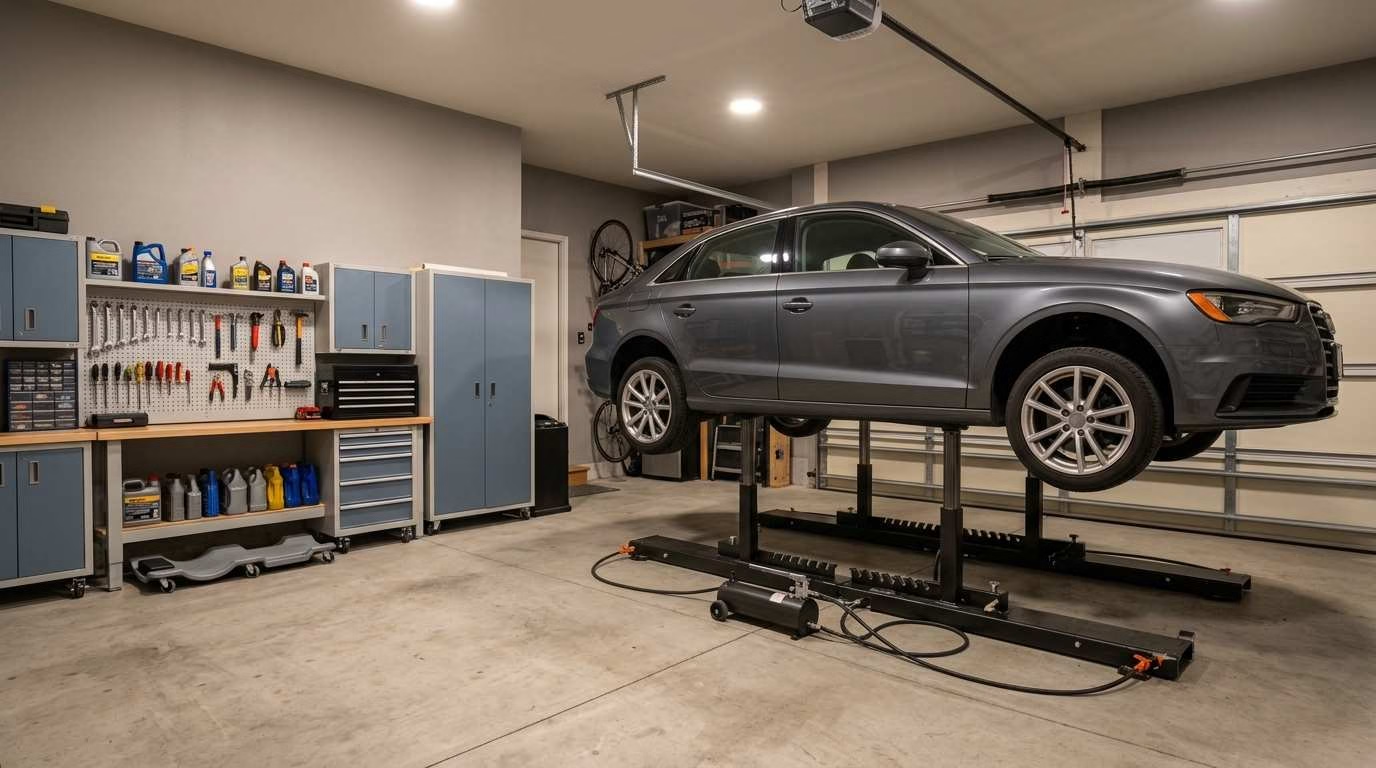
The best portable car lift for a home garage is the QuickJack 6000TL. It offers a useful mix of capacity, compact storage, and easy setup. You do not need to drill into your garage floor.
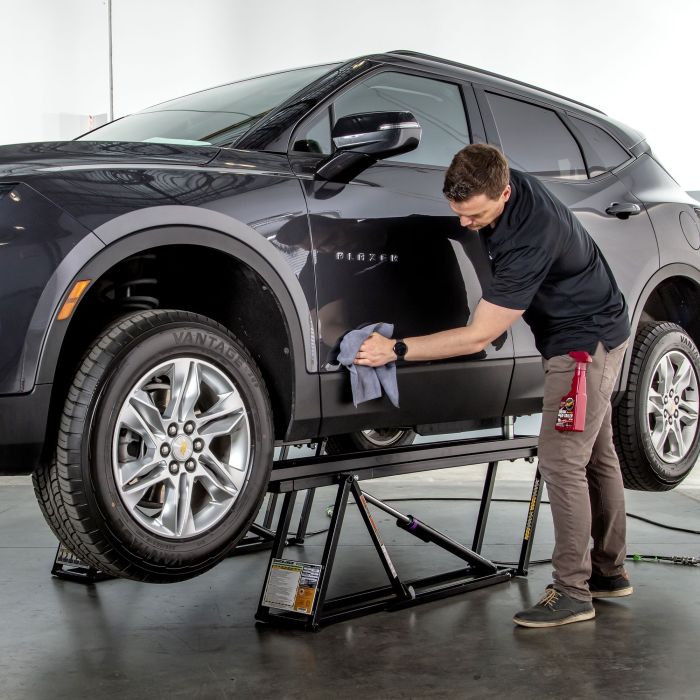
However, it will not suit every vehicle or repair. Heavier trucks may need the QuickJack 7000TLX. Major underbody work may call for the MaxJax M7K. Vehicle storage requires a different lift again.
This guide will help you choose the right type.
The Best Portable Car Lifts at a Glance
Prices can change. Freight, adapters, and power needs may raise your final cost.
The short answer:
- Choose the QuickJack 6000TL for most cars and crossovers.
- Choose the QuickJack 5000TL for lighter cars and tighter budgets.
- Choose the QuickJack 7000TLX for long SUVs and light trucks.
- Choose the MaxJax M7K for exhaust and transmission work.
- Choose the Dannmar DMR-6 for more height without side posts.
- Choose the APlusLift HW-8S for vehicle storage.
How We Chose the Best Portable Car Lifts
A high capacity does not make a lift the best choice. It must fit your car, garage, and usual repair jobs.
Here are the main points used to compare these lifts.
Lifting capacity
The rated capacity is the most weight a lift supports. Your vehicle should sit well below that limit.
Do not use the listed curb weight alone. Fuel, tools, cargo, and added parts all increase the load.
A safety margin also gives you more room for a future vehicle. Still, extra capacity does not fix poor lift-point placement.
Lift-point compatibility
Lift points are the approved areas that support your vehicle. They may sit under pinch welds, frame rails, or reinforced pads.
Measure the distance between the front and rear lift points. Then compare that number with the lift’s supported range.
This step matters more than many buyers expect. A long truck lift may not fit a short sports car. A compact lift may not reach an SUV’s lift points.
Maximum working height
Lift height affects the jobs you can perform.
- 21 to 25 inches: Good for brakes, oil changes, and wheel service.
- 40 to 50 inches: Better for seated underbody work.
- Full-rise height: Best for standing, but needs more ceiling space.
A low-rise lift can replace jack stands for many tasks. It cannot copy the access of a full two-post lift.
If you have enough space, compare these choices with the best 2-post car lifts for a home garage.
Real portability
Some portable lifts weigh less than 100 pounds per frame. Others weigh close to 1,000 pounds.
Ask where you will store the lift. Also ask how often you must move it.
A frame lift can hang on a wall. A scissor lift usually rolls to one side. A removable two-post lift leaves anchors in the floor.
Garage requirements
Measure the full work area before you order anything.
Check:
- Ceiling height
- Door tracks
- Garage door opener
- Hanging lights
- Bay width
- Bay length
- Outlet location
- Floor condition
- Storage space
Cold garages can also make long repair jobs unpleasant. A suitable garage heater for a home workspace may improve comfort during winter projects.
Safety systems
A sound lift should have mechanical locks. These hold the vehicle without relying on fluid pressure.
Useful safety features include:
- Automatic lock bars
- Several lock positions
- Arm restraints
- Stable rubber blocks
- Even-flow hydraulic systems
- Clear visual lock points
The safety system still depends on correct use. You must engage the locks before going under the vehicle.
Owner feedback and common problems
Owner reports show problems that short tests may miss.
Common themes include:
- Heavy frames
- Leaking fittings
- Uneven lifting
- Poor block placement
- Limited work height
- Slow replacement parts
- Difficult freight delivery
One complaint does not prove a whole model is bad. Patterns matter more than isolated reports.
Best Portable Car Lift Reviews
Each review below follows the same basic test. You will see what the lift does well, where it struggles, and who should use it.
1. QuickJack 6000TL: Best Portable Car Lift Overall
The QuickJack 6000TL is the strongest general pick. It suits many cars while leaving enough capacity for some crossovers and SUVs.
It also works in a normal garage. You do not need tall ceilings or permanent posts.
QuickJack 6000TL key specifications
- Lift type: Low-rise frame lift
- Capacity: 6,000 pounds
- Maximum lift height: About 24 inches
- Collapsed height: About 3.5 inches
- Frame weight: About 78 pounds each
- Power: Common home power options
- Floor anchors: Not required
- Lift time: About 30 seconds
- Typical price: Around $1,900
Always check the current manual. Small specifications can change between versions.
Why the QuickJack 6000TL is our top pick
The 6000TL sits in a useful middle ground. It has more capacity than the 5000TL, yet it avoids the long frames of the 7000TLX.
That makes it easier to match with a mixed home fleet. It may cover a sedan, sports car, and family crossover.
The two frames leave the middle area open. You can reach much of the exhaust and floor pan without a crossbeam blocking you.
Storage is another strength. You can slide the frames away or place them on approved wall hangers.
What jobs can you do with it?
The QuickJack 6000TL works well for:
- Oil and filter changes
- Brake pad and rotor service
- Tire rotations
- Wheel swaps
- Suspension checks
- Shock and spring work
- Underbody inspections
- Detailing
- Light exhaust repairs
You will still work from a creeper or low seat. The car will not rise high enough for you to stand.
What owners like
Owners often praise the speed. The whole car rises at once, so you avoid lifting four separate corners.
Many users also like the low profile. It fits under vehicles that can be hard to raise with a standard floor jack.
If you own a very low car, read this guide to the best floor jacks for lowered cars. A floor jack can still help with setup and backup tasks.
Common complaints and problems
The frames are not light. Each one weighs about as much as a large bag of concrete.
That can become annoying if you store them after every use. Small wheels help, but rough floors make movement harder.
Block placement also takes time. You may need to move from side to side several times.
Other reported issues include:
- Hydraulic fittings that seep
- Air trapped in the system
- Hoses lying across the work area
- Blocks shifting during early setup
- Delays with replacement parts
Most concerns can be reduced through careful setup. Still, inspect every contact point before going to full height.
QuickJack 6000TL pros and cons
Pros
- Good capacity for mixed vehicle use
- No floor drilling
- Small storage footprint
- Fast lifting cycle
- Open access through the center
- Works under many low cars
- Mechanical safety locks
Cons
- Heavy to move by hand
- Low working height
- Requires careful block placement
- Not ideal for large drivetrain work
- Hoses can get in your way
Who should buy the QuickJack 6000TL?
It suits you if you work on cars at home several times per year. It is most useful for brakes, tires, oil, and suspension jobs.
It also fits garages that cannot hold permanent posts. Renters may find it useful if the owner allows this equipment.
Who should skip it?
Skip it if you need standing access. A removable or fixed two-post lift will suit you better.
It is also a poor choice if your vehicle’s lift points fall outside its range. Never force the blocks into an unsafe spot.
2. QuickJack 5000TL: Best Budget Portable Car Lift
The QuickJack 5000TL gives you the main QuickJack benefits at a lower cost. It lifts many passenger cars without taking up much garage space.
Its lower rating makes fit checks more important.
QuickJack 5000TL key specifications
- Lift type: Low-rise frame lift
- Capacity: 5,000 pounds
- Maximum lift height: Up to 24 inches
- Collapsed height: About 3 inches
- Frame length: About 70 inches
- Frame weight: About 78 pounds each
- Lift-point range: About 37 to 60 inches
- Lift time: About 30 seconds
- Power: Common home power options
- Typical price: $1,650 to $1,925
Measure your car before choosing this model. Do not rely on vehicle class alone.
Why it is the best value for smaller vehicles
You get electric hydraulic lifting and mechanical locks. You also get a compact frame that requires no floor anchors.
If your car weighs well under 5,000 pounds, more capacity may add little value. The 5000TL can then be the smarter choice.
It works well for owners who plan to keep lightweight vehicles. It may also save money for pads and adapters.
Best vehicles for the QuickJack 5000TL
The 5000TL often suits:
- Small roadsters
- Compact cars
- Midsize sedans
- Sports cars
- Lightweight project cars
- Some small crossovers
Do not assume every small car fits. Very short cars may have lift points inside the minimum range.
Owner feedback
Owners often say the 5000TL makes routine work less tiring. It removes the need to lift one end, place stands, and repeat.
Sports-car owners value the low frame height. The lift can reach vehicles that offer little room for a normal jack.
Some owners keep the frames on the floor between uses. This saves setup time but takes up parking space.
QuickJack 5000TL limitations
The 5,000-pound rating leaves less room for heavy vehicles. Many electric cars, SUVs, and trucks can exceed its useful range.
It also lifts only about two feet. That is enough for brakes and oil changes, but not ideal for a clutch or transmission job.
Extra adapters can add to the cost. Check whether your vehicle needs pinch-weld pads or taller blocks.
QuickJack 5000TL pros and cons
Pros
- Lower cost than larger QuickJack models
- Compact storage
- No concrete drilling
- Good choice for low cars
- Fast setup after initial assembly
- Useful open-center design
Cons
- Limited to lighter vehicles
- Low working height
- Heavy frames
- Short vehicles may not fit
- Less room for future vehicle changes
Is the 5000TL worth buying over the 6000TL?
Choose the 5000TL if all your vehicles sit well below its limit. It makes sense if the price gap helps your budget.
Choose the 6000TL if you may buy a heavier vehicle. The added capacity gives you more options.
Fit still comes first. Compare the lift-point range of both models before deciding.
3. QuickJack 7000TLX: Best Portable Car Lift for Trucks and SUVs
The QuickJack 7000TLX combines a 7,000-pound rating with extended frames. It is built for vehicles with widely spaced lift points.
That makes it a strong portable car lift for SUVs and light trucks.
QuickJack 7000TLX key specifications
- Lift type: Extended low-rise frame lift
- Capacity: 7,000 pounds
- Maximum lift height: Up to 24.5 inches
- Collapsed height: About 3.5 inches
- Frame length: About 76 inches
- Lift-point range: About 43 to 66 inches
- Floor anchors: Not required
- Typical price: $1,975 to $2,175
The large minimum lift-point spread deserves close attention. This model may not fit a smaller car.
Why longer frames matter
A long vehicle may place its front and rear lift points far apart. Standard frames may not reach both positions.
The TLX frame adds that missing reach. This can help with full-size SUVs and long crossovers.
Frame length is not the same as capacity. A heavy short vehicle and a long lighter vehicle have different needs.
Best uses for the 7000TLX
The model works best for:
- Light-duty pickups
- Full-size SUVs
- Long-wheelbase crossovers
- Large luxury sedans
- Mixed garages with heavier vehicles
Truck adapters may add useful height. They can also help the blocks reach high frame rails.
The biggest 7000TLX fitment warning
The extended frame begins at a wider lift-point range. A compact car may have points too close together.
This creates an odd problem. The strongest QuickJack may be the least useful choice for a small vehicle.
Measure each car you plan to raise. Include any future vehicle only after your current fleet fits.
Common owner complaints
The 7000TLX frames are long and heavy. Moving them across a small garage can feel like a separate job.
The low rise also remains. Higher capacity does not give you enough room to stand.
Other concerns include:
- Extra cost for truck adapters
- Harder wall storage
- Limited fit for short cars
- More floor space during setup
- Awkward block alignment on some frames
QuickJack 7000TLX pros and cons
Pros
- Strong 7,000-pound rating
- Fits many long vehicles
- No floor anchoring
- Useful for trucks and SUVs
- Low collapsed profile
- Open-center access
Cons
- Too long for some small cars
- Harder to move
- Needs more storage space
- Limited working height
- Adapters may cost extra
QuickJack 7000TL versus 7000TLX
The standard 7000TL suits many vehicles with normal lift-point spacing. The 7000TLX reaches farther toward both axles.
Choose the TLX only when you need that reach. Do not select it just because the frame is longer.
Check these four points:
- Front-to-rear lift-point distance
- Vehicle weight
- Space beside the vehicle
- Frame storage area
The standard version may be more flexible in a mixed fleet.
4. MaxJax M7K: Best High-Rise Portable Car Lift
The MaxJax M7K is a removable two-post lift. It gives you far more access than a low-rise frame system.
Its posts bolt into floor sockets during use. You can remove and roll them away later.
MaxJax M7K key specifications
- Lift type: Removable two-post lift
- Capacity: 7,000 pounds
- Column height: About 89.5 inches
- Maximum lift height: About 47 inches
- Minimum pad height: About 4.75 inches
- Power: 110-volt models are available
- Floor anchors: Required
- Setup time: About 15 minutes after installation
- Typical price: About $5,195
Your garage floor must meet the current installation rules. Have the slab checked if its details are unknown.
What makes MaxJax different from QuickJack?
MaxJax lifts with adjustable arms. The center under your vehicle stays open.
It also raises the car much higher. You can work from a low stool instead of lying flat.
The main differences are simple:
| Feature | QuickJack | MaxJax |
|---|---|---|
| Working height | About 24 inches | About 47 inches |
| Floor drilling | No | Yes |
| Center access | Good | Very good |
| Setup | Faster | More involved |
| Storage | Compact frames | Removable columns |
| Typical cost | Lower | Much higher |
MaxJax feels closer to a shop lift. QuickJack feels like a powered replacement for jack stands.
Best repairs for the MaxJax M7K
The extra space helps with:
- Exhaust replacement
- Driveshaft removal
- Differential work
- Transmission service
- Suspension rebuilds
- Fuel tank work
- Long project-car repairs
- Underbody restoration
You may still need to sit or crouch. Yet the added height makes long jobs less tiring.
What owners like
Owners value the open floor below the car. No large platform blocks the transmission or exhaust.
The arms also give you more placement options. They can reach approved lift points on many vehicle shapes.
Users with low ceilings appreciate the short columns. A full two-post lift may not fit the same garage.
Common MaxJax concerns
Installation takes real planning. You must drill accurate holes and place anchors in sound concrete.
Some older owner reports mention uneven lifting and hydraulic noise. Leaking fittings and cylinders also appear in long-term discussions.
These issues do not affect every lift. They still show why correct bleeding and setup matter.
Other drawbacks include:
- High purchase cost
- Heavy columns
- Longer setup time
- Permanent floor sockets
- Concrete limits
- More maintenance than a basic frame lift
MaxJax M7K pros and cons
Pros
- Almost double the height of QuickJack
- Open center area
- Adjustable lifting arms
- Good wheel and suspension access
- Works in many low-ceiling garages
- Columns can be removed
- 7,000-pound capacity
Cons
- Expensive
- Requires suitable concrete
- Needs drilling
- Harder to install
- Columns are heavy
- Takes longer to set up
Who should buy the MaxJax M7K?
Choose it if you perform complex repairs at home. It also suits project cars that stay raised for several days.
It makes sense when you want two-post access but lack ceiling height.
Who should avoid it?
Avoid it if you cannot drill the floor. This includes many renters.
You should also avoid drilling into post-tensioned concrete without a scan. Hidden steel cables can cause serious damage if struck.
A low-rise frame lift is simpler if you mainly change oil and brakes.
5. Dannmar DMR-6: Best Portable Mid-Rise Scissor Lift
The Dannmar DMR-6 sits between QuickJack and MaxJax. It raises the vehicle to about 48 inches without using side posts.
Its center platform creates both its main strength and weakness.
Dannmar DMR-6 key specifications
- Lift type: Mid-rise scissor lift
- Capacity: 6,000 pounds
- Maximum lift height: About 48 inches
- Lowered height: About 4.75 inches
- Overall length: About 81 inches
- Overall width: About 41.5 inches
- Weight: About 944 pounds
- Power: 110 volts
- Lift time: About 45 seconds
- Safety locks: Several height positions
This lift rolls across the floor. You will not want to move it far or often.
Why choose a mid-rise scissor lift?
A mid-rise lift gives you room to sit under parts of the car. It also keeps tall posts away from the doors.
That setup works well for wheel and brake service. It is also useful for side body repairs.
The DMR-6 is a good middle choice if your garage cannot take a full lift. It gives you more height than QuickJack without drilling for two posts.
Where the DMR-6 performs best
Use it for:
- Brake repair
- Wheel service
- Suspension work
- Body repair
- Paint preparation
- Detailing
- Underbody checks
- Light truck maintenance
Adjustable arms help reach different lift points. The included truck adapters add more options.
Important limitations
The scissor structure sits under the middle of the car. It may block the exact part you need to reach.
This can affect:
- Exhaust systems
- Driveshafts
- Fuel tanks
- Transmission removal
- Some fluid pans
The unit also weighs close to half a ton. “Portable” means it can roll, not that it is easy to carry.
Low cars may need shallow ramps. The 4.75-inch lowered height can be too tall for some sports cars.
Dannmar DMR-6 pros and cons
Pros
- About 48 inches of rise
- No side columns
- Good for wheel and body work
- Several lock positions
- Adjustable support arms
- Fits many low-ceiling garages
Cons
- Very heavy
- Center structure blocks access
- Needs more floor space
- Hard to move on rough floors
- May not fit very low cars
- Freight delivery can be difficult
Dannmar DMR-6 versus MaxJax M7K
Both lifts reach a similar working height. Their layouts are quite different.
Choose the DMR-6 if you do not want floor anchors. It also leaves both sides of the vehicle open.
Choose MaxJax if center underbody access matters. Its arms leave the exhaust and transmission area clearer.
MaxJax costs more and needs stronger floor preparation. The DMR-6 takes up more space below the car.
6. APlusLift HW-8S: Best Portable Lift for Car Storage
The APlusLift HW-8S is a four-post storage lift. Your vehicle drives onto two raised runways.
It is less suited to brake work. Yet it can create a second parking level in one garage bay.
APlusLift HW-8S key specifications
- Lift type: Four-post storage lift
- Capacity: 8,000 pounds
- Overall length: About 178 inches
- Overall width: About 106 inches
- Overall height: About 84 inches
- Drive-through width: About 93 inches
- Power: 110 volts
- Mobility: Caster kit
- Typical price: About $2,995
- Common extras: Drip trays, jack tray, and ramps
Your ceiling needs more room than the lift height alone. You must include both vehicles and safe clearance.
Why a four-post lift is better for storage
A four-post design supports the vehicle by its tires. That makes drive-on parking simple.
You can leave a second vehicle below it if the ceiling allows. Drip trays help protect the lower car.
Long-term storage also keeps the suspension in a normal resting position. The wheels remain loaded as they would on the road.
Maintenance jobs it handles well
A four-post lift works well for:
- Oil changes
- Fluid checks
- Underbody cleaning
- Rust inspection
- Undercoating
- Exhaust checks
- Detailing
- Seasonal storage
The long runways also make vehicle placement easy.
Maintenance jobs it handles poorly
The wheels stay on the runways. That limits brake and suspension access.
It is less useful for:
- Tire rotations
- Brake repairs
- Wheel bearing work
- Shock replacement
- Ball joint service
- Wheel removal
A bridge jack can raise one end by the frame. However, that adds cost and setup time.
The hidden costs of a four-post lift
The listed price may not reflect the final cost.
Plan for:
- Freight delivery
- Terminal pickup
- Forklift rental or service
- Professional assembly
- Bridge jacks
- Longer entry ramps
- Door-track changes
- Light relocation
- Electrical work
The shipment is large and heavy. Confirm unloading details before it leaves the warehouse.
APlusLift HW-8S pros and cons
Pros
- Adds vehicle storage
- Strong 8,000-pound rating
- Easy drive-on loading
- Usually needs no permanent posts
- Caster kit allows movement when empty
- Useful for oil and inspection work
Cons
- Large garage footprint
- Needs high ceilings
- Blocks wheel and suspension access
- Difficult freight delivery
- Bridge jack costs extra
- Not easy to move in daily use
Who should buy it?
Choose this lift if parking is your main problem. It suits collectors and seasonal-car owners.
It also works for owners who perform light maintenance. You gain storage but give up some repair access.
What Real Owners Say About Portable Car Lifts
Product specifications tell only part of the story. Daily setup, storage, and fit can affect your experience more.
The same themes appear across many owner discussions.
“I wish I had bought one sooner”
Many owners say a lift changes how often they work on their cars. A small job feels easier when the car rises with one button.
Brake work becomes less tiring. Oil changes require less crawling and lifting.
The surprise is not just speed. It is the reduced effort before the repair even starts.
“Portable does not mean lightweight”
Portable lift frames can be awkward. Their weight feels more noticeable in a tight garage.
Scissor lifts and removable posts are much heavier. Wheels help, but floor cracks and rough concrete still resist movement.
Think about storage before delivery. A clear wall or fixed parking spot can save a lot of effort.
Fitment causes more frustration than lifting capacity
A lifting system can support your car’s weight yet fail to reach its lift points.
Owners often struggle with:
- Short lift-point spacing
- Wide rocker panels
- Tall pinch welds
- Uneven frame contact
- Plastic side skirts
- Block movement
Measure your vehicle before ordering. Correct adapters can also prevent damage.
Low-rise lift height is enough for some jobs, not all
A 24-inch rise feels generous during brake work. It can feel cramped during an exhaust replacement.
Low-rise lifts suit:
- Oil service
- Brake work
- Tire rotations
- Wheel cleaning
- Suspension checks
Higher lifts suit:
- Transmission work
- Driveshaft removal
- Full exhaust replacement
- Fuel tank removal
- Long restoration jobs
Choose based on your hardest planned repair.
Hydraulic issues appear across multiple lift styles
Owners report leaks, trapped air, and uneven movement across several brands. These problems are not unique to one design.
Initial setup often includes filling and bleeding the system. Bleeding removes trapped air from the lines.
Stop using the lift if one side moves in an odd way. Check the manual before making adjustments.
Customer support can shape the ownership experience
A leaking fitting may be cheap. Waiting weeks for the right part can still ruin a project.
Check warranty terms before buying. Also review who handles freight damage and replacement parts.
An established local dealer may offer easier support. Online prices may be lower but require more self-service.
Types of Portable Car Lifts Explained
Portable lifts use several designs. Each design favors a different type of work.
Low-rise frame lifts
QuickJack is the best-known example.
Two separate frames sit below the vehicle. Hydraulic pressure raises both sides together.
Best for:
- Oil changes
- Wheel service
- Brakes
- Tight garages
- Low vehicles
- Wall storage
Main drawback: You still work close to the floor.
Portable two-post lifts
MaxJax uses two removable columns. Adjustable arms support the vehicle by its approved lift points.
Best for:
- Exhaust jobs
- Transmission service
- Restoration work
- Open underbody access
- Low-ceiling garages
Main drawback: The posts need floor anchors.
Mid-rise scissor lifts
A scissor lift raises from a large center structure. It offers more height than a low-rise frame lift.
Best for:
- Brake work
- Suspension repair
- Bodywork
- Detailing
- Seated repair work
Main drawback: The center frame can block parts.
Portable four-post lifts
A four-post lift supports the vehicle on runways. The tires stay loaded.
Best for:
- Car storage
- Oil changes
- Inspection work
- Seasonal parking
Main drawback: Wheel and suspension access is poor without a bridge jack.
Tilting and mechanical ramp lifts
Tilting lifts raise one end or angle the whole vehicle. Some use a floor jack instead of a hydraulic power unit.
They often cost less. They also tend to offer less height and fewer lock positions.
Many models keep the tires on their ramps. That limits brake and wheel work.
They can help with basic oil service. However, powered lifts offer more control and wider use.
How to Choose the Right Portable Car Lift
Start with your vehicle. Then match the lift to your garage and repair plans.
Do not begin with capacity alone.
Check your vehicle’s actual weight
Find the curb weight in your owner’s manual or official vehicle data. Curb weight includes normal fluids and fuel.
Then account for added items:
- Toolboxes
- Off-road parts
- Larger wheels
- Cargo systems
- Bed covers
- Batteries
- Restoration parts stored inside
Do not confuse curb weight with gross vehicle weight rating. The gross rating is the maximum loaded limit.
Measure the lifting points
Use this simple process:
- Park on level ground.
- Find the approved lifting points.
- Mark the front and rear points.
- Measure their center-to-center distance.
- Compare it with the lift’s range.
- Check the required block height.
Do not measure the wheelbase. The wheels do not show the exact lift-point distance.
Measure your garage
Check more than the bare ceiling.
Measure around:
- Open garage doors
- Door tracks
- Motors
- Light fixtures
- Shelves
- Ceiling beams
- Fans
- Power outlets
- Wall cabinets
Add the lift height to your vehicle’s roof height. Then leave safe room above both.
Also confirm door clearance. A raised vehicle may block access to the cabin.
Consider your most difficult repair
Your next job may be an oil change. Your future job may involve an exhaust or clutch.
Match the lift to the hardest likely task:
- Routine service: Low-rise frame lift
- Brake and bodywork: Low-rise or mid-rise lift
- Transmission and exhaust: Portable two-post lift
- Vehicle storage: Four-post lift
This approach may prevent an expensive upgrade later.
Decide how often the lift must be moved
A lift that stays on the floor needs less effort. One that moves after every repair needs easy storage.
Think about your normal routine:
- Does the bay hold a daily car?
- Can frames remain under the vehicle?
- Do you have wall hangers?
- Can a scissor lift roll to one side?
- Where will removable posts go?
Measure the storage area too. Do not assume the parts will fit.
Check the concrete before buying an anchored lift
Anchored lifts place strong loads on small floor areas. The slab must meet the stated thickness and strength.
Watch for:
- Cracks
- Expansion joints
- Thin edges
- Old repairs
- Moisture damage
- Post-tension cables
- Heating pipes
Do not guess where hidden cables run. Have the floor scanned if you are unsure.
Account for accessories
The basic lift may not include everything your vehicle needs.
Common extras include:
- Pinch-weld blocks
- SUV adapters
- Truck extensions
- Wall hangers
- Drip trays
- Bridge jacks
- Longer ramps
- Hydraulic fluid
- Air tools
- Wheel chocks
- Electrical upgrades
List these costs before comparing final prices.
Portable Car Lift Capacity Guide
Capacity should exceed your vehicle’s normal weight. It must also match the frame and lift-point layout.
Here is how the common ratings compare.
Is a 5,000-pound lift enough?
A 5,000-pound lift can handle many passenger cars. It often suits sports cars, compact cars, and midsize sedans.
It leaves less room for:
- Large SUVs
- Electric vehicles
- Light trucks
- Heavy luxury cars
- Future vehicle changes
Check actual weight and lift-point spacing. Both must fit.
When should you choose a 6,000-pound lift?
A 6,000-pound capacity gives you more flexibility. It can cover many cars and some crossovers.
This range often works well for mixed home garages. It adds room without forcing you into very long frames.
Still, some trucks and large SUVs need more.
Who needs a 7,000-pound lift?
Consider a 7,000-pound model for:
- Full-size SUVs
- Light-duty trucks
- Heavy luxury vehicles
- Large electric vehicles
- Heavier project cars
Check weight distribution too. Large batteries and engines can place more load near one end.
Does a higher capacity make a lift safer?
Not by itself.
A strong lift can still become unsafe through:
- Poor block placement
- Wrong lift points
- Uneven flooring
- Damaged pads
- Unlocked safety bars
- Excess cargo
- Incorrect setup
Choose enough capacity, then focus on correct use.
Portable Car Lift Safety Tips
A car lift supports several thousand pounds over your body. Slow, careful setup is worth the time.
Always follow the current manual for your exact model.
Use the lift only on an approved surface
Place the lift on the surface listed by its maker. Keep the area level and clean.
Oil, loose floor tiles, gravel, or soft ground can affect grip. Never build an unapproved base from scrap wood.
Check outdoor-use rules before lifting on a driveway.
Use the manufacturer-approved lifting points
Your vehicle manual should identify safe lift points. These areas are built to carry the load.
Avoid placing blocks under:
- Thin floor panels
- Plastic trim
- Fuel tanks
- Exhaust parts
- Rusted metal
- Unmarked body seams
Use the correct pad for pinch welds. A plain block may crush or bend them.
Perform a low-height stability check
Raise the tires only a few inches at first.
Then stop and check:
- All four contact points
- Block position
- Vehicle balance
- Frame direction
- Hose clearance
- Lock movement
Lower the car if anything looks wrong. Do not try to fix a block while it carries weight.
Engage the mechanical locks
Hydraulic pressure raises the lift. Mechanical locks hold it during work.
Raise the lift beyond the chosen lock. Then lower it onto that lock.
Confirm both sides are fully engaged. Do not rely on the power unit alone.
Inspect the lift before each use
Check these parts:
- Hoses
- Fittings
- Cylinders
- Lift frames
- Support arms
- Rubber blocks
- Safety locks
- Fasteners
- Floor anchors
- Power cables
Replace damaged parts with approved components. Do not patch a high-pressure hose.
Keep the work area clear
Route hoses away from your feet. Remove tools before lowering the vehicle.
Keep children and pets out of the garage. No one should sit inside the vehicle during lifting.
Use proper lighting. Dark corners make poor block placement harder to notice.
Read the manual before the first lift
Initial setup may include fluid filling, bleeding, and test cycles.
Practice with the lift empty. Learn how the locks move and release.
Then perform a low raise with the vehicle. Do not rush the first full lift.
Portable Car Lift vs. Floor Jack and Jack Stands
A portable lift saves effort. A floor jack and stands cost less and take up little room.
The right choice depends on how often you work.
Setup time
A floor jack requires several lifting steps. You must position each stand and check the balance.
A portable lift raises both sides at once. Once set up, the actual lift cycle is faster.
You may still spend time placing frames and blocks. Tight garages can slow this step.
Working height
Tall jack stands can offer useful clearance. Yet getting all four corners even takes care.
Low-rise lifts give a steady, repeatable height. Mid-rise models offer much more room.
Neither option should rely on hydraulic pressure alone.
Garage space
A floor jack and four stands fit along a wall. QuickJack frames need more length but can also use wall storage.
Scissor lifts take up floor space. Removable two-post lifts need storage for both columns.
Four-post lifts become part of the garage layout.
Cost
A quality jack and stands cost far less than a powered lift.
A portable lift may also need:
- Adapters
- Fluid
- Electrical work
- Freight service
- Storage mounts
- Replacement hoses
The higher cost makes more sense when you work often.
Best choice for occasional maintenance
A floor jack and stands may be enough if you change oil twice per year.
They are also easier to move between homes. This matters if you rent or relocate often.
Spend money on solid equipment rather than the highest capacity you can find.
Best choice for frequent DIY repairs
A portable lift makes sense if you work every month. It reduces setup effort and raises all four wheels together.
You may also start jobs sooner because lifting feels less taxing.
After wheel work, tighten fasteners to the correct setting. This guide to the best torque wrench options explains two popular choices.
QuickJack vs. MaxJax: Which Is Better for a Home Garage?
QuickJack and MaxJax solve different problems. QuickJack favors simple setup. MaxJax favors working height and open access.
Your repair plans should decide the winner.
Choose QuickJack if…
QuickJack is the better fit if:
- You cannot drill your floor.
- Your garage has a low ceiling.
- You need compact storage.
- You work on brakes and wheels.
- You change oil at home.
- You want faster setup.
- Your budget is limited.
It is also easier to transport than MaxJax.
Choose MaxJax if…
MaxJax makes more sense if:
- You need greater lift height.
- You carry out long repairs.
- You work on exhaust systems.
- You may remove a transmission.
- Your concrete meets the rules.
- You have space to store the posts.
- You want open center access.
The higher price pays for better repair access, not easier portability.
Which one is more portable?
QuickJack wins.
Its frames are heavy, but you can roll or store each one. No floor anchors remain.
MaxJax columns have wheels. Yet they are large, heavy, and tied to installed floor sockets.
Think of MaxJax as removable rather than fully portable.
Which one offers better value?
QuickJack offers better value for routine home service. It costs less and requires less garage work.
MaxJax offers better value for major repairs. The extra height can save hours of awkward work.
Neither choice wins for every owner.
Common Portable Car Lift Buying Mistakes
Most poor purchases start with missing measurements. A few minutes with a tape can prevent a costly return.
Buying more capacity without checking frame length
A higher rating may come with longer frames. Those frames can miss the lift points on small cars.
Choose fit before raw capacity.
Measuring wheelbase instead of lift-point spread
Wheelbase measures axle to axle. A lift supports the body at different points.
Measure between the approved front and rear lift areas.
Ignoring the garage-door opener
Your bare ceiling may look high enough. The opener and tracks can still hit the roof.
Measure with the door both open and closed.
Assuming “portable” means one person can easily move it
A 78-pound frame feels heavy after a long repair. A 944-pound scissor lift is movable only on wheels.
Plan the route and storage spot first.
Forgetting delivery and unloading costs
Large lifts arrive by freight truck. Some cannot use a normal liftgate.
You may need:
- A forklift
- Terminal pickup
- A flat trailer
- Extra helpers
- Professional assembly
Confirm these details before shipment.
Choosing a four-post lift for frequent brake work
Four-post runways keep the wheels loaded. This works for storage, but not easy wheel removal.
A bridge jack can help. It also adds cost.
Buying a low-rise lift for transmission removal
A 24-inch rise can feel cramped during major underbody work.
Choose a mid-rise or two-post design if transmission work is likely.
Drilling into concrete without checking the slab
Concrete may hide cables, pipes, or weak patches.
Do not drill until you know the slab type and condition.
Ignoring accessory costs
A low list price can grow after you add adapters and delivery.
Build a full cost list before comparing models.
Relying only on marketplace star ratings
Star ratings blend many owners and vehicle types. They rarely tell you whether the lift fits your car.
Read detailed reports about:
- Lift-point fit
- Long-term leaks
- Setup time
- Customer support
- Freight damage
- Part supply
Specific comments are more useful than a simple average.
Our Final Verdict
The best portable car lift for a home garage is the QuickJack 6000TL for most drivers. It balances capacity, storage, and price without needing floor anchors.
Still, your vehicle and repair plans may point elsewhere:
- Best overall: QuickJack 6000TL
- Best budget choice: QuickJack 5000TL
- Best for trucks and SUVs: QuickJack 7000TLX
- Best for serious repairs: MaxJax M7K
- Best mid-rise option: Dannmar DMR-6
- Best for vehicle storage: APlusLift HW-8S
The largest lift is not always the best one. Correct fit matters more than the number on the label.
Before choosing, make sure you:
- Confirm the vehicle’s real weight.
- Measure its lift-point spacing.
- Check floor-to-ceiling clearance.
- Inspect your garage floor.
- Plan where the lift will be stored.
- Include adapters in your budget.
- Review freight and unloading needs.
- Read the full manual.
Frequently Asked Questions
What is the best portable car lift for a home garage?
The QuickJack 6000TL is the best general choice. It works with many cars, needs no anchors, and stores in a small space.
The MaxJax M7K is better for major repairs. The QuickJack 7000TLX better suits long trucks and SUVs.
Are portable car lifts safe to work under?
A well-made portable lift can provide secure support when used correctly. It must sit on an approved surface and contact the right lift points.
Always lower the lift onto its mechanical locks. Never rely on hydraulic pressure alone.
Is QuickJack safer than jack stands?
QuickJack raises both sides together and uses built-in locks. This can reduce some setup errors found with separate stands.
However, no tool removes the need for care. Poor block placement or an unsuitable floor can still create risk.
How high does a portable car lift raise a vehicle?
The height depends on its design.
- Low-rise frame lifts reach about 21 to 25 inches.
- Mid-rise lifts reach about 40 to 50 inches.
- Portable two-post lifts reach about 47 to 51 inches.
- Four-post storage lifts may rise much higher.
Remember that lift height and underbody clearance are not always the same.
Can you use a portable car lift on asphalt?
Only use a surface approved by the lift maker. Asphalt can soften, sink, or shift under high loads.
Concrete is often preferred. Check the manual for your exact model before outdoor use.
Can I leave a car on a portable lift overnight?
Some lifts allow long support periods when resting on their mechanical locks. Other models may have different rules.
Follow the manual. Inspect the locks before leaving the vehicle raised.
Can I use a portable lift outside?
Some models can work outside on a suitable level surface. You must protect the electrical and hydraulic parts from weather.
Do not assume grass, gravel, or asphalt is safe. Check the surface rules first.
Can a QuickJack lift a truck or SUV?
Yes, if the selected model fits the vehicle’s weight and lift-point range.
A 7000TLX may suit long SUVs and light trucks. Taller blocks or truck adapters may also be needed.
Is a 5,000-pound car lift enough?
It is enough for many passenger cars. Your loaded vehicle must remain within the rating.
A 6,000-pound model may give you more room for future vehicles.
Do portable car lifts require special electrical wiring?
Many home models run on a normal 110-volt outlet. Some use 220 volts or a 12-volt power unit.
Check circuit needs before ordering. Avoid long, undersized extension cords.
Do portable car lifts need to be bolted down?
Low-rise frame lifts usually do not need bolts. Many mid-rise scissor lifts also remain free-standing.
Portable two-post lifts need anchors. Four-post models may be free-standing but still need a suitable floor.
Can I remove a transmission using a portable car lift?
You may struggle with a low-rise lift. It often lacks enough working room for safe and easy removal.
A portable two-post lift is usually better. It gives you more height and a clearer center area.
What is the difference between QuickJack TL and TLX models?
TLX models use longer frames. They reach lift points spread farther apart.
That helps with long vehicles. It can also make the lift unsuitable for short cars.
Is a portable car lift worth the money?
It can be worth it if you work on vehicles often. It reduces lifting time and makes routine jobs less tiring.
A floor jack and stands may offer better value for rare use.
What maintenance does a portable car lift need?
Typical care includes:
- Checking hydraulic fluid
- Inspecting hoses and fittings
- Cleaning the frames
- Testing mechanical locks
- Checking rubber pads
- Inspecting floor anchors
- Bleeding trapped air
- Tightening approved fasteners
Use the service schedule in your lift’s manual. Stop using it if you find leaks, cracks, or damaged locks.