
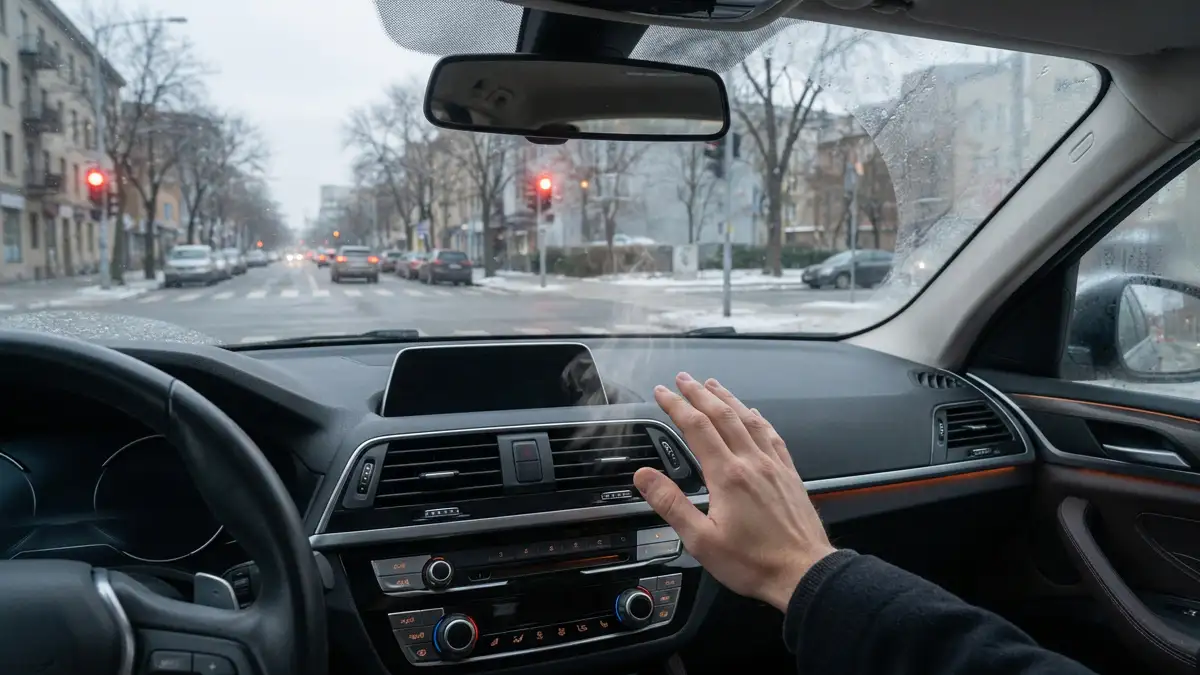
If your car heater only works when driving, you already know the pattern. Warm air on the motorway. Cold air at every red light. Then warmth again the moment you pull away.
That flip-flop feels like a big repair. Most of the time it is not. Your heater borrows heat from the engine, so the fault usually sits in the coolant loop, not behind the dashboard.
This guide starts with the cheapest checks. It also tells you when to stop driving and let a shop take over.
Quick Answer
Here is the short version, in the order I would check them:
- Low coolant is the most common cause. Check the reservoir when the engine is cold.
- Trapped air in the cooling system comes next, especially after coolant work.
- A thermostat stuck open keeps the engine too cool to make heat.
- A clogged heater core or a stuck heater control valve blocks flow.
- A weak water pump can do it too, though it gets blamed more often than it fails.
Before any of that, run one test. Does the vent air turn cold while the blower still pushes hard? Or does the airflow itself fade at idle? That answer splits the whole diagnosis in two.
How Your Car Heater Actually Works
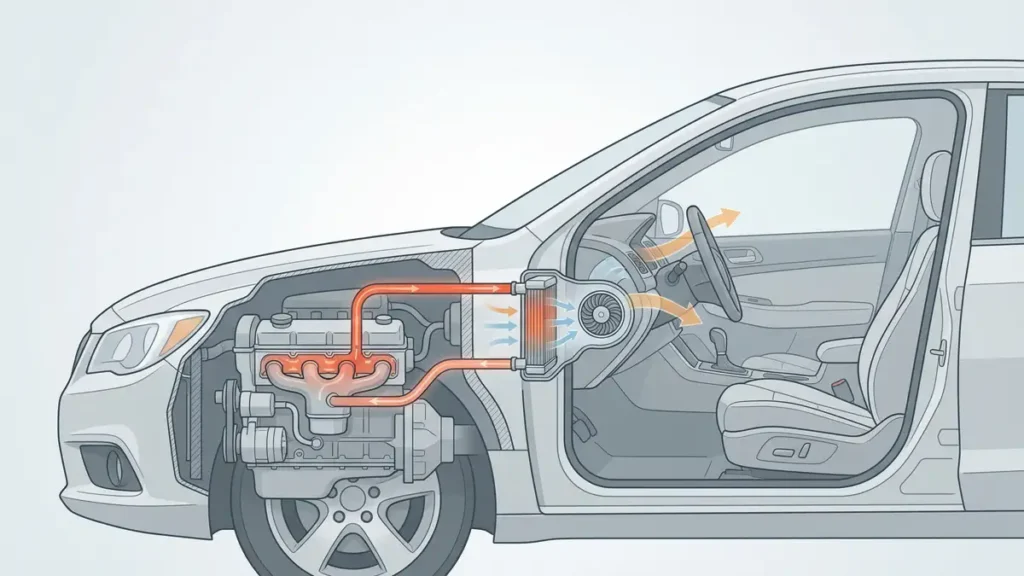
Your heater makes no heat of its own. It borrows it.
Hot coolant leaves the engine and passes through the heater core. That is a small radiator tucked behind the dash. A blower fan pushes cabin air across the core, and warm air comes out of your vents.
Here is the part that matters. At idle, the water pump turns slowly. Coolant flow is at its lowest. Any weakness in the system shows up first at a stop light, then hides again once you drive.
First, Separate Cold Air From Weak Airflow
Rest your hand at one vent. Set the fan to a fixed speed, not auto. Then watch what changes when you stop.
Strong airflow that turns cold at idle
The blower still pushes hard, but the air loses its heat. That points to coolant. Low level, trapped air, poor flow, or an engine that never warms up.
Airflow itself drops at idle
The air gets weak, not just cool. Look at the blower motor, its resistor, the cabin filter, or a duct problem. That is a different repair, and usually a cheaper one.
Do not skip this step. It keeps you from pricing a heater core when you need a cabin filter.
If the air only turns cold when the AC is on, this is not a heater fault at all. Our guide to a car AC that stops cooling after some time covers that pattern.
Cause 1 — Low Coolant (Most Common, Cheapest to Rule Out)
Why low coolant kills heat at idle
The heater core often sits high in the cooling circuit. When the level drops, it is one of the first parts to run dry.
At idle, there is not enough flow to push coolant up and through it. Rev the engine and the pump speed makes up the difference for a while. That is why the heat comes back on the move.
Symptoms to look for
- Heat returns when you rev the engine or drive.
- You hear gurgling behind the dash.
- The reservoir sits below the cold MIN mark.
- The level drops again after you top it up.
- A sweet smell or white, crusty residue near hoses.
How to check it yourself (engine cold only)
Wait until the engine is fully cold. Open the reservoir, not the radiator cap. Compare the level with the MIN and MAX marks. Use the coolant type listed in your owner’s manual.
Never open a pressurised cap on a warm engine. Hot coolant can spray and cause serious burns. That includes the radiator cap on many cars.
DIY vs. mechanic, and rough cost
A top-up is cheap, maybe $10 to $30 for coolant. But a level that keeps falling is a leak, not a maintenance item.
A pressure test and leak diagnosis usually runs about $100 to $150. The repair after that depends on where it leaks. These are rough US ranges, and prices vary by car and region.
The mistake to avoid
Topping up every week and calling it fixed. Coolant does not get used up. If the level drops, it left somewhere.
Also skip the cheap universal coolant if your car calls for a specific type. Mixing types can turn the coolant into sludge. If your radiator runs dry while the bottle stays full, read coolant reservoir full but radiator empty next.
Cause 2 — Air Trapped in the Cooling System
When this is the likely culprit
Think back. Did the heat fail right after a coolant change, a thermostat, a radiator, or a water pump job? Trapped air is a top suspect then.
A reservoir that looks full proves nothing. Air can sit in a high pocket while the bottle reads normal.
Symptoms
- Gurgling or rushing water sounds behind the dash.
- Heat that surges, fades, then returns.
- A temperature gauge that wanders.
- Cool vents even with a full reservoir.
How to check and bleed it
Air collects at the highest point. On many cars, that is the heater core. Some models have a bleed screw near the thermostat. Others need the engine run with the cap off until the bubbles stop.
Plenty of newer cars want a vacuum fill tool. Some need a scan-tool routine that runs the electric pump and opens the heater valve. Use the procedure for your model. A generic method can leave air in the system or overheat the engine.
DIY vs. mechanic, and rough cost
A DIY bleed costs nothing but time, if you have the right steps. A shop vacuum fill or bleed is often $80 to $150.
If the problem started right after a service, ask that shop to recheck the work first. That is fair, and it is often the fastest fix.
Cause 3 — Thermostat Stuck Open
What a stuck-open thermostat does
The thermostat is a valve. It stays closed while the engine warms, then opens to send coolant to the radiator.
If it sticks open, coolant runs through the radiator too early. The engine never reaches full temperature. At a stop there is little spare heat. At speed, the engine works harder and finally makes enough.
Symptoms
- The gauge is slow to rise, or it settles low.
- Heat stays weak on a long cold drive.
- The temperature drops at motorway speed on a cold day.
- A P0128 code appears on many newer cars.
How to check it yourself
Watch your warm-up time for a few days. Note where the gauge settles and whether it falls at speed.
A faulty coolant temperature sensor can copy these signs. So a code alone is not proof. Someone should compare the reported temperature with the real one before buying parts.
DIY vs. mechanic, and rough cost
The part is often $30 to $80. Access is the wild card. Some cars are simple. Others bury it under the intake.
Shop cost is often $150 to $400 or more. On a car with a slow warm-up in extreme cold, check for a service bulletin before you pay for a thermostat.
Cause 4 — Restricted Heater Core or Heater Control Valve
How a partially blocked heater core behaves
Corrosion and sediment narrow the tiny passages inside the core. At idle, flow is too low to push through. At higher RPM, the pump forces enough coolant through to warm the air.
This one is real, but it is also the cause people jump to first. Confirm it before you authorise a dashboard-out job.
Symptoms and the hose test
Find the two heater hoses at the firewall. With the engine warm and switched off, feel both. One hot and one much cooler is a clue.
So is heat from one side only on a dual-zone car. There is no standard temperature gap that proves a blockage, though. Treat the hose test as a hint, not a verdict.
Check the coolant condition too. Brown or gritty coolant points to neglected service and a likely restriction.
Heater control valve (vehicle-specific)
Some cars use a valve to control coolant flow to the core. It may be vacuum or electric. If it sticks closed, you get little or no heat at any speed.
If your car has one, check it before blaming the core. Many modern cars do not use one at all, so this step may not apply to you.
Flush vs. replace
Flush only after someone confirms a restriction. A flush can restore flow. It can also open a weak core and start a leak.
Skip harsh chemicals unless a shop recommends them for your system and the type of debris. A soft flush with low pressure is the safer first try.
DIY vs. mechanic, and rough cost
A shop flush is often $100 to $200. Replacement is the big one, roughly $500 to $1,500 or more.
The range is wide because some dashboards come apart easily and some do not. Ask for the estimate in writing before work starts.
Cause 5 — Weak or Failing Water Pump
How a pump loses flow at idle
A mechanical pump turns with the engine. Its impeller can erode, crack, or spin loose on the shaft. Flow drops at low RPM first. You feel it as cold air at idle.
Symptoms beyond the heater
- Coolant weeping from the pump area.
- A whine, chirp, or grind from the belt side.
- Overheating in traffic but not on the open road.
- A gauge that climbs when you stop.
Important caveat for modern cars
Many newer cars use an electric pump. The computer controls it, not engine speed. Some also close grille shutters and run the engine hot on purpose for efficiency.
On those cars, cold heat at idle does not prove a bad pump. A shop should confirm flow and pump command before anyone quotes a replacement.
DIY vs. mechanic, and rough cost
Often $300 to $900 or more. If the pump runs off the timing belt, the belt job comes with it and the price climbs.
This is not a good first DIY job on most cars. It needs the right coolant, the right torque, and a proper bleed afterward.
Cause 6 — HVAC Doors, Blower and Cabin Filter (The “Wrong Air Path” Group)
Blend door actuator
The blend door mixes hot and cold air. When its actuator fails, you get stuck-hot or stuck-cold air at every speed. Clicking behind the dash is a common sign.
A door can move partly, but speed-dependent heat is not the typical pattern. Keep this lower on the list unless you hear clicking or the temperature never changes.
Blower motor, resistor and cabin filter
A clogged cabin filter or a failing blower resistor cuts airflow. That matches the weak-airflow branch from earlier.
A resistor often fails on one or two speeds first. If only the top speed works, that is a strong clue. Our guide to a blower motor that only works on high walks through that test.
How to check
Cycle the blower through every speed. Listen for clicks when you change the temperature setting. Pull the cabin filter and hold it up to a light. If you cannot see through it, replace it.
Rough cost
Cabin filter $15 to $60. Blower resistor $50 to $200. Blend door actuator roughly $150 to $500, mostly labour.
Cause 7 — “It Might Be Normal”: Modern Engines, Cold Weather and TSBs
Highly efficient engines warm slowly
Small turbo engines and hybrids waste little heat. At idle, they may make less heat than a high fan setting can pull out of the coolant.
That is not a fault. It is physics plus a tight emissions target. Try a lower fan speed and see if the air stays warmer.
Manufacturer service bulletins exist for this symptom
Some makers have bulletins for low heater output at idle. Certain 2018 to 2020 Mitsubishi Eclipse Cross models had the issue, fixed with a software update to the A/C control unit. Some GM models have a bulletin about slow warm-up in extreme cold.
These are not universal fixes. They simply show why your car’s model, engine, and outside temperature matter. Ask a dealer whether a bulletin covers your VIN.
EVs and hybrids
A full EV has no engine coolant to borrow. It uses a resistance heater or a heat pump. Diagnosis is different, and so are the parts. Do not apply a coolant-first checklist to a car that has no engine loop.
The 10-Minute Diagnostic Checklist
Work through these in order. Stop as soon as you find something that does not add up.
- Airflow test. Strong but cold, or weak? This decides your path.
- Recent work. Did this start after coolant, thermostat, or pump service? Think air pocket.
- Coolant level. Check cold. Below MIN? Top up and watch it.
- Gauge behaviour. Does it reach normal and stay there? If not, think thermostat or sensor.
- Heater hoses. One hot, one cool? Think restriction.
- Pump clues. Any weep, whine, or overheat at idle? Think water pump.
- Still stuck? Book a pressure test and a temperature check with the fault present.
What NOT to Do
- Do not pour in stop-leak as a first move. It can clog the heater core and the radiator.
- Do not approve a heater core on a guess. Ask for a pressure test and a flow check first.
- Do not open the cooling system while it is hot.
- Do not ignore a rising gauge just because the heat returns when you drive.
When to Stop Driving and See a Mechanic
Loss of cabin heat is annoying. Some versions of it are urgent. Pull over safely if any of these happen:
- The temperature gauge climbs above normal.
- An overheating warning appears.
- You see steam or smell hot coolant.
- Coolant is leaking fast.
- The heater suddenly goes cold while the gauge rises.
- The defroster cannot keep the windscreen clear.
A car that cannot clear its glass is not safe in traffic. Neither is one that is losing coolant. Heat loss plus a rising gauge often means coolant is escaping or circulation has stopped.
A good shop should test before quoting. Expect a code scan, a pressure test, real versus reported coolant temperature, heater hose temperatures, control valve and pump checks, and a blend door command test.
Red flag: a quote for a heater core before anyone has checked the coolant level or pressure-tested the system.
Prevention: Keeping Heat in the Cabin
- Check the coolant monthly, with the engine cold.
- Use the coolant your manual specifies. Never run plain water long term.
- Fix leaks instead of topping up forever.
- Replace the cabin filter once a year, or more often in dusty areas.
- Watch your warm-up time. A slow change often means the thermostat is drifting.
- After any cooling repair, confirm the heat is steady at idle before you pay.
FAQ
Why does my car heater blow cold at idle but hot while driving?
At idle, coolant flow and engine heat are at their lowest. If the level is low, air is trapped, or the core is partly blocked, the heater core gets too little hot coolant. Driving raises pump speed and engine load, so the heat comes back.
Can low coolant really cause no heat only at idle?
Yes. This is the most common cause. The core sits high in the system, so it starves first when the level drops. Check the reservoir cold, then find out why the level fell.
Why does the heat come back when I rev the engine?
Revving spins the water pump faster. That pushes more coolant through the core, even if the core is partly blocked or the level is low. It is a useful clue, not a fix.
Can a bad thermostat cause heat only while driving?
Yes. A thermostat stuck open can keep the engine below normal temperature. Heat then depends on extra engine load. Confirm the real coolant temperature before replacing it, because a sensor fault can look the same.
Is it safe to drive with a heater that only works while driving?
Short trips are usually fine if the gauge stays normal and the glass stays clear. Stop if the gauge climbs, steam appears, or coolant is leaking. A cold cabin is uncomfortable. An overheating engine is expensive.
How much does it cost to fix a heater that only works when driving?
It depends on the cause. A coolant top-up is cheap. A thermostat is often $150 to $400 fitted. A heater core is the big one, often $500 to $1,500 or more. Get the cause confirmed first.
Should I flush the heater core myself?
Only after a restriction is confirmed. A flush will not fix low coolant, trapped air, or a thermostat. It can also start a leak in a weak core. Try the cheap checks first.
Could it just be the cabin air filter?
It can, but only if the airflow is weak. A filter does not change the air temperature. If the vents still blow hard and the air turns cold, the filter is not your problem.
How do I know if it is the heater core or just air in the system?
Recent coolant work points to air. Gurgling and fluctuating heat also fit air. A core restriction tends to be steady and gets worse over months. A hose temperature check and a proper bleed will tell you more than guessing.
Conclusion: What to Do Next
When your car heater only works when driving, start with the simple stuff. Check the coolant cold. Think about recent repairs. Watch the gauge on your next drive.
Most cases end at low coolant or trapped air. A thermostat is the next most likely. The heater core is the exception, not the default.
So do this today. Park on level ground, wait for a cold engine, and check the reservoir. If the level is low, top it up with the right coolant and watch it for a week.
If it drops again, or the gauge climbs, stop topping up and book a pressure test. That one step protects your engine and saves you from paying for parts you did not need.