
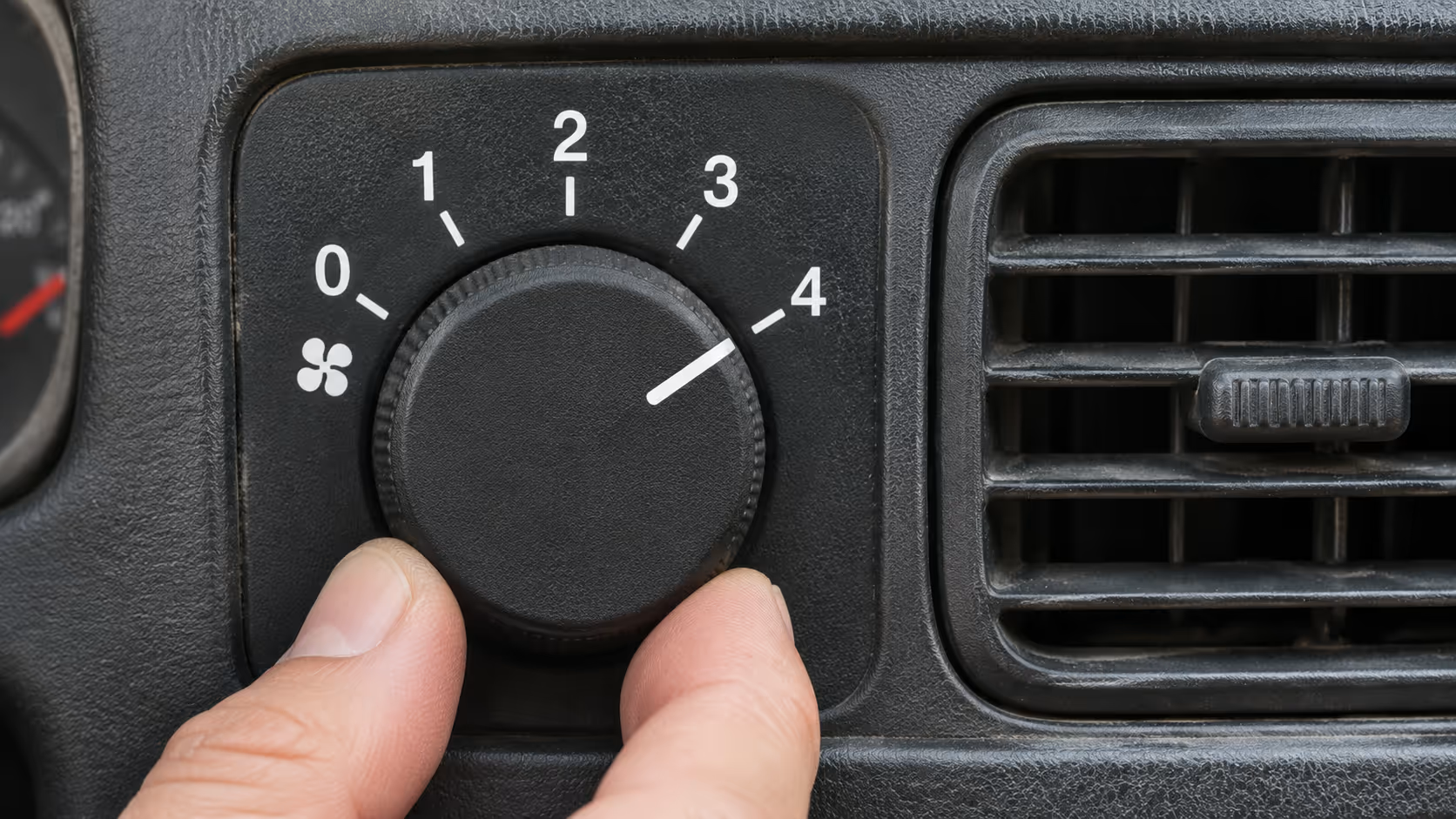
You turn the fan dial through 1, 2, and 3. Silence. Then you hit 4, and air pours from the vents. If your car blower motor only works on high, start with the blower resistor and its plug on a car that uses fixed speed steps. High can still work when the path for the lower speeds breaks.
Before you buy a part, turn the dial back to low and listen. Does the fan go quiet, or does it keep blasting? That one check can send you down a different repair path.
Quick answer: Why does my heater blower only work on high?
On many cars, the lower speeds share a resistor pack. High gets its own path around the parts that slow the fan. A break in that shared path can take out every lower speed at once.
- Silent on low, strong on high: Check the resistor and its plug first if your car uses a resistor pack.
- Full blast even on low: Check which speed control your car has. A shop can test whether the fan gets the speed you request.
- You hear the speed change, but barely feel air: Check the vent setting and cabin air filter before you buy electrical parts.
Can I keep driving if the fan only works on high?
Try the windshield defog setting while parked. If high keeps the glass clear and you have no signs of heat damage, you may be able to drive to a repair shop. Allow for a change in weather. If the windshield starts to fog and you can’t clear it, pull over safely.
Stop using the fan if you smell hot plastic or find a scorched plug. If smoke appears while driving, pull over safely, shut the car off, and get everyone out. Move away and call emergency services if you suspect a fire.
How blower speed control works
The blower moves air through the vents whether you ask for heat or A/C. Your fan dial tells the car how fast you want that blower to turn. How the car acts on that request depends on its wiring.
Why a blower motor works on high but not low
Think of a four-speed dial. On low, current flows through more of the resistor pack. On the middle speeds, it flows through less. On high, it can skip the resistor elements, so the motor gets full power.
You can sketch the two paths as low: power through resistance to run the fan slowly and high: a direct path to run it fast. A break at a point shared by speeds 1 through 3 can leave speed 4 working. Your wiring diagram shows where those paths meet.
How an electronic blower controller changes fan speed
With an electronic setup, you choose a speed, the climate panel sends a request, and a controller adjusts power to the fan. Many systems do this by switching power on and off in quick pulses. The longer each pulse stays on, the more power the motor gets.
A row of fan bars on the dash shows what you asked for. It doesn’t prove the controller got the message. Check the parts listing or wiring diagram for your exact climate system before you order a resistor.
What causes the lower blower speeds to stop working?
If low is silent and high works, start with the parts the missing speeds share. On a car with a resistor pack, check the pack and plug together. If both pass, work back toward the switch.
1. An open resistor pack or internal thermal fuse
An “open” is a break that current can’t cross. A break in one part of the pack may cost you just one speed. A break in a shared path can take out several.
Some packs have a thermal fuse that opens if the pack gets too hot. If it opens, find out why the pack overheated. Never bridge that fuse with wire.
2. A melted blower motor resistor connector or damaged terminal
Look at the plug where it meets the pack. A poor contact can build heat at one pin. Brown plastic, a misshapen socket, or a terminal that has slipped back into the plug can point you toward the fault.
Some 2003–2007 Chevy Silverado and GMC Sierra trucks with specific manual heat or A/C setups had a documented issue at this connection. If you own one, have a shop check the service information for your truck. A new resistor pushed into a heat-damaged plug can leave you with the same fault.
3. A faulty fan switch or a break in the lower-speed wiring
The dial may click into place even when its contacts fail to pass current. A broken wire between the switch and pack can have the same effect. If the pack tests good, the next question is whether the correct signal reaches it on each speed.
Your wiring diagram may show a separate feed, fuse, or relay for part of the circuit. Check what it supplies before you swap it. A strong high speed already tells you at least one path works.
Why the same failure can come back
A worn motor can still spin on high while drawing too much current. A squeal or slow start gives you a reason to ask for a current test. Noise alone can’t tell you how many amps the motor draws.
Also check for water marks near the plug and scuffed wires near a dash bracket. If the trouble follows rain or started after dash work, tell the shop. Those details can help narrow the search.
Step-by-step diagnosis before spending money
Your first checks need little more than your ears and the owner’s manual. Stop if you smell burning plastic. Run the following checks only if you can do so safely.
Step 1. Test every fan setting while parked
Select the dash vents, open them, and switch out of AUTO if your car allows it. Keep the vent and temperature settings fixed. Move from off through each fan speed, then back down.
Write down what you hear and feel at each step. For example, “silent on 1 and 2, steady on 3 and 4” tells a shop more than “the heat is broken.” If air comes from the floor instead of the dash, note that too.
If every speed works but the air stays warm with the A/C on, check why your car A/C blows warm air.
Step 2. Identify the control system and check the fuse diagram
Find your car’s year, model, and climate-control option. The same model can come with different controls. Use the owner’s manual to locate the fuses and the matching service diagram to see which speeds each feed serves.
If a fuse has blown, use only the specified rating. If it blows again, leave the fan off and have the circuit checked. A larger fuse could let the wires overheat.
If the correct fuse blows again, leave the fan off and check why a car fuse keeps blowing.
Step 3. Inspect the resistor and plug with power off
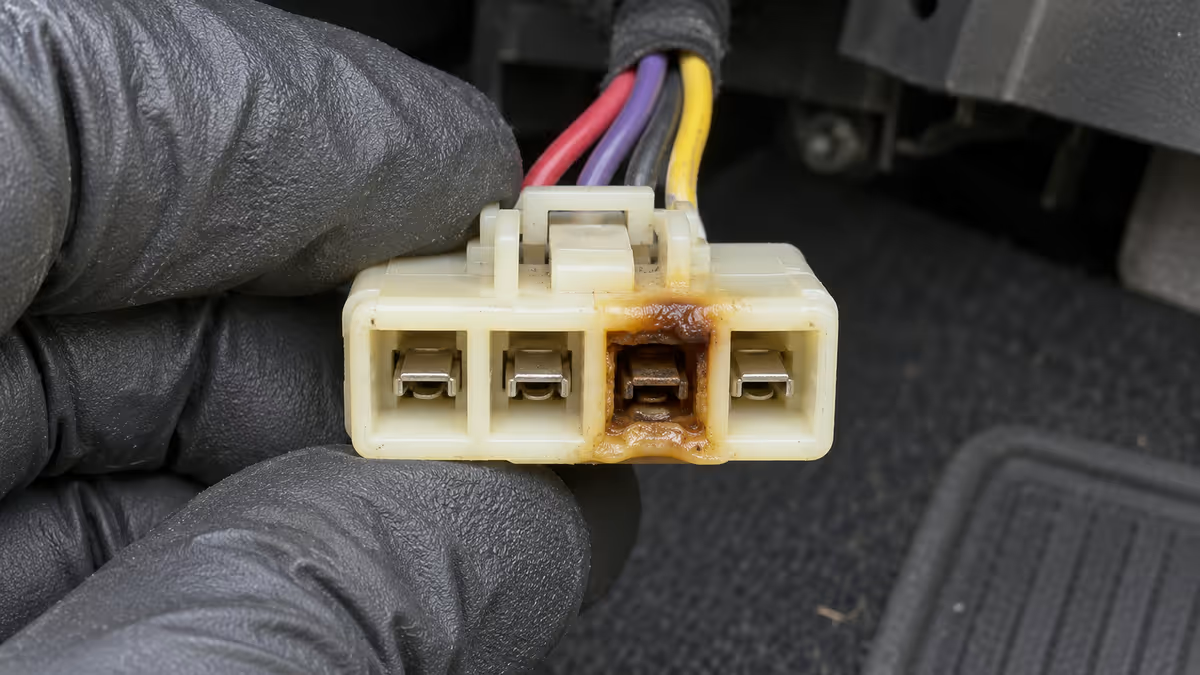
Find the part in your service guide before you remove trim. It may sit near the blower under the passenger side of the dash. Follow the car’s power-down steps and let the pack cool before touching it.
If you can reach it safely, release the plug by its latch. Look at the pin faces and wire ends on both sides. If you see bare wire, melted plastic, or an airbag component in your way, leave the next step to a shop.
Step 4. Learn how to test a blower motor resistor
For a conventional pack, get the pin chart first. With power off and the pack unplugged, set your meter to ohms. Touch the leads together to check the meter. Then check each pin pair listed in the chart.
“OL” means the meter sees no path on that range. If the chart calls for a small resistance there, recheck your probe contact. If it still reads open, that path has failed. A beep alone won’t tell you whether the resistance meets spec.
If the pack passes, the next check is whether the switch feeds the correct pins. If you have an electronic controller, skip the resistor test. Ask a shop to check its power, ground, speed request, and output.
Step 5. Check motor current after a repeat failure
If a new pack fails too, ask the shop to measure blower current with a clamp meter. Ask for the measured amps and the limit for your car at that speed. The fuse rating alone won’t give you the motor’s normal draw.
Keep the test result with your notes on which speeds failed. That gives you something concrete to compare if the trouble comes back.

How to fix it: DIY or repair shop?
Your decision comes down to access, plug condition, and the test result. A sound plug and an easy-to-reach pack make a very different job from burned wires deep under the dash.
DIY candidate: Replace a confirmed faulty, accessible resistor
This is usually an easy to moderate job if the pack sits behind a small trim panel. Match the new part to your climate controls and plug shape. Check the service steps before you take the dash apart.
- Follow the power-down steps, let the pack cool, and release the plug.
- Remove the fasteners and seat the new pack fully in its original spot in the air duct.
- Refit the plug and trim. Restore power as directed, then test off and each speed.
Shop repair: Burned wiring, repeat failures, or an uncertain controller diagnosis
A burned socket calls for a closer look at the mating pins and wire ends. A shop can cut back damaged wire and fit the specified plug and splices. If the motor draws too much current, fixing the plug alone leaves the new parts at risk.
For electronic controls, ask what the controller received and what it sent to the motor. Those two readings help explain why the shop recommends a controller, wiring repair, or motor.
What does it cost to fix a blower that only works on high?
For a U.S. budget in November 2026, use these ranges as a starting point. Your model, local labor rate, and access under the dash can change the quote.
- Blower resistor replacement: About $140–$198 installed. The estimated parts share is $80–$111. That share is already in the installed price.
- Blower motor replacement: About $383–$435 installed if tests show the motor needs work. A fan that runs on high does not, by itself, justify this cost.
These ranges exclude taxes and fees. For DIY, price the exact part that fits your car. For shop work, ask whether the quote includes diagnosis, plug repair, or an electronic controller. Don’t add both ranges together without an itemized quote.
How to prevent another resistor or connector failure
Match the fix to what you found. If water reached the plug, trace the leak. If a wire rubbed through on a bracket, repair the wire and secure it clear of the edge. If the motor drew too much current, address that before fitting another pack.
Once the repair is complete, test off, low, each middle speed, and high. Switch to defog and check that air reaches the glass. If a speed drops out again, note which one and whether the fan was hot or cold.
Frequently asked questions
Two sounds can help you narrow this down. Listen for a change in fan pitch when you turn the dial, then check whether the air at the vent changes with it.
Can a fuse cause the blower to work only on high?
Yes, if the missing speeds use a separate fused feed. If one fuse feeds every speed, a fully blown fuse there would also stop high. The diagram for your car settles which case applies.
How do I know if the blower motor or resistor is bad?
If high starts promptly and the lower steps are silent, test the pack and check its plug first. If the motor squeals or starts slowly even on high, ask for a motor-current test. Both faults can exist at the same time.
Why does my blower motor only work on high after replacing the resistor?
If the new part never restored low speed, check the part number, plug pins, and feed from the switch. If it worked for a week and failed again, tell the shop that. A repeat failure gives the technician a reason to check for heat damage, water, or excess motor current.
Could a clogged cabin air filter make the fan seem dead on low?
Yes. A clogged filter can leave so little air at the vent that low feels dead. Listen near the blower while you change speeds. If its pitch rises with each step, check the filter if your car has one.
If the motor is silent on every lower step and suddenly roars on high, start with the speed circuit. Changing the filter won’t mend a break in that path.
What to do before you buy a blower motor
If your car blower motor only works on high, park and record what happens at each speed. Note any smell, noise, or recent repair. Then identify your fan control and check the plug if you can reach it safely.
Taking it to a shop? Bring that short list. If the quote includes both a motor and a resistor, ask what the plug looked like and how many amps the motor drew. Those answers help you decide what to approve.