
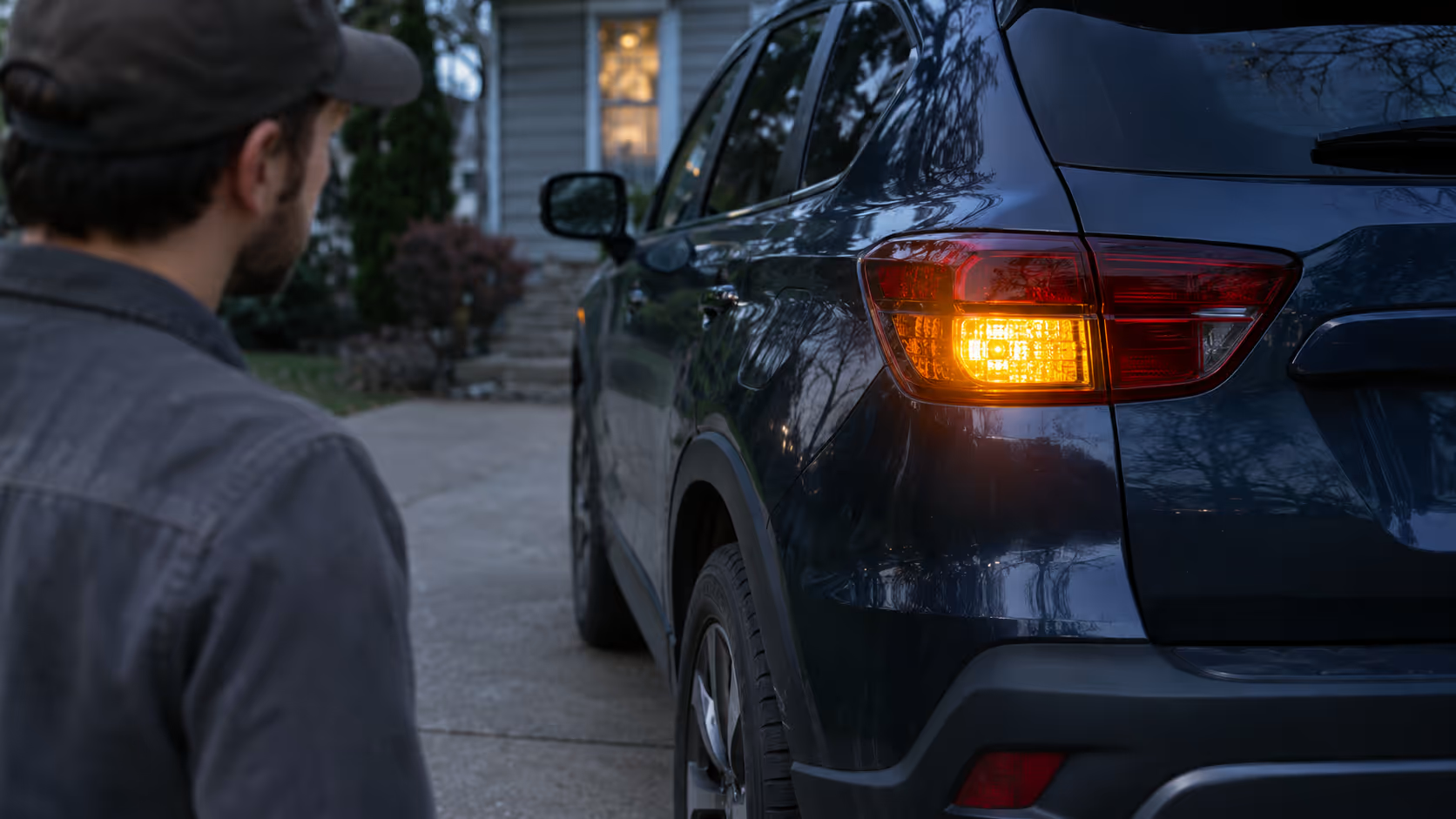
Turn signal blinking fast but bulb is good? Check the other turn lamps on that side first. A rear lamp or mirror light can go out while the bulb you checked still blinks. If every lamp works, check what changed, then look at the bulb fit, socket, and ground.
That quick tick is called hyperflash. You can narrow it down while the car is parked. Start with what you can see before you spend money on parts.
Quick answer — Why a working bulb can still trigger hyperflash
A bulb can light up and still draw too little current. A wrong bulb, an LED swap, or a bad contact can set off the same warning as a dead lamp. On some cars, only the dash arrow speeds up.
- Just one side is fast: Check each turn lamp on that side.
- It started after bulb or lamp work: Check the part number or try the stock setup.
- Only the dash arrow is fast: Look for a dim lamp or one that cuts out. Then check how your car flags a lamp fault.
Turn signal blinking fast but bulb is good? Use this checklist
Park the car and set the brake. Test the left and right turns on their own. Note what you see on the dash and what a helper sees outside.
- A lamp is dark, dim, or cuts out: Start with checks 1 and 2. Go to the socket in check 5 if the right bulb still acts up.
- All lamps look fine and you just changed one: Start with check 2 for a stock bulb or check 3 for an LED swap.
- It only happens when you tow: Start with check 4 and test the truck on its own.
- Nothing changed and all lamps look fine: Check the sockets, ground, and power feed. Then find out how your car controls the flash rate.
Diagnose a fast-blinking turn signal in seven checks
Start with the checks that cost the least. Test the turn signal again after each fix. If the fault comes and goes, try to spot what sets it off.
1. Check every turn signal on the affected side
Turn on the side that blinks fast. Walk around the car or ask a helper to look. Check the front and rear, plus any mirror or fender light that serves as a turn signal. At the rear, look for a dark section in a lamp with more than one light source.
Switch to the other side. Compare the same lamp positions for light output. Watch for a few cycles so you can catch a brief drop-out.
A two-filament bulb can still work as a tail or parking light when its turn filament is out. Check it with the turn signal on. Use the hazards for a second look, then test each turn on its own again.
2. Confirm the bulb part number, wattage, and fit
This check matters if the fast blink started right after a bulb change. Look up the bulb for your year, trim, and lamp position. Match the part number, wattage, and base. A bulb can fit and light up with the wrong load.
Turn the lights off and let the bulb cool. Take it out and check that its contacts line up with the socket. Seat it fully or try a known-good bulb of the exact type. If it still blinks fast, move on to the socket check unless you just switched to LEDs.
3. Rule out an LED conversion or aftermarket lamp mismatch
An LED can look bright and draw less current than the stock bulb. Some cars read that lower draw as a dead lamp. The same thing can happen with a full set of new tail lights.
Try the stock bulbs or lamp units if you still have them. If the flash rate goes back to normal, check the new parts for fit with your car’s lamp checks.
- A matched LED flasher may help on a car with a plug-in flasher. Check the part and pin layout for your car.
- Some cars have a factory setup change for a specific lamp swap. Ask a shop to check what your model supports.
- Some kits use load resistors. They get hot and can melt nearby parts. Use the kit’s mounting rules, keep them clear of wires and plastic, and check that the fix still flags a dead lamp.
If the stock lights work well and you want a quick fix, you can leave them in. For factory LED lights, check the plug and the lamp unit itself.
4. Isolate a trailer or other recent wiring changes
If you tow, park first and unplug the trailer lights. Test both turns on the tow vehicle. If the fast flash stops, check the trailer plug, light grounds, and bulbs. A bad ground or a mismatch with trailer LEDs can show up only when you hook up.
If the fast flash stays, a tow kit or its wiring on the truck can still be at fault. Check recent work on a tow plug, flatbed, or tail lights. Look for bent pins, bad splices, and wires that have rubbed through. A shop can test the tow module or converter if the plugs and lamps look good.
If a fuse keeps blowing after wiring work, use the timing to narrow down which circuit to inspect.
5. Inspect the socket, connector, and lamp housing
Turn the lights off and let the bulb cool. Look for green or white crust, loose pins, and dark or melted spots. Check where the plug clips in. If the fault shows up after rain or a car wash, look for water in the lamp.
If you also have headlights that flicker while driving, check their plugs, grounds, and nearby wires.
Clean light buildup only if the contacts are sound. Fit a new socket or wired plug if the old one is loose, burned, or badly worn. Fix the leak if you find one. If a new socket gets hot or melts again, have a shop check the bulb load and the wiring.
6. Test the ground and power feed under load
Ask a helper to watch the turn lamp as you press the brake. Try it again with the parking lights on. If the turn lamp goes dim or another lamp glows, check for a bad shared ground.
If the brake lights stay on when the car is off, check which lamps stay lit to narrow down the cause.
If you use a meter, get the wiring diagram for your car. Find the lamp ground and follow the service test for the right pins. Set the meter to DC volts. On a circuit with a steady chassis ground, put one lead on the lamp ground and one on the battery’s negative post. Keep the lamp plugged in and read the drop while the lamp is lit.
Compare the result with the service limit or with the good side if the two circuits match. A large drop can point to a loose ground bolt, a bad splice, or a partly broken wire. If the ground checks out, use the service steps to check the power feed under load. A quick check at an unplugged socket can miss a bad joint that fails when the lamp draws current.
Clean and secure a bad ground if you can reach it. For a hidden break, an odd meter reading, or a sealed LED unit with more than one feed, get help tracing the fault.
7. Check the flasher, lamp electronics, or body control module
Look up how your car makes the signals blink. Some cars use a plug-in flasher. Other cars use a body control module, or BCM. On some trucks the dash arrow can speed up while the outside lamps keep their usual pace.
If your car has a separate flasher, test it only after you check the bulb load and wiring. Follow the test for that part number. If the turn request cuts in and out or fails to reach the flasher or module, check the stalk and its circuit.
If the BCM runs the lights, use a scan tool that can read body codes. A basic engine code reader may miss them. A shop can trace the bulb-out signal, check the tow module if fitted, and look up fixes for your model.
A fault can also be inside the lamp. For example, the rear lamp board on a 2012 GMC Acadia can cause a fast blink even when the lamp still lights up. Test the lamp circuit and check the right setup for your car before you pay for a module.
How long will it take, and when should you call a mechanic?
A walk-around takes a few minutes and costs nothing. A bulb or socket swap can be quick if you can reach it from the trunk or under the hood. Some cars need trim or the whole lamp taken out first.
These are rough U.S. price examples in dollars. Use your year and trim to price the part or ask a shop for a quote. Test time depends on where the fault is and how often it shows up.
| Fix | Difficulty | U.S. cost example | Time to plan for |
|---|---|---|---|
| Correct stock bulb | Easy | About $11 for a pair | Quick with rear access or a clear path under the hood |
| Socket or wired plug | Easy to intermediate | About $13–$22 for sample sockets | More time if you must splice wires or pull the lamp |
| LED or trailer light mismatch | Easy to shop-level | Free to test with stock bulbs on hand or to unplug a trailer | A quick test first. Parts or setup work vary. |
| Bad ground or damaged wire | Intermediate to shop-level | Quote after the fault is found | Depends on access and whether the fault comes and goes |
| Separate flasher | Easy to intermediate | About $153–$183 at a shop | Quick once found if it plugs in and you can reach it |
| Sealed lamp or control module | Shop-level diagnosis | Price the lamp by VIN. About $702–$762 for BCM replacement at a shop. | Allow for tests and any setup work the car needs |
Get a shop to trace the fault if a socket melts again, a signal cuts out, or a bad wire runs out of reach. If a lamp is dark or cuts out, fix it before you drive. Other drivers need to see which way you plan to turn.
Frequently asked questions
Why is my blinker still fast after I replaced the bulb?
Check that the new bulb has the right part number and fits snugly. Then check each turn lamp on that side. If they all work, look for a dim lamp or a loose pin in the socket.
Can a bad ground make a turn signal blink fast even when it lights up?
Yes. A weak ground can cut the current enough to set off a lamp warning. If the lamp dims when you press the brake, test the ground while the lamp is on.
Why does the dash blink fast when the outside lights look normal?
Some cars use the fast dash arrow as a bulb-out warning while the other lamps keep their normal pace. Watch each lamp for a few cycles. If all look good, a body scan can help find the lamp circuit that sent the warning.
Why do my hazards work normally but one turn signal blinks fast?
The car may check lamp faults in a different way during turns and hazard mode. Use the turn stalk to test each side on its own. Check for a dim lamp or one that drops out.
How do I stop LED turn signals from hyperflashing?
Put the stock bulb or lamp back in as a test. If that works, use the stock setup or check which LED parts and fixes suit your car. A plug-in LED flasher only works on cars that take one.
Do I need a new flasher relay if only one side blinks fast?
Check the lamps, sockets, and wiring on that side first. If these pass, find out if your car has a separate flasher and follow its test steps. A fast blink alone does not show that the flasher has failed.
Conclusion — Retest every signal after the fix
Still asking, “Turn signal blinking fast but bulb is good?” Start with all the lamps on that side. Then check the bulb type, socket, and ground before you pay for a flasher or module.
Once you make a fix, test both turns and the hazards from outside the car. Try the brakes and parking lights too if they changed the flash. If it still acts up, note which side is fast, where you see it, and what you changed. Those details give a shop a place to start.