
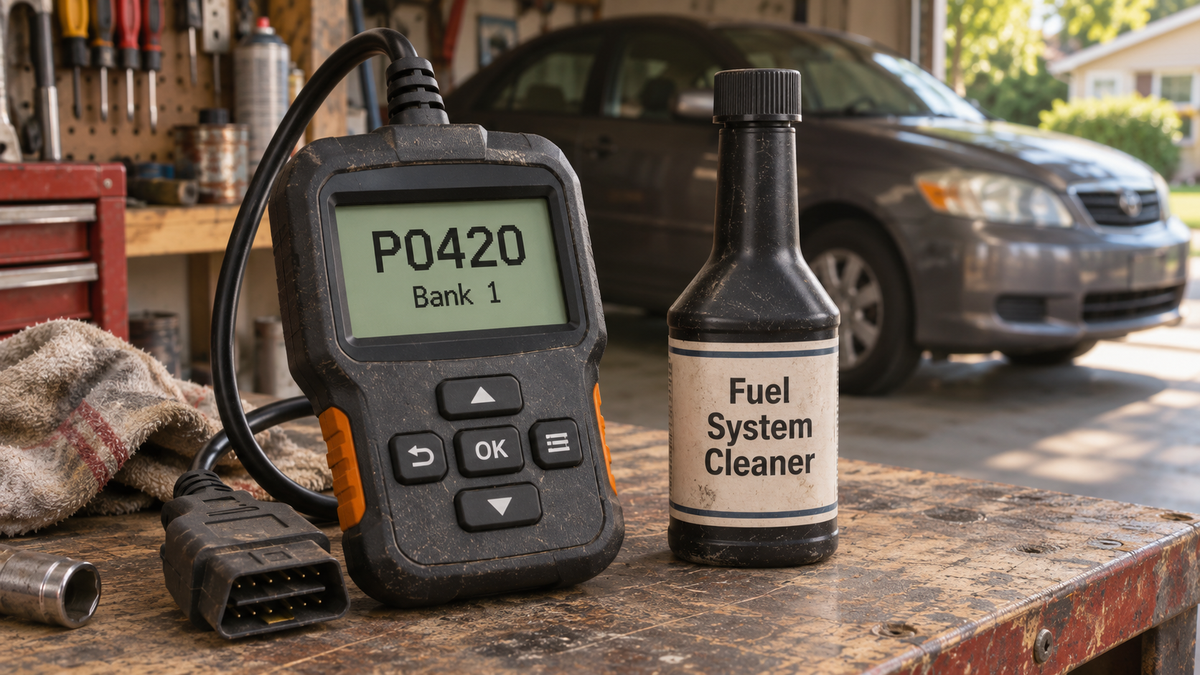
A P0420 after fuel system cleaning can clear on its own. The timing tells you when the light came on. It can’t tell you whether the cleaner caused it or whether you hurt the catalytic converter. If the light stays steady and the engine feels smooth, save the scan before you spend money on parts.
If the light flashes or the car starts to shake, pull over safely and shut it off. That changes the plan. A misfire can send raw fuel and oxygen into the exhaust and overheat the converter.
1. Why did P0420 appear right after fuel system cleaning?
Your scanner may say “Catalyst System Efficiency Below Threshold, Bank 1.” Bank 1 is the side with cylinder one. The engine computer ran a test and judged that the converter on that bank fell short. The car can still feel fine because exhaust can flow through a worn converter.
Start with what you know. Was the light on before the service? Did anyone erase codes? Did the cleaner go into the gas tank, through the intake, or through a shop’s fuel service equipment? Those details help you work out which change came first.
The first post-service drive may have finished a test already in progress
The car doesn’t test the converter each time you turn the key. It needs the right heat, load, and driving conditions. The first good chance to finish the test might come on your drive home from the shop.
If the light came on during the trip home, here’s why P0420 can show up after a long drive.
Ask for the scan from before the service. A pending P0420 on that scan means the car had already seen a failed test. If the shop first scanned it after the service, the start date is still unknown. A weak converter is possible. A claim that the cleaner pushed it over the edge would take more evidence.
P0420 after fuel injector cleaner: was the dose too strong?
Check the bottle size and the amount of gas you had when you poured it in. Twelve ounces in four gallons works out to three ounces per gallon. Your tank’s full capacity doesn’t help with that math unless you filled it as directed.
Use the label for the exact Techron, STP, or Sea Foam product you used. Brands sell more than one formula. Keep the bottle if you suspect a mix-up, and ask the maker how to handle that dose. A high dose alone can’t tell you whether the engine ran rich when the code set.
P0420 and Sea Foam: intake spray versus gas-tank treatment
Sea Foam lists one ounce per gallon for routine fuel maintenance. Its tank-cleaning guidance starts at two ounces per gallon. That rate applies to its fuel treatment. The intake spray is a separate product with its own directions.
Some owners say the light went out after Sea Foam. Others saw it come back. One owner described getting P0420 after treatment, then seeing the code again. These reports leave out a key detail: did the car run and pass its catalyst test between scans? Without that result, a quiet dashboard tells you little about what the cleaner did.
2. Will P0420 clear on its own, and how long should I wait?
Yes, the light can go out if the car runs its test and sees enough passes. Start with a photo of the scan and the mileage. Leave the codes in place. That gives you a record even if the light goes out tomorrow.
With a steady light, a smooth engine, and P0420 alone, plan to recheck after two or three drives that meet the car’s test conditions. Roughly 50–100 miles of normal mixed driving is a handy time to look. There’s no mileage that makes every car run this test. Three short trips to the store can leave it waiting.
If a fresh pending P0420 shows up after a known pass or reset, book a diagnosis. You can stop the mileage count there. If all you see is the same stored code, check the light status and test results before deciding it failed again.
What to tap on a cheap OBD2 reader
With the car parked, open OBD II → I/M Readiness → Since DTCs Cleared. Look for “Catalyst” or “CAT.” Menu names vary, and some apps offer a separate screen for the current drive.
“Incomplete” means the test still needs to finish. “Complete” means it ran at least once since the last reset. “Unsupported” means the car doesn’t report that monitor through this item. Read the pending codes too. A complete flag stays set across trips, so it cannot tell you the date of the last pass.
If CAT stays incomplete, look up the drive cycle for your year and engine. Other engine faults can hold up the test. Have those checked before you keep adding miles.
3. Did I permanently damage my catalytic converter?
One treatment followed by one code gives you too little to conclude that. What matters more is how the engine ran before and after the light came on. Think back to a rough idle, oil top-ups, unexplained coolant loss, or a light that flashed under load.
A spark misfire can send fuel and oxygen down the exhaust. When they react inside the hot converter, its core can get hot enough to melt. Oil or coolant entering the exhaust can also foul the surface that cleans the gases. Fixing the engine fault helps protect any replacement.
The rich-condition warning: P0172 and negative fuel trim
P0172 means the computer detected a rich condition on Bank 1. If your reader shows live data, find STFT B1 and LTFT B1. These are short- and long-term fuel trim. Check them with the engine warm and in closed loop, when it uses sensor feedback to adjust fuel.
A minus sign means the computer is cutting fuel. Say the short reading holds near −5% and the long reading sits at −10%. That’s roughly −15% combined correction. A steady correction beyond about 10% in either direction deserves a closer look. Each engine has its own limits.
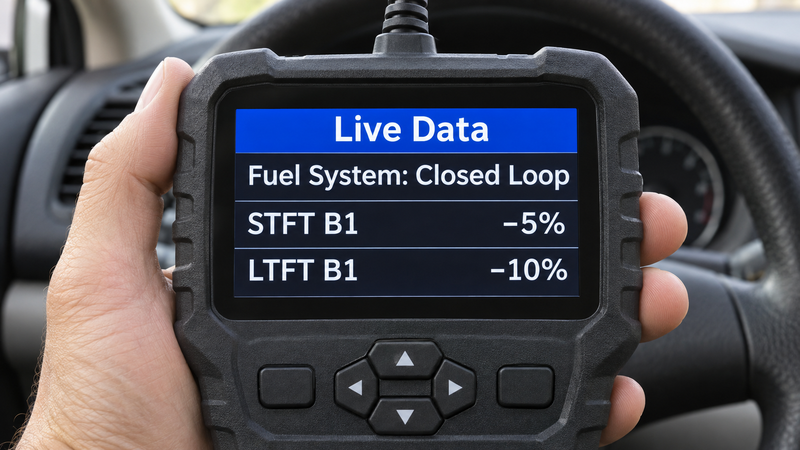
A brief swing as you touch the gas means much less than a trend at steady speed. Save the readings and note the rpm. If P0172 comes with a steady large fuel cut, ask for a fuel-control check. The numbers alone can’t name a leaking injector or show how hot the converter got.
4. What to do if cleaning didn’t work
Start with the checks that cost little and preserve clues. The last two tool tests answer specific questions. You may never need either one. The prices below are rough U.S. examples, and your engine and local labor rate can change the quote.
1. Save the freeze frame and check pending codes
Open “Freeze Frame” before you clear anything. Save the code attached to the frame, engine speed, load, coolant temperature, and fuel trim if shown. Then photograph all pending and confirmed codes. An existing reader can make this a $0 check. A general shop diagnosis may cost about $125–$183.
Record what you felt at that mileage. “Steady light at highway speed, no shake” gives the shop more to work with than “light came back.” If you see a misfire, rich-mixture, or sensor heater code, flag it. The shop may need to solve that fault before it can trust the catalyst test.
2. Inspect for an exhaust leak
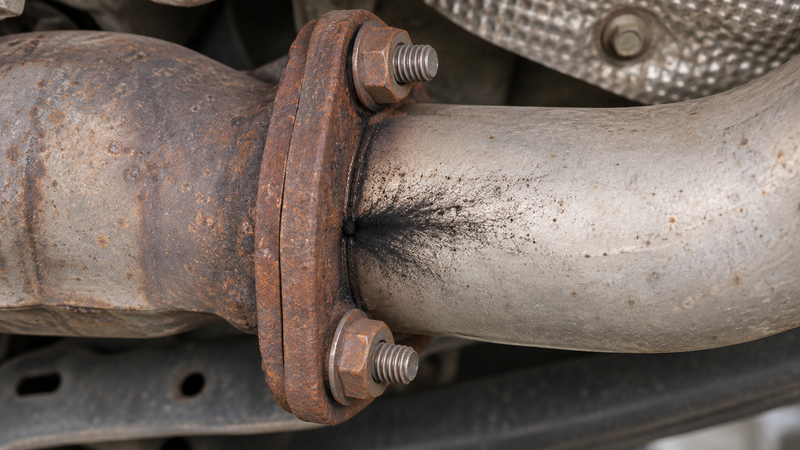
Start with a cold engine. From a safe spot, look for black soot at the manifold, pipe joints, flex pipe, and sensor mounts. A gap ahead of or near the rear sensor can draw air into the exhaust. That can change the reading the computer uses to judge the converter.
A visual check costs nothing. A clean joint can still leak. If you hear a tick on cold starts or see a broken fastener, point out that exact spot and ask for a leak test. Leave under-car checks to a shop if you lack safe access.
3. Compare the front and rear oxygen-sensor readings
A live-data reader may let you graph both sensors at no extra cost. On many warm engines with narrowband sensors, the front signal swings while the rear one changes less. If the rear closely repeats the front under the specified test conditions, weak oxygen storage is one possible cause.
Check which front sensor the car uses first. A wideband air/fuel sensor reports differently. A flat rear line also needs a response test before you trust it. Ask the shop to check the sensor, wiring, and heater. A sensor test can cost about $49–$72. It can save you from buying a good part twice.
If you’ve already changed a sensor, check the replacement part and connector before buying another.
4. Check inlet and outlet heat if it answers a question
An infrared thermometer can show whether some reaction is taking place. On a fully warm unit, a tech compares the inlet and outlet weld rings under the same conditions. Even a 20°F rise at the outlet can occur with a working converter.
Pipe thickness, rust, and the spot you aim at can change a reading. A small rise or a cooler outlet is too little evidence to condemn the part. Sample tools cost about $23–$65. If buying one would still leave you needing a shop test, keep that money for the diagnosis.
5. Test backpressure if the car loses power under load
Does the car pull well at low speed but struggle as load rises? Tell the shop when it happens. If the tech suspects a blockage, pressure readings at different points can help locate a crushed pipe, clogged converter, or restricted muffler.
A gauge can cost around $65, with shop labor priced separately. This test answers a flow question. A converter can pass gas freely and still fail its chemical efficiency test. With smooth power and P0420 alone, ask what points to a blockage before paying for this step.
6. Ask what confirmed the converter failure
Before you approve the work, ask which bank failed and which test showed it. Useful evidence includes a repeat monitor failure, sound fuel control, a leak check, and sensors that respond as the maker expects. On some cars, a shop can show the oxygen-storage test result next to its factory limit.
Before you approve the quote, check for warranty coverage and service bulletins.
For a sense of scale, U.S. installed estimates can run about $440–$525 for an oxygen sensor and $2,280–$2,480 for a converter. A quote for your car may fall outside those ranges. Ask for the part, labor, and any engine repair as separate items. If oil loss or misfire caused the damage, include that in the repair plan.
Does a fuel additive fix P0420?
A fuel detergent can help with mild injector deposits. Its job is to clean parts the fuel reaches. That gives it a role in fuel-system care, but it can’t rebuild a cracked core or repair a sensor wire. Use the symptoms below to decide where the next dollar goes.
| What you’ve found | Will an additive help? | Next step |
|---|---|---|
| Signs of mild injector deposits | A suitable detergent may help the deposits. | Check fuel trim and the next catalyst test after treatment. |
| Trouble began with a suspect tank of gas | The answer depends on what’s in the fuel. | Keep the receipt and ask for a fuel check if symptoms persist. |
| Light went out after a bottle and a code reset | Too soon to know. | Check CAT readiness and pending codes before buying more. |
| Cracked, melted, worn, or oil-fouled core | A bottle can’t restore the core. | Confirm the failure and fix any oil, coolant, or misfire problem. |
| Exhaust leak, bad sensor, or damaged wire | Fuel cleaner can’t repair these faults. | Test the joint or circuit and repair the fault you find. |
When can you keep driving, and when should you stop?
Steady light and normal power: If P0420 is the only code and the engine feels smooth, short normal trips are reasonable while you gather scan data. Set your recheck point now so you don’t lose track.
New sulfur smell, a rich code, or falling power: End the wait and arrange a check. A rotten-egg smell alone can’t tell you which part failed. Tell the shop when it starts and whether the engine also feels rough.
Flashing light or active misfire: Ease off, pull over where it’s safe, and shut the engine off. Arrange assistance if it’s shaking or the light keeps flashing. Skip any drive cycle while the engine is in that state.
The emissions-test trap: clearing P0420 before inspection
Erasing P0420 can switch off the light and reset the readiness monitors. At the test lane, the inspector can see that the car still has checks to run. Too many incomplete monitors can mean a wasted visit, even with a clean code list.
Before you go, look at three things together: the light, pending codes, and readiness. A completed catalyst test with the light off and no fresh P0420 gives you better information than a blank screen right after a reset. Check your state’s rules for your model year. Other required monitors may still need to finish.
Frequently asked questions
Can too much Techron or injector cleaner cause P0420 the next day?
The light can appear the next day, but that timing doesn’t prove an overdose caused it. Work out the dose from the gas actually in the tank. Save any other codes and tell the shop if the engine began to run rough.
Why did my check-engine light go off after Sea Foam and come back?
If someone cleared the codes, the car may have needed another warm drive to rerun its test. If nobody cleared them, the dashboard alone can’t explain the change. Read the pending codes while the evidence is fresh.
Is 100 miles enough to know whether P0420 is gone?
It’s a good time to check the scanner. If CAT still says incomplete, those miles haven’t answered the question. Look up the model-specific test conditions before planning another long drive.
Can my car run normally with a weak catalytic converter?
Yes. The core can let exhaust through even after it loses some ability to clean the gases. That’s why a smooth-running car can set P0420 and why a pressure test alone can miss the fault.
Should I replace the downstream O2 sensor first because it costs less?
Pay for the sensor when a test points to it. Ask whether the rear sensor responds when the shop changes the mixture under controlled conditions. A slow trace on one screenshot gives you too little to justify a new part.
What should I ask the dealer after a fuel induction service?
Ask what product went in, where it went, and whether the shop cleared codes. Get a copy of the scan from before the work if there is one. A date, mileage, and pending-code list can settle whether the fault was already there.
Conclusion: what to do on your next drive
If you’re booking a shop visit for P0420 after fuel system cleaning, bring the scan and the service receipt. Ask one question before you approve a part: “What did you find that explains why Bank 1 failed its test?” A leak location, a failed sensor response test, or a measured catalyst result gives you something concrete to base that decision on.