
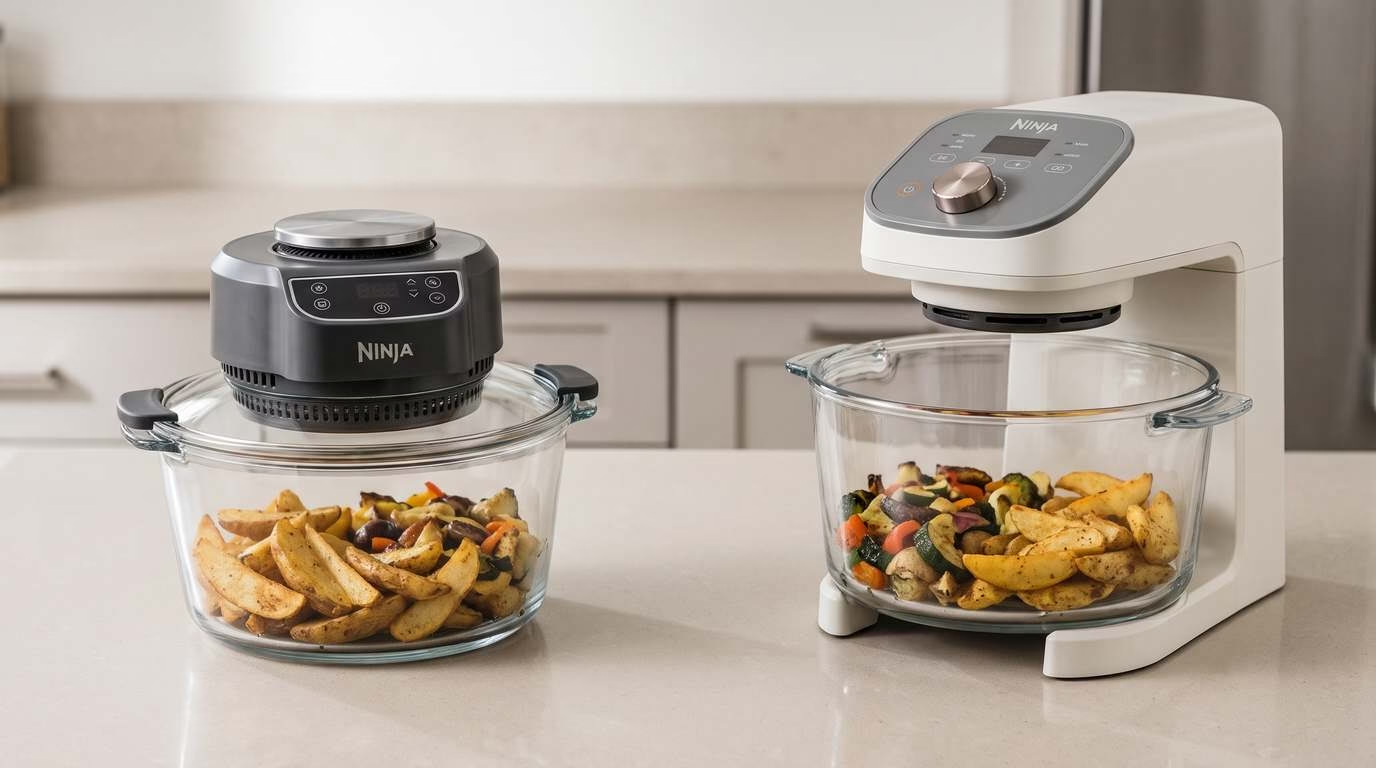
Choosing between the Ninja Crispi vs Ninja Crispi Pro comes down to three things: space, meal size, and heat control. Pick the original Crispi for small meals and easy storage. Choose the Pro for larger batches and the option to set your own cooking temperature.
Both use glass bowls for cooking, serving, and storing food. Yet the Pro isn’t an automatic upgrade for every kitchen.
This comparison draws on product specs and online owner discussions, including Reddit. The picks weigh reported strengths and drawbacks, rather than relying on sales claims alone. This page contains Amazon affiliate links. If you buy through them, I may earn a small commission at no extra cost to you. As an Amazon Associate I earn from qualifying purchases.
This guide covers the US Crispi FN101 and Crispi Pro AS101. Other versions may have different modes, parts, or power needs.
Quick Verdict: Which Ninja Crispi Is Right for You?
Choose the original Crispi if you want an air fryer you can put away. Its small bowl suits a quick meal or snack. The removable cooking pod also makes it easier to move between places.
Choose the Crispi Pro if you want more room and direct heat control. Its larger bowl gives you more options for bigger meals. The fixed design also means you don’t lift off a hot pod to stir food.
| Your main need | Better fit | Why |
|---|---|---|
| Small meals and snacks | Crispi | Includes a small 6-cup bowl |
| Easy storage | Crispi | Removable pod and nesting parts |
| Moving between home and work | Crispi | Portable design |
| Setting a specific temperature | Crispi Pro | Adjustable heat controls |
| Larger batches | Crispi Pro | Includes a 6-qt bowl |
| Replacing an original that works well | Keep your Crispi | Upgrade only to solve a clear need |
The smarter buy is the one that fits your usual meal. Don’t pay for extra space that you’ll rarely use.
- For portability: Check Ninja Crispi on Amazon.
- For capacity and heat control: Check Ninja Crispi Pro on Amazon.
Ninja Crispi vs Ninja Crispi Pro: Specifications Compared
The Pro adds more than a bigger bowl. You also get more cooking modes and a fixed countertop frame.
Here’s how the two US models compare.
| Specification | Ninja Crispi FN101 | Ninja Crispi Pro AS101 |
|---|---|---|
| Power rating [rated electrical power] | 1,500W | 1,800W |
| Included glass bowls | 4 qt and 6 cups | 6 qt and 2.5 qt |
| Approximate bowl sizes in liters | 3.8L and 1.4L | 5.7L and 2.4L |
| Heat control | Preset modes | Adjustable settings |
| Cooking modes | Air Fry, Max Crisp, Bake, Recrisp | Air Fry, Max Crisp, Bake/Proof, Roast, Recrisp, Dehydrate |
| Maximum advertised heat | 450°F | 450°F |
| Design | Removable PowerPod | Fixed countertop unit |
| Size: length × width × height | 11.5 × 9.76 × 11.81 inches | 11.8 × 12.2 × 11 inches |
| Included extras | Two lids, two crisper plates, adapter | Two lids, two crisper plates, adjustable base |
| US limited warranty | One year | One year |
A crisper plate is the raised tray that holds food above the bowl.
The Pro’s higher power rating does not prove it cooks faster. Food size, bowl choice, heat setting, and load all affect the result. Both models also reach the same advertised maximum temperature.
Prices vary by color, bundle, and sale. Compare the exact box contents before you judge the price gap.
Temperature Control Is the Biggest Functional Difference
Original Crispi: Choose a Mode and Cooking Time
The original Crispi keeps the controls simple. You choose a mode and set the time. You cannot dial in a specific temperature.
That may suit you if you cook the same snacks and meals often. Once you know which mode works, there’s little to adjust.
The trade-off shows up with recipes that call for an exact heat setting. You must choose a suitable mode and watch the food. You can’t simply copy the recipe’s temperature.
Crispi Pro: More Control, With Mode-Specific Limits
The Pro lets you set the temperature within each mode’s range. That gives you another way to adjust browning and cooking time.
Still, its full temperature range isn’t available in every mode. Dehydrate [dry food with low heat] can go down to 80°F. The US model’s Air Fry mode starts at 300°F.
The Pro also includes proofing [gentle warmth to help dough rise]. Those lower-heat tasks expand what you can do beyond crisping food.
Choose the Pro for heat control if you’ll use it. If preset modes already meet your needs, this feature may add little value.
Capacity and Counter Space: How Much Bigger Is the Pro?
What You Get in Each Box
The original gives you a 6-cup bowl and a 4-qt bowl. You can use the small one for a light meal. The larger one gives you room for a bigger portion.
The Pro comes with 2.5-qt and 6-qt bowls. Its smallest included bowl is larger than the original’s smallest bowl.
You can also buy a compatible 4-qt bowl for the Pro. It isn’t part of the standard bundle covered here. Add that cost if you think you’ll want a size between the two.
Container Volume Does Not Tell the Whole Story
A 6-qt bowl holds more than a 4-qt bowl. That doesn’t mean every food benefits from filling it to the top.
Air frying needs hot air to reach the food. A deep pile of fries differs from a single layer of chicken pieces. Bowl volume alone won’t tell you how much will crisp well at once.
Treat serving counts as rough guides, too. A batch of side dishes isn’t the same as a full meal.
Think about your usual food before you choose. The Pro’s extra room matters most when your meals need it.
Storage Versus a Permanent Countertop Setup
The original’s main space benefit is how you can pack it away. The pod lifts off, and the parts can nest for storage.
The Pro keeps its fixed shape. It suits a spot where it can stay ready for daily use.
Measure more than the space under a cabinet. You also need room to pull out the bowl and set it down. The original needs a clear spot for its pod while you turn food.
Cooking Results: What Can You Reasonably Expect?
Both models can air fry food and refresh leftovers. Their shared Recrisp mode suits food you want to warm while restoring some crunch.
The same-bowl system adds convenience. You can store leftovers in the glass bowl, then use it again for reheating. That can cut down on dish changes.
Storing leftovers in those bowls? Our guide to the best refrigerator storage bins can help keep them easy to find.
Chicken and vegetables draw mixed owner reports. Some Pro owners describe great results with both. Others report browned or charred edges before the middle finishes cooking.
Whole chicken shows the same split. The Pro’s large bowl offers more room for a bird. Yet extra space doesn’t guarantee that chicken and vegetables will finish together.
Fresh fries can take some trial and error as well. One Pro owner described dry outsides with undercooked centers. That’s a useful complaint to consider, but it doesn’t prove every unit has the same issue.
| What you cook | What matters most |
|---|---|
| Leftovers | Portion size, heat, and the finish you want |
| Chicken pieces | Thickness, spacing, and checking doneness |
| Vegetables | Piece size and how full you load the bowl |
| Whole chicken | Fit, heat, time, and internal doneness |
| Fresh fries | Consistent cuts and enough room for airflow |
| Baked foods | Recipe choice and control over browning |
The Pro adds proofing and dehydration, along with a separate Roast mode. Those features give you more options. They don’t make it a full replacement for every oven task.
There’s no clear basis here to promise better results from the Pro. You’re buying more control and room, not a guaranteed win with every food.
Cleaning, Glass Containers and Everyday Handling
Why Owners Like the Glass Containers
Seeing your food cook is one of the most praised features. You can watch the color change through the bowl. That won’t reveal internal doneness, but it helps you track browning.
Owners also like using one bowl for several jobs. You can prep, cook, serve, and store without moving food each time.
Cleanup earns positive comments, too. The removable glass bowls are a key part of that appeal. You still need to wash the crisper plate and clean the unit as directed.
Washing the plastic lids in a dishwasher? Our Bosch 300 vs 500 vs 800 dishwasher comparison shows which series dries plastic best.
Handling the Pod Versus Removing the Bowl
With the original, you lift off the pod to reach your food. Then you set it aside while you stir or turn the contents.
Some owners like the simple lift-off design. Others find it awkward to handle a hot cooking unit during a meal.
The Pro keeps the heating unit in place. You remove the glass bowl instead. That may feel more natural if you prefer a fixed appliance.
Neither setup removes the need to handle hot parts with care. Choose the motion that best fits your space and comfort.
Glass Does Not Mean the Entire Appliance Is Coating-Free
The glass bowl is only one part of the system. It doesn’t make the whole appliance plastic-free or coating-free.
For example, the Pro’s crisper plates use aluminum with a nano-ceramic coating [a thin ceramic-based surface layer]. Its handles and storage lids include plastic.
PFAS and PTFE [types of fluorinated chemicals] are separate from the question of whether a coating exists. A plate can be made without those materials and still have a coating.
If you want bare glass or bare metal touching all your food, look closely. Don’t base that choice on the words “glass air fryer” alone.
Ninja Crispi vs Crispi Pro: What Reddit Owners Say
Owner discussions help show what daily use can feel like. They also show why two people can reach very different views.
These reports are self-reported experiences. They don’t confirm a defect rate or prove which model most buyers prefer.
Original Crispi: Reported Advantages
Easy cleaning stands out in the original Crispi feedback. Owners also praise the clear bowl and its use as a serving dish.
Portability is another reason some favor it over the Pro. Users describe taking it to work or to family homes. Others simply like being able to put it away.
Smaller meals fit that use well. If you cook a quick portion, the small bowl can be a useful part of the kit.
Original Crispi: Reported Drawbacks
The lack of manual heat control bothers some users. They want to enter a recipe’s exact temperature.
Handling the pod is another sticking point. Lifting it off is simple in theory, but not everyone enjoys that step.
There are also reports of broken glass bowls. Other owners describe regular use without such trouble. These accounts do not show how often breakage occurs or what caused it.
Crispi Pro: Reported Advantages
Pro owners often value the larger bowl and adjustable heat. Those features make the appliance feel more flexible.
Some report strong results with chicken and vegetables. Others like having a fixed unit ready on the counter.
You also avoid finding a spot for a separate hot pod. For some buyers, that change matters as much as the extra capacity.
Crispi Pro: Reported Drawbacks
Uneven results appear in some Pro complaints. Reports include food browning outside before it cooks through.
One owner found broccoli browned too fast in the small bowl. They preferred the extra room in the larger one.
Space and cost also come up. Some owners want the optional 4-qt bowl but dislike buying it separately. Others prefer the original because it’s easier to move and store.
Take these reports as clues about possible trade-offs. They’re more useful than treating either model as a universal winner.
Is the Ninja Crispi Pro Worth the Extra Money?
When Paying More Makes Sense
The Pro makes sense when you can name a feature you’ll use often. The clearest reasons are its larger bowl and heat controls.
It may also suit you if you want to proof dough or dry food. Those jobs go beyond the original model’s four modes.
A fixed design can be a valid reason on its own. If lifting a hot pod would annoy you each day, that matters.
When the Original Is the Smarter Purchase
Choose the original if its bowls fit your normal portions. It gives you the core glass-bowl cooking experience without the Pro’s fixed frame.
It also suits a kitchen where appliances must go into a cabinet. The same goes if you want to take it between places.
Outfitting a whole kitchen? Our things to buy for a new home checklist covers what else to buy.
There’s little value in extra modes you won’t use. A smaller feature set can still be the right fit.
Should Existing Crispi Owners Upgrade?
Start with what frustrates you about your current Crispi.
If you keep wishing for exact heat control, the Pro addresses that. If the large bowl feels too small, the Pro adds room.
If your current meals turn out well, there’s less reason to switch. More modes alone don’t make your existing air fryer less useful.
Before you buy, compare the full cost. Include any extra bowl you want, rather than judging the appliance price alone.
Which One Should You Buy? Recommendations by Buyer
The best choice in the Ninja Crispi vs Ninja Crispi Pro comparison follows your routine.
| Your situation | Recommendation | Next step |
|---|---|---|
| You cook smaller portions and need easy storage | Original Crispi | Check Crispi on Amazon |
| You want larger batches and adjustable heat | Crispi Pro | Check Crispi Pro on Amazon |
| Your current Crispi meets your needs | Keep it | Wait until you can name a clear reason to upgrade |
| You want a fully coating-free system | Check materials before choosing either | The glass bowl alone does not meet that goal |
Think about the last few meals you cooked. Would more bowl space or heat control have helped? Or would easy storage have mattered more?
That answer is more useful than the word “Pro” on the box. Buy for the task you repeat, not the feature you might try once.
Frequently Asked Questions
What is the main difference between Ninja Crispi and Crispi Pro?
The original Crispi uses a removable cooking pod and preset modes. The Pro has a fixed frame, adjustable heat, and a larger included bowl. It also adds more cooking functions.
Can you change the temperature on the original Ninja Crispi?
You cannot set an exact temperature on the US FN101. You select a cooking mode and time instead. The Pro lets you adjust heat within each mode’s limits.
Does the Crispi Pro cook better than the original?
It gives you more control, but that doesn’t prove better results with every food. Owner reports include both strong praise and cooking complaints. Bowl choice, food size, and loading can affect the outcome.
Are Ninja Crispi containers compatible with the Pro?
For the US ranges checked here, compatible 2.5-qt and 4-qt bowls work with both systems. The 6-cup bowl is for the original, while the 6-qt bowl is for the Pro. Check the exact accessory model before buying.
Is the Ninja Crispi Pro better for family meals?
Its 6-qt bowl gives you more room for larger batches. That makes it a better fit when capacity is your main need. Your practical serving count still depends on the food and portion size.
Are the glass containers and accessories dishwasher-safe?
The glass bowls, crisper plates, and storage lids are listed as dishwasher-safe. Follow the care guide for your exact model and each part. The electrical cooking unit does not go in the dishwasher.
Are Ninja Crispi air fryers completely plastic-free or coating-free?
No. Glass bowls don’t mean every part uses glass or bare metal. The Pro includes coated crisper plates and plastic parts, such as handles and lids.
Do US and UK Ninja Crispi models have the same specifications?
Not always. Modes, maximum heat, bundles, and electrical ratings can differ. Match the model number and voltage to your market before you buy.
Is upgrading worthwhile if I already own a Crispi?
Upgrade if you need the Pro’s larger bowl, heat controls, or added modes. If your current unit handles your meals well, keeping it is reasonable. The right Ninja Crispi vs Ninja Crispi Pro choice should fix a real gap in your cooking.