
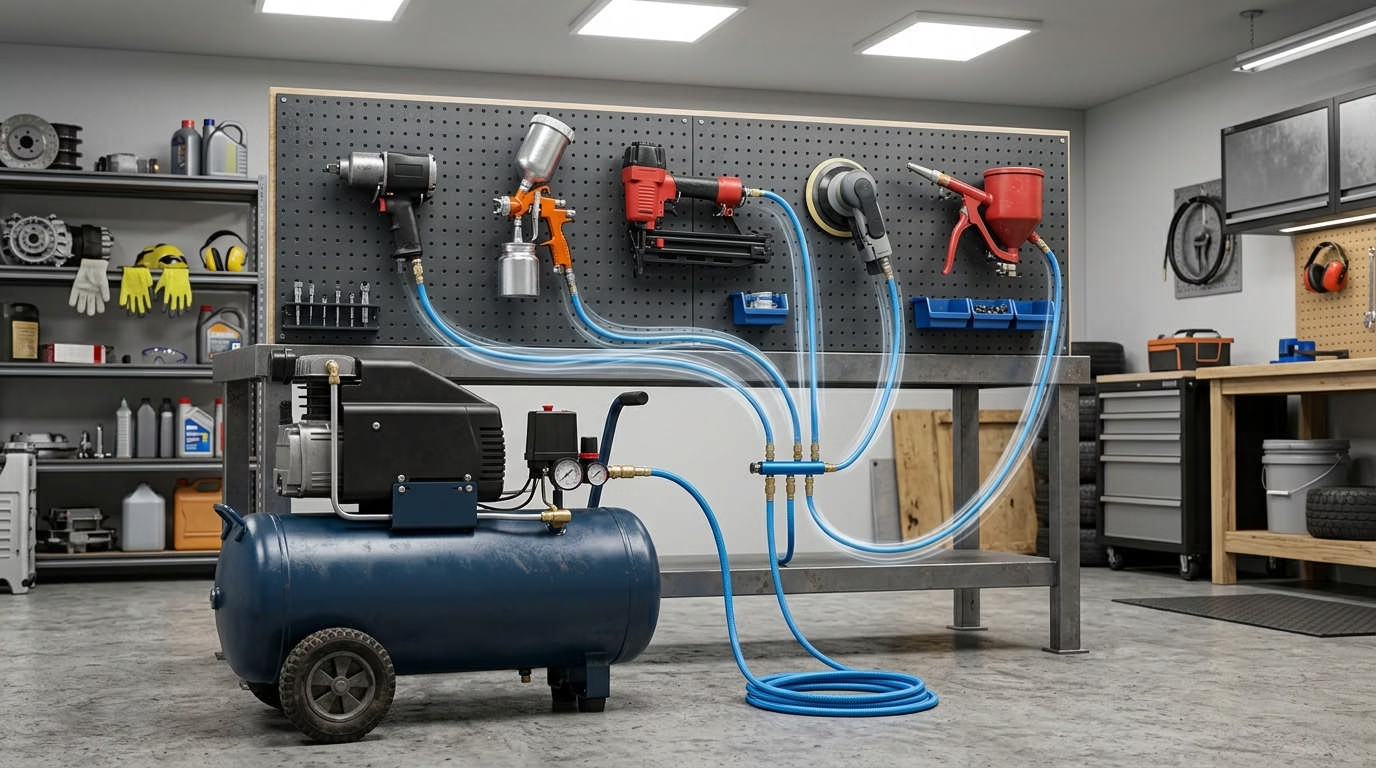
Buying the wrong size air compressor is easy to do. Go too small, and your tools lose power. Go too big, and you pay for air you’ll never use.
This air compressor CFM calculator fixes that. Pick the tools you plan to run. It works out your airflow, PSI, tank size, and compressor type in seconds. No math. No guesswork.
It uses the same method pros use. Add up what your tools need. Add a safety margin for leaks. Then match that to your compressor’s duty cycle. The result is a size built for your shop, not just one tool.
Air Compressor CFM Calculator
Select the tools that may run at the same time. The calculator estimates airflow, pressure, tank size, and compressor type.
Select Your Air Tools
Select every tool that may operate at the same time.
What do CFM and SCFM mean?
CFM means cubic feet per minute and measures airflow. SCFM is airflow measured under standard conditions. For this sizing estimate, CFM and SCFM are treated as equivalent.
What does PSI mean?
PSI measures air pressure. A compressor must supply enough airflow at or above the pressure required by the tool.
How should I choose a tool duty cycle?
Choose 100% for nearly nonstop use, 75% for heavy use, 50% for intermittent use, or 25% for short bursts.
Adjust the Sizing Settings
Add reserve capacity and account for compressor recovery time.
Calculation Breakdown
Review the airflow contribution from each selected tool.
Select at least one tool to view the calculation breakdown.
| Tool | Quantity | Duty Cycle | Tool Airflow | Effective Airflow |
|---|
Alternate Design Version
Portable
Portable
Portable
Workshop
Workshop
What CFM means
CFM (Cubic Feet per Minute) is the volume of air a tool consumes or a compressor delivers per minute. It is the single most important number for sizing — more important than HP or tank size.
What SCFM means
SCFM (Standard CFM) is CFM referenced to standard conditions — typically 14.7 psia, 68°F, 36% humidity. SCFM lets you compare compressors fairly. CFM and SCFM are not always interchangeable: a compressor delivering 10 CFM at 90 PSI in a hot shop may not equal 10 SCFM.
Why PSI matters
PSI is pressure, not flow. A tool needs both: enough CFM to keep running and enough PSI to develop rated power. A compressor must deliver the required CFM at the required PSI — a high-PSI compressor with low CFM will stall a die grinder.
Why tank size matters
The tank is a buffer, not a source of continuous air. It absorbs short peaks (e.g. a nail gun’s burst) so the pump can cycle. A bigger tank extends run time but does not raise sustained airflow — only the compressor’s pump CFM does that.
Why horsepower alone isn’t enough
HP ratings are inconsistent: some brands quote peak HP (motor startup), others running HP. Two “5 HP” compressors can deliver very different CFM. Always compare delivered CFM @ 90 PSI instead.
Sizing for continuous-use tools
Paint sprayers, sandblasters, die grinders and orbital sanders run continuously. The compressor’s delivered CFM must equal or exceed the tool’s CFM at all times — no duty-cycle discount.
Sizing for intermittent-use tools
Impact wrenches, nail guns and ratchets fire in short bursts. Average CFM = tool CFM × duty cycle %. The compressor can be sized closer to the average demand, with a tank sized for the peak burst.
How much extra CFM to allow
Industry rule: add 25–30% for leaks (typical 10–15% loss), pressure drop across hose/regulator/filter, and future expansion. Older piping or planned tool additions push this toward 40%+.
Home Garage
Tire inflation, brad nailer, occasional blow gun. A small oil-less portable is fine. Look for ≥4 CFM at 90 PSI delivered.
DIY / Hobby
Impact wrench, nail guns, air ratchet, light grinding. A 2–3 HP portable with 20 gal tank handles most DIY projects comfortably.
Impact Wrench Use
Intermittent duty (~25–30%). A 1/2″ gun runs well on a 10 CFM compressor; a 1″ gun really needs a stationary 60+ gal unit.
Nail Guns
Brad/finish/framing nailers use very little air per shot. Even a small 4-gal pancake handles a framing nailer. Tank size matters more than CFM here.
Paint Spraying
Continuous duty. HVLP guns are thirsty — most small “5 HP” portables can’t keep up. Add 25% CFM buffer to prevent pulsing and pressure drop at the gun.
Sandblasting
Extremely high air consumption and continuous duty. Nozzle size and blasting pressure dominate CFM requirements. Realistically requires a stationary 5–7.5 HP compressor minimum.
Professional Workshop
Multiple tools, simultaneous operators, continuous-use tools. Plan for future expansion. Stationary two-stage compressor with 175 PSI max and 60–80 gal ASME tank is the standard.
How to Size Your Air Compressor
Want to do the math by hand? Here's the short version.
1. List your tools
Write down every tool you might run at the same time. Skip tools you'll only use alone, on different days.
2. Add up the CFM
Each tool has a CFM rating, shown on the box or manual. Add up the tools that run together. That's your total air demand.
3. Add a safety margin
Shops lose air to leaks and long hoses. Add 20% to 30% on top of your total. This also leaves room for tools you add later.
4. Check your PSI, then pick a type
Find your highest PSI tool. Your compressor must hit that PSI too, not just the right CFM. Light jobs suit a portable compressor. Heavy or nonstop jobs need a stationary one.
Or skip the math. Use the calculator above—it runs these steps for you.
Once you know the CFM and tank size you need, make sure the compressor can actually get full power. A thin or overly long cord causes voltage drop that starves the motor—check the right size with our extension cord gauge calculator.
Air Compressor Sizing FAQs
What happens if my compressor's CFM is too low?
Your tool loses power. Spray guns sputter. Sanders slow down. Impact wrenches lose torque. The fix is a bigger compressor, not a bigger tank.
Can I run two or more tools at the same time?
Yes, but plan for it first. Add up the CFM for every tool that runs at once. That total, not any single tool, sets your compressor size.
Can a small compressor run a paint sprayer?
Not for long. Paint guns need steady, nonstop air. A small tank empties fast and causes weak, spotty spray. Look for at least 4 CFM at 90 PSI for HVLP guns. Conventional guns need more.
Should I round my compressor size up or down?
Round up. Compressors lose some output over time. A little extra CFM gives you room to grow. It also keeps the pump from running nonstop.
Does hose length affect how much CFM I need?
Yes. Long or thin hoses cause pressure drop. Use a hose at least 3/8 inch wide. Keep it as short as you can.
What if I plan to add more tools later?
Buy a bit more CFM than you need today. Most pros add 10% to 20% extra room for tools they'll add later.
Know your number? See our picks for the best garage air compressors next.