
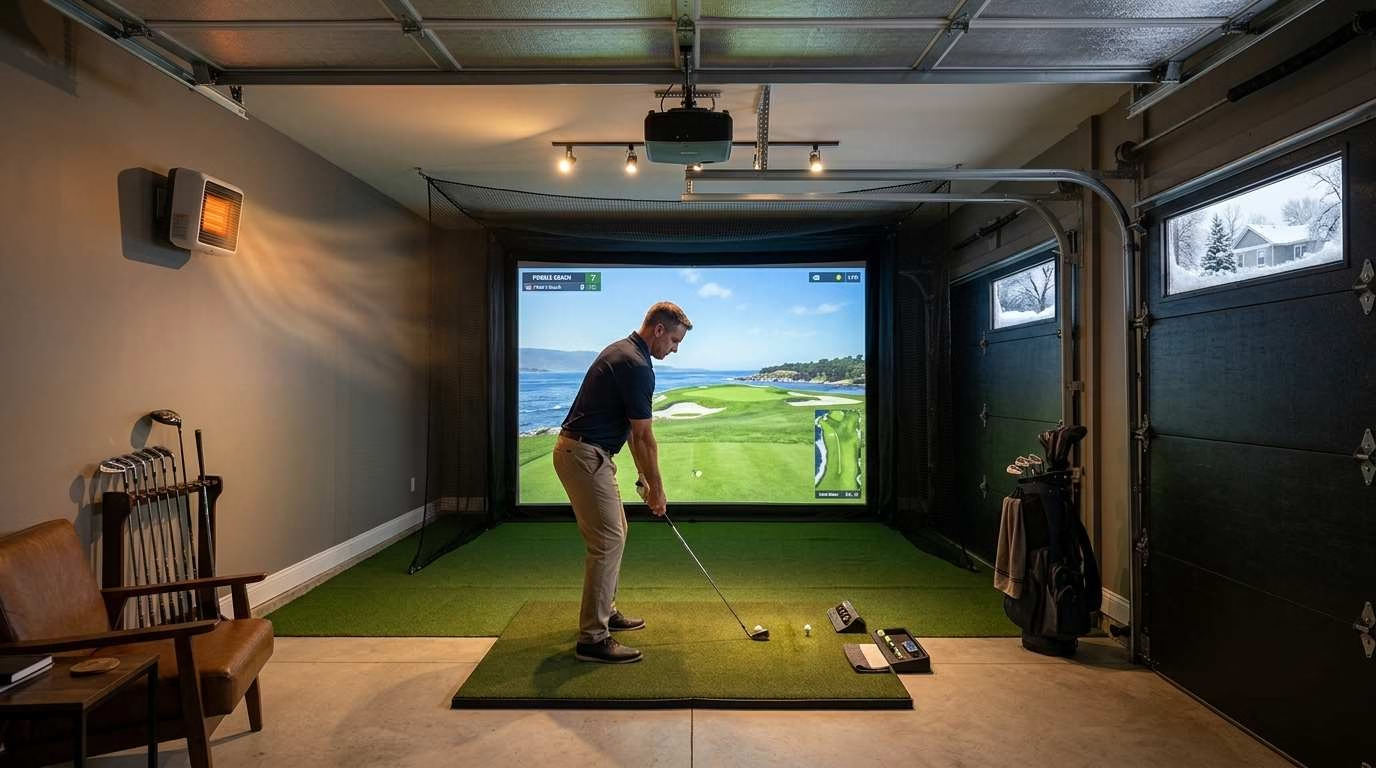
A cold garage can make winter golf feel like a chore. The best garage heater for a golf simulator should warm your space without causing fumes, excess noise, or power issues.

For most insulated garages, a 240V ceiling heater offers the best balance. Infrared heat works well for short sessions and quiet play. A vented gas heater makes more sense for large garages in very cold areas.
This guide compares seven options for different spaces, budgets, and heating needs.
Safety note: Some heaters need new wiring, a gas line, or outdoor venting. Use a licensed installer when the product or local code requires one.
Our Top Picks at a Glance
The table below gives you the fast answer. Pay close attention to the power needs and ideal use.
Do not rely on the coverage number alone. An insulated 500-square-foot garage may feel warmer than a drafty 300-square-foot one.
A 120V heater is best for spot heat or mild weather. Most cold garages need a 240V or vented gas heater. also read: 7 Best Garage Heaters for Uninsulated Garages, Ranked by Real User Verdicts.
Which Garage Heater Should You Buy?
Choose your heater based on how you use the simulator.
- Choose the King KBP2406 ECO2S for the best mix of heat, controls, and quality.
- Choose the Comfort Zone CZ220 if you want low-cost whole-room heat.
- Choose the Dr. Infrared DR-238 when silent operation matters most.
- Choose the Dr. Infrared DR-239 for stronger heat aimed at your hitting mat.
- Choose the Modine Hot Dawg HD45 for frequent winter use in a cold area.
- Choose the Dyna-Glo EG7500DH for a large insulated garage with 240V power.
- Choose the Heat Storm Phoenix Wi-Fi for remote control in a small space.
Your use pattern also matters. A short practice session calls for fast, direct heat. A four-player round needs even room heat for several hours.
How to Choose a Garage Heater for a Golf Simulator
A golf simulator has needs that a normal workshop does not. You need room for your swing, stable conditions for your gear, and low noise during play.
Use the following factors to narrow your choices.
Start With Garage Size and Insulation
Start by measuring the floor area. Multiply the length by the width to find the square footage.
Then check the ceiling height. A tall ceiling adds more air for the heater to warm. This often makes a garage feel colder than its floor size suggests.
You should also inspect:
- Wall insulation
- Ceiling insulation
- Garage door insulation
- Gaps around doors and windows
- Cold concrete floors
- Outdoor winter temperatures
- How often the main door opens
Here is a rough starting point:
| Garage Condition | Approximate Heating Need |
|---|---|
| Small, well-insulated garage | 10,000–20,000 BTU |
| Typical insulated two-car garage | 20,000–35,000 BTU |
| Large or partly insulated garage | 30,000–50,000 BTU |
| Large, uninsulated garage in a cold area | 40,000 BTU or more |
BTU means the amount of heat a unit can produce. A higher number means more heat, but also greater power or fuel use.
These ranges are only a rough guide. Climate and air leaks can cause large changes.
Do not forget the garage door. It is often the weakest part of the room. Thin panels and worn seals can release heat fast.
Decide Between Whole-Room and Spot Heating
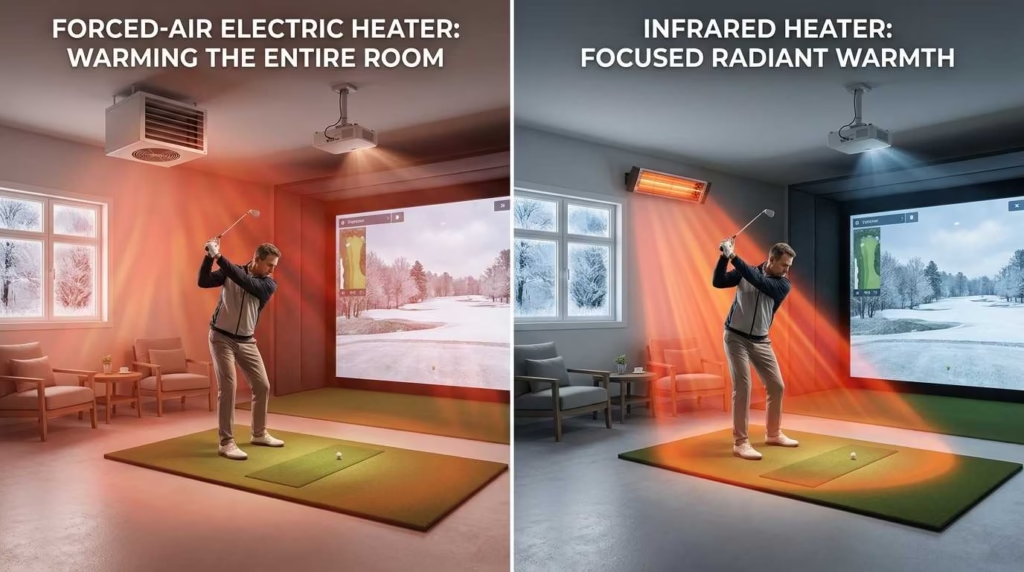
A forced-air heater warms the air. A fan then spreads that warm air around the garage.
This works well when:
- Several people use the simulator
- Sessions last several hours
- You want an even room temperature
- You store sensitive gear in the garage
- You use the room for other tasks
An infrared heater works in a different way. It sends heat toward people and objects in its path.
Think of the sun on a cold day. The air may feel cold, but the sunlight still warms your skin.
Infrared heat works well when:
- You practice alone
- Sessions are short
- The garage has air leaks
- You mainly need warmth at the mat
- Fan noise would bother you
Some garages benefit from both types. A forced-air heater can warm the room before play. A small infrared unit can then keep the golfer comfortable.
Check Your Available Electrical Power
Most plug-in heaters use a standard 120V outlet. Their output usually stops near 1,500 watts.
That can warm a small room or one person. It often cannot heat a freezing two-car garage.
Larger electric heaters use 240V power. These models may produce 5,000 to 7,500 watts.
Before choosing one, check:
- Your electrical panel capacity
- Available breaker spaces
- Circuit size
- Wire size
- Distance from the panel
- Other gear on the same circuit
Your projector, computer, lights, and launch monitor also use power. Do not place them on a circuit that already runs near its limit.
Never connect a high-draw heater to a power strip. Avoid extension cords unless the manufacturer allows one.
A licensed electrician can check your panel and install the right circuit. This may add to the total cost, so get an estimate first.
Consider Noise During Play
Heater noise matters in a golf simulator.
A loud fan can cover the sound of club impact. It can also make group chat less clear. If you record swing videos, a nearby blower may fill the audio.
There are three common noise levels:
- Silent: Fanless infrared heaters
- Low to moderate: Small wall heaters
- Moderate to loud: High-output forced-air units
A large heater does not always cause more trouble. It may warm the room fast and switch off. A small fan heater may run through the whole session.
Mounting can also affect noise. A loose bracket may create a buzz or shake. A solid mount can reduce this issue.
Think About Airflow and Screen Movement
Strong airflow may move a loose impact screen. This can change the screen’s shape and make the image look less sharp.
Do not aim a forced-air heater at:
- The impact screen
- The projector lens
- The projector vents
- The launch monitor
- Loose curtains
- Your face at address
Aim the air across the room instead. This spreads heat without pushing the screen back and forth.
Also check your swing path before mounting any heater. Include your backswing, follow-through, and the swing paths of taller guests.
Account for Fumes, Ventilation, and Moisture
Electric heaters do not burn fuel inside the garage. That means they do not make indoor combustion fumes.
Gas and propane systems need more care.
A vented natural gas heater sends fumes outdoors. This makes it a better long-term option than a portable unvented heater.
An unvented propane heater releases combustion products into the room. It can also add water vapor. That extra moisture may collect on cold tools, windows, and electronics.
Portable fuel heaters can also create:
- Odors
- Hot surfaces
- Open flames
- Carbon monoxide
- Added humidity
- Fuel storage concerns
A carbon monoxide alarm adds a layer of warning. It does not make poor venting safe.
Follow the heater instructions and local code. If you want permanent gas heat, use a trained installer.
Look for Useful Controls
Good controls make cold-weather practice much easier.
Look for:
- A built-in thermostat
- A wall thermostat
- Two heat levels
- A timer
- Remote control
- Wi-Fi schedules
- Fan-only mode
- Overheat shutoff
A wall thermostat often gives a better room reading. The thermostat inside a ceiling heater may sense the warm air near the unit.
Smart control is useful, but heating output still comes first. A 1,500-watt heater will not heat a large freezing garage just because it has an app.
The 7 Best Garage Heaters for Golf Simulators
The right product depends on your space and use. These seven models each solve a different heating problem.
1. King Electric KBP2406 ECO2S – Best Overall
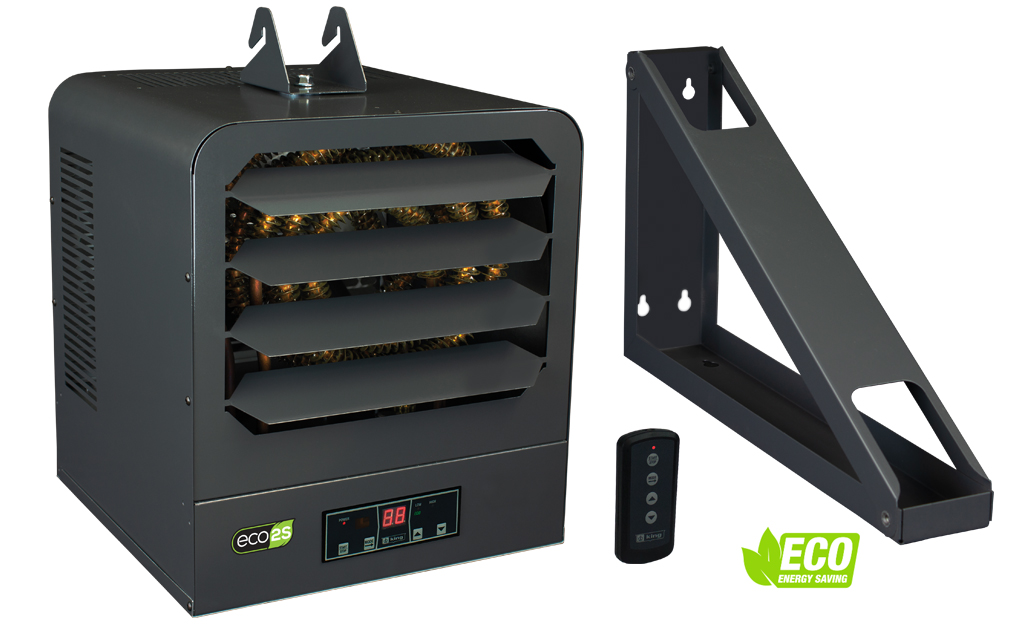
The King Electric KBP2406 ECO2S is the best fit for most insulated simulator garages. It offers strong heat, useful controls, and flexible mounting.
Its maximum output reaches 5,700 watts. That equals about 19,454 BTU. It uses 240V power and needs the correct circuit.
Key Features
- Up to 5,700 watts
- Up to 19,454 BTU
- Two-stage heating
- Built-in digital thermostat
- Timer
- Remote control
- Fan-only mode
- Adjustable louvers
- Wall or ceiling mounting
The two-stage system sets this model apart. It can use high heat during warm-up, then switch to a lower level.
That makes sense in a simulator room. Your body, projector, and gaming computer all add heat after play starts.
The remote is also useful. You can change the setting without walking near the unit or reaching toward the ceiling.
Adjustable louvers help direct airflow. You can aim the heat across the garage instead of at the impact screen.
The King is not silent. It uses a fan to spread warm air. Still, its controls may help it run less once the room reaches the set temperature.
Pros
- Strong output for many insulated garages
- Better controls than basic shop heaters
- Two heat stages
- Reliable room-wide warmth
- Does not use floor space
- Fan-only mode adds summer value
Cons
- Requires 240V power
- Professional wiring may be needed
- Fan noise remains present
- Higher price than basic heaters
The King suits you if you use your simulator often. It also works well if you want one fixed electric heater for the whole room.
2. Comfort Zone CZ220 – Best Budget

The Comfort Zone CZ220 gives you high output without many extra features. It is a simple 5,000-watt ceiling heater made for garages and shops.
It runs on 240V power and must be hardwired. Its output is close to 17,000 BTU.
Key Features
- 5,000-watt output
- About 17,000 BTU
- Built-in thermostat
- Adjustable louvers
- Ceiling mounting
- Steel housing
- Overheat protection
- Power light
The main appeal is value. You get enough heat for many small or mid-size insulated garages without paying for Wi-Fi or a digital screen.
Its louvers let you aim the warm air. The mount can also change the heater’s angle.
The built-in thermostat controls the heat. However, the manual dial is less exact than a good wall thermostat.
The heater itself may be low-cost. The wiring may not be. A new 240V circuit can add a large expense.
Get an electrical quote before you judge the full cost.
Pros
- Low price for a 5,000-watt heater
- Strong output for its size
- Simple controls
- Ceiling mount saves floor space
- Adjustable airflow
- Tough steel case
Cons
- Basic thermostat
- No remote or app
- Fan noise may distract you
- Needs a 240V circuit
- Installation may raise the total cost
The CZ220 works best when your garage already has suitable power. It is a practical option if you want warmth rather than smart features.
3. Dr. Infrared Heater DR-239 – Best Electric Infrared Heater

The Dr. Infrared Heater DR-239 warms the player instead of all the garage air. This makes it useful for short practice sessions.
It produces 3,000 watts or 10,260 BTU. It needs a 220V to 240V supply.
Key Features
- 3,000-watt output
- 10,260 BTU
- Carbon infrared elements
- Silent operation
- Two power levels
- Remote control
- Wall or ceiling mount
- Weather-resistant case
- Overheat protection
The DR-239 sends radiant heat toward your body and mat. You feel warmth soon after switching it on.
It has no fan. That means no blower noise and no moving air against your impact screen.
Placement is key. You must aim it at the area where you stand. A person outside that zone may feel much colder.
This heater is not the best choice for even room heat. It will not warm hidden corners or areas behind large objects.
It is also less useful for a group. Players often move between the mat, seating area, and computer.
Pros
- Silent
- Fast direct warmth
- No combustion fumes
- Does not move screen fabric
- Remote control
- Wall or ceiling mounting
- Good for short sessions
Cons
- Requires higher-voltage power
- Heat is directional
- Does not warm the full room evenly
- Placement affects comfort
- May not suit group play
Choose the DR-239 if direct warmth matters most. It is a good match for solo practice in a drafty garage.
4. Modine Hot Dawg HD45 – Best Natural Gas Heater

The Modine Hot Dawg HD45 is made for cold garages and long winters. It offers much more heat than a standard electric space heater.
The HD45 has a 45,000 BTU input rating. It mounts near the ceiling and uses a fan to spread warm air.
Key Features
- 45,000 BTU input
- Power-vented system
- Ceiling mounting
- Wall thermostat support
- Fast room heating
- Compact overhead design
- Natural gas operation
- Outdoor exhaust
This heater makes sense if you use your simulator several times each week. It can warm a cold room faster than a small electric model.
The power vent sends combustion gases outside. That is a key benefit for a room where people may stay for several hours.
A wall thermostat makes daily use simple. You can hold a low temperature between sessions, then raise it before play.
The unit needs more work to install. You may need:
- A gas line
- An exhaust vent
- Electrical power
- A thermostat
- Wall or ceiling support
- Local permits
Installation can cost more than the heater. This is not a casual plug-in option.
It also has a fan and exhaust motor. You will hear it run, though proper sizing can limit long cycles.
Pros
- High heat output
- Good for harsh winters
- Fast warm-up
- Vents fumes outdoors
- Works with a wall thermostat
- Keeps floor space open
- Suitable for regular use
Cons
- High installation cost
- Needs gas and venting
- Makes some fan noise
- May be too large for small garages
- Professional setup is often required
The Hot Dawg fits a serious, year-round simulator room. It makes the most sense if natural gas is already close to the garage.
5. Dr. Infrared Heater DR-238 – Best Quiet Heater
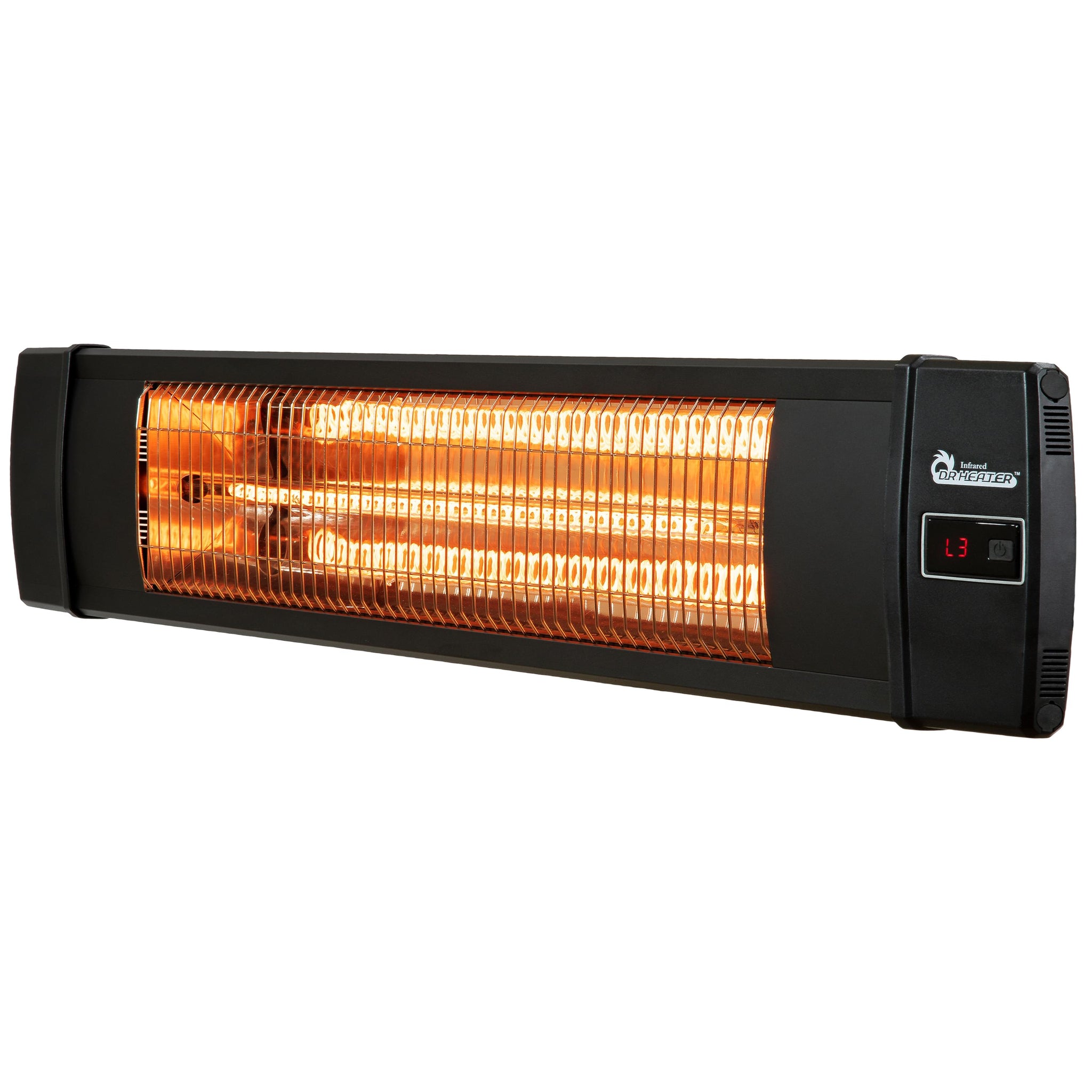
The Dr. Infrared Heater DR-238 is the quietest choice in this group. It has no fan, so it will not add blower noise to your session.
It uses a standard 120V outlet. Its top setting is 1,500 watts, or about 5,200 BTU.
Key Features
- 1,500-watt maximum output
- About 5,200 BTU
- Three heat levels
- Fanless infrared heat
- Remote control
- Wall or ceiling mounting
- Indoor and outdoor use
- Standard 120V plug
The DR-238 is easy to place over a hitting mat or seating area. It provides quick heat without taking up floor space.
It is useful for swing videos and voice recording. There is no fan to fill the audio.
However, it is still a small heater. It cannot replace a whole-garage unit in most cold areas.
You may get the best result by using it with another heat source. Warm the room first, then use the DR-238 near the player.
It can also work alone in a small, well-sealed garage. Mild winter areas are a better fit.
Pros
- Silent operation
- Uses a standard outlet
- Fast personal warmth
- Remote included
- Flexible mounting
- No fumes
- Compact design
Cons
- Low total output
- Limited heating zone
- Poor fit for large cold garages
- No full room thermostat
- Needs careful aim
Pick the DR-238 if noise is your top concern. Treat it as a personal heater rather than a full garage furnace.
6. Dyna-Glo EG7500DH – Best for a Large Insulated Garage
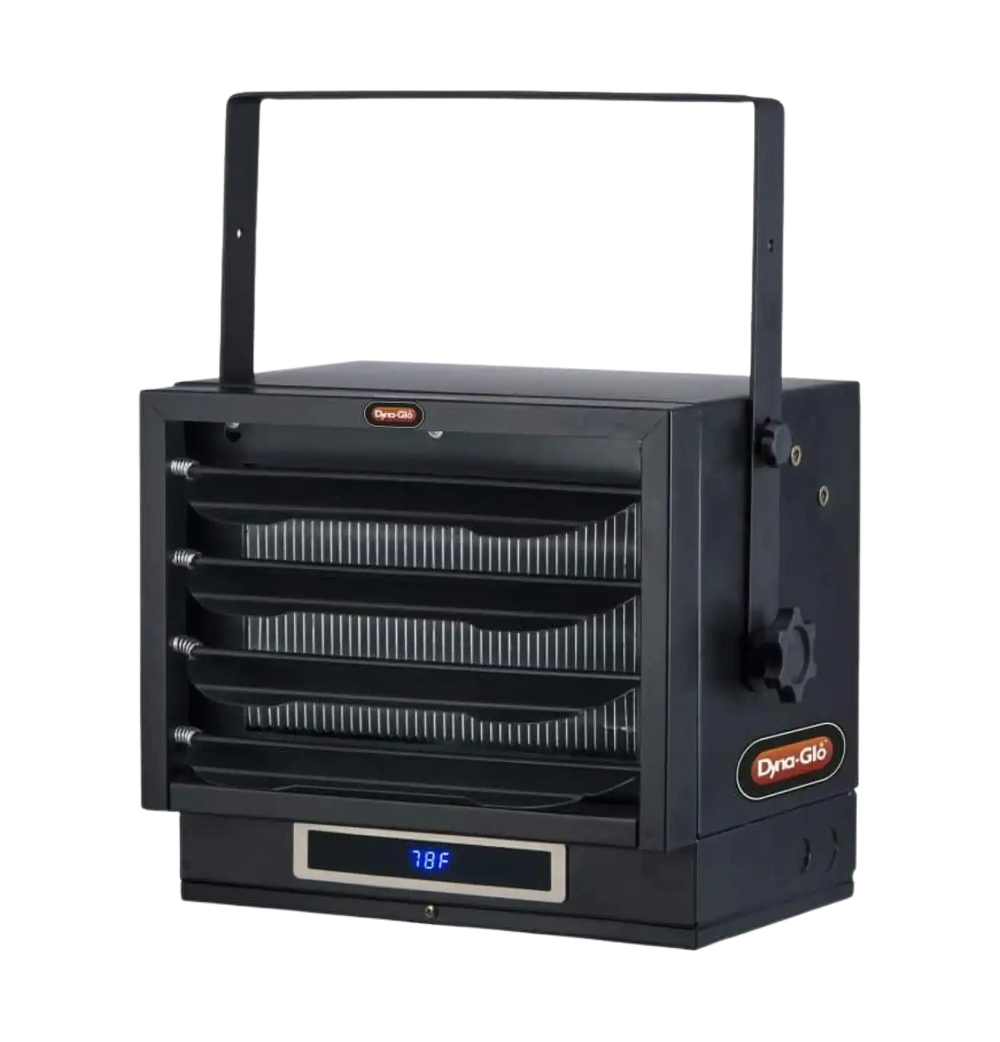
The Dyna-Glo EG7500DH offers the highest electric output on this list. It delivers up to 7,500 watts, or 25,589 BTU.
It is built for large insulated garages. It needs a hardwired 240V circuit.
Key Features
- 7,500-watt maximum output
- 25,589 BTU
- 5,000-watt lower setting
- Digital temperature control
- Remote control
- Eight-hour timer
- Adjustable airflow
- Fan-only setting
- Overheat protection
The dual output gives you more control. Use 7,500 watts to warm the room, then switch to 5,000 watts.
Its remote and timer are useful in a simulator. You can change settings without stopping the round.
The digital display is also easier to read than a small dial near the ceiling.
This heater moves a fair amount of air. That helps with large spaces, but it adds noise. It may also move a loose screen if aimed poorly.
Its power demand is another concern. The heater draws far more current than a plug-in model. Your panel and wiring must support it.
Pros
- High electric heat output
- Two power settings
- Digital controls
- Timer and remote
- Good air movement
- Built for large spaces
- Fan-only mode
Cons
- Needs a large 240V circuit
- Fan noise can be clear
- Higher running cost
- May move loose screen fabric
- Coverage depends on insulation
The Dyna-Glo suits a large garage where gas is not an option. It is best for owners with enough panel capacity.
7. Heat Storm HS-1500-PHX-WIFI – Best Smart Heater
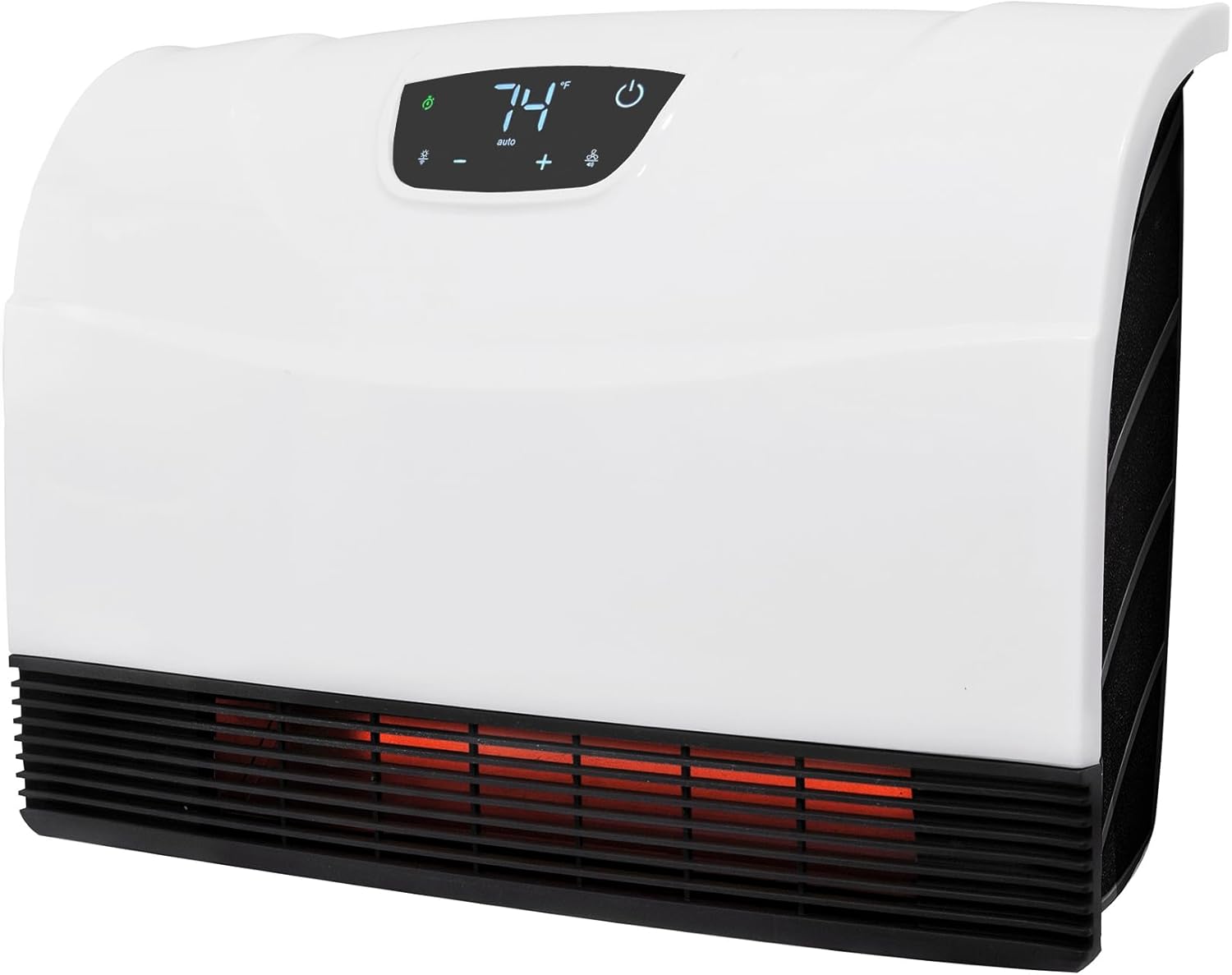
The Heat Storm Phoenix Wi-Fi puts easy control ahead of raw output. You can change settings and create schedules through its app.
It produces 1,500 watts or about 5,200 BTU. It plugs into a standard 120V wall outlet.
Key Features
- 1,500-watt output
- About 5,200 BTU
- Wi-Fi controls
- Custom schedules
- Digital thermostat
- Remote control
- Wall-mounted design
- Safety shutoffs
- Two heat modes
The schedule feature is its main strength. You can set the heater to run before a planned practice session.
That helps in a small insulated room. You do not have to enter a cold space and wait beside the heater.
Wall mounting also keeps the floor clear. This is helpful near clubs, cables, and the hitting area.
Do not mistake smart controls for high power. This heater still has the same basic limit as other 1,500-watt units.
It works best in:
- A small simulator room
- A mild climate
- A well-insulated garage
- A closed simulator bay
- A space that already has background heat
It also uses a small fan. It is quieter than many large garage heaters, but it is not silent.
Pros
- App control
- Custom schedules
- Standard wall plug
- Digital thermostat
- Remote included
- Space-saving wall mount
- Easy daily use
Cons
- Limited output
- Not silent
- Poor fit for a freezing large garage
- Best used as added heat
- Needs a strong Wi-Fi signal
The Heat Storm suits you if control matters more than speed. It can preheat a small space before you begin playing.
Honorable Mentions
A few other options may suit your garage better. They missed the main list due to cost, controls, or setup limits.
Fahrenheat FUH54
The Fahrenheat FUH54 is a heavy-duty 5,000-watt electric heater. It uses 208V or 240V power and produces about 17,065 BTU.
It includes:
- An adjustable thermostat
- Ceiling mounting hardware
- Adjustable louvers
- Fan delay
- Overheat protection
- Vertical or horizontal airflow
The fan delay is useful. It waits for the heating element to warm before moving air. It also runs after the heat stops to remove stored heat.
The main drawback is value. Its controls feel basic next to newer digital models. Its price may also be high in some stores.
Still, it remains a good option if you value a simple design and proven parts.
Cold-Climate Mini-Split
A mini-split is a wall-mounted heat pump. It moves heat instead of making all its heat through electric coils.
A cold-climate model can offer:
- Quiet heating
- Air conditioning
- Lower running costs
- Remote control
- Steady room temperature
- Moisture control in summer
This can be an excellent long-term option. It is especially useful if you play throughout the year.
The main barrier is upfront cost. You may need a new circuit and trained installation.
A mini-split may also warm a freezing garage more slowly than a large gas heater. It works best when you maintain a moderate base temperature.
Dyna-Glo 30,000 BTU Vent-Free Natural Gas Heater
This wall heater offers strong radiant heat without an outdoor exhaust pipe. It may warm a garage faster than small electric units.
However, “vent-free” does not mean risk-free. The heater releases its combustion products into the room.
That may lead to:
- Added moisture
- Window condensation
- Odors
- Air quality concerns
- Greater need for fresh air
It may suit some code-approved spaces. Still, a vented gas heater is a stronger general choice for regular simulator use.
Where Should You Place a Heater in a Golf Simulator Garage?
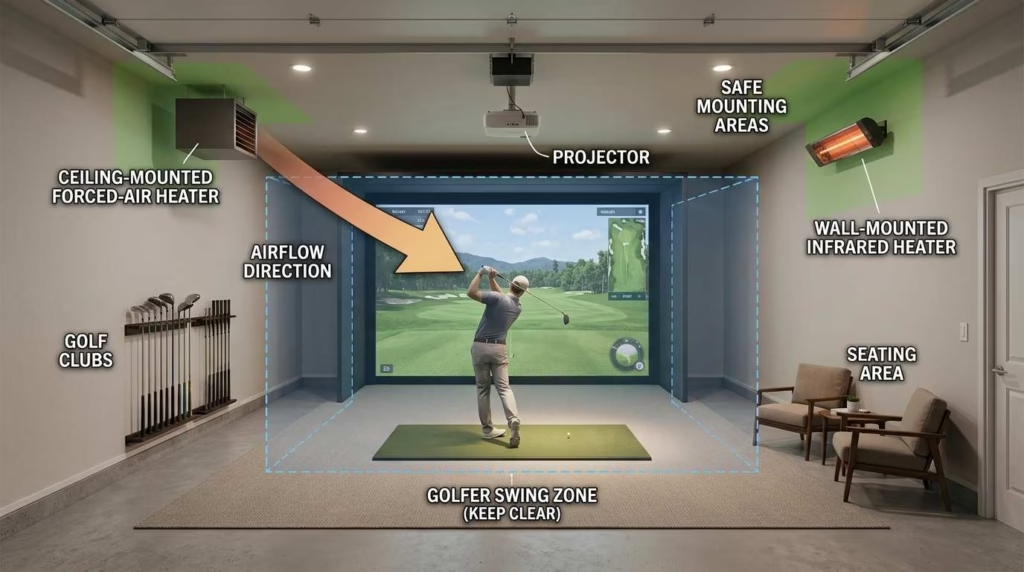
Heater placement affects comfort, noise, and safety. It also affects your screen and projector.
Plan the full swing area before you drill any holes.
For Forced-Air Heaters
Mount the unit high on a side or rear wall. Aim the air across the garage.
Avoid direct airflow toward the impact screen. A loose screen may move, which can harm image quality.
Also avoid the projector. Hot air and dust may affect its cooling system.
Keep the heater outside every golfer’s swing path. Test the space with your tallest user and longest club.
A good forced-air setup should:
- Spread heat across the room
- Avoid the screen
- Avoid the projector
- Stay clear of shelves
- Remain easy to service
For Infrared Heaters
Aim an infrared heater toward the hitting mat or seating area. It must have a clear path to the person.
Mount it high enough to prevent accidental contact. Keep it outside the backswing and follow-through zones.
Do not place it too close to the screen. Follow all listed clearances for fabric, wood, and other materials.
One heater may cover the mat. A second unit may be needed near the seating area.
For Gas Heaters
Use a trained installer to pick the right location. The exhaust, gas line, and air supply must meet code.
Place the thermostat away from direct heater airflow. Otherwise, it may sense warm air too soon and stop the heater early.
Keep the exhaust outlet clear of:
- Doors
- Windows
- Fresh-air intakes
- Plants
- Snow buildup
- Stored items
Your installer should also leave enough room for future service.
How to Make Any Garage Heater Work Better
A larger heater is not always the best fix. Reducing heat loss may give you a warmer room for less money.
Follow these steps before moving up in heater size:
- Insulate the garage door. Thin metal panels lose heat fast.
- Replace worn door seals. Check the sides, top, and bottom.
- Seal window gaps. Use suitable caulk or weather strips.
- Insulate the ceiling. Warm air rises toward the roof.
- Cover the cold slab. Use suitable gym tiles or insulated flooring.
- Close off unused space. Heat the simulator area, not every storage corner.
- Preheat before play. Give the room enough time to warm.
- Clean the heater. Dust can reduce airflow and add noise.
- Keep the garage door shut. Plan trips in and out first.
- Lower the heat later. Players and electronics add warmth.
A ceiling fan can move trapped hot air down. Use a low speed so it does not disturb the screen.
Create a Microclimate Around Your Simulator
A microclimate is a small heated zone inside a larger cold room.
You can build one with heavy, retractable curtains. Hang them around the simulator bay while keeping full swing clearance.
Then heat only that smaller area.
This approach can offer several benefits:
- Faster warm-up
- Lower heat loss
- Less power use
- Better comfort at the mat
- A warmer seating zone
- Less need to heat stored items
Use safe, flame-resistant materials. Keep all curtains outside the heater’s stated clearances.
A targeted infrared heater works well in this setup. A small forced-air unit may also work if the bay has proper airflow.
FAQs About Heating a Garage Golf Simulator
What is the best type of heater for a garage golf simulator?
A 240V ceiling heater is the best all-around type for many insulated garages. It warms the whole room and keeps the floor clear.
Infrared is better for quiet, direct warmth. Vented gas works well for large garages in harsh winters.
Your best choice depends on power, insulation, climate, and session length.
How many BTUs do I need for a two-car garage?
An insulated two-car garage may need about 20,000 to 35,000 BTU. A cold or drafty space may need more.
Ceiling height also matters. A tall garage holds more air.
Use these figures as a starting point. A proper heat-loss check gives a safer size.
Can a 1,500-watt heater warm a garage?
A 1,500-watt heater can warm a small insulated area. It can also provide direct heat to one person.
It will struggle to heat a large cold garage. Use it for spot heat, mild weather, or added warmth.
For whole-room heat, you may need 240V power or gas.
Is an infrared heater good for a golf simulator?
Yes, if you want quiet and fast personal warmth. Infrared heat works well over the hitting mat.
It does not warm all the garage air. People outside its direct path may remain cold.
It is often best for solo practice or short sessions.
Is a propane heater safe in a golf simulator garage?
Portable propane heaters bring added concerns. These include fumes, moisture, hot surfaces, and carbon monoxide.
Use only products approved for the space. Follow every ventilation and clearance rule.
For regular use, a vented fixed heater is often a better choice. A carbon monoxide alarm does not replace safe venting.
Will heater airflow move an impact screen?
Strong airflow may move a loose screen. This can affect the image and create noise.
Aim forced air across the room, not at the screen. You can also lower the fan setting once the room feels warm.
A fanless infrared heater avoids this problem.
Can cold temperatures damage a golf launch monitor or projector?
Each device has its own safe storage and use range. Check the manual before leaving it in a cold garage.
Rapid warming can also lead to condensation. Moisture may form on cold parts when warm air enters the room.
Let cold gear adjust before you switch it on.
Should I leave my garage heater running all winter?
That depends on your climate, insulation, and stored gear. You may need low heat to protect pipes or electronics.
Keeping a room warm all winter can cost more. Yet warming it from a deep freeze may take a long time.
A programmable thermostat can hold a low base temperature. You can raise it before play.
Is a mini-split better than a garage heater?
A mini-split is often quieter and more efficient than electric coil heat. It can also cool the room in summer.
However, it costs more to install. It may not warm a freezing garage as fast as a large gas unit.
It is a strong choice for a well-insulated, year-round simulator room.
Does a 240V heater use less electricity than a 120V heater?
Not just because it uses higher voltage. Energy use depends on wattage and run time.
A 5,000-watt heater uses more power per hour than a 1,500-watt heater. It also produces much more heat.
The larger unit may warm the room faster. Your total cost depends on how long it runs.
Final Verdict: What Is the Best Garage Heater for a Golf Simulator?
The best garage heater for a golf simulator depends on whether you need room heat or player heat.
The King Electric KBP2406 ECO2S offers the best overall mix. It has enough output for many insulated garages and gives you useful controls.
The Comfort Zone CZ220 is a simpler low-cost option. The Dr. Infrared DR-238 is better if you need silent spot heat.
For strong radiant heat, the DR-239 is a better fit. For a large electric setup, consider the Dyna-Glo EG7500DH.
The Modine Hot Dawg HD45 makes more sense in harsh winters. Its vented gas design works well for frequent, long sessions.
Start with the garage itself before choosing more heat. Seal drafts, insulate the door, and close off unused space.
That work helps any heater run less. It can also make your simulator warmer, quieter, and more pleasant to use.