
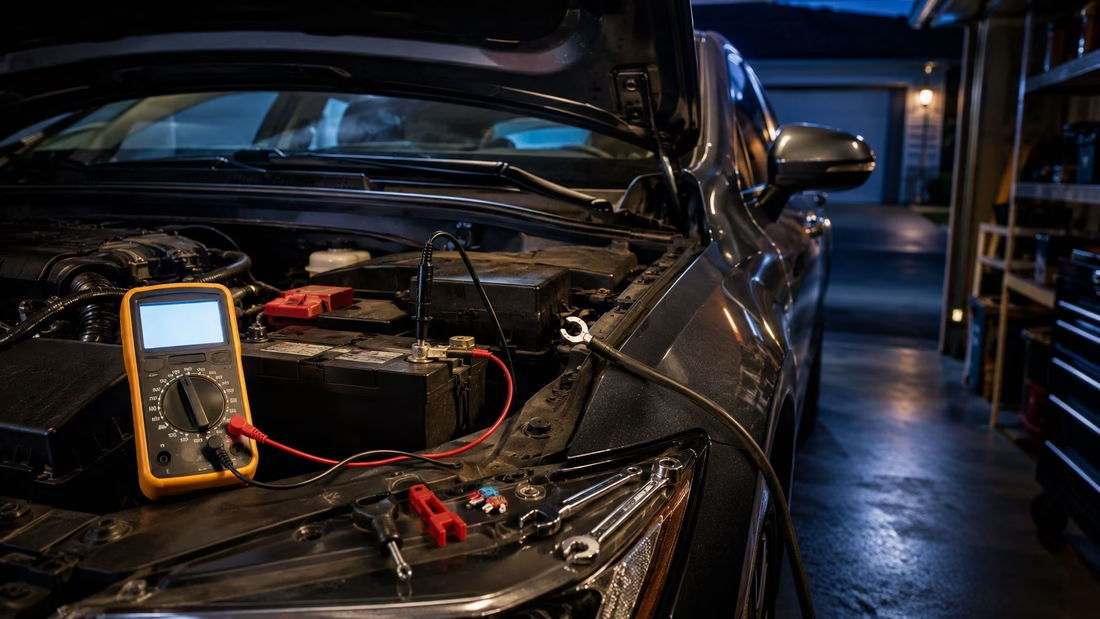
Your car starts fine after a jump. You drive for an hour and park it. Yet the next morning, the battery is dead again. For a systematic approach to detecting unwanted current draw, consult this article on conducting a parasitic draw test.
A bad battery may seem like the clear cause. But a parasitic battery drain may be quietly using power while your car sits. A stuck light, relay, or control unit can drain even a healthy battery overnight.
Quick Answer
A parasitic battery drain happens when a device keeps pulling too much power after you turn off the car. You can find it by measuring the key-off current with a digital multimeter. Then remove fuses one at a time until the reading drops.
Do not start the engine during this test. You could blow the meter’s fuse or damage the meter.
What Is a Parasitic Battery Drain?
Your car does not become fully powerless when you remove the key. Some parts still need a small amount of power.
These may include:
- The clock
- Radio memory
- The alarm
- Keyless entry
- Computer memory
- Security features
- Remote access systems
This small current draw is normal. The problem starts when a light, switch, relay, or control unit stays on.
The unwanted load may not seem large. Yet it keeps pulling power for hours. By morning, the battery may lack enough energy to crank the engine.
How Much Parasitic Draw Is Normal?
There is no single limit for every vehicle. The normal amount depends on the car’s age and equipment.
Many vehicles settle between 20 and 50 milliamps after all systems go to sleep. That equals 0.02 to 0.05 amps on your meter.
Some newer cars may use more. They have many control units and online features. Always check the correct limit for your make and model.
Do not judge the reading right after turning off the car. Many systems stay awake for several minutes. Some may take much longer to shut down.
Signs Your Car Has a Parasitic Drain
A dead battery does not prove that you have an electrical drain. Still, the pattern can offer useful clues.
Watch for these signs:
- The battery dies overnight.
- The engine cranks slowly each morning.
- A charged battery loses power within a few days.
- The car starts well when driven every day.
- It will not start after sitting for a weekend.
- The battery tests well but keeps going flat.
- A cabin, trunk, or glove box light stays on.
- You hear a relay clicking after removing the key.
- The problem began after adding a dash cam or stereo.
- An electrical part works while the car is off.
- A new battery develops the same problem.
A weak battery can cause many of these signs. So can a bad alternator or loose battery cable. Rule out those faults before testing for key-off drain.
What Can Drain a Car Battery Overnight?
Some causes are easy to spot. Others hide behind trim panels or inside a control unit.
Here are the most common places to look.
A Light Stays On
A dome light is easy to notice. A hidden light is not.
Check these areas:
- Glove box
- Trunk
- Cargo area
- Vanity mirror
- Under the hood
- Center console
- Door storage areas
A bad latch switch may tell the car that a door is still open. The light may stay on even when the door looks shut.
You can place your phone inside the glove box or trunk. Start recording, close the lid, and open it after a minute. The video will show whether the light went out.
An Added Accessory Uses Constant Power
Aftermarket parts cause many overnight battery drains. The device may be faulty or wired to an always-on circuit.
Common examples include:
- Dash cameras
- Phone chargers
- GPS trackers
- Alarm systems
- Remote starters
- Stereos
- Amplifiers
- Trailer controllers
- Decorative lights
A dash cam with parking mode is meant to stay active. However, it needs a safe low-voltage cutoff. Without one, it may keep running until the battery becomes too weak to start the car.
A Relay Gets Stuck
A relay is an electric switch. It lets a small signal control a larger load.
The contacts inside a relay can stick together. This may keep a fan, pump, light, or other part powered after shutdown.
A bad relay may feel warm after the car has sat for hours. You may also hear faint clicking from the fuse box.
Do not rely on heat alone. Some parts stay warm for a while after normal use.
A Control Unit Will Not Go to Sleep
Modern cars have many small computers. These are often called control modules. They handle functions such as locks, lights, seats, and engine controls.
The units should enter a low-power sleep mode after you park. A fault may keep one or more of them awake.
Possible triggers include:
- An open door or hood switch
- A smart key left near the car
- A faulty radio
- A damaged door control unit
- A problem in the car’s data network
- Water inside an electrical connector
- An added device that keeps sending signals
This type of fault can be hard to find. Pulling a fuse may wake other units and change the reading.
The Alternator Has a Bad Diode
The alternator charges the battery while the engine runs. Inside it, diodes control the flow of current.
A failed diode may allow current to flow backward after shutdown. The alternator can then drain the battery while the car sits.
The alternator may still seem to charge while driving. That is why a basic charging check may not reveal the fault.
Wiring Is Damaged
Wires can rub against metal, suffer water damage, or get chewed by rodents. A damaged wire may create a path for unwanted current.
Look for:
- Cracked wire covers
- Green or white corrosion
- Loose ground cables
- Melted connectors
- Wet fuse boxes
- Signs of rodent damage
- Poorly joined aftermarket wires
Stop if you find burned wires or a strong hot-plastic smell. Disconnecting the wrong cable may make the fault worse.
Rule Out Other Problems First
A parasitic draw test takes time. A few basic checks can save you from following the wrong path.
Check the Battery
Start with a fully charged battery. A weak or damaged battery can lose charge even when the car has no unusual drain.
Inspect it for:
- A swollen case
- Cracks
- Leaking fluid
- Loose posts
- Heavy corrosion
- A strong sulfur smell
Battery age matters too. An old battery may accept a charge but fail under the starter’s large load.
A simple voltage reading does not prove that the battery is healthy. A load or conductance test gives you a better view of its condition.
Inspect the Battery Connections
Loose or dirty terminals can block current. This may make a charged battery act dead.
Check both terminal clamps. They should not twist by hand. Also inspect the negative cable where it bolts to the body and engine.
Clean off corrosion with the correct safety gear. Replace any cable that feels stiff, swollen, or badly damaged.
Check the Charging System
Your alternator must replace the power used to start the engine. If it cannot keep up, you may park with a partly charged battery.
A low battery every morning may come from:
- A weak alternator
- A loose drive belt
- Poor battery cables
- A bad ground
- Short trips
- Heavy electrical use
Your car may also fail to crank even when the battery appears charged. If that matches your problem, read why the engine won’t turn over when the battery is good. The starter, cables, fuse, or safety switch may be at fault instead.
Think About Your Driving Habits
Short trips can slowly lower the battery’s charge. Starting the engine takes a large burst of power. A five-minute trip may not replace it.
Cold weather also reduces the battery’s available power. A minor fault may only become clear during a cold spell.
Tools You Will Need
You do not need a large tool set. However, your meter must safely measure direct current.
Gather these items:
- Digital multimeter with a fused high-amp input
- Safety glasses
- Work gloves
- Basic wrench or socket set
- Fuse puller
- Fuse-box diagram
- Battery charger
- Notepad or phone
- Vehicle owner’s manual
A low-current DC clamp meter is another option. It measures current without breaking the battery connection. Yet many basic clamp meters cannot read small loads with enough detail.
How to Test for a Parasitic Battery Drain
This method places the multimeter between the battery post and cable. All key-off current then flows through the meter.
Never start the engine during this test. Do not switch on the headlights, fan, or heated seats either. A large current can blow the meter fuse.
For a more focused walkthrough, see this step-by-step parasitic draw test with a multimeter.
1. Fully Charge the Battery
Charge the battery before you begin. Testing a low battery can give you false or changing results.
If the battery will not hold a charge, test or replace it first. You need a stable power source for a useful drain test.
2. Turn Everything Off
Remove the key and switch off all accessories.
Check the following:
- Headlights
- Cabin lights
- Radio
- Climate controls
- Heated seats
- Phone chargers
- Dash camera
- Trunk light
- Glove box light
Keep the smart key away from the car. A nearby key can wake the entry system.
3. Prepare the Doors and Latches
You may need access to a fuse box inside the car. An open door can keep the cabin lights and control units awake.
Use a screwdriver to push the door latch into its closed position. This lets the car think the door is shut.
Be careful when you finish. Pull the door handle to release the latch before closing the door. Closing it with the latch already set can cause damage.
You may need to do the same for the hood or trunk latch.
4. Let the Car Go to Sleep
Close the doors and lock the car if your test setup allows it. Then wait.
Some cars go to sleep within 15 minutes. Others take 30 minutes or longer. Certain systems may wake up at set times, so watch the reading for a while.
During this wait:
- Do not press the key fob.
- Do not open a door.
- Do not move the smart key near the car.
- Do not press the brake pedal.
- Do not adjust a seat.
- Do not plug in a device.
5. Set Up the Multimeter
Move the red lead to the meter’s high-amp input. This port may have a 10A label.
Set the meter to direct-current amps. Start with the highest current range.
Do not place the probes across both battery posts in amp mode. That creates a direct path through the meter and may blow its fuse.
6. Connect the Meter in Series
Disconnect the negative battery cable.
Then connect:
- One probe to the negative battery post
- The other probe to the removed negative cable
The meter now forms a bridge between the post and cable. All standby current flows through it.
Keep the probes secure. A broken connection may reset timers and wake control units when power returns.
7. Read the Current Draw
A high first reading may be normal. Lights and control units may wake when you make the connection.
Wait for the reading to settle.
Here are simple conversions:
- 0.01 amps equals 10 milliamps.
- 0.03 amps equals 30 milliamps.
- 0.05 amps equals 50 milliamps.
- 0.10 amps equals 100 milliamps.
- 0.50 amps equals 500 milliamps.
Compare the final reading with the limit for your car. A stable reading well above that limit points to excess draw.
How to Find the Faulty Circuit
Finding a high reading is only the first half of the job. Next, you need to learn which circuit causes it.
Find Every Fuse Box
Your car may have more than one fuse panel.
Common spots include:
- Under the hood
- Below the dashboard
- Behind the glove box
- In the trunk
- Beside the rear seat
- Under a front seat
Use the fuse chart in the owner’s manual. Take a photo before removing anything.
Pull One Fuse at a Time
Keep watching the meter. Remove one fuse and note what happens.
Follow this order:
- Record the starting current.
- Pull one fuse.
- Wait for the reading to settle.
- Record any change.
- Put the fuse back.
- Move to the next fuse.
A large drop points to the circuit powered by that fuse.
For example, your meter may show 0.35 amps. You pull the interior-light fuse, and it falls to 0.04 amps. The unwanted load is likely on that circuit.
Check Every Part on That Circuit
A fuse label may name only the main function. One fuse can power several lights, switches, or control units.
Use the fuse chart or wiring details to list each part on that circuit. Disconnect those parts one at a time.
Watch the meter after each change. When the draw falls to the normal range, you have found the likely branch or part.
Do not replace the part based on the fuse alone. Check its plug, switch, relay, and wires first.
What if No Fuse Changes the Reading?
The drain may be on a circuit that does not pass through the small fuse panels.
Possible causes include:
- Alternator wiring
- Starter wiring
- Main power cables
- An added amplifier
- A tracker wired to the battery
- A trailer accessory
- An alarm with its own fuse
Main battery cables can carry very high current. If you are not sure how to test them, let a trained technician handle this stage.
A Faster Test for Modern Cars
Pulling a fuse can wake a sleeping control unit. That may restart the wait timer and make the test slow.
A technician may instead measure the tiny voltage drop across each fuse. Current flowing through a fuse creates a small drop between its two test points.
This method lets the fuses stay in place. However, you need a sensitive meter and the correct chart for each fuse type.
It is easy to misread the result. Use this method only if you understand millivolt readings and fuse sizes.
Common Testing Mistakes
Small setup errors can waste hours. They can also harm your meter.
Avoid these mistakes:
- Testing a battery that is still low
- Assuming the battery must be healthy because it is new
- Measuring before the car goes to sleep
- Leaving a door or trunk switch active
- Keeping the smart key near the vehicle
- Using the meter’s low-current port at the start
- Connecting the meter across the battery in amp mode
- Starting the engine with the meter connected
- Switching on a high-current device
- Pulling several fuses at once
- Forgetting where each fuse belongs
- Replacing a part based only on the fuse label
- Ignoring added wiring and accessories
- Applying one normal limit to every vehicle
Also check the meter fuse if the display shows no current. A blown meter fuse can make a real drain look like a zero reading.
How Fast Can a Parasitic Drain Kill a Battery?
The time depends on several factors:
- Battery capacity
- Battery age
- State of charge
- Outside temperature
- Size of the drain
- Power needed by the starter
You can make a rough estimate with this formula:
Approximate hours = usable battery capacity in amp-hours ÷ current draw in amps
Suppose a battery has 50 amp-hours of rated capacity. A 0.50-amp drain could use 12 amp-hours in 24 hours.
That does not mean the battery can always start the car for four full days. A starting battery may fail to crank the engine long before it becomes fully empty. Cold weather may shorten that time even more.
A small drain may take several days to cause trouble. A lamp or large control unit can cause a no-start by the next morning.
How to Fix a Parasitic Battery Drain
The correct repair depends on the cause.
Common fixes include:
- Replace a bad door or trunk switch.
- Repair a light that does not turn off.
- Replace a stuck relay.
- Fix damaged or wet wiring.
- Clean corroded plugs and grounds.
- Remove a faulty charger or added device.
- Rewire accessories to a switched power source.
- Add a safe low-voltage cutoff to parking devices.
- Repair an alternator with a leaking diode.
- Test a faulty control unit before replacing it.
- Install any needed software update for the vehicle.
Pulling a fuse may stop the drain for now. It is not always a safe long-term fix. That fuse may also power airbags, brake controls, lights, locks, or other key systems.
How to Stop Another Dead Battery for Now
You may need a short-term plan while you find or repair the fault.
You can:
- Fully recharge the battery.
- Unplug added accessories.
- Use a proper battery maintainer during storage.
- Remove a suspect accessory fuse if it is safe.
- Keep the smart key farther from the parked car.
- Drive long enough to restore the lost charge.
Disconnecting the negative cable may stop the drain. Yet it can erase radio settings, stored data, and learned control values. Some vehicles may also need special reset steps.
A battery disconnect switch has the same limits. It hides the fault rather than fixing it.
When to Get Professional Help
Some drains are simple. Others need wiring plans and scan tools.
Get expert help if:
- The wiring becomes hot.
- You smell burning plastic.
- A fuse keeps blowing.
- The car is a hybrid or electric vehicle.
- No fuse lowers the current.
- A control unit keeps waking on its own.
- The problem involves the main battery cable.
- The car has complex added electronics.
- Water has reached a fuse box.
- You cannot keep the meter connected safely.
- The reading changes in an odd pattern for hours.
Electrical faults can damage wiring or start a fire. Stop testing if you see smoke, sparks, or melted parts.
How to Prevent Future Battery Drain
A few habits can lower the chance of another flat battery.
- Unplug chargers before parking.
- Check hidden lights from time to time.
- Use switched power for added devices.
- Keep battery terminals clean and tight.
- Repair water leaks near electrical parts.
- Keep the smart key away from the parked car.
- Test an aging battery before cold weather.
- Use a maintainer during long storage.
- Investigate repeated low-battery warnings early.
Do not keep jump-starting the car without finding the cause. Deep discharge can shorten the life of a starting battery.
Frequently Asked Questions
Can a Bad Alternator Drain a Battery Overnight?
Yes. A failed diode can let current flow through the alternator while the engine is off. The alternator may still provide some charge while driving, so test both its output and key-off draw.
What Is an Acceptable Parasitic Draw?
Many vehicles settle near 20 to 50 milliamps. Some use more due to added factory systems. Use the limit listed for your exact vehicle rather than treating 50 milliamps as a fixed rule.
Can a Bad Battery Look Like a Parasitic Drain?
Yes. A weak battery may not hold its charge. It can also show normal voltage but fail when the starter demands high current.
Charge and test the battery before searching for a drain.
Can a Relay Drain a Car Battery?
Yes. A relay with stuck contacts may keep a fan, pump, light, or control unit running. Check the relay and the device it controls before replacing either part.
How Long Should I Wait for Sleep Mode?
The wait may range from a few minutes to well over half an hour. It depends on the vehicle and its equipment.
Watch the meter until the current stops falling. Avoid touching the car while you wait.
Can a Dash Cam Drain the Battery?
Yes. Parking mode keeps many dash cams active after shutdown. The risk rises if the camera lacks a working low-voltage cutoff.
Can I Test for Drain Without Disconnecting the Battery?
Yes. A low-current DC clamp meter can measure current through the battery cable. A voltage-drop test across the fuses is another option.
Both methods need accurate tools and careful setup.
Will Removing the Negative Cable Stop the Drain?
It will usually interrupt the flow of current. However, it will not reveal or repair the cause.
Battery removal can also erase settings or create reset needs on some cars.
Find the Drain Before Replacing More Parts
A battery that keeps dying overnight does not always need replacement. First, test the battery and charging system. Then measure the key-off current after the car enters sleep mode.
If you find a high parasitic battery drain, pull fuses one at a time. Trace the circuit before replacing any part. This steady process helps you find the real fault without guessing—or waking up to another dead battery.