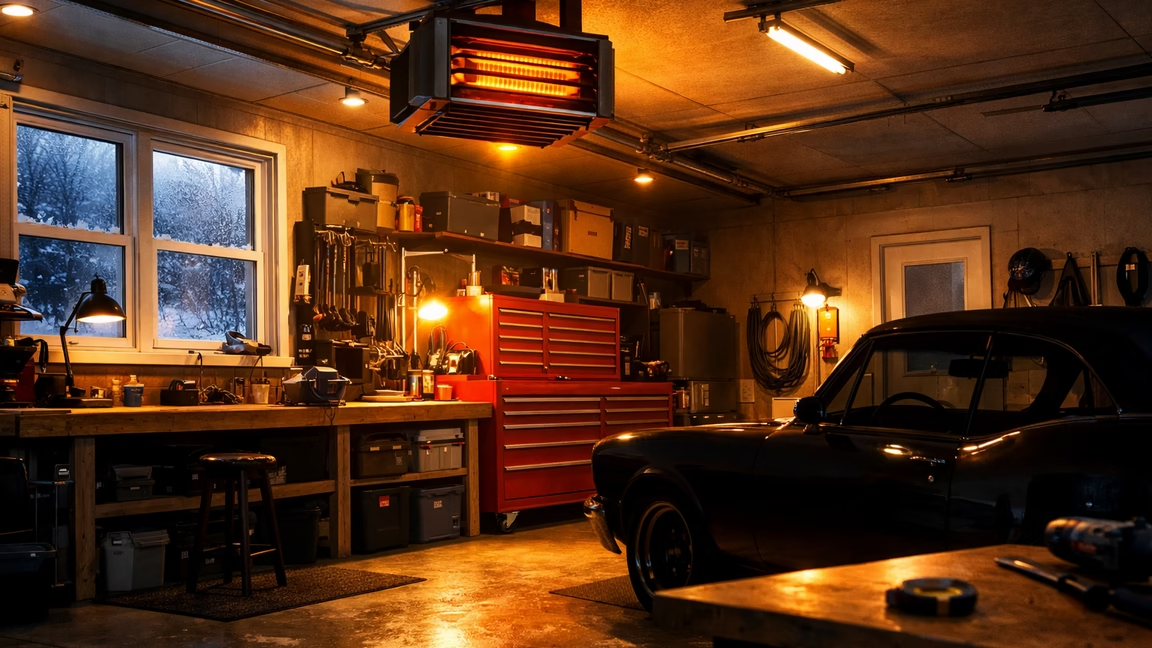
Let’s face it. Wrenching on a project in a freezing garage is miserable. Your hands go numb, and your tools feel like blocks of ice. You need a good heater, but guessing the right size is a costly mistake. If you buy a small unit, it runs all day, and you still freeze.
If you go too big, you waste hard-earned money upfront. That is exactly why we built this free Garage Heat Calculator. It does the hard math for you. In seconds, you will know the exact BTUs needed to turn your icy shop into a warm workspace.
Garage Heat Calculator
Engineering-grade BTU calculation using surface area heat loss methodology.
Required Heating Capacity:
Heat Loss Breakdown:
Engineering Note: This calculator assumes a rectangular garage with flat ceiling. Add 20% safety factor for extreme wind exposure or large thermal bridges. For precise sizing, consult a Manual J load calculation.
How to Use the Garage Heat Calculator
Using our tool is fast and easy. Just grab a tape measure and follow these quick steps.
First, enter the exact size of your room. We need the length, width, and ceiling height in feet.
Next, think about the weather. What is the absolute coldest it gets outside during winter? Enter that number. Then, enter the cozy temperature you actually want inside your shop.
Finally, select your insulation level. Is your garage just bare studs and metal? Choose poor. Do you have thick drywall and a finished ceiling? Choose excellent.
Click calculate. The tool will instantly give you the exact BTUs required to keep you warm all winter.
The Science: 3 Factors That Determine Garage Heating
You might wonder how we get that magic number. It all comes down to basic physics. Three main factors decide how much heating power your garage really needs.
Total Cubic Volume
Square footage alone is not enough. Heat rises to the ceiling. A garage with a massive 12-foot ceiling needs much more power than one with a standard 8-foot ceiling. We multiply length, width, and height to find your total cubic space.
Temperature Rise
Think of this as the heat gap. It is the jump from the bitter cold outside to your warm target inside. If it is 20 degrees outside and you want it to be 70 degrees inside, your gap is 50 degrees. A bigger gap takes a lot more BTUs to bridge.
Insulation Quality
This is the most crucial part of the puzzle. A bare garage leaks heat like a sieve. Good insulation traps the warmth inside where you need it. The better your walls and doors are insulated, the smaller the heater you have to buy. It really is that simple.
Recommended Garage Heaters by BTU Class
Now that you have your BTU number, what comes next? You need the right heater. Here is a quick breakdown to help you choose the best option for your shop.
Small Spaces (Up to 10,000 BTUs)
Recommended Small Spaces Garage Heater
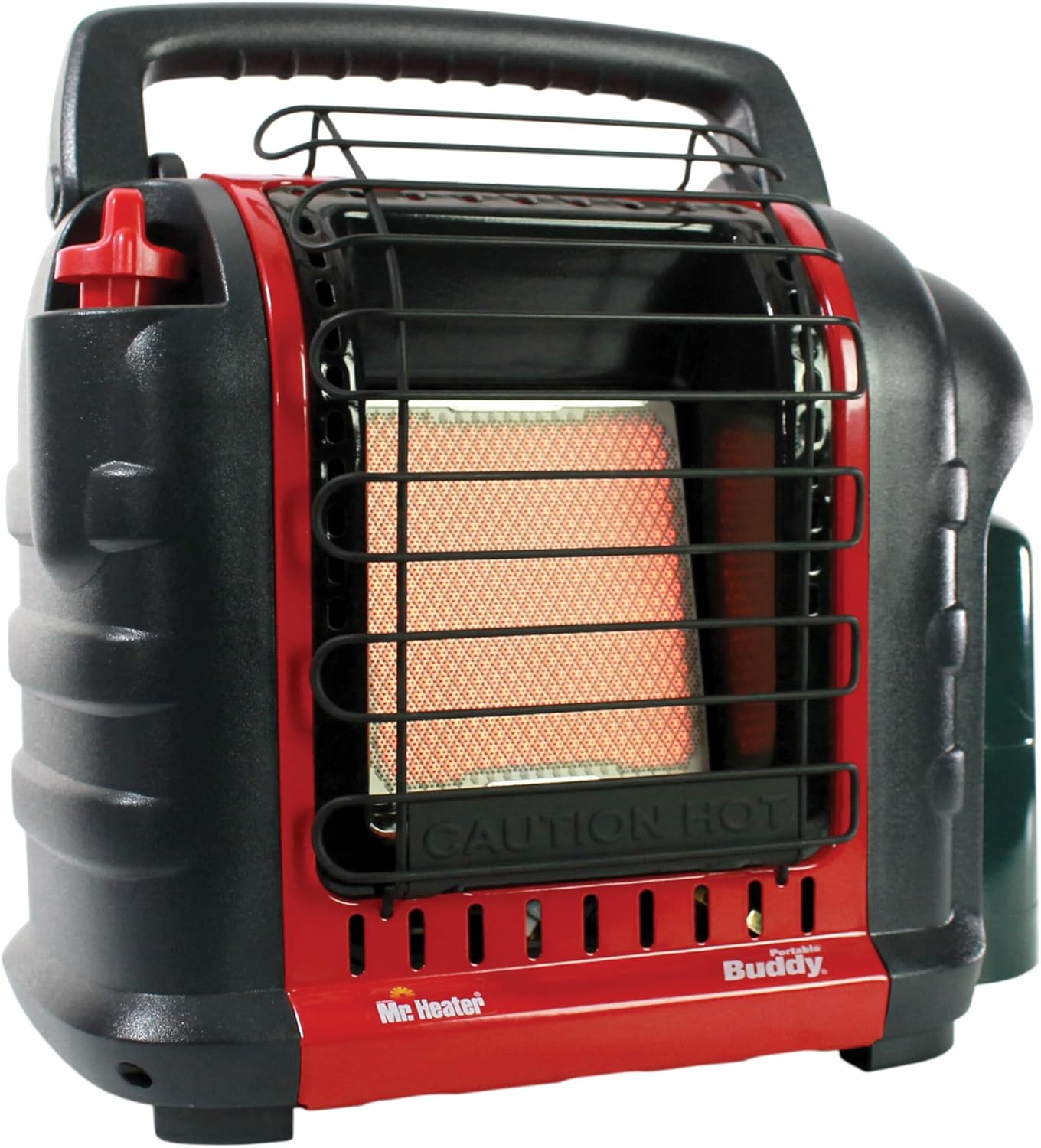
Mr. Heater MH9BX Portable Propane Heater
- High Capacity: 4,000 to 9,000 BTUs (heats up to 225 sq. ft.)
- Safety First: Features an Oxygen Depletion Sensor (ODS) and auto tip-over shut-off.
- Highly Rated: 4.6/5 stars from over 2,500 ratings for instant, clean-burning radiant heat.
- Portable Design: Lightweight with a fold-down handle; runs off a standard 1 lb. propane cylinder.
If your number is low, keep it simple. A basic 120V electric heater works great. These plug right into a normal wall outlet. They are perfect for small, well-insulated single-car bays. They cost less upfront and are very easy to move around as you work.
Medium Bays (15,000 to 30,000 BTUs)
Recommended Medium Space Garage Heater

Mr. Heater 18,000 BTU Big Buddy PRO
- High Capacity: Adjustable 6,000, 12,000, and 18,000 BTUs (heats up to 500 sq. ft.).
- Versatile Fuel Options: Runs on two 1 lb. propane cylinders or connects to a 20 lb. tank (hose sold separately).
- Built-in Safety: Oxygen Depletion Sensor (ODS) and accidental tip-over shut-off switch.
- Durable & Efficient: Features a heavy-duty wire guard, shock-absorbing insulation, and clean-burning radiant heat.
For a standard two-car space, you need more muscle. Step up to a heavy-duty 240V electric heater or a medium propane unit. These push out serious heat. You will stay warm even on the coldest days. Just remember, a 240V heater needs a dedicated wall outlet.
Large Shops (40,000+ BTUs)
Recommended Large Space Garage Heater

DEWALT 68,000 BTU Cordless Forced Air Heater
- Massive Heat Output: Variable 27,000 to 68,000 BTUs capable of heating up to 1,700 sq. ft.
- Hybrid Power Options: Run cord-free using a DEWALT 20V MAX/FlexVolt battery or plug into a standard 120V AC outlet.
- Quiet Burner Technology: Engineered to be 50% quieter than standard forced-air heaters of the same size.
- Jobsite Ready: Includes a 10 ft. hose and regulator, overheat detection, and a thermo-electric safety shut-off valve.
Big spaces need big power. If you have a large workshop or very poor insulation, look at high-capacity heaters. Ceiling-mounted propane or natural gas units are the top choice here. They blast hot air fast and keep your valuable floor space clear.
Frequently Asked Questions
Can I heat a 2-car garage with a 120V heater?
Usually, no. A standard 120V space heater puts out about 5,000 BTUs. That is barely enough for a tiny room. For a two-car space, it will run all day and you will still feel cold. You really need a larger unit.
Is propane or electric cheaper for heating a garage?
It strictly depends on where you live. Electric heaters cost less to buy. However, high electricity rates can hurt your wallet. Propane heaters cost more upfront, but the fuel is often much cheaper to burn. Check your local utility rates to know for sure.
How much does it cost to run a 50,000 BTU heater?
A 50,000 BTU propane heater uses about half a gallon of fuel per hour. If propane costs three dollars a gallon, you pay about one dollar and fifty cents an hour. Running it just while you actively work keeps your monthly costs very low.
Conclusion
Do not let harsh winter weather ruin your garage projects. Guessing your heating needs is a bad idea. It wastes your time, money, and energy. Our free Garage Heat Calculator takes the mystery out of the whole process. You get the exact math you need to buy your gear with total confidence.
Grab your tape measure, plug in your stats, and find your perfect heater today. Stay warm, save money, and get back to doing what you love in the shop.