
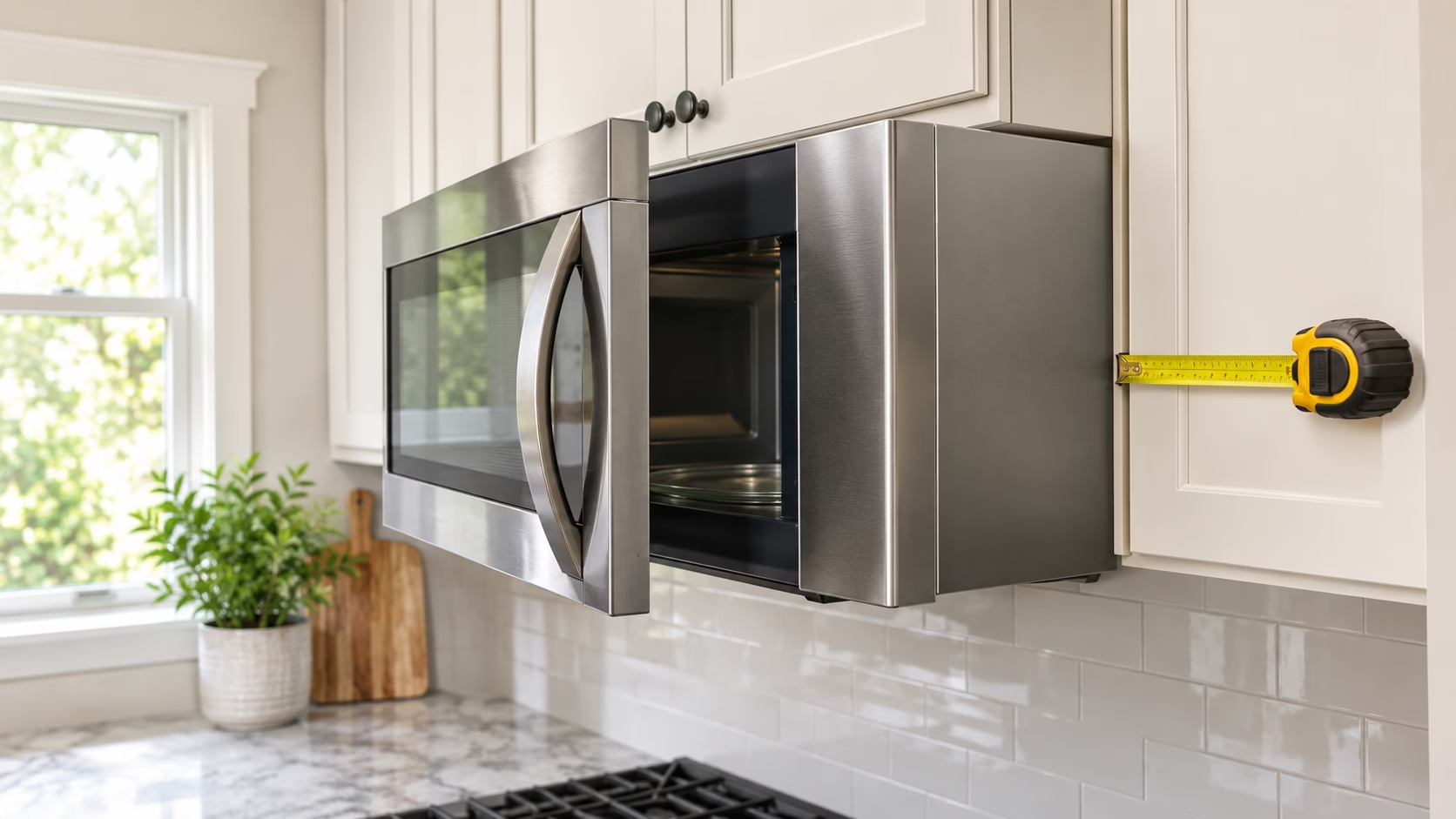
You can fit some over-the-range microwaves beneath 15-inch-deep cabinets. The right model may need a special mounting kit. Before you buy an over the range microwave for 15 inch deep cabinets, check three things: the kit, the front projection, and the door swing.
For this shortlist, I reviewed owner-posted feedback and online buyer discussions. Those accounts help show what can go wrong after installation and use. They are personal reports, not proof of how every unit performs. This page contains Amazon affiliate links. If you buy through them, I may earn a small commission at no extra cost to you.
Here are the three models covered below. Treat them as a shortlist to check, rather than a ranked list.
Fit Guide / Over-the-Range Microwave Models
Three GE models, one mounting question
If your cabinets sit deeper than standard, the mounting kit matters as much as the microwave itself. Here’s what each model offers — and what to verify before you drill.
| Model | Why you might consider it | Mounting kit for deeper cabinets | Main fit concern | Amazon |
|---|---|---|---|---|
01 GE JVM3160RFSS
The straightforward pick |
Basic cooking controls |
JX15BUMPBB
Listed as an option |
Check projection with the kit fitted | Check listing Amazon product page |
02 GE JVM6175SKSS
The smart-cooking step up |
Sensor cooking
Adjusts cooking time using food feedback |
JX15BUMPBB
Listed as an option |
Check the supplied mounting template | Check listing Amazon product page |
03 GE Profile PVM9005SJSS
The premium capacity pick |
Larger stated capacity
Bottom controls |
Exact compatibility still needs confirmation |
Check the full model revision | Check listing Amazon product page |
Disclosure: the Amazon links above are affiliate links (tag reviewfriendl-20) — as an Amazon Associate we earn from qualifying purchases, at no extra cost to you. Confirm mounting-kit compatibility and cabinet dimensions on the manufacturer page before ordering.
All three are discontinued models. You may find remaining stock or resale listings. Check the seller, condition, warranty, and exact model before ordering.
Can you install an over-the-range microwave under 15-inch-deep cabinets?
Yes, if the exact model supports that cabinet depth. You may need a bump-out kit [a bracket that moves the unit forward].
The kit helps place the microwave farther from the wall. That can keep deep cabinets clear of parts that need space. Yet the kit also makes the microwave stick out more.
For the GE kit discussed here, the stated forward offset is 3 inches. That is a manufacturer-published figure, not a hands-on measurement.
A microwave’s listed depth does not prove it will fit. That number describes the appliance itself. It may not show the final depth with a special bracket.
You need to check three things:
- Mounting: Does the model support your cabinet depth and chosen kit?
- Airflow: Will the cabinet leave all required vents clear?
- Door movement: Can the door open without hitting nearby doors or handles?
Before choosing a vent setup, compare ducted and ductless ventilation.
A door that opens freely does not prove the vents are clear. Check each point on its own.
Measure your cabinets before comparing microwaves
Start with your kitchen, not the product listing. A few careful checks can prevent a costly return.
Use the same wall and cabinet reference points for each measurement. Take photos so you can explain the space to an installer.
Cabinet box depth versus cabinet-door depth
Measure from the finished wall to the front of the cabinet box. Then measure to the closed cabinet-door face.
Those are two different depths. A cabinet sold as 15 inches deep may have doors that extend farther.
Write down:
- Wall to cabinet-box front.
- Wall to closed cabinet-door face.
- How far cabinet handles extend.
- Any trim that reaches past the doors.
Also check the wall behind the microwave. Tile or a thick backsplash may affect the mounting surface. Record where it starts and ends.
For the article’s projection checks, use the closed cabinet-door face as your reference. State handle projection on its own.
Check the microwave opening and adjacent obstacles
Measure the gap between the side cabinets. Record the height of the opening, too.
Next, check the hinge side. A nearby wall or tall cabinet can limit the door’s movement. Cabinet knobs can also sit in its path.
Look beyond the first day of use. You need room to remove filters and reach parts meant for routine care.
Check these details before choosing a model:
- Opening width and height.
- Space near the door hinge.
- Nearby cabinet doors and handles.
- Filter access.
- Vent path.
- Required space above the cooktop.
Use the exact installation instructions for the last two checks. Do not copy clearances from another model.
For more on airflow, read our range hood CFM guide.
Three-model comparison: projection, door opening, and mounting kit
The hardest part of this search is comparing like-for-like figures. Product depth, door-open depth, and installed projection mean different things.
Closed-door projection means how far the microwave extends past your cabinet doors. Door-open depth means how far it reaches forward with the door open. Neither figure proves it will clear a wall beside the hinge.
Here is what the research supports so far:
| Fit detail | GE JVM3160RFSS | GE JVM6175SKSS | GE Profile PVM9005SJSS |
|---|---|---|---|
| Closed-door projection past your cabinet doors | Not measured; depends on the installed unit and kit | Not measured; depends on the installed unit and kit | Not measured; kit choice remains unresolved |
| Published door-open depth | 39 inches | 39⅛ inches | Not verified in the research |
| Evidence for door-open figure | Manufacturer specification; not a physical measurement | Manufacturer specification; not a physical measurement | Unverified |
| Hinge-side clearance | Not verified for your layout | Not verified for your layout | Not verified for your layout |
| Deeper-cabinet kit | JX15BUMPBB listed | JX15BUMPBB listed | Confirm exact compatibility |
The two door-open figures are baseline product specifications. Do not treat them as installed wall-to-door dimensions with a bump-out kit. The published information reviewed did not establish that setup.
For a useful fit check, ask for the full installed dimensions. Your installer needs to account for the bracket and cabinet doors.
You can estimate projection with this formula:
Installed wall-to-front depth − wall-to-cabinet-door depth = front projection
Use matching reference points. Keep the microwave handle separate if the depth figure leaves it out.
Any result from that formula is calculated, not measured. A physical check after mounting gives you stronger evidence.
GE JVM3160RFSS — basic option, subject to installation checks
The JVM3160RFSS is the basic cooking option in this group. You might consider it if you want simple controls for daily reheating.
Its stated capacity is 1.6 cubic feet [the maker’s listed cooking-space volume]. It offers timed cooking and familiar preset buttons. It lacks the sensor-cooking feature that sets the next model apart.
For deeper cabinets, JX15BUMPBB appears as an optional kit. Confirm that match for the full revision shipped to you.
The kit’s forward offset means the microwave will sit farther out. Do not expect a near-flush look just because the product seems shallow.
Owner discussions raise two points worth knowing. Some JVM3160-family posts describe door-switch trouble. Those posts span different revisions and do not show a failure rate.
Other owners mention the vent starting during microwave use. That behavior is documented for this model family. It does not, by itself, mean the unit has failed.
This leaves you with a fairly clear buying test. Check the fit first, then decide whether basic controls meet your needs.
Check the GE JVM3160RFSS listing on Amazon.
GE JVM6175SKSS — sensor cooking, with revision checks
The JVM6175SKSS adds sensor cooking. That may appeal to you if you prefer less guesswork with some heating tasks.
Its stated capacity is 1.7 cubic feet [the maker’s listed cooking-space volume]. The small capacity difference alone should not drive your choice. Your dishes still need to fit the usable space.
Like the basic GE model, it lists JX15BUMPBB as an optional kit. That gives you a starting point for a deeper-cabinet installation.
Still, check the new mounting template. Do not assume an old GE bracket or screw pattern will work.
One owner reported a changed top mounting-hole position during replacement. The old and new units had closely related model numbers. That is a useful fit warning, though it remains one owner’s account.
A separate exact-model repair thread discusses door-switch and control concerns. The posts do not establish one clear cause. They also cannot tell you how often such faults occur.
Your main reason to choose this model is its cooking feature set. The research does not show a clear fit advantage over the basic model.
Before ordering, compare the template with your cabinet base. Make sure the required mounting points have proper support.
Check the GE JVM6175SKSS listing on Amazon.
GE Profile PVM9005SJSS — larger capacity, with dimensional uncertainty to resolve
The PVM9005SJSS offers a larger stated cooking space. It also places the controls along the bottom.
Its listed capacity is 2.1 cubic feet [the maker’s listed cooking-space volume]. That may interest you if you often heat large dishes. Check your dish sizes rather than relying on volume alone.
This model needs the most care in the current shortlist. Its exact deeper-cabinet kit compatibility remains unverified here.
A detailed owner post describes differences between two model revisions. The reported changes include the outer size and mounting hardware.
Those are owner-reported measurements. They were not independently checked. Still, the account gives you a good reason to request the full model code.
The sales name may leave out a revision digit. Ask the seller for the code on the appliance label. Then use the instructions that match that unit.
At this stage, consider the PVM9005SJSS a candidate that needs more checks. Do not order it for a tight space based on its sales name alone.
Check the GE Profile PVM9005SJSS listing on Amazon.
GE versus Whirlpool: why the mounting-kit numbers differ
A kit marked for 15-inch cabinets is not a universal bracket. The part number must match the appliance and installation type.
GE and Whirlpool offer different kits. Even two Whirlpool kits can serve different models and goals.
| Kit | Stated purpose | What you must confirm |
|---|---|---|
| GE JX15BUMPBB | Forward-offset kit in black; used with compatible black and stainless models | Exact microwave compatibility |
| GE JX15BUMPWW | White version of the GE kit | Exact microwave compatibility |
| Whirlpool W11185746 | Deeper-cabinet kit for select conventional and low-profile models | Model match and permitted cabinet depth |
| Whirlpool W11630300 | Flush-installation kit for a specified model list | Model match and the defined flush setup |
For GE, the published kit offset is 3 inches. That can solve one fit issue while changing the front projection.
Whirlpool’s W11185746 is a separate design. Its stated use includes select microwave hoods beneath cabinets up to 15 inches deep.
W11630300 serves a different listed group of models. Its flush-installation purpose does not make it a substitute for W11185746.
Do not choose between them by cabinet depth alone. Start with the microwave’s full model number. Then check the kit listed for that model.
Whirlpool models were researched for this comparison. A matching direct Amazon product listing was not verified. For that reason, they are not presented as Amazon picks here.
What forums and Reddit reveal about real installation problems
Owner posts help you spot questions that sales pages may miss. They work best as clues for your own fit checks.
They do not prove that a product will fail. Repair forums also draw people who already have problems.
Front projection can surprise you
A forum discussion shows a common concern: should the microwave stick out? The buyer expected it to line up with the upper cabinets.
That question matters here, too. A deeper cabinet does not guarantee a flush front. A forward-offset bracket can make the microwave extend farther.
Decide what projection you can accept before ordering. Check it from the side, where the difference is easier to see.
Replacement fit needs a fresh check
The GE replacement accounts point to a useful habit. Use the new template, even when the sales model looks familiar.
Compare mounting points, vent parts, and the full model revision. Keep the old unit until you have checked the replacement.
Fan behavior needs context
An automatic fan start can sound like a fault. For the two GE families noted above, that behavior can be expected.
Read the operating guide before judging the noise or fan response. If the behavior differs from the guide, seek model-specific support.
Owner reports need careful wording
A post about a broken switch is one failure report. It is not proof that every unit has weak switches.
The same rule applies to praise. One happy owner cannot establish long-term reliability.
Use detailed posts that name the model and explain the issue. Give less weight to vague praise or posts built around shopping links.
Before ordering: confirm these five details
You can narrow this purchase with five checks. Save the answers with your order details.
- Confirm the exact model and revision.
Ask for the full appliance-label code. Check whether the listing is new, used, or refurbished. - Check the permitted cabinet depth.
Read the matching installation instructions. Include cabinet doors and trim in your measurements. - Confirm the kit and its availability.
Check the exact part number. Ask whether it comes with the microwave or costs extra. - Check projection and door movement.
Get installed dimensions for the chosen setup. Confirm both forward reach and hinge-side space. - Read the sale terms.
Check delivery, installation, warranty, and returns. For discontinued stock, ask who handles warranty claims.
For an over the range microwave for 15 inch deep cabinets, the best next step is a fit check. Give your installer the full model code, cabinet measurements, and proposed kit. Resolve any missing clearance figure before placing the order.
If you’re considering a separate hood instead, compare our under-cabinet range hood picks.
Frequently asked questions
Does a 15-inch-deep microwave fit beneath 15-inch-deep cabinets?
Not always. Product depth does not show the required cabinet depth.
The cabinet could block a vent or affect door movement. Check the exact installation instructions and kit requirements.
How far will the microwave project after installing a bump-out kit?
That depends on the unit, bracket, and cabinet-door depth. The GE kit discussed here has a stated 3-inch forward offset.
That offset is not the final projection past your doors. You still need the full installed depth.
Does depth with the door open include the kit offset?
Do not assume it does. A general product specification may describe the appliance without that kit.
The published figures reviewed here did not confirm the complete installed setup. Check the matching diagram or request that dimension.
Can a microwave door open beside a wall?
It depends on the hinge design and nearby obstacles. Total door-open depth does not prove side clearance.
Check the door’s path against the wall, trim, and cabinet handles. Use any model-specific side-clearance rule.
Are Whirlpool W11185746 and W11630300 interchangeable?
Do not treat them as interchangeable. They have different stated uses and compatibility requirements.
Choose the part listed for your full model number. A shared reference to 15-inch cabinets is not enough.
Can I reuse my old mounting bracket?
Only if the new model’s instructions allow it. A similar sales name does not prove compatibility.
Compare the supplied bracket and template before removing parts. For an over the range microwave for 15 inch deep cabinets, the approved mounting setup should guide your purchase.