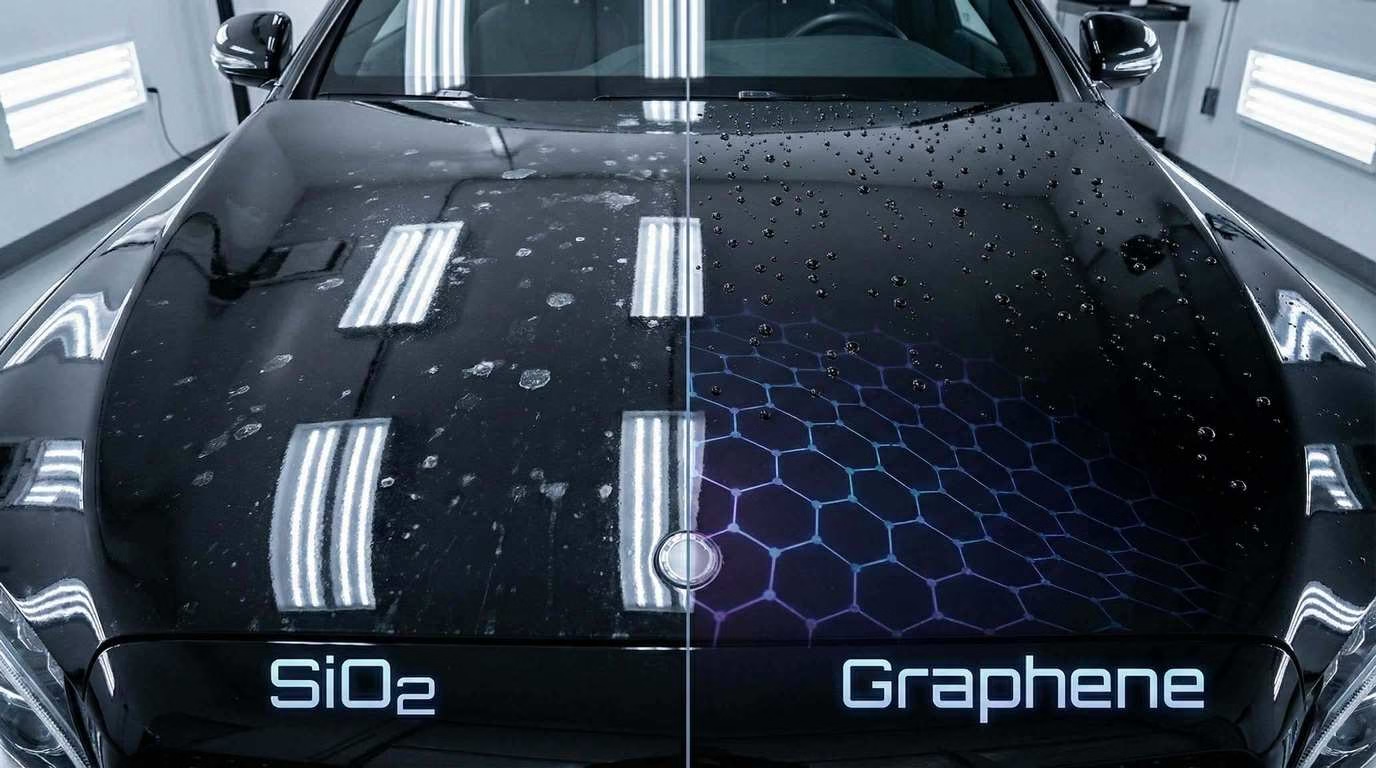
Quick Decision: Which One?
- Choose SiO2 (Standard Ceramic) If: You have a “Garage Queen.” You want the deepest, candy-like gloss possible and the car rarely sees rain.
- Choose Graphene (rGO) If: You have a “Daily Driver.” Your car sits outside 24/7. You need protection against water spots and high surface temperatures.
You have seen the marketing. “Graphene is 200 times stronger than steel!”
It sounds amazing. But let’s use some common sense. If the liquid in that $20 spray bottle was actually stronger than steel, you wouldn’t be able to wipe it off with a microfiber towel.
As a chemical engineer, I can tell you that “Graphene” coatings are not a magic forcefield. In fact, most of them are just standard Ceramic Coatings with a dusting of graphene powder added to the mix. However, that “dusting” changes the physics of how the coating behaves on your paint.
Here is the molecular breakdown of what you are actually buying.
The Incumbent: What is SiO2 (Ceramic)?
Standard ceramic coatings rely on Silicon Dioxide (SiO2). In the industry, we call this “Liquid Glass.”
The Chemistry
SiO2 is the same compound found in quartz and sand. When suspended in a resin/solvent, it flows into the microscopic pores of your car’s clear coat. As the solvent evaporates, the SiO2 creates a cross-linked bond, hardening into a rigid, glass-like shell.
- The Pro (Incredible Gloss): Because it forms a smooth, glassy shell, SiO2 refracts light incredibly well. This gives you that “hard candy” shine that looks wet even when dry.
- The Con (Heat Retention): Silica is an insulator. It holds heat. When your black car sits in the sun, the surface gets incredibly hot.
- The Achilles Heel: Hot surface + Water beads = Water Spots. Because the surface is hot, water droplets evaporate quickly, leaving behind hard mineral deposits that etch into the coating.
The Challenger: What is Graphene (rGO)?
First, a correction. You are not buying pure Graphene. Pure Graphene (a single atomic layer of carbon) is incredibly expensive and unstable to produce in bulk.
What you are buying is Reduced Graphene Oxide (rGO). This is a derivative that can be suspended in a liquid. Think of rGO not as a replacement for Ceramic, but as an additive.
The Structure
Imagine the standard Ceramic coating as a layer of concrete. Graphene Oxide acts like the steel rebar inside that concrete. It forms a microscopic “chicken wire” mesh of carbon atoms within the ceramic resin. This adds structural flexibility (tensile strength) to the rigid glass layer.
The Benefit: Heat Dispersion
Carbon is a conductor. Unlike SiO2 (insulator), Graphene helps disperse heat across the panel. This lowers the overall surface temperature of your paint, which is the key to its biggest advantage.
The Showdown: Real World Differences
Forget the marketing. Here is how they perform in the lab and on the road.
1. Gloss Level
- Winner: SiO2 (Ceramic).
- Why: SiO2 is optically clear. Graphene Oxide is naturally dark (grey/black). While Graphene coatings still shine, they tend to provide a slightly darker, “richer” tone rather than the pure, high-frequency gloss of SiO2.
2. Water Spot Resistance (The Dealbreaker)
- Winner: Graphene.
- Why: Because Graphene conducts heat and lowers the surface temperature, water evaporates more slowly. This gives you time to wipe the car dry before the minerals bake into the paint. If you park outside, this is the main reason to switch.
3. Durability & Flex
- Winner: Graphene.
- Why: Clear coat expands and contracts with temperature changes. SiO2 is rigid; if it flexes too much, it can micro-crack. The “rebar” structure of Graphene adds flexibility, allowing the coating to move with the paint without failing.
| Feature | SiO2 (Ceramic) | Graphene (rGO) |
|---|---|---|
| Gloss Level | High (Glassy) | Medium (Rich/Dark) |
| Heat Rejection | Low (Retains Heat) | High (Disperses Heat) |
| Water Spotting | Prone to etching | Resistant |
| Slickness | Very Slick | Slightly “Tacky” feel |
The “Snake Oil” Test: How to Spot Fake Graphene
Because “Graphene” is a buzzword, many cheap sprays contain barely enough of it to legally put it on the label. Here is how to spot the fakes:
- The Color Test: Reduced Graphene Oxide is carbon. It is black or dark grey. If the liquid in the bottle is crystal clear, bright blue, or neon green, it likely contains trace amounts of graphene (or dye) and is mostly just a standard sealant.
- The Separation: Real rGO particles are heavy solids suspended in liquid. They should settle at the bottom. If the bottle doesn’t tell you to “Shake Well,” or if you don’t hear a mixing ball rattling inside, be skeptical.
The Verdict: Evolution, Not Revolution
Graphene is not “magic.” It is simply the next iteration of ceramic chemistry. It fixes the biggest flaw of traditional ceramics: water spotting.
If you are looking for the absolute best durability for a car that lives outdoors, Graphene is the scientifically superior choice. We tested the top formulas to see which ones actually hold up—check out our results on the Best Ceramic Spray Coating.
However, remember: No coating can fix bad paint. If your clear coat is already swirled, scratched, or dull, putting Graphene on top is a waste of money. You must polish the paint first. Read our Paint Correction 101 Guide to learn the proper order of operations before you seal it.