
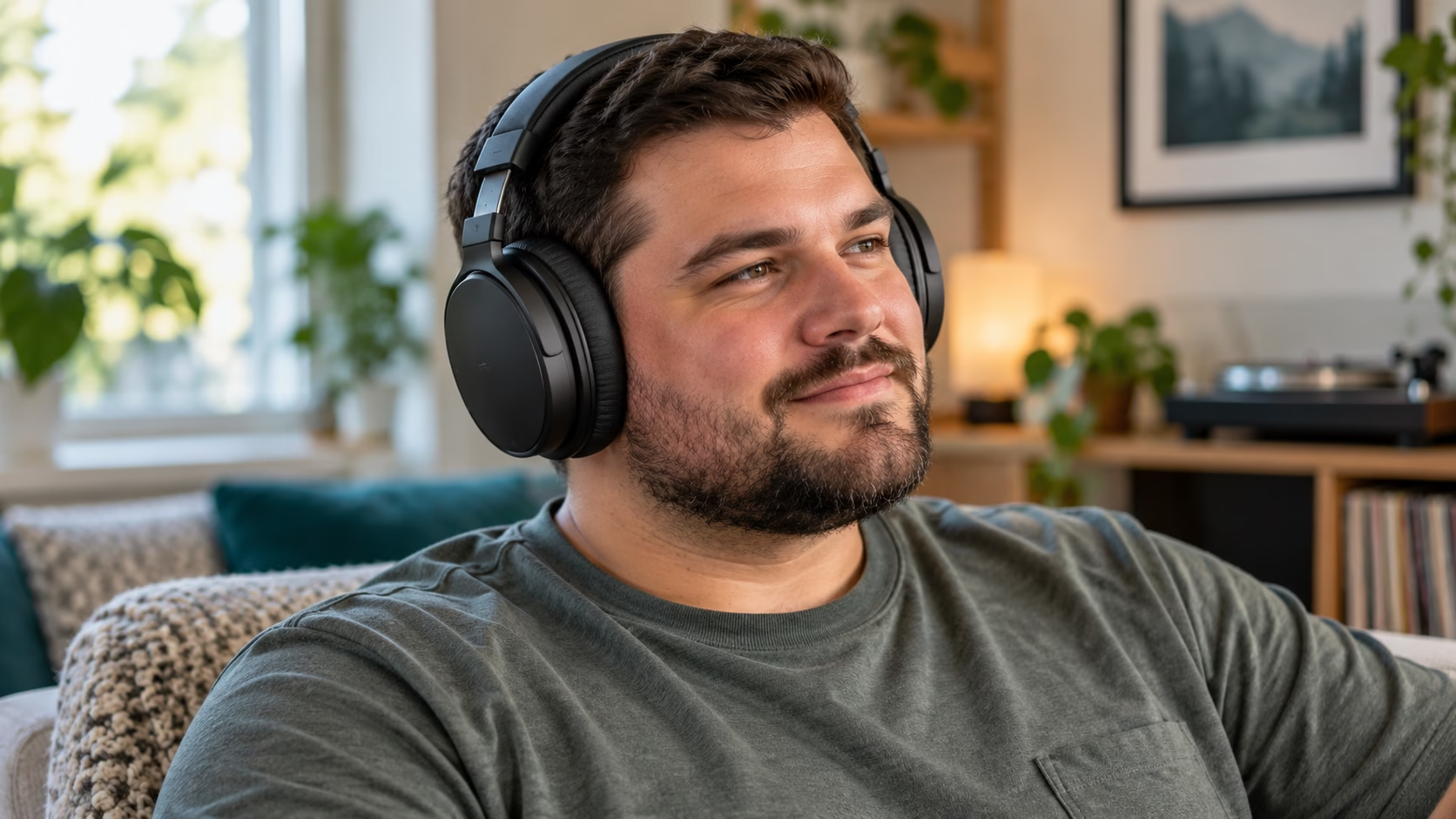
The best headphones for people with big heads need more than large earcups. You also need enough headband reach and a fit that feels good.
For quiet home use, start with the Sennheiser HD 599. For wireless use and noise control, consider the Bose QuietComfort 2023. For gaming, look at the Arctis Nova 7—but check its headband reach first.
Your best choice depends on where your current pair feels tight. Pressure at your temples needs a different fix from ears that touch the cups.
This guide draws on product details and published reviews to help you compare fit and use. It is a research-based shortlist, not a hands-on test of every pair. This page includes Amazon affiliate links. If you buy through them, I may earn a small fee at no extra cost to you. As an Amazon Associate I earn from qualifying purchases.
Quick Picks: Which Headphones Should You Consider?
Start with how you plan to use your headphones. A roomy pair for a quiet room may suit you poorly on a bus.
The HD 599 is a good starting point for wired home use. The Bose QuietComfort 2023 adds wireless use and noise control. The Nova 7 adds gaming features and a chat mic.
These are starting points within this list. No pair comes with a promise that it will fit your head.
Find your everyday listening companion
Compare seven options, their best uses, and the fit details to check.
Affiliate disclosure: As an Amazon Associate I earn from qualifying purchases.
| Product | Best suited to | Main fit or buying check | Amazon link |
|---|---|---|---|
| Sennheiser HD 599 Ivory model | Everyday listening Everyday home listening | Check ear space and headband reach. | View on Amazon |
| Bose QuietComfort Headphones · 2023 · Black | Wireless & ANC Wireless use and noise control | Confirm the exact model and cushion fit. | View on Amazon |
| HiFiMAN Edition XS | Planar listening Home listening with planar drivers | Check crown pressure, weight, and fit. | View on Amazon |
| SteelSeries Arctis Nova 7 Original Nova 7 Wireless | Gaming & chat Wireless gaming and voice chat | Check headband reach and platform support. | View on Amazon |
| AKG K702 | Studio listening Studio work and quiet-room listening | Check how the headband sits on your crown. | View on Amazon |
| Sennheiser HD 800 S | Premium audio Premium home audio | Weigh fit, source needs, and total cost. | View on Amazon |
| Philips SHP9500 | Budget listening Budget home listening, at a fair price | Check seller, condition, and remaining stock. | View on Amazon |
How We Selected These Headphones
This list gives you seven options for different needs. It does not rank comfort through a single score. A pair that suits one wide head may press on another.
The selection looks at headband design, ear space, intended use, and known trade-offs. Product details help confirm features. Published reviews add context about fit and daily use.
Those sources answer different questions. A spec sheet can confirm weight or a cable type. It cannot tell you how a headband will feel on your crown.
Owner reports can help you spot issues worth checking. Still, a reader with large ears may have a different fit problem from yours. Even two people with the same hat size may need different shapes.
That is why each pick includes reasons to buy and skip it. You will also see notes on model versions and value. The aim is to help you form a sensible shortlist before you spend.
The 7 Headphones to Consider for a Bigger Head
1. Sennheiser HD 599 — Everyday Home-Listening Pick

The HD 599 is a useful place to start for quiet home listening. It has large earcups and soft pads that you can replace. Those features make it worth a look if small cups bother you.
It uses an open-back design [cups let sound pass through]. You can hear sounds around you, and people nearby may hear your music. That suits a quiet room more than a shared desk.
For fit, check two things apart from cup size. First, do the cups reach your ears without pulling the band down? Next, can your ears sit inside the pads without touching the edges?
Large cups alone cannot answer those questions. You also want the band to rest well on your head. Check for pressure at the crown and along your jaw.
This is the everyday home pick because its role is clear. It gives you a wired option without moving straight to a premium audio setup. You still need a sound source with a suitable headphone connection.
Buy if: You want wired headphones for music, videos, or games at home.
Skip if: You need wireless use or a pair that blocks room noise.
Check the Sennheiser HD 599 on Amazon
2. Bose QuietComfort Headphones (2023) — Wireless ANC Pick

The Bose QuietComfort 2023 serves a different need from the open-back picks. It offers wireless use and active noise cancellation [electronics reduce outside noise]. That makes it a more relevant option for travel or noisy rooms.
For a larger head, start with the band adjustment. The cups should reach your ears while the band rests on your crown. You should not need to pull the cups down to keep them in place.
Then check the cushion seal around each ear. If you wear glasses, test the fit with them on. A soft cushion can still press your frames into your temples.
Be careful with product names here. The QC45, QuietComfort 2023, and later models are separate products. Do not assume a review or feature list applies to all of them.
The 2023 model belongs on your shortlist if its price makes sense. An older model can still meet your needs. But compare the exact offer before treating it as a bargain.
Buy if: You want wireless headphones with noise control for daily use.
Skip if: The listing leaves the model unclear or offers poor value.
Check the Bose QuietComfort 2023 on Amazon
3. HiFiMAN Edition XS — Planar-Audio Pick

The Edition XS is worth a look if home listening comes first. It uses planar magnetic drivers [thin membranes create sound]. That driver type gives you another option beyond the other home picks.
It is not a fit shortcut, though. A large design can still place pressure in the wrong spot. Pay close attention to the band where it meets your crown.
Its listed weight is 405 grams. That figure helps you compare models, but it cannot predict comfort alone. How the weight rests on your head matters too.
Try the fit while sitting as you normally would. Look down, turn your head, and lean back in your chair. Check whether the cups shift or make you keep adjusting them.
Also think about your sound source before buying. Check the headphone specs against your device’s output. You may need more power than your current device can provide at your preferred level.
Do not add an amplifier just because the headphones use planar drivers. An amplifier [device that adds audio power] should solve a real need in your setup.
Buy if: You want a home-listening pair and are curious about planar audio.
Skip if: Low weight and easy travel use come first.
Check the HiFiMAN Edition XS on Amazon
4. SteelSeries Arctis Nova 7 — Wireless Gaming Option

The Arctis Nova 7 brings gaming sound and voice chat into one headset. Its elastic band lets you adjust how the top of the headset rests. That is useful if crown pressure is your main concern.
But a soft band does not create endless room. Headband reach remains a point to check, especially on a tall head. This model should not be your blind pick for the largest fit.
Set the band before judging the cups. Both ears should sit inside the pads without pulling the headset down. You should also have a stable fit when you turn toward a second screen.
The mic makes this a more direct gaming option than a music-only pair. You can join voice chat without planning a separate desk mic.
Check the exact version before adding it to your cart. Nova 7, 7P, and 7X listings can differ in platform support. Generation names matter too, so match the listing to your PC or console.
Buy if: You want a wireless gaming headset with a mic, and it fits.
Skip if: You often run out of headband reach on other headsets.
Check the Compatible Arctis Nova 7 Model on Amazon
5. AKG K702 — Studio-Focused Option

The AKG K702 is an open-back headphone aimed at close listening and studio work. It suits a quiet space where you can focus on sound. It is less suited to a busy commute.
Its headband design makes it worth comparing with standard padded bands. But self-adjusting fit does not mean the shape will suit every head. You still need to check where the band rests.
Pay attention to the top of your head during a longer session. A fit that seems fine at first may reveal one small pressure point. Also check whether the cups stay centered around your ears.
For music work, consider the rest of your desk setup. You need a suitable audio connection and enough output for your needs. If you also take calls, plan for a separate mic.
The open cups let outside sounds through. They also let sound escape into the room. That makes the K702 a more natural choice for a private workspace.
Think of it as a studio-focused option, not an all-purpose travel pair.
Buy if: You want wired headphones for close listening in a quiet room.
Skip if: You need noise blocking, wireless use, or a headset mic.
6. Sennheiser HD 800 S — Premium Home-Listening Option

The HD 800 S belongs in the premium part of this list. It is worth considering when home audio is a serious interest. It is a less obvious choice for a simple fit problem.
Its large earcup shape is a reason to assess it in person. Check the space around your ears, then the reach of the band. A high price does not remove the need for those basic checks.
This is another open-back model. You will hear your room, and your music can reach others nearby. Plan to use it where those traits will not cause problems.
Its listed impedance is 300 ohms [electrical resistance seen by your source]. That number alone does not settle your amplifier needs. Check both the headphone requirements and the output of your sound source.
Look at the full cost before deciding. Your budget may need to cover more than the headphones themselves. You should also consider the cables or source gear your setup needs.
Buy if: You have a premium home-audio budget and can assess fit carefully.
Skip if: You mainly want an affordable fix for tight headphones.
Check the Sennheiser HD 800 S on Amazon
7. Philips SHP9500 — Budget Option, If the Offer Makes Sense

The Philips SHP9500 earns a place here as a conditional budget option. Its breathable cushions are worth a look if heat bothers you. Its open-back design points toward use at home.
There is one big buying catch: Philips has stopped making it. You may still find stock, but that does not promise a low price. Check the actual offer rather than its old budget reputation.
Look closely at the seller and product condition. A used or imported listing may come with different terms. Read the return details before you decide.
For fit, focus on usable ear space. Check whether your ears touch the inside of the cups. Breathable pads will not solve a lack of depth.
Also compare the price with other suitable options. If the cost has climbed, the case for buying it gets weaker. You do not need to pay more just to own a former budget favorite.
Buy if: A reputable seller has it at a fair, competitive price.
Skip if: Limited stock has pushed the cost beyond its value to you.
Check Philips SHP9500 Availability on Amazon
How to Choose Headphones That Fit a Bigger Head
Your old headphones can help you choose the next pair. Notice where they press, slip, or fail to reach. That gives you a better starting point than size labels alone.
Headband Reach and Head Width Are Different Problems
A wide head can push the cups apart. A tall head may need more reach from the band. Some people need both.
Your hat size gives you useful context, but it cannot settle the fit. Two heads with the same circumference can have different shapes. Hair can also change how the band sits.
Check whether the cups reach your ears without tension from above. Then check pressure at the sides. Solving one problem does not always solve the other.
Clamping Force Is Only One Part of Comfort
Clamping force means the inward squeeze from the headphones. Less squeeze may help if your temples feel sore. Yet a very loose pair may shift when you move.
The pads also affect how that force feels. Broad contact can feel different from one small pressure point. Your jaw shape can change where the lower pad rests.
Treat published clamp figures as clues, not comfort promises. Tests use a set method and shape. Your head may spread the band differently.
Check Internal Earcup Space
The outside size of a cup can mislead you. You need room inside the pad opening for your ear. You also need depth between your ear and the inner surface.
Look for internal height, width, and depth when those details are available. A driver’s size does not tell you the pad opening size. They describe different parts.
If your ears touch the inside, note where that happens. The top, edge, or tip may need more space. Do not assume a wider headband will fix ear contact.
If hearing aids also take up ear room, read our guide to the best headphones for people with hearing aids.
Consider Glasses and Cushion Contact
Always check fit with your usual glasses. The arms can sit between the cushions and your head. Pressure that feels mild at first may become hard to ignore.
Try the fit in your normal sitting position. Move your head and check for shifting frames. You should not need to keep moving your glasses for relief.
Cushion gaps may also affect sound and noise control. Aim for a gentle, even fit around each ear.
Want more picks built around temple comfort? See our guide to the best headphones for people who wear glasses.
Match the Design to Your Listening Environment
Open-back headphones let sound move through the cups. They suit places where sound leakage will not disturb others. They also let room noise reach you.
Closed-back headphones have enclosed cups. They are often a more practical starting point for shared spaces. Some add active noise control for outside sounds.
Choose the design before chasing a fit label. A comfortable pair still needs to work where you listen.
Verify the Exact Listing and Return Conditions
Match the product name, generation, and variant to your chosen model. Check whether the offer is new, used, or refurbished. Then review the seller and return terms.
Do not assume all Amazon listings carry the same conditions. Read the terms shown for that offer.
For a fit-sensitive purchase, this step deserves your time. Even careful research cannot replace wearing the headphones yourself.
A Simple Fit Check When Your Headphones Arrive
Give yourself time to set the fit before judging it. Use your normal chair, device, and glasses. Then work through these checks.
- Set the headband. Center the cups over your ears without pulling them down.
- Check ear space. Look for folded ears or contact with the inner cup.
- Put on your glasses. Notice any pressure where the arms meet your temples.
- Check the crown. The band should not create one sharp pressure point.
- Move naturally. Turn, look down, and lean back to check for slipping.
- Try a normal session. Recheck comfort after some time, not just the first minute.
Stop if the fit becomes painful. You do not need to push through discomfort to prove a pair works. Avoid bending or stretching the frame unless the maker gives clear instructions.
Keep the packaging while you assess the fit. Follow the return terms if the pair does not suit you.
Frequently Asked Questions
What should I look for in headphones for a large head?
Start with enough headband reach and a comfortable spread between the cups. Then check internal ear space and pressure at the crown. Match those features to the problem you have with your current pair.
Are headphones for large heads also suitable for large ears?
Not always. Head size affects band reach and how far the cups spread. Ear size affects the space needed inside each cushion.
A pair may fit your head well yet still touch your ears. Check both parts of the fit.
Which options should I consider if I wear glasses?
Choose based on cushion contact as well as headband fit. Try your shortlisted pair with the frames you wear each day. No model in this list can promise comfort with every frame shape.
Check for temple pressure and gaps around the pads. Both can matter during long sessions.
Are open-back headphones suitable for office use?
They can work in a quiet private office. In a shared space, they may let in too much noise. People nearby may also hear your audio.
For busy offices, consider an enclosed design or noise-cancelling pair. Your need for calls may also affect the choice.
Can a suspension headband still be too small?
Yes. A suspension headband [strap beneath the outer frame] still has limits. The frame, cup position, and strap adjustment all affect available space.
A soft strap may spread weight well while leaving too little reach. Check both comfort and cup position.
How do I choose the correct Bose or Arctis Nova 7 version?
Match the full product name to the listing before buying. For Bose, confirm the model and generation. For the Nova 7, check the generation and platform variant.
Do not rely on the main product photo alone. Read the selected option and its stated features.
Which Pair Should You Choose?
Start with the problem you want to fix. If your cups cannot reach your ears, focus on headband travel. If your ears touch the inside, focus on usable cup space.
For quiet home use, begin with the HD 599. For wireless noise control, assess the Bose QuietComfort 2023. For gaming and chat, check whether the Nova 7 has enough reach.
The best headphones for people with big heads should suit your routine as well as your shape. Pick the most relevant option, check its exact listing, and take time to assess the fit. Your comfort matters more than its place on a list.