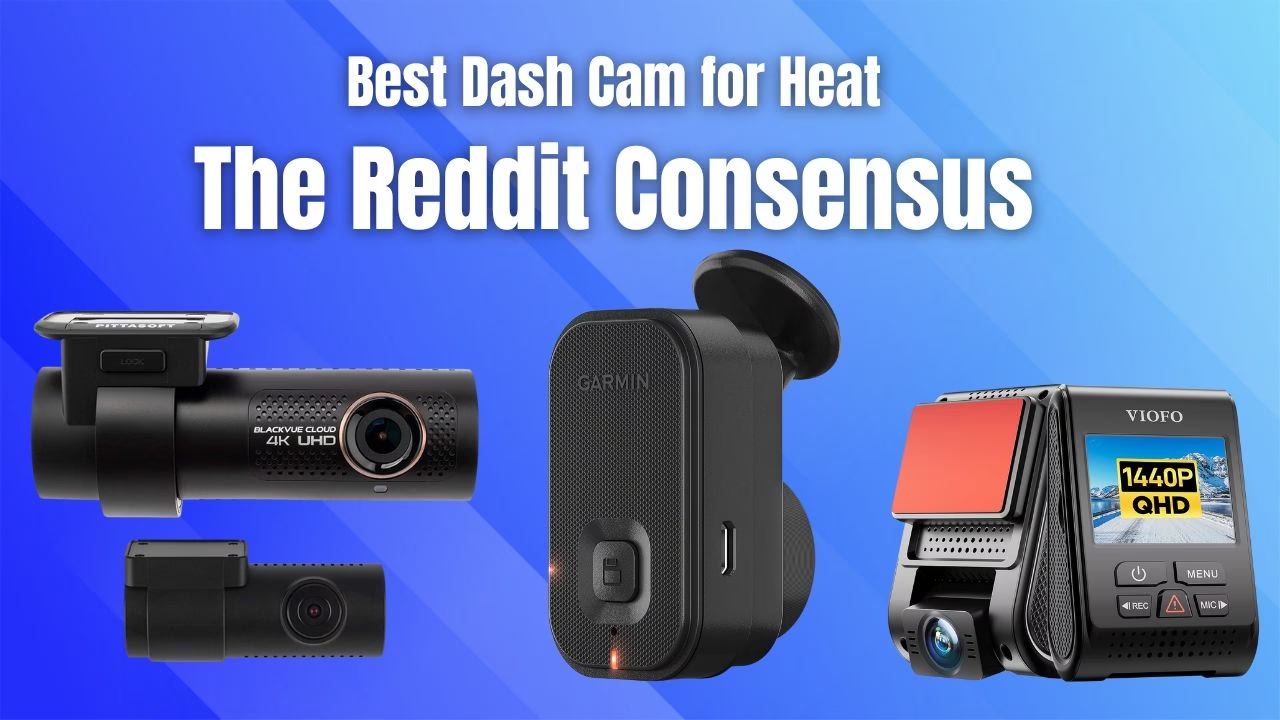
I analyzed 12 months of Reddit threads to find the only dash cams that won’t melt in the summer sun. Skip the marketing specs—here are the 3 survivors.
Table of Contents
Most dash cam reviews read like recycled marketing copy. They’re stuffed with specs but empty of real-world experience. Meanwhile, your car’s interior is hitting 130°F+ this summer, and you need to know which cameras actually survive. We spent weeks digging through Reddit threads, forum posts, and long-term user reports to find the truth. No sponsored fluff—just hard data from people who’ve baked these cameras for years.
Note: These cameras are specialized for extreme heat. If you need a camera for a standard vehicle in a moderate climate, check out our Best Dash Cam 2026 (Universal Guide).
1. VIOFO A119 V3 (2K)
The Verdict: The “Toyota Camry” of dash cams. It uses a supercapacitor instead of a battery, so it handles 140°F+ heat without swelling. No WiFi, but it never dies.
Check Price on Amazon →2. BlackVue DR900X Plus
The Verdict: The “Plus” model specifically fixed the overheating issues of the older generation. It is the only choice if you need crystal clear license plates in shimmering heat.
Check Price on Amazon →3. Garmin Dash Cam Mini 2
The Verdict: It is the size of a car key. Because it has no screen and runs on a capacitor, it generates very little heat and hides completely behind your rearview mirror.
Check Price on Amazon →VIOFO A119 V3: The Budget Tank
The VIOFO A119 V3 isn’t the flashiest camera, but it’s the one Reddit users report surviving year after year in blistering heat. Its wedge-shaped body feels rigid and simple, designed to be forgotten until you need it.
The Reddit Consensus: This is the “set-it-and-forget-it” champion for brutal climates. Users in Arizona and the UAE—places where summer feels like an open oven—report their A119 V3s logging years of service without failure. The secret is its supercapacitor, a critical component that handles heat far better than failure-prone lithium-ion batteries found in cheaper models.
The Dealbreaker: You’re buying a legacy champion, not a modern tech star. The A119 V3 feels dated. It lacks Wi-Fi, so transferring footage means pulling the memory card. You’ll navigate menus through a small screen and listen for its loud, beeping status alerts instead of helpful voice notifications. It does the job, but without any modern finesse.
A Real User Report: “My A119 has six years on it in the hot Arizona sun… Only recently had to change the SD card… Camera still works perfect.”
Verdict: Buy if your top priority is proven, no-nonsense reliability on a budget. Avoid if you want app connectivity, voice controls, or the latest video quality.
BlackVue DR900X Plus: The Heat-Tolerant 4K King
If you need crystal-clear license plate readability in the shimmering heat, the VIOFO won’t cut it. You need 4K. Usually, 4K cameras overheat rapidly because high resolution generates massive heat. The DR900X Plus is the exception.
The Reddit Consensus: Users in Arizona and Tucson (where interiors hit 150°F+) specifically recommend the “Plus” model over the older versions. One user noted they experienced “zero problems” with the DR900X Plus in the same heat that killed their previous VIOFO A129 Pro. It is widely considered the only reliable 4K option for desert climates.
The Dealbreaker: It is expensive, but the real cost is the ecosystem. To use the “BlackVue Over the Cloud” features (remote viewing, instant notifications), you need to buy the optional LTE module and a data plan. Without that extra hardware, you are overpaying for features you can’t use.
A Real User Report: “I had the Viofo A129 Pro… and it would overheat constantly. Switched to the DR900X Plus and have had zero problems in the same Tucson heat.”
Verdict: Buy if you need 4K resolution for insurance purposes and live in a high-heat area. Avoid if you aren’t willing to pay extra for the LTE module to unlock the cloud features.
Garmin Dash Cam Mini 2: The “Invisible” Survivor
The Garmin Mini 2 takes a different approach to heat: minimal surface area. It is the size of a car key and has no screen and no internal battery (it uses a capacitor). Because it doesn’t have to power a screen, it generates significantly less internal heat than larger competitors.
The Reddit Consensus: This is the go-to recommendation for people who want a camera that “disappears” behind the rearview mirror. Because it is so small and lightweight, it rarely falls off the windshield when the adhesive gets hot—a common problem with heavy flagship cameras.
The Dealbreaker: The “Time-Sync” Issue. A specific flaw often mentioned on Reddit is that the camera can lose track of the correct date/time if left unpowered for too long, because it lacks a battery to keep the internal clock running. You may need to open the app occasionally to re-sync it, or your footage might have the wrong timestamp.
The Specific Flaw: “My Mini 2 loses date and time overlay on recordings… I have to reconnect to it through the Drive app to fix it.”
Verdict: Buy if you want a tiny, discrete camera that won’t clutter your windshield. Avoid if you need a screen to instantly replay footage without using your phone.
Hot weather doesn’t just make you uncomfortable. It stress-tests your dash cam. Adhesives soften. Storage gets cranky. Electronics throttle. If you’re searching “best dash cam for hot weather reddit,” the real goal is simple: footage that exists when you need it. Every time.
- Hot-weather checklist
- Can a dash cam overheat?
- How to choose for high heat
- Mounting and placement for heat
- Settings that help in hot climates
- Hot and cold weather balance
- FAQ
Hot-weather checklist: what “heat resistant” should look like in real life
“Best dash cam for hot climates” sounds like a product feature. In practice, it’s a behavior pattern: stable recording, stable mounting, and stable storage—day after day. Use this checklist to spot a genuinely dash cam for hot climate setup.
- Consistent recording in direct sun: no random gaps, no constant reboot loops.
- Secure mounting that doesn’t drift: heat can weaken adhesives and suction over time.
- Reliable file saving: the last clip should save cleanly, not corrupt.
- Simple controls: the best dash camera for hot weather is the one you don’t fiddle with.
- Stable storage behavior: heat punishes weak memory cards faster than you expect.
- Parking reliability (if you use it): hot parked cabins are the toughest test.
Heat-proof priorities (the short list)
If you only remember three things, remember these. They’re the core of “best dash cam for high temperature” choices.
A shifting camera ruins evidence faster than any spec-sheet limitation.
Heat reveals weak connections and unstable adapters.
Consistent writing is the difference between “captured” and “missing.”
Even small shade choices can reduce thermal stress on any dash cam.
Can dash cam overheat? Yes. Here’s what triggers it (and how to prevent it)
The keyword question “can dash cam overheat” is popular for a reason. Overheating typically happens when heat load exceeds what the device can shed. That can be caused by sun exposure, enclosed parking, high-demand recording modes, or poor airflow around the unit.
- Parking in direct sun behind a steep windshield
- Long parked recording sessions in a sealed cabin
- High workload settings running nonstop
- Camera placed in a hot “dead air” pocket
- Mount high behind the mirror where it’s less sun-blasted
- Keep cable routing tidy so the camera sits flush and stable
- Use realistic recording settings that don’t over-stress the device
- Choose shade or a windshield cover when you can
How to choose the best dash cam for hot weather (without falling for hype)
If you’re typing “what is the best dash cam for hot weather,” you’re really asking: “Which one will keep recording through summer without drama?” Here’s a quick decision flow that builds confidence fast.
- Start with your parking reality. Garage vs street parking changes everything in hot weather.
- Decide your heat exposure. Full sun all day? Choose for stability first, not fancy features.
- Pick your coverage. Front-only is simpler. Front and rear adds context but adds wiring and workload.
- Plan your power. Stable power beats speed. Clean connections beat complicated setups.
- Choose for low-drama maintenance. Easy clip access and reliable storage will matter more than you think.
- Test once, then relax. A short midday test is worth more than hours of reading reviews.
Mounting and placement for hot weather: make any dash cam more heat-ready
Heat attacks your setup from two angles: thermal stress and mechanical stress. So your mount choice and placement matter a lot. A stable, discreet placement improves footage and reduces overheating risk.
Best placement for hot climates
- High and centered behind the rear-view mirror to reduce direct sun exposure and distraction.
- Avoid tinted-dot areas that weaken adhesion and cause drift.
- Keep it out of the “hot bubble” near vents or tight corners where air doesn’t move.
- Level the horizon so plate readability doesn’t suffer.
Mount stability checklist (fast and effective)
- After a hot day: check for slow drift or wobble.
- After a bumpy drive: confirm the camera didn’t tilt.
- After a wash: make sure moisture didn’t sneak into the mount contact.
Cable routing that prevents “heat tug”
- Route along the headliner and trim so nothing hangs in the sun.
- Leave gentle slack so expanding plastics don’t pull the mount.
- Keep wiring away from airbags and moving parts.
Settings that help in hot weather (and reduce overheating risk)
A dash cam isn’t just a camera. It’s a tiny computer writing video constantly. Hot weather is when “maximum everything” can backfire. The goal is reliable coverage, not bragging rights.
- Choose stable recording behavior over heavy workload modes.
- Keep clip lengths practical so files stay manageable.
- Use event protection so important moments aren’t overwritten.
- Don’t chase perfect brightness at night if it increases stress and glare.
- Use sensible triggers to reduce constant recording.
- Balance coverage with thermal reality in a parked, sealed cabin.
- Prioritize capturing incidents, not recording every minute.
Best dash cam for hot and cold weather: one setup that survives the whole year
Many drivers want one solution that handles everything: best dash cam for hot and cold weather. The good news is the strategy doesn’t change. You’re still building around stability: stable mount, stable power, stable storage, and sensible settings. Temperature extremes just make the weak points obvious sooner.
Reduce direct sun exposure, reduce workload strain, and keep mounts from drifting.
Confirm cold-start reliability, mount adhesion, and stable file saving during short trips.
Frequently asked questions (hot weather dash cams)
What is the best dash cam for hot weather?
Best dash cam for hot weather reddit: what do people usually agree on?
Can dash cam overheat, and what should I do if it happens?
What does “dash cam heat resistant” actually mean?
What is the best dash camera for hot weather if I use parking mode?
Best dash cam for hot and cold weather: do I need two different setups?
What is the best dash cam for high temperature and high heat driving?
The Reddit-vetted guide in one line: choose stability over hype, mount it smart, keep power clean, and treat storage like the heart of the system. Do that, and “best dash cam for hot weather” stops being a stressful search and becomes a set-and-forget win.
Natural keyword variations you can sprinkle around your picks: best dash cam for hot climates, best dash cam for high temperature, best dash cam for extreme heat, dash cam hot weather, dash cam heat resistant, and best dash cam for hot and cold weather. One clean year marker that fits search intent: 2025.
Heat Survival: Lowering Internal Temps
A black dash cam on a windshield can reach 170°F in minutes. Here is how to keep it cool enough to keep recording.
Final Verdict
- Choose the VIOFO A119 V3 if your definition of reliability is “it works for years without any fuss.” You are trading the latest 4K resolution and cloud features for a device with a proven, battle-tested design that survives extreme temperatures year after year.
- Choose the BlackVue DR770X Box if you need top-tier heat tolerance and want advanced connected features. You must be willing to invest not just in the camera, but also in the required LTE module and data plan to make it truly functional. It’s the winner for raw high-temperature performance.
- Choose the Thinkware U3000 if your car bakes in the sun all day and you need a camera with intelligent parking mode that won’t give up in the heat. You’re paying for professional-grade cooling features that keep it running when others fail.