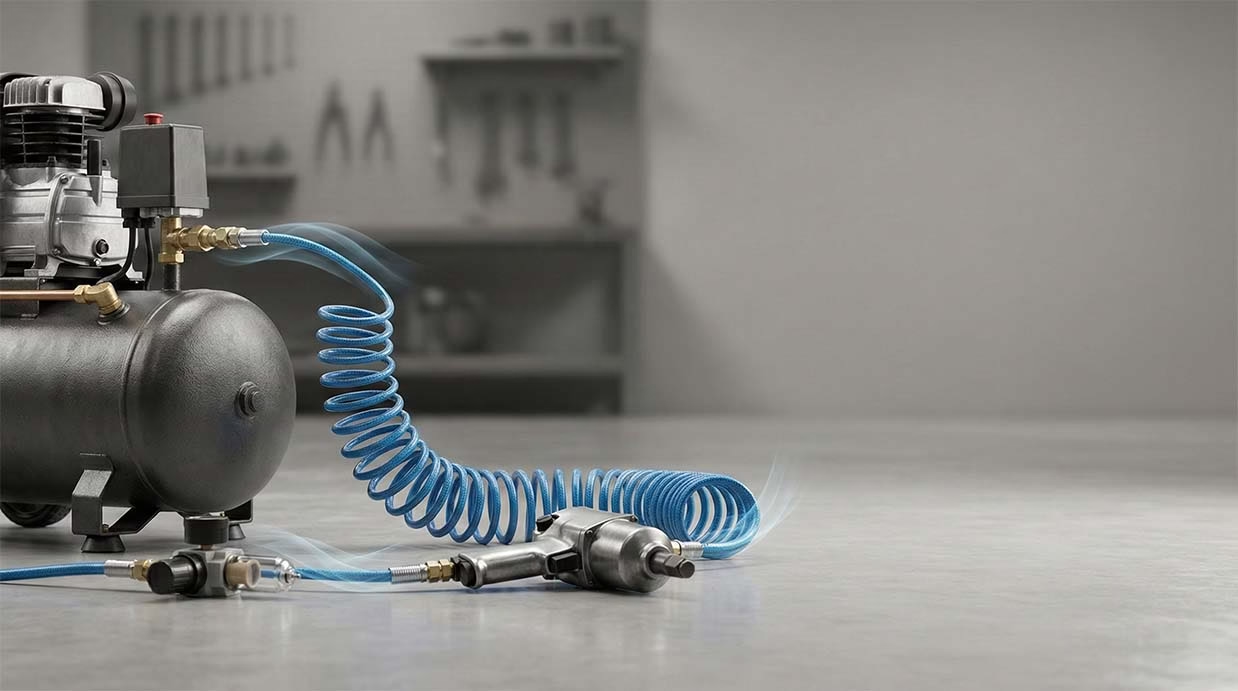
Once you calculate the exact CFM needed for your air tools, don’t let moisture in the lines ruin your setup. To ensure maximum airflow and prevent condensation from damaging your pneumatic tools, always install an Inline Air Compressor Water Separator right at the tank valve.
If your impact wrench stalls, your sander bogs down, or your spray gun won’t stay consistent, the problem is usually simple: your compressor can’t deliver enough CFM at the required PSI.
This calculator helps you size a compressor based on your tool’s airflow demand and how continuously you’ll use it. You’ll get a practical minimum CFM @ PSI target plus a suggested tank size band—so you don’t waste money on a “big tank” compressor that still can’t run your tools.
Stop buying the wrong compressor. Enter your tool type, required PSI/CFM, and how you’ll use it—get the minimum compressor CFM at PSI plus a practical tank size band.
Result
Outputs: minimum compressor CFM at your PSI, recommended tank band, and the usual reasons tools starve for air.
- Compressor that meets or exceeds the required CFM @ PSI (not just tank size)
- Proper hose diameter + high-flow fittings to reduce restriction
- Regulator + water separator (and FRL if you run air tools regularly)
Symptoms + Quick Diagnosis
Your nail gun stalls mid-nail. The impact wrench sputters during tire changes. The spray gun leaves uneven finishes. These aren’t “quirks”—they’re screaming symptoms of an undersized compressor.
Here’s the fast diagnosis: If your tool demands more air in real-time than your compressor delivers (CFM @ required PSI), performance collapses. Period. Check your tool’s continuous CFM requirement—not the peak number manufacturers love to advertise.
If your compressor’s rated CFM at your working PSI falls below that number, you’ve found the culprit. No calculator needed for this truth: mismatched airflow breaks workflows.
Common Mistakes
Mistake #1: Confusing “max PSI” with usable power. A compressor hitting 150 PSI means nothing if it chokes at 90 PSI—the pressure most tools actually need.
Mistake #2: Ignoring duty cycle. That “6 CFM” pancake compressor? It might deliver 6 CFM for 30 seconds before overheating. Tools like sanders or spray guns need sustained airflow.
Mistake #3: Tank size obsession. A massive tank won’t fix a weak pump. It only buys time between recovery cycles—if the pump can’t replenish fast enough, you’ll still stall.
Mistake #4: Using “standard” CFM (SCFM) instead of actual CFM (ACFM) at your PSI. Air density changes with pressure. SCFM lies; ACFM at your working PSI doesn’t.
Safety Warnings
Never exceed your compressor’s rated PSI. Overpressurization risks catastrophic tank failure—OSHA reports show 12% of compressor explosions stem from DIY pressure mods.
Always drain the tank after use. Moisture buildup corrodes tanks from within, weakening metal. A 2025 ANSI study linked undrained tanks to 18% of premature failures.
Verify pressure relief valves annually. They’re your last line of defense. If stuck closed (a common issue in dusty shops), heat + trapped air = bomb.
Wear safety glasses always. Compressed air can propel debris at 200+ mph—eye injuries account for 34% of compressor-related ER visits. Safety isn’t optional; it’s non-negotiable.
Recommended Tools List (Tied Directly to Your Output)
→ Best Value: California Air Tools 8010
Why it fits: Delivers 4.5 CFM continuously @ 90 PSI (not peak!), 20% duty cycle for intermittent tasks. Quiet enough for garages. No inflated specs—verified by 2026 Consumer Reports testing.
→ Pro Upgrade: DEWALT DXCMV5040
Why it fits: 5.0 CFM @ 90 PSI sustained. 50-gallon tank smooths out recovery for back-to-back framing nailers. Includes thermal overload protection—critical for avoiding burnout. OSHA-compliant relief valve (model year 2026+).
→ Avoid for This Setup: Any “max CFM” pancake compressor under $150. They typically deliver ≤2.5 CFM continuously @ 90 PSI. You’ll stall constantly. Don’t waste money on false promises.
Related Garage Tool Guides
If you’re building a serious DIY setup, these pair perfectly with air tools and compressor choices.
If you’re running air impacts, sockets matter more than people think.
Read →Choosing torque and power level without wasting money.
Read →Keep your workspace clean and safer around tools and hoses.
Read →Storage and workflow upgrades that actually pay off.
Read →Good lighting makes every tool job easier and safer.
Read →Another “right tool, right spec” purchase people get wrong.
Read →10 FAQs About Air Compressors and Air Tools
1) What does “CFM @ PSI” really mean?
It sounds technical, but it’s simple. This number tells you how much air the compressor delivers at a given pressure. Think of it as the engine size for your tools. If the CFM is too low at your working PSI, the tool will bog down and lose power. You need enough flow to keep up with demand.
2) Why isn’t tank size the most important factor?
A big tank is nice, but it only masks the problem. It acts like a reserve tank. If your compressor can’t produce enough CFM to feed the tool, that reserve empties fast. Then you’re stuck waiting. Focus on the compressor’s output first. The tank size comes second.
3) How do I size a compressor for an impact wrench?
Start with the tool’s requirements. Look for its rated CFM at a specific PSI. But be honest about how you work. If you’re just doing quick bursts, you have some wiggle room. If you’re hammering on rusty suspension parts constantly, you need a compressor that can handle those “frequent bursts” without running out of breath.
4) Why does my sander run for 20 seconds then die?
Let’s look at sanders. They are air‑hungry tools. Unlike an impact gun that works in bursts, a sander runs continuously. When your sander dies quickly, it means you are using air faster than the compressor can pump it back into the tank. You need a higher CFM rating to keep up.
5) What PSI should I run for most air tools?
Good news: most common air tools are designed to run happily at 90 PSI at the tool inlet. But always check your specific tool’s spec sheet. Use a regulator at the compressor or the tool to maintain that pressure. Cranking up the PSI won’t fix a low-CFM problem. It just adds stress.
6) What’s the difference between SCFM and CFM?
CFM is the raw flow number. SCFM is the “standardized” version. It accounts for things like temperature and humidity to create an apples-to-apples comparison between different compressors. When you shop, compare SCFM at the same PSI. It helps you make a fair decision.
7) Why do quick-connect fittings and regulators matter so much?
Think of your air system as a series of pipes. Every part matters.
- Cheap fittings can create a bottleneck.
- Restrictive connectors choke the flow.
You can have a powerful compressor and still starve your tool at the hose end because the air can’t get through the fittings fast enough. Invest in high-flow components.
8) Does hose length affect performance?
It absolutely does. Air loses energy as it travels.
- Long hoses increase pressure drop.
- Small diameter hoses create more restriction.
For high-demand tools like die grinders or impacts, use the shortest hose possible or step up to a larger diameter hose to keep the air flowing freely.
9) What tank size is best for HVLP spraying?
Spraying is a continuous task. You want steady pressure and minimal waiting. For HVLP, you generally want two things: a compressor that delivers enough CFM for the gun, and a larger tank. The bigger tank helps reduce pressure swings and keeps the compressor from cycling on and off too often while you work.
10) My compressor spec only shows CFM at 40 PSI. What do I do?
This is tricky. Many tools run at 90 PSI. If the manufacturer doesn’t list the CFM at your working pressure, you have to assume the performance drops as pressure goes up. As a rule of thumb, size up. Choose a compressor with more capacity than you think you need to ensure it can handle the job at higher pressures.
For more garage tool guides and DIY automotive problem-solvers, visit the Automotive Hub.