
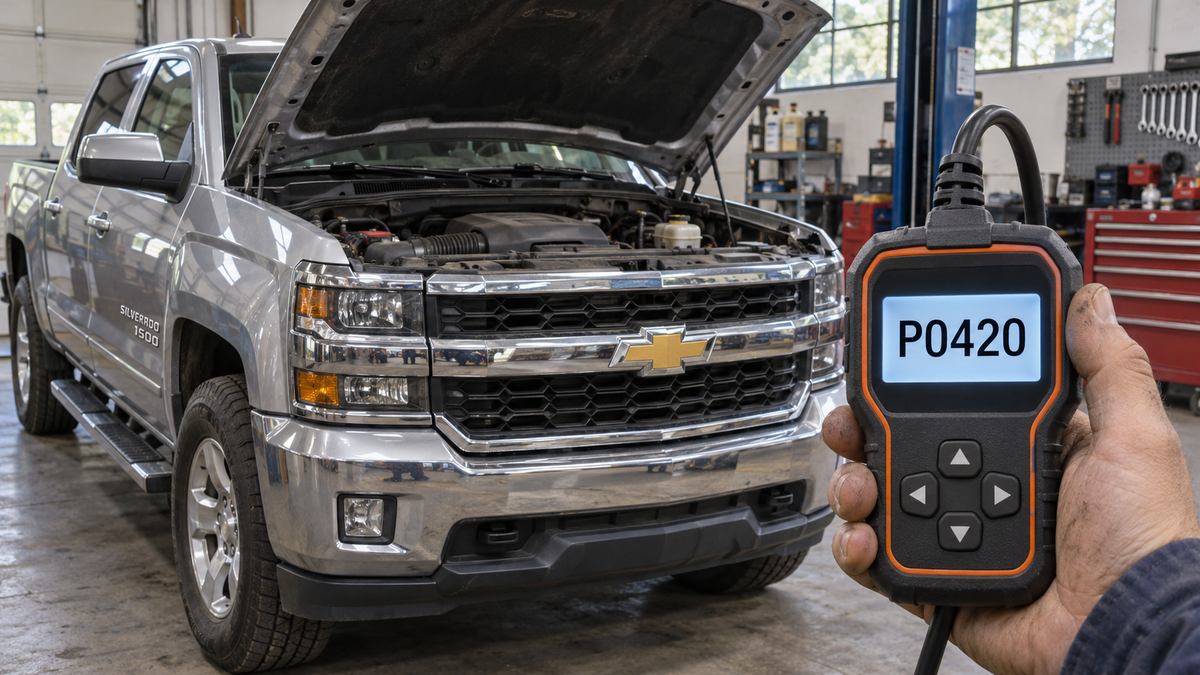
A P0420 Chevy code means the engine computer found low catalyst efficiency on Bank 1. That’s the side with cylinder 1. The computer checks how well the catalytic converter stores oxygen. A worn converter can fail that test. So can a leak that lets fresh air reach a sensor.
If the light flashes and your Chevy shakes, ease off the gas. Pull over safely if it keeps flashing. If the light stays steady and the car feels fine, save the scan and check your VIN before you buy parts.
P0420 Chevy at a glance
A Cruze converter replacement can run about $1,064 to $1,589 installed. Yet a covered repair on an eligible 2019 Silverado 1500 can cost you $0. Your first useful question is simple. What did the test show on your car?
Last reviewed November 18, 2026. This guide covers U.S. gasoline models.
Jump to your Chevy: model, engine and first check
Have your model year, engine size, mileage, and last repair bill handy. Two cars with the same badge can need quite different checks. Tap your model to go straight to its section.
| Jump to your model | First check |
|---|---|
| Cruze | 1.4L automatic campaign or 1.8L LWE recall |
| Sonic | 1.8L LWE emissions update |
| Trax | 2015 software version and exhaust leaks |
| Equinox | 2.4L engine code and oil-use history |
| Malibu | Engine, transmission, and old coverage |
| Cobalt | Build date and software match |
| Traverse | Flex-pipe bracket and both pipe joints |
| Silverado 1500 | 2019 VIN coverage or 2022 2.7L coil ground |
| Tahoe | Recent V8 converter replacement |
| Colorado | Engine layout and any misfire |
The emissions label under the hood lists the engine family or test group. Take a clear photo. If a bulletin lists a three-letter engine code, ask the dealer to look it up by VIN. The engine family on the label and GM’s engine option code serve different purposes.
Check your VIN for a GM bulletin, software update or warranty
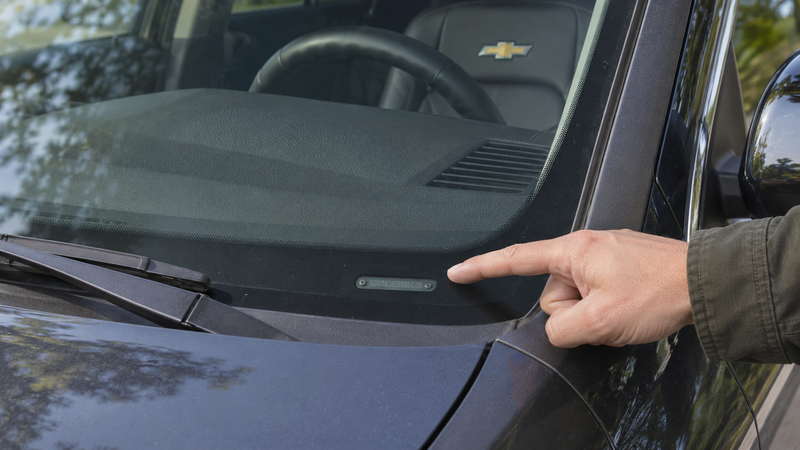
Start with the 17-character VIN at the base of your windshield. Enter it in NHTSA’s recall search to see open safety recalls. Then search by year, make, and model for manufacturer communications. A technical service bulletin tells a shop how to check a known fault. It does not, by itself, pay the bill.
Next, call a Chevy service desk. Ask them to check your VIN in GM’s vehicle history. An emissions campaign or special coverage can apply even if the safety recall search is clear. Here’s what to ask before you book:
- Does my VIN have an open emissions campaign or special coverage for this fault?
- Has anyone already done that work? What date and mileage appear on the claim?
- Is there a software update for my engine and symptoms?
- What is my first in-service date? When would I owe a diagnostic fee?
For many U.S. light-duty Chevys, federal emissions coverage lasts eight years or 80,000 miles for the converter and certain major control units. The first limit reached ends that coverage. An oxygen sensor can have a different term. Check the warranty booklet for your year, vehicle class, and emissions label.
A defect claim concerns a failed covered part. A performance claim has separate terms tied to a qualifying emissions-test failure. If your car failed inspection, keep the report. State coverage can differ, so give the dealer your registration state before you approve outside work.
Small Chevys: Cruze, Sonic and Trax
On these cars, start with the engine code. Even two versions of the Cruze have different reasons for an update.
Cruze: check the 1.4L and 1.8L campaigns separately
On a 2013 Cruze with the 1.4L LUV turbo, ask about diagnostic tip PI1505. It directs the shop to check campaign 14801A or its later version. That campaign covered certain 2011–2013 1.4L LUJ or LUV cars with automatic transmissions. It changed how the engine adds fuel under load.
On certain 2013–2014 cars with the 1.8L LWE, ask about 16186 instead. High exhaust heat could crack the ceramic core. The update helps prevent excess heat. It cannot mend a core that has already cracked.
Did the code first appear after exhaust work? Have the shop check the gasket it disturbed. A Cruze owner traced the fault to a gasket that sat wrong. If the joint seals and the software is current, ask for the catalyst test result.
Sonic: does the 1.8L emissions recall fit?
If you have a 2013 or 2014 Sonic, get the engine code before you call. Some 1.8L LWE cars share the 16186 emissions recall with the Cruze. Ask for the date of the update and compare it with the date your light came on.
If the core had heat damage before the update, the monitor may still fail. Ask the shop to run the test again under the right conditions. If you have the 1.4L Sonic, give the dealer that engine code so they can check its own service history.
Trax: check the calibration before approving a converter
For a U.S. 2015 Trax with the 1.4L turbo, ask about 19-NA-057. The revised bulletin tells the shop to check for leaks and damage first. It then calls for a check of the software version in the engine control module, or ECM.
If the car needs the update, the shop must also follow the transmission module instructions. Ask whether the price includes both checks. A paid reflash makes little sense if the car already has the right software and a flange still leaks.
Equinox, Malibu and Cobalt: check the exact engine
An old bulletin can still help you trace a fault after its coverage ends. Ask for past repair records as well as the warranty end date.
Equinox: is oil consumption part of the failure?
How far can you drive before you need to add a quart? Write down the miles and the amount you add. Those two numbers can tell a shop more than a clean dipstick just after an oil change.
On certain 2010–2011 Equinox models with the 2.4L LAF, GM identified heat damage or wear at the front face of the converter. Program 15810 had a 10-year/120,000-mile limit. On certain 2012–2013 2.4L LEA cars, the issue was oil burned through worn piston rings. Program N192287100-01 covered specific Bin 4 emissions builds for 10 years or 150,000 miles.
For the LEA, ask whether there’s a ring repair on file. GM’s procedure uses those records or an oil-use test to guide converter and sensor replacement. The separate 2012 ring program, 16118-01, had a shorter time limit. If the engine still burns oil, deal with that before fitting fresh parts.
Malibu: which older engines had converter coverage?
GM program 10134B addressed wear in the mat that holds the converter core. It listed the 2006–2007 2.2L L61. For 2008, it listed the 2.4L LE5 with the MN5 four-speed automatic and the 2.4L LAT Hybrid.
The coverage ran for 10 years or 120,000 miles. On a car of this age, its main value is a clue to the repair history. If your Malibu has a different engine, ask for the test procedure tied to your build.
Cobalt: check the build before paying for a reflash
For an early 2.2L L61, bulletin 05-06-04-073 is a lead to check. It has build limits. Ask the shop to match your VIN and software before it adds a reflash to the quote.
For a 2008 2.2L, start with that engine’s P0420 chart. Check exhaust joints and the rear sensor wiring. If those checks pass, ask to see the result of the warm catalyst test.
Traverse: a V6 exhaust leak that can look like a bad converter
A new rattle is worth mentioning when you book the car. Tell the shop whether it started before the light came on.
Traverse: inspect the flex-pipe bracket and Bank 1 pipe
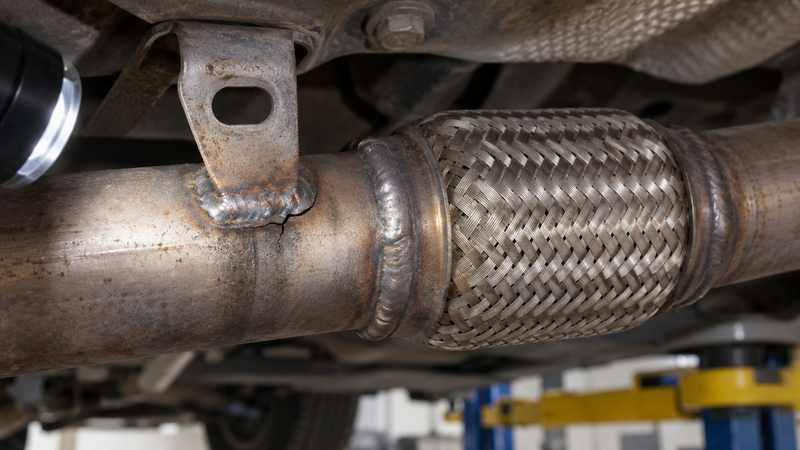
On a 2018–2022 Traverse with the 3.6L LFY, ask about PIP5681C. A weld can break at the Bank 2 flex-pipe bracket. The break can also damage the pipe that leads to the Bank 1 converter. A crack there can bring on P0420 even when the converter core is sound.
Ask the shop to show you the crack. Is it in the pipe at the bracket? The revised procedure calls for pipe work and a check of the other connection. That fault alone does not justify a new converter.
Check special coverage for the front pipe, too. The program numbers are N212356540 for certain 2019 VINs, N222385510 for 2021, N242445280 for 2022, and N252503850 for 2023. Each has a 15-year/150,000-mile limit. Match the VIN since the diagnostic bulletin covers a different set of years.
Silverado 1500, Tahoe and Colorado: identify the truck first
Tell the shop whether you have a 1500 or an HD truck. Then give the model year and engine. Some search results for a Silverado describe a fault found on an HD chassis cab.
Silverado 1500: check the 2019 coverage and 2022 2.7L ground
If you own a 2019 Silverado 1500, ask about N262548050 before paying for a converter. GM issued this special coverage in April 2026. It covers certain trucks for 15 years or 150,000 miles from first service, whichever comes first.
The dealer must confirm that the warm-up converter needs replacement. An eligible truck with that fault can get the repair at no charge. If you already paid, ask about the claim deadline on your owner letter. Keep the invoice and proof of payment.
On a 2022 Silverado with the 2.7L L3B, the clues are different. Does it also backfire under load, struggle to start, or set coil codes? PIP5854 directs the shop to check the ignition-coil ground for a loose clamp. Fix a proven ground fault and retest before you price a converter.
Tahoe: did the code appear just after converter replacement?
If P0420 came back soon after a new converter went in, keep the install date and mileage. PIP3119P describes a break-in check for listed 2002–2018 V8 Tahoes and Silverados. Ask the installer to confirm the correct part, bank, and test procedure.
A scan that shows the monitor has yet to run gives you no pass or fail. Ask for the result after it runs. If the original converter has been on the truck for years, use the normal fault checks below.
Colorado: identify the engine before locating Bank 1
A 2007 Colorado with the 3.7L inline-five has one row of cylinders. A 2009 5.3L V8 has two. Use the diagram for your engine to find cylinder 1, then trace its exhaust to the monitored converter.
On a 2015 3.6L LFX with a rough idle or misfire, ask about PIP5303. It covers software for those symptoms. If P0420 is the only complaint, start with leak checks and scan data. That bulletin gives no basis for a reflash on the code alone.
Can I keep driving with P0420?
Steady light, smooth engine: If the temperature and oil pressure look normal, book a check soon. Save the codes first. P0420 alone cannot tell you how many miles you can safely drive.
Flashing light or hard shaking: Ease off the gas and avoid hard pulls. A misfire can send raw fuel into the exhaust and overheat the core. If the light keeps flashing or the engine runs badly, pull over safely, shut it off, and arrange help.
Severe power loss, low oil pressure, or overheating: Stop as soon as it’s safe. A blocked exhaust can cut power, but a low-efficiency code alone cannot prove a blockage. Tell the shop what you felt as well as what the scanner showed.
What usually causes P0420? Rank the clues on your car
Start with what changed just before the light came on. A leak after a pipe repair deserves a much earlier look than a sensor that has given you no sign of trouble.
| What you notice | What to check first |
|---|---|
| Steady light alone, after repeated completed test failures | A worn core moves up the list once leak, sensor, engine, and software checks pass. |
| Tick, rattle, or recent exhaust work | Inspect joints and brackets. Test the suspect area for a leak. |
| Shaking, fuel-trim codes, oil use, or coolant loss | Find the engine fault. A new core may suffer the same damage. |
| Sensor circuit code or a trace that stays stuck | Test wiring, heater power, and sensor response. |
| Exact VIN and symptoms match a software bulletin | Check the installed version and follow the checks in that bulletin. |
Once you’ve narrowed down the cause, follow the P0420 repair steps from cheapest to costliest.
Diagnose P0420 from the cheapest checks to the costly ones
You can do the first few checks in your driveway. The goal is to narrow the fault enough to choose the next test. If your scanner lacks a reading, save what it shows and tell the shop what’s missing.
1. Save the codes, freeze frame, and readiness status
Before you clear anything, photograph each stored and pending code. Save the freeze frame, the snapshot the computer took when it logged a fault. Include engine speed, load, coolant temperature, and fuel trims if your tool shows them.
Next, open the readiness screen. A catalyst monitor marked “not ready” has yet to finish since the last reset. Note any recent battery work, exhaust work, or flashing light. Put the date and mileage beside the scan so you can compare it with the next one.

2. Find misfires and fuel-control problems first
P0300 points to a random or multiple-cylinder misfire. P0301, for example, points to cylinder 1. If your tool shows misfire counts, look for a count that keeps climbing. Give an active misfire priority over the converter test.
Fuel trims tell you how the computer adjusts the fuel mix. Short-term trim changes quickly. Long-term trim shows the correction it has learned. Positive numbers mean it adds fuel. Negative numbers mean it takes fuel away.
Compare readings at warm idle and at a steady raised speed when safe. A large positive correction at idle that shrinks as speed rises gives the shop a reason to test for an intake leak. Use the limits for your engine. One brief swing when you touch the gas tells you little.
Check oil use and any loss of coolant, too. A low reservoir alone does not prove coolant entered the engine. Ask for the cause of the loss before spending money on a core that could get fouled again.
3. Look for a leak and inspect the sensor wiring
Let the exhaust cool. From a safe spot, look for black soot at a flange, missing bolts, a cracked weld, or wires melted against a pipe. Pay close attention to any joint opened during a recent repair.
Soot gives you a place to test. A clean joint can still leak. If you can’t see the joint or reach it safely, ask a shop for a controlled leak test. Never crawl under a car held up only by a jack.
4. Compare the right sensor signals under the right conditions
On your scan tool, B1S1 means Bank 1, Sensor 1, ahead of the converter. B1S2 is the sensor after it. Graph both on the same time scale with the engine warm. Check what units the tool uses before you read the lines.
A narrowband front sensor can switch between low and high voltage. A wideband front sensor may show current or lambda, a measure of the air-fuel mix. You can’t compare those two sensor types against the same voltage rule.
During the proper test, a sound converter stores oxygen and slows the rear sensor’s response. A rear trace that closely follows the front can suggest a weak core. A rear trace that barely moves could reflect oxygen storage or a sensor that fails to respond. Have the shop check the sensor response, circuit, and leaks before it calls the core bad.
5. Confirm the converter and prove the repair
Ask the shop to run the GM catalyst test for your engine. Some scan tools show the onboard test results under Mode $06. The result only makes sense with the correct test ID, units, and limits for your vehicle.
Ask which of three results the shop saw. A pass means the monitor passed on that run. A fail means the measured result missed the limit. No result means the test could not reach a verdict. If your car also loses power under load, a separate restriction test can check for a blocked exhaust.
After the repair, ask for the completed monitor result and a check for pending codes. Keep both with the invoice. A dark dash just after a reset gives you less information than that one saved scan.
What does it cost, and should I use a shop or dealer?
Use these U.S. estimates to size up a quote. They cover different repairs. Tax, rusted hardware, local labor, and the exact part can change your total.
| Repair | DIY or independent shop | Dealer route |
|---|---|---|
| ECM update | Save your scan at home. A qualified independent may charge roughly $75–$150 for programming alone. | Budget roughly $150–$300 for customer-pay programming. Confirm the local fee. An open campaign can cover it. |
| Failed Cruze O2 sensor | Parts run about $155–$196. Installed estimate is $234–$311, including $78–$115 labor. A sensor test alone runs about $49–$72. | Ask for a quote for the specific sensor and a check of its warranty. |
| Exhaust leak | A gasket and a pipe assembly are different jobs. Ask for the leak location and an itemized price. | A qualifying Traverse pipe repair can cost $0. Have the VIN checked first. |
| Failed Cruze converter | Installed estimate is $1,064–$1,589, including $102–$150 labor. Parts-only examples follow. | Ask for an OE quote matched to the VIN. Confirm who pays diagnosis and hardware. |
For a Cruze 1.4L, parts listings show just how far prices can spread. One federal direct-fit front unit listed at $167.22. A CARB-listed direct-fit example was $950. A genuine GM front unit listed at $1,109.40, with a $1,720.13 suggested retail price. Check the position on the car before comparing two listings.
If your state requires a CARB-approved replacement, match the year, engine family, converter position, and Executive Order number to the approved application. A part can bolt into place and still be wrong for your car. Ask for the part number and warranty on the written quote.
What if you drive a different Chevy? These model-wide estimates cover installed converter replacement. They do not price a software update, sensor, or pipe repair.
| Model | Estimated installed converter cost |
|---|---|
| Cruze | $1,064–$1,589 |
| Sonic | $1,517–$1,593 |
| Trax | $1,256–$1,498 |
| Equinox | $1,642–$1,887 |
| Malibu | $1,724–$1,980 |
| Cobalt | $2,578–$2,630 |
| Traverse | $2,930–$3,118 |
| Silverado 1500 | $2,928–$3,063 |
| Tahoe | $2,995–$3,124 |
| Colorado | $987–$1,083 |
What wastes money or causes an inspection failure?
- Clearing the light before a test. Clearing codes can erase the freeze frame and reset readiness. Your car may arrive at inspection with too few completed tests.
- Buying both sensors on a guess. Ask which sensor failed its response or circuit test. If neither failed, keep looking for the leak or engine fault.
- Pouring in cleaner for a broken part. A bottle cannot seal a pipe, mend cracked ceramic, or change the ECM software.
- Using an O2 spacer or simulator to hide the fault. Defeating emissions monitoring violates the federal Clean Air Act. A vehicle can fail a visual or tampering check even with the light off.
- Choosing a universal converter on price alone. Check approval, size, location, and the cost to weld it in. Ask who pays if the weld leaks or the part fails its warranty test.
How to protect the replacement converter
Find out what damaged the old part. If the engine still misfires or runs rich, excess fuel can overheat the new core. If oil or coolant reaches the exhaust through the engine, a new core can lose efficiency again. Fix the cause and keep a dated log of fluid use.
On a 2014 Cruze case, a technician reported that an original-equipment converter resolved a repeat code after an aftermarket part. Another Cruze owner found a poorly seated gasket. The useful difference is what the next test finds. Keep the part number, leak-test result, and final monitor reading so a repeat visit starts with evidence.
Frequently asked questions
Can I drive my Chevy with P0420 and a steady light?
If it runs smoothly with normal oil pressure and temperature, arrange a check soon. If the light flashes, it runs rough, or it loses power, ease off and stop safely if symptoms persist.
Does P0420 mean Bank 1 Sensor 2 is bad?
No. That sensor helps test the converter. Ask whether its heater, wiring, or response failed a test before you agree to replace it.
Where is Bank 1 on my Chevy engine?
It’s the bank that contains cylinder 1. An inline engine has one bank. On a V engine, check the cylinder diagram for your exact engine before choosing a side.
Will Chevy replace my Silverado converter for free?
Certain 2019 Silverado 1500 trucks qualify under N262548050. The dealer must match the VIN, check time and mileage, and confirm the covered converter needs replacement.
Why did P0420 come back after new oxygen sensors?
New sensors can still detect an exhaust leak or a weak core. Check the connectors and any joints opened during the job. Ask whether the catalyst monitor ever passed after the repair.
If the light came back after the swap, here’s what to check after an oxygen sensor change.
Can burning oil cause P0420 on an Equinox?
Yes. On certain 2.4L engines, worn rings let oil reach the combustion chambers. Bring oil-use records and any ring-repair invoice to help the shop trace the damage.
Will clearing P0420 let my Chevy pass inspection?
A reset can leave the catalyst monitor incomplete. Your state decides how many incomplete monitors it allows. Fix the fault and check readiness before you return.
What if my Chevy has P0420 and P0430 together?
P0430 points to Bank 2. Start with faults that affect both banks, such as a rich fuel mix or misfires. Ask for separate test results before approving two converters.
See how to compare both banks when P0420 and P0430 appear together.
Before you approve the repair
For a P0420 Chevy repair, save the scan and get the VIN coverage answer first. Then ask the shop two things. Which test showed the part failed? What result will show the repair worked? Those answers tell you what your money will buy.