

Seeing P0420 and P0430 same time on your scan report? Check for a fault that affects both banks before you buy two catalytic converters. Both can wear out, and one engine problem can harm both. But finding two codes today tells you little about when each part began to fail.
If the engine shakes and the check engine light flashes, skip the test drive. Pull over safely and arrange help. If the light stays steady and the car runs smoothly, save the scan. Those readings can help you decide what to do about that repair quote.
What P0420 and P0430 Codes Actually Mean
P0420 means the car found low catalyst efficiency [how well the exhaust gets cleaned] on Bank 1. P0430 means it found the same issue on Bank 2. Each bank is a group of cylinders feeding a monitored exhaust path.
Think of the converter as a part that can store and release oxygen. As the engine changes its fuel mix, that storage helps smooth the change seen past the converter. The engine computer uses sensor readings to check that response. If it falls outside the limit for your car, the computer can log a code.
A converter can still let gas flow through after it loses its ability to clean it. A blocked exhaust calls for a different test. If your car loses power under load, tell the shop even if neither code appears.
Read the last digit, too. P0421 and P0431 refer to warm-up catalyst efficiency on Banks 1 and 2. A pre-cat [converter close to the engine] may sit ahead of another converter on the same pipe. Counting metal cans under the car won’t tell you which section the computer tested.
Bank 1 vs Bank 2: Find the Correct Converter
Find cylinder #1 on the service diagram for your exact engine. Its exhaust group is Bank 1. On a two-bank system, the other group is Bank 2. Sensor 1 sits upstream [before the monitored converter]. Sensor 2 sits downstream [after the monitored converter] in the layout below.
| Exhaust path | Before the converter | Monitored part | After the converter |
|---|---|---|---|
| Bank 1, includes cylinder #1 | B1S1 | Bank 1 converter · P0420 | B1S2 |
| Bank 2 | B2S1 | Bank 2 converter · P0430 | B2S2 |
Read each row from left to right, in the direction exhaust flows. This sketch shows two separately monitored paths. For example, on the Honda V6 models in bulletin 21-010, Bank 1 is at the rear and Bank 2 is at the front. Check your own layout before you order a “left” or “front” part.
P0420 and P0430 Same Time: Shared Causes to Check
Start with faults that could keep doing harm. Then check things that could make a good converter look weak. Use the clues you have to choose which test comes next.
- Misfire or excess fuel. A cylinder that misses can send fuel and oxygen into the exhaust. That mix can burn inside a converter and damage its core. A miss on one cylinder points first to its own bank. Look for evidence before blaming it for the other code.
- Oil burning or coolant loss. Oil or coolant that enters the exhaust can coat the working surface inside a converter. Note how much you add and the miles between top-ups. A puddle under the car alone tells you little about what reached the exhaust.
- Exhaust leaks. A gap near a sensor can draw in outside air and skew its reading. Pay close attention to joints disturbed during recent repairs. A leak on one pipe deserves a separate check from a leak on the other.
- Fuel mix or engine temperature. If both banks need the same large fuel correction, look for something they share. Check intake leaks, fuel pressure, and the air meter where fitted. Follow up on a coolant-temperature fault if the engine fails to warm up as expected.
- Sensor or wire faults. A slow sensor, damaged plug, or heater fault can spoil the test. Ask what response test the sensor failed before approving a set of four.
- Software or an earlier repair. Check for a bulletin that fits your engine. If someone fitted new converters, compare the part numbers with the emissions label under the hood. Suspect contaminated fuel only when the timing and fuel tests support it.
When both catalytic converters really are bad
Both original parts have often seen the same miles, heat cycles, and exhaust. Both can fall below their limits over time. Oil burning or a fuel fault that affects both banks can also shorten both parts’ lives.
The strongest case for two replacements is a failed test on each bank after fuel control, leaks, and sensor response check out. If just one side fails, ask what finding supports work on the other side.
Diagnose Both Codes in This Order
Save the evidence before clearing anything
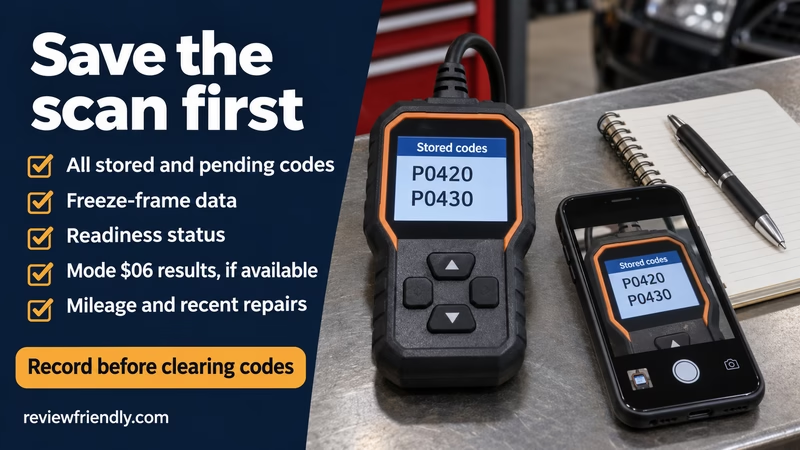
Save the full scan report, including pending [fault seen but not yet confirmed] and stored codes. Capture the freeze frame [snapshot when a fault was stored]. Note which code owns that frame, plus road speed, engine load, coolant temperature, and fuel trims. Your reader may show just one frame for several faults.
Open readiness [which emissions checks have run]. If your tool offers Mode $06 [results from onboard emissions tests], save the bank, test value, units, and allowed range. These are results from the last completed test. A raw number without its test name and limit won’t tell you whether a bank passed.
Write down the mileage, recent repairs, warning-light behavior, and fluid top-ups beside those readings. Keep the first scan so you can compare it with the one after repair.
| What you find | Where to go next |
|---|---|
| A flashing light with rough running | Stop the drive and address the misfire. |
| Two monitored banks in the factory diagram | Use Branch A. |
| One monitored bank but the reader shows P0430 | Use Branch B before buying parts. |
| A shared fault is found and fixed | Run the proper monitor and check both banks again. |
| Both banks still fail | Check coverage and get a test result for each side. |
Branch A — confirmed two-bank engine

Use this route for a V6, V8, or inline-six with two confirmed catalyst monitors. Start with other engine codes. A misfire, lean or rich code, oxygen-sensor heater fault, or coolant-temperature fault can change what the catalyst test sees. Diagnose the fault behind the code. Replacing a coil because its cylinder missed can leave a bad injector or low compression untouched.
Next, check oil and coolant use. Compare cold coolant levels under the same conditions. Check the oil as your manual directs. If levels keep dropping with no clear external leak, ask for an engine or cooling-system check before spending money on the exhaust.
Inspect the exhaust when cold. Look for loose flange bolts, black soot at joints, cracked flex sections, and damage near the sensor mounts. A clean joint can still leak. A shop can check for small leaks with smoke and low pressure.
Use rated stands on firm, level ground and chock the wheels. Never get under a car held up by a jack alone. Leave sensor removal and running pressure tests to a shop if access is tight. Hot exhaust can burn skin, and a seized sensor can tear threads out of the pipe.
Compare live data under the same conditions
Warm the engine and confirm closed loop [computer adjusts fuel using sensor feedback]. Compare each bank at the same speed and load. Save a graph so you can see a trend over time. One screenshot from a cold idle can send you down the wrong path.
| Reading | What to look for |
|---|---|
| Short- and long-term fuel trim [fuel added or removed] | Check both banks near warm idle and at steady speed. Persistent values outside about ±10% deserve a closer look. Use factory limits for the decision. |
| Upstream switching O2 sensor | A conventional narrowband sensor often moves across roughly 0–1 volt. Look for a response when the fuel mix changes. |
| Upstream wideband sensor [measures the fuel mix precisely] | Use the specified air/fuel or lambda reading [actual mix relative to ideal]. This sensor uses a different signal from a switching sensor. |
| Downstream O2 sensor | During suitable steady operation, expect less activity than at the front. A flat line can also come from a dead circuit. Verify the sensor responds. |
| Bank-specific monitor result | Compare the completed value with the limit for that test. Check the units and whether the limit is a minimum or maximum. |
If both banks add fuel at idle but need much less at higher speed, check for unmetered intake air. If one bank stands out, inspect that side first. A normal trim reading alone cannot prove the cylinders all burn cleanly.
Check warranty and bulletins before authorizing paid work. If both codes return after the other faults are fixed, ask for an oxygen-storage test on each bank. A shop can track front and rear response with a scope [tool that graphs electrical signals]. A five-gas exhaust test can also reveal a poor fuel mix. A sample from a shared tailpipe alone cannot identify which bank failed.
If power drops under load, ask for pressure readings before and after the suspect part. Typical screening figures are below 1.5 psi at idle and 3 psi at 2,000 rpm. Use your engine’s specs. High pressure behind the converter points farther down the pipe.
After repair, use the drive conditions specified for your car. Check that the catalyst monitor completed and look for returning pending codes. A dark dash right after a reset gives you no result to judge.
Branch B — why is P0430 on a single-bank inline-four?
Read the actual code digits again and confirm the VIN and engine in the scanner. Check factory service data for supported codes and exhaust layout. Two converters in a row can still serve one bank.
If the car has a documented split system, use its own test procedure. If factory data shows one catalyst monitor, confirm the result with another compatible tool. Resolve that mismatch before anyone sells you a Bank 2 converter.
Vehicles With Documented P0420/P0430 Reports
These examples show why repair history matters. An owner’s result can give you a question to ask. It cannot tell you how often the same fault affects your model.
| Vehicle | What happened | What to take from it |
|---|---|---|
| 2013 Toyota Tundra, 4.6L V8 | An owner reported improvement after replacing converters on a truck with both codes. | Two worn parts are possible. Check ongoing oil use as well. |
| 2008 Honda Odyssey, J35A7 V6 | An owner reported both codes. The discussion did not establish a final repair. | Ask about oil use before blaming the engine design. |
| 2017 Ford F-150, 2.7L EcoBoost | An owner reported both codes came back after new converters and sensors. | Ask for before-and-after test data before paying for more parts. |
| 2016–2019 Ford Police Interceptor Sedan, 3.7L Ti-VCT | Ford documented a repair involving the affected converter or converters and a software update. | Check the exact model. The sedan bulletin does not cover the F-150. |
Check Warranty and TSBs Before Spending
Federal coverage and state-specific protection
For eligible U.S. light-duty vehicles, federal emissions warranties cover specified major parts for eight years or 80,000 miles, whichever comes first. Those parts include the converters, the emissions control computer, and the onboard diagnostic device. The clock starts with the original sale. A used-car purchase does not restart it.
The defect warranty covers qualifying faults in materials or workmanship. The performance warranty has separate conditions, including a failed approved emissions test and a requirement to repair the car. Have a manufacturer-authorized dealer check your VIN, mileage, original sale date, and state emissions coverage before an outside shop starts work.
Verified bulletin examples
A technical service bulletin [factory guidance for a known issue] can change the next test. Give the dealer your full code list. Ask whether the latest procedure applies and who pays for the work.
| Bulletin | Vehicles listed | What to ask about |
|---|---|---|
| Honda 21-010 | 2018–2019 Odyssey, 2017–2019 Pilot and Ridgeline. VIN eligibility applies. | With catalyst codes alone, Honda calls for a cylinder air/fuel test. Other listed misfire or imbalance codes change the repair path. The specified injector repairs have a 10-year/150,000-mile limit, whichever comes first. This procedure requires no software update. |
| Ford 21-2063 | 2016–2019 Police Interceptor Sedan with the 3.7L Ti-VCT engine. | Ford pairs affected converter replacement with engine computer programming. |
| GM PIP5232C | 2016 and earlier GM cars and the gasoline light- and heavy-duty trucks covered by the bulletin. | With unexplained early failure, inspect the coil ground terminal crimp and contact surfaces on the affected bank. |
| Infiniti ITB13-053a | 2011–2012 QX56, chassis Z62. | The procedure calls for affected-bank manifold/converter and air/fuel sensor replacement. Check whether the computer also needs programming. |
Choose legal replacement parts
In California, match an aftermarket converter to its CARB Executive Order [state approval for listed vehicles]. Check the exact engine family and part number. New York also requires approved aftermarket parts for covered gasoline light- and medium-duty vehicles, including federal-certified applications.
Colorado’s rule covers spark-ignition vehicles under 14,001 pounds gross vehicle weight rating. Maine’s rule covers qualifying 2001-and-newer gasoline vehicles under 14,000 pounds with California/50-state certification. Photograph the emissions label before shopping. Ask the installer to put the matching approval number on the quote.
Cost to Fix P0420 and P0430: Compare the Actual Repairs
A $1,500–$4,000 quote raises a fair question. What work does that price buy? A leak repair, a covered injector repair, and two manifold-mounted converters are three very different jobs. The codes alone cannot price them.
For context, a September 2026 U.S. repair estimate put a general converter replacement at $2,280–$2,480 before taxes and fees. It does not price both banks on your car. Parts and labor can overlap when a shop works on both sides, so doubling a general estimate can mislead you.
Ask for these items in writing:
- The test that failed on each bank and the fault that caused the damage, if known.
- The exact assemblies, part numbers, and emissions approvals.
- Separate prices for parts, labor, hardware, programming, and root-cause repairs.
- The parts and labor warranty, including what happens if the codes return.
- A completed monitor check after the work.
Compare the original equipment part with a correctly approved aftermarket part for your engine. A lower price can help if the fit, approval, and warranty check out. A cheap part listed for the wrong emissions family can leave you paying for the job twice.
Already paid for new converters? Follow these checks after catalytic converter replacement before approving more work.
Skip converter deletes, oxygen-sensor simulators, and spacers used to defeat the monitor. Bypassing emissions controls is illegal on a road car. Clearing codes resets readiness and can erase the best clues you had for the repair.
Frequently Asked Questions
Can both catalytic converters fail at the same time?
Yes. They share miles, and an engine fault can expose both to heat or contamination. Seeing both codes on one scan cannot tell you the exact day either converter went bad.
What causes P0420 and P0430 together?
Check misfires, fuel mix, fluid use, and exhaust leaks first. Then test sensor response and each converter. Recent work on both exhaust paths gives you a good place to look.
Can P0420/P0430 appear after a misfire is fixed?
Yes. The repair can stop fresh damage while leaving a heat-damaged core behind. Confirm the miss is gone, then let the catalyst monitor run again.
If the warning returns, see what to do when your check engine light flashes, then stops.
Is it safe to drive with P0420 and P0430?
With a steady light and smooth running, arrange prompt diagnosis. If the light flashes or the engine shakes, ease off the throttle. Stop safely and get help if flashing persists, power drops sharply, or the engine overheats.
Can oxygen sensors cause both catalyst codes?
Faulty readings can affect the monitor. Check the wiring, heater, and response of each suspect sensor. Two codes alone give you little reason to buy four sensors.
If you already changed a sensor, use these P0420 checks after an oxygen sensor change.
How much does fixing both codes cost?
Ask for a price based on the fault the shop found. If it recommends two converters, request the results for both banks and a VIN-based warranty check before you agree.
Should I buy a used car with both codes?
If your test-drive notes say “P0420 and P0430 same time,” make the purchase decision after an independent inspection. Ask for a written estimate and the catalyst readiness result. If the seller just cleared the light, leave room to walk away until the car completes its test.