
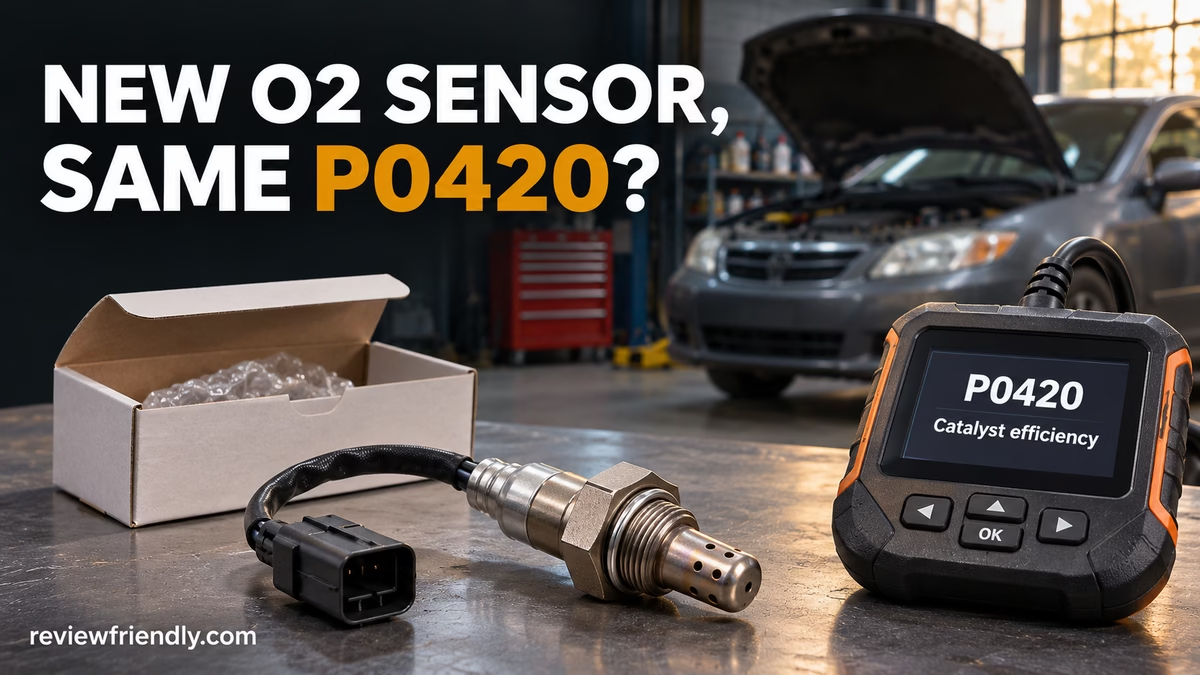
If you see P0420 after oxygen sensor change, save the scan before you clear it. Does your scanner say permanent, or has the code come back as pending? That one word can change what you do next.
A permanent code can linger after a good repair. A fresh pending code means the car detected a fault again. If it came back, check the part you fitted and the joints you touched. Get a test result before you pay for a converter.
Read my scan · Compare sensor graphs · Check exhaust work · Review a quote · Confirm the fix
P0420 still there after a new O2 sensor? Read the code status first
Open the engine menu on your scanner. Save all the codes, including any for the sensor heater or a misfire. Take a photo of the freeze frame [engine readings when the fault set]. Write down the mileage and whether the dash light is on.
| What your scan shows | What to do now |
|---|---|
| Permanent P0420 only, light off | Look for fresh codes and check catalyst readiness [whether the car ran its test]. The car clears a permanent code once it verifies the repair. |
| Pending P0420 after a known reset | Save it, even if the light is off. The car has seen a fresh fault. Check what else happened on that trip. |
| Confirmed P0420, no record of a reset | Ask for the scan from the repair date. A stored entry alone can’t tell you when the fault happened. |
| No fresh code, catalyst “not ready” | Keep the scan. The car still needs the right conditions to finish its test. |
Suppose you pick up the car with the light off. The next morning, your app shows a pending P0420. Tell the shop about that new result. It gives them more to work with than a photo of the dash.
What P0420 and P0430 mean after a sensor swap
A catalytic converter treats harmful gases in the exhaust. Inside, its coating can store and release oxygen as the fuel mix changes. Your car checks how well that process works. P0420 means the result fell outside the allowed range on Bank 1. P0430 flags the same test on Bank 2.
Bank 1, Bank 2, Sensor 1, and Sensor 2
Bank 1 is the side with cylinder No. 1. On a straight four-cylinder engine, you usually have just one bank. On a V-shaped engine, check the cylinder diagram. Guessing by the driver’s side can send you to the wrong part.
On a common two-sensor layout, exhaust flows from the engine past Sensor 1, through the converter, then past Sensor 2. Your scanner may call the rear sensor on Bank 1 B1S2. If you have several converters, ask which one sits between the sensors used for this test.
Why would P0420 and P0430 appear after an O2 sensor change?
Check whether both codes are fresh. A stored Bank 1 code and a new Bank 2 code may come from different trips. If both are new, compare the banks when the engine is warm and under the same load.
Look for faults that affect both sides, such as a fuel mix that’s too rich. If only one bank shows odd readings, start there. Also check for a service bulletin [repair notice for specific vehicles]. For example, Ford bulletin 25-2233 covers certain 2022–2023 F-150 trucks with the 3.5L PowerBoost engine. Its checks include a software update and a set drive routine. Have the shop confirm your truck meets the bulletin’s terms.
Replaced the downstream O2 sensor and P0420 returned? Verify the part
Start with the box or receipt. “Fits my car” isn’t enough if the same model came with two engines or two exhaust layouts.
Confirm the part number, sensor type, and connector
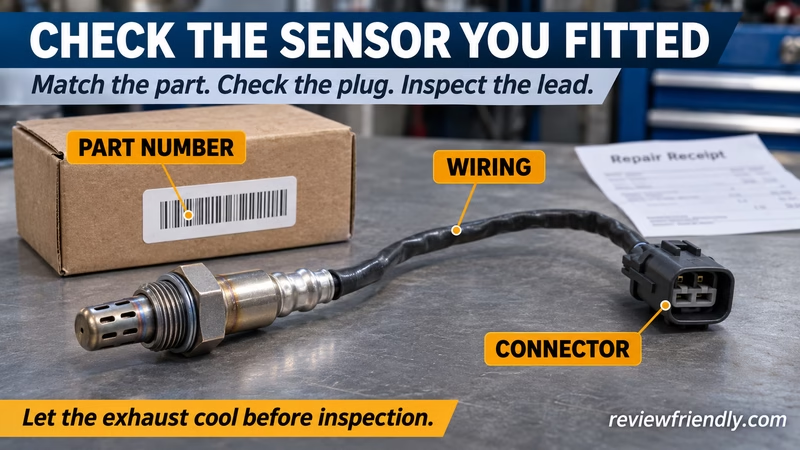
Match the part number to your VIN [vehicle identification number], engine, emissions label, bank, and sensor position. Check the number on the installed part if you can see it. A plug that clicks into place tells you little about the signal the computer expects.
A direct-fit sensor comes with the plug for its listed use. A universal sensor may use the old plug and a supplied joint kit. Follow that kit’s wiring guide. Wire colors can differ across brands.
If you need another sensor, compare an original part with a listed direct-fit Denso, NTK, or Bosch part. The right part number, signal type, and plug matter more than the name on the box. If the sensor you just fitted passes its checks, keep it.
Check the work you can see before testing a circuit
Let the pipe cool. Check for a loose latch, a pin pushed back in the plug, or a lead pulled tight across a heat shield. Follow the wire to the sensor. Look for melted spots and check that the sensor sits square in its mount.
If you have a heater code, save its number. The heater helps the sensor reach its working heat. A shop can check its power feed and control circuit against your wiring diagram. Avoid guessing at pins or applying battery power to test a sensor.
How to compare upstream and downstream O2 live data
Your graph helps answer two questions. Can the rear sensor detect a change in the exhaust? Once you know it can, how much of the front sensor’s activity reaches the rear? Answer them in that order.
Choose the right scan tool and data items
A basic code reader can show codes and readiness. For this check, you need a scanner or app that graphs two signals together and saves the log. If you already have one, start there.
Pick a PID [one measured value on your scanner] for each sensor on the same bank. A narrowband front sensor can show voltage swinging as the mix moves rich and lean. A wideband front sensor measures a wider range. Your app may show current or lambda [air-fuel ratio relative to ideal]. Choose the measured value for your engine. A commanded value shows what the car asked for.
Select the rear sensor’s supported signal. Check the units on both axes. If your app lists only rear voltage, look for the front reading under “air/fuel” or “equivalence ratio.” For help finding those screens, see how to read OBD2 live data and fuel trims.
Record a warm baseline and compare the traces
- Save your codes and freeze frame. If the light flashes and the engine shakes, skip this test. Pull over safely and shut the engine off. See what a flashing check-engine light means.
- Warm the car as its service guide directs. Check for closed loop [computer uses sensor feedback to adjust fuel]. Run stationary checks outdoors on level ground. Set the parking brake and use Park or Neutral as your guide directs.
- If your vehicle permits it, record a steady stretch near 2,500 rpm [engine turns per minute]. Save both sensor signals on one time scale. Note engine speed, coolant heat, and fuel trims. Log fewer items if the graph updates too slowly.
- Mark when you press or release the throttle. Compare steady running with steady running. A sudden lift can change both readings. A parked test may never meet the conditions for the car’s own catalyst check.
- If the rear line stays flat, ask for the specified rich/lean response test. A shop scanner can command a change on supported vehicles. Ask to see the response before anyone names the part that failed.
| What you see at steady speed | What it tells you | Next check |
|---|---|---|
| Front signal changes. Rear moves less. | A known-good rear sensor can look like this when the converter stores oxygen well. | Check the completed catalyst test. |
| Rear follows much of the front activity. | A working rear sensor may be showing weak oxygen storage. | Rule out leaks and fuel faults. Run the vehicle’s catalyst test. |
| Rear stays fixed, even during the proper response test. | The signal may be stuck. A steady line alone can’t prove the converter works. | Check the rear circuit and sensor. |
| Front reads in lambda. Rear reads in volts. | The two scales mean different things. | Compare timing using the service procedure. Skip voltage-to-voltage comparisons. |
Ask for Mode $06 [results of onboard tests] if the tool supports it. Have the shop identify the right bank, test value, units, and pass limit. That gives you a result you can compare after the repair. One screenshot at idle rarely answers all those questions.
Follow the P0420 decision tree before buying another part
Work down this list after you confirm the code came back. At each step, a fault you can show gives you a reason to pause.
- Does the new sensor fit and respond? Yes → check for leaks. No → correct the part, plug, wiring, or heater fault. Test its response again.
- Is there a leak before or near the rear sensor? Yes → repair the leak, check the seal, and rerun the monitor. No → check fuel trims.
- Are fuel trims outside the expected range? Yes → find out why the engine adds or removes fuel. Compare idle and raised speed on each bank. No → check for misfires and oil use.
- Does the engine misfire or use excess oil? Yes → find the cause first. Raw fuel can overheat a converter, and burned oil can foul it. No → check for a matching bulletin and run the specified catalyst test.
- Does the converter still fail with sound inputs? Yes → identify the exact assembly and check warranty coverage. No → save the passing result. If the test never ran, find out which conditions it needs.
Common causes, what they cost, and what makes each more likely
A fresh weld near the rear sensor makes a leak worth checking first. A failed catalyst test after the leak and fuel checks shifts the odds toward the converter. There is no sound percentage you can apply to every car after a sensor swap.
These are rough U.S. parts-and-labor ranges for specific jobs, checked in November 2026. Your engine, local labor rate, and access can change the bill. Get a written quote that lists diagnosis, tax, and related work separately.
| Possible cause | Clue and test | Difficulty and cost |
|---|---|---|
| Exhaust leak | Look for soot near a joint. A small leak may leave no mark. Ask for a low-pressure smoke test of the suspect area. | Easy visual check. A manifold gasket job runs about $417–$596. Price a weld or clamp on its own. |
| Sensor, plug, or heater fault | Compare the part number. Check the plug and test the circuit if the signal fails to respond. | Basic inspection; electrical tests take skill. About $440–$523 for a confirmed sensor replacement. Check your parts warranty first. |
| Fuel fault, misfire, or oil use | Read fuel trims and misfire counts. Track oil added between changes. Check plugs on the affected cylinders. | Shop diagnosis. About $238–$320 for an ignition coil if it fails its test. An oil-use repair needs a separate quote. |
| Weak or mismatched converter | A repeat failed storage test, with correct fuel control and no leak, points here. Match the installed part to the vehicle. | Advanced test. About $2,280–$2,480 for converter replacement as a broad U.S. estimate. |
| Software or a result near the limit | Check the exact bulletin, software version, test units, and pass limit. A close result alone doesn’t justify a software update. | Shop-level check. Ask for a VIN-based price and any warranty coverage. |
| Incomplete monitor | No fresh fault yet. Check the drive conditions needed to run the test. | Basic recheck. No parts cost if you already own the scanner. |
Fuel trim is the amount of fuel the computer adds or takes away. Positive trim adds fuel. Negative trim takes it away. If the engine also uses more gas than usual, note when that started. It can help the shop connect the scan data to your complaint.
P0420 after exhaust replacement: start with the part that changed

Ask the installer to mark the new part on the invoice or on a photo. Find the rear sensor on the same layout. A repair beside that sensor gives you a different starting point from one at the tailpipe.
After a muffler or rear exhaust replacement
If only the rear muffler changed, find out whether the shop also loosened a joint farther forward. Check for a pipe pulled out of line or a lead tugged near the rear sensor. Ask if the code was on the intake scan before the work began.
A leak far behind the monitored section is a weaker clue than a leak at the sensor mount. If there are no signs of a fault near the sensors, return to the scan result before paying to redo the muffler.
After a flex pipe, front pipe, or sensor bung replacement
The bung is the threaded seat for the sensor. A pinhole in its weld or a gap at a flange can draw air into the exhaust. The sensor can then report extra oxygen that entered through the leak.
Have the installer check welds and gaskets on a cold exhaust. Compare the bung’s angle, depth, and distance from the converter with the stock layout. There is no single correct distance for every vehicle. If you need space under the car, use rated jack stands at the approved points. Never crawl under a car held up by a jack alone.
After a converter replacement or a reused O2 sensor
Check which converter the shop fitted and whether it faces the right way. Verify each sensor sits in its intended port. A reused sensor with an intact lead can still work. A new one can still be wrong for that port.
If the converter itself was the part you paid for, use the P0420 checks after catalytic converter replacement. Have the part number and warranty slip handy when you call the installer.
Why a budget converter can bring P0420 back
If testing points to the converter, get two details before comparing prices. Which assembly did the car test? Which replacement is approved for that exact spot on your engine?
What the converter’s coating, substrate, and fit change
Inside the shell is a support with many small passages. A thin coating on those passages holds active materials, including precious metals. The support, the coating, and the amount of active metal all affect how the part treats exhaust over time.
Two shells can fit the same pipe yet perform differently. A price tag won’t tell you how much metal is inside or how close the part runs to your car’s test limit. With a universal weld-in part, the installer also has to get the position, pipe joints, and sensor location right.
EPA-policy replacement, CARB Executive Order, or OEM?
Read the emissions label under the hood. Photograph the model year, engine size, and test group [engine family used for emissions approval]. Ask the shop to check original emissions warranty coverage before it prices a new part.
In California, an aftermarket converter needs a California Air Resources Board approval for your application. In the state’s converter database, match the year, model, engine, test group, and converter position. Match the listed part number and EO [Executive Order approval number] to the proposed part. “CARB compliant” on a box is too little to go on.
Other states have their own rules. In New York, model year and the vehicle’s emissions certification matter. Check the state rules for your vehicle before you order. Where federal policy applies, ask the installer to document why replacement is needed and how the part matches your vehicle.
An original equipment part can make sense if warranty covers it or the shop can’t find an approved aftermarket match. Ask for the installed price and warranty on each suitable choice.
What to ask the shop before approving a converter
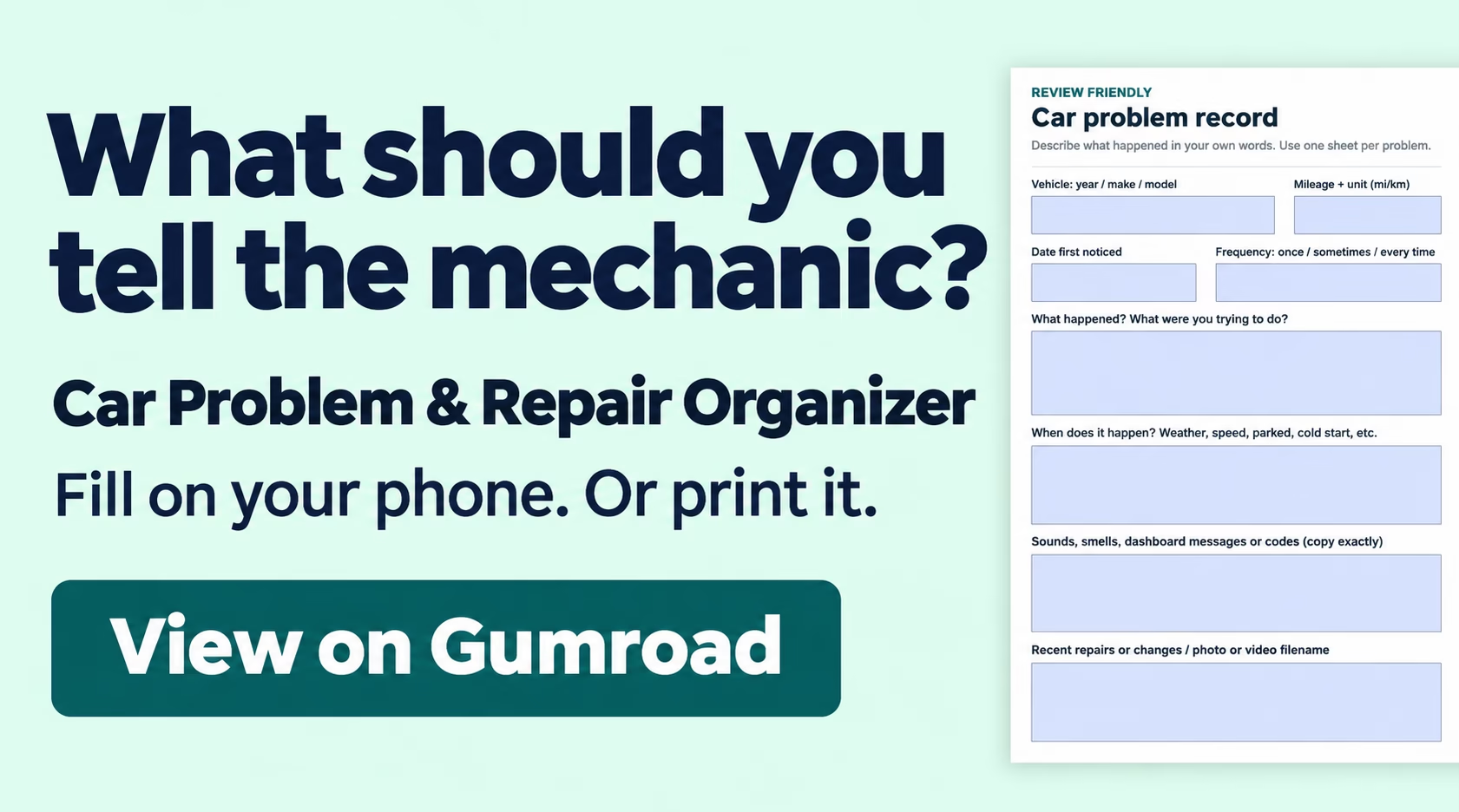
Bring the scan, the sensor receipt, and the mileage when the light came back. Then ask these questions. The answers should tell you what failed and how the shop will check its work.
- Which bank and which converter failed? Ask them to point it out on the exhaust diagram.
- How did the replacement sensor respond? Ask to see the front and rear readings with units and engine speed.
- Where did you check for leaks? Mention any new flex pipe, flange, or sensor mount. Ask whether a low-pressure smoke test found a leak there.
- What did the fuel trims and misfire counts show? Tell them about rough starts, oil top-ups, or a sudden drop in gas mileage.
- Which test supports this quote? Ask for the catalyst result and its pass limit. If the car also lacks power, a backpressure test [measures resistance to exhaust flow] can check for a blockage. Free flow still leaves chemical efficiency to be tested.
- How will you confirm the repair? Ask for the part number, warranty, and a copy of the final scan.
If the estimate just says “P0420, needs cat,” ask what ruled out the new sensor and the nearby joints. Save the answer with the invoice so you can follow up on the same fault.
How to clear P0420 and confirm the fix
Save the old report first. If your service procedure calls for a reset, clear the code once after repair. Each fresh reset can wipe useful data and restart readiness checks.
Drive the route your vehicle needs for its monitor. Some tests need a cold start, steady road speed, or a coast with your foot off the gas. Pick a safe route and review the log once parked. Holding the engine at 2,500 rpm in the driveway does not complete every car’s drive cycle.
When catalyst readiness shows complete, scan again for pending and confirmed codes. Save the test result if your tool shows it. If only a permanent entry remains, let the car verify the repair. If readiness stays incomplete, check for another fault or a missing drive condition before spending more.
Frequently asked questions
Why is P0420 still there after I replaced the downstream O2 sensor?
Look at the label beside the code. A permanent entry can stay on screen while the car checks your repair. If a fresh pending P0420 shows up, the car saw a fault again. Save that scan and inspect the sensor plug and nearby exhaust joints.
Should I replace the upstream O2 sensor too?
Check the upstream reading first. Some engines use a wideband sensor there, so a basic voltage graph may tell you very little. Find the correct data item for your engine and check for a heater or circuit code. Buy another part only if the tests point to it.
Does a flat downstream O2 graph mean my converter is good?
A steady rear reading can be normal on a warm engine. It can also hide a stuck signal. Ask whether the rear sensor responds during the specified fuel-mixture test. Once you know it responds, the car’s own catalyst test can help you judge the converter.
Why did P0420 and P0430 appear after I changed one sensor?
Check when each code set. If both are fresh, compare the two banks at the same engine speed and load. A shared fuel problem can affect both sides. A fault that shows up on just one side gives you a better place to start checking.
Use this two-bank catalyst diagnostic guide to work through the shared causes.
How many miles should I drive after fixing P0420?
There is no set mileage that proves the fix. Look up the drive cycle for your engine and check catalyst readiness afterward. Once the test has run, look for a fresh pending or confirmed code. Save that result before you clear anything or return to the shop.
Before you spend more, save these three things
If your next shop visit is for P0420 after oxygen sensor change, bring the scan report, the part number, and the catalyst test result. Missing that last item? Write one question on the work order: “What test will tell us whether this converter needs to come out?”