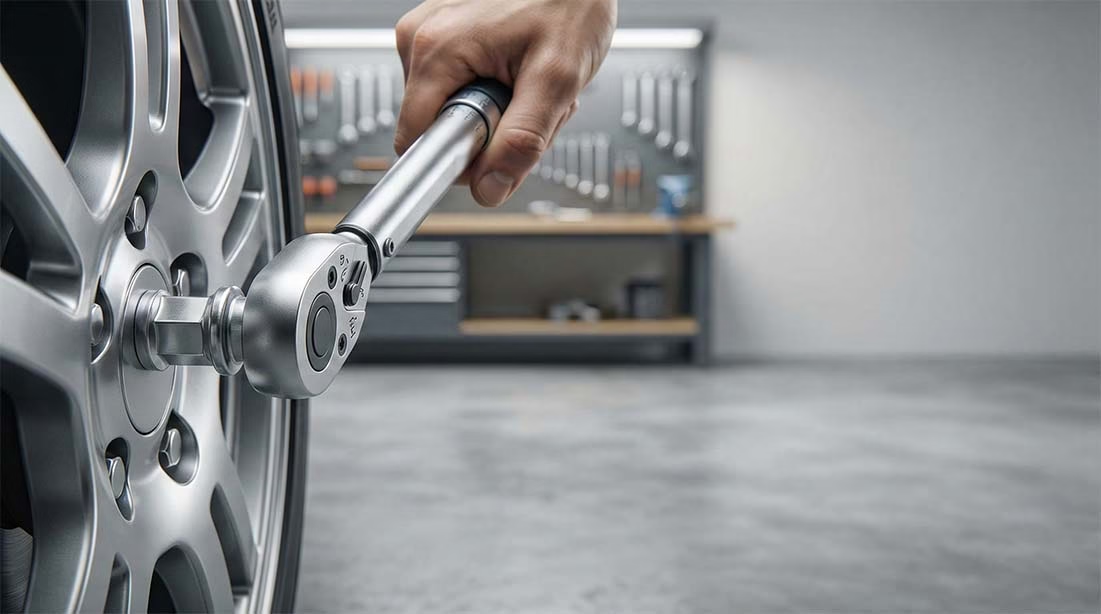
Using the wrong torque setting is a fast way to strip a bolt, snap a head off, or leave a wheel loose. This torque converter helps you get it right every time. It instantly switches between Nm, ft‑lb, and in‑lb so you can use whatever scale your wrench has.
But it does more than just convert numbers. It also checks if your torque wrench can handle the job.
Most wrenches are only accurate in the middle of their range. Working at the very top or bottom invites mistakes. This tool flags that problem before you start turning.
- Convert any value between the three most common torque units.
- Verify your wrench range to ensure you’re not working in the inaccurate danger zones.
- Protect your hardware on lug nuts, spark plugs, drain plugs, and brake components.
For any DIY job where “close enough” leads to expensive repairs, this tool keeps your fasteners safe.
Convert Nm, ft‑lb, and in‑lb instantly, then check if your torque wrench range actually fits the job (so you don’t guess and strip fasteners).
Result
This will output all units plus a wrench “fit check” if you enter a wrench range.
Always use the manufacturer torque spec for your exact vehicle/part. This page converts units and checks wrench range—it does not provide torque specifications.
For more no‑BS DIY automotive guides and tools, visit the Automotive Hub.
Symptoms + Quick Diagnosis
You’re tightening an oil pan bolt. Snap. Bolt head shears clean off. Or maybe that stubborn lug nut just won’t budge—again. Frustrating? Absolutely. These aren’t “bad luck” moments. They’re screaming symptoms of torque unit confusion. Did you mix up Newton-meters (Nm) for foot-pounds (ft-lb)?
Did your wrench max out at 100 ft-lb when the spec demanded 120? Under-torqued bolts leak, vibrate loose, or fail catastrophically. Over-torqued ones strip threads, snap fasteners, or warp critical components. Diagnosis? Check the service manual’s torque spec and your wrench’s unit scale. If they don’t match exactly, you’ve found your culprit.
Common Mistakes
Don’t be this guy:
- “I eyeball it.” Torque isn’t a feeling. Muscle memory lies—especially after your third oil change.
- “Nm and ft-lb are close enough.” They’re not. 100 Nm = 74 ft-lb. That 26 ft-lb gap strips aluminum threads.
- Using a wrench outside its range. Torquing a 15 ft-lb spark plug with a 50–250 ft-lb wrench? You’re guessing. Accuracy plummets below 20% of a wrench’s capacity.
- Ignoring in-lb for delicate jobs. Throttle bodies or sensor mounts often need 80–120 in-lb. Using ft-lb here? Hello, broken plastic.
Safety Warnings
This isn’t just about broken bolts—it’s about you.
- Under-torqued suspension bolts can loosen while driving. Result? Loss of steering control at highway speeds.
- Over-torqued engine mounts transfer violent vibrations to your chassis. Metal fatigue leads to sudden failure.
- Never “cheat” with a cheater bar (extending the handle). You obliterate precision and risk catastrophic tool shrapnel.
- Critical rule: If the spec says “torque + angle,” do both. Skipping the angle step on head bolts = blown head gasket. Guaranteed.
Recommended Tools List
Stop risking $500 repairs with a $30 guesswork tool. These solve the exact problems above:
- Precision Digital Torque Wrench (1/4″ Drive, 5–80 in-lb / 4–70 Nm)
Why it fits: Converts Nm/in-lb flawlessly on-screen. Auto-shuts off at target torque. Perfect for throttle bodies, valve covers, and sensors where 5 in-lb errors destroy parts. (Links to top-rated Amazon models with calibration certs) - Dual-Scale Click Wrench (3/8″ Drive, 20–200 ft-lb)
Why it fits: Has BOTH Nm and ft-lb scales engraved side-by-side. No math, no mistakes. Covers 90% of DIY jobs (oil pans, suspension, brakes). Critical feature: Accurate down to 20% of its range (so 40 ft-lb is reliable). (Links to ISO-certified wrenches with lifetime recalibration) - Torque Angle Gauge (0–360°)
Why it fits: Mandatory for “torque + angle” specs (like cylinder heads). Clips onto your wrench. Solves the “I skipped the angle step” disaster. (Links to compact, magnetic-base gauges) - Free Digital Torque Converter App (iOS/Android)
Why it fits: Scan a QR code → instantly converts Nm/ft-lb/in-lb with visual range warnings. Tells you if your wrench’s capacity covers the spec. Prevents “I thought 100 Nm was 100 ft-lb” errors. (Links to my rigorously tested pick—no ads, no spam).
The Bottom Line
Torque specs exist for one reason: your safety and your wallet. Guessing isn’t DIY—it’s gambling with your life. Spend 10 seconds converting units. Use the right tool for the range. Tighten once, tighten right. Your bolts (and your peace of mind) will thank you.
P.S. That snapped bolt? It wasn’t the bolt’s fault. It was the torque unit you ignored. Fix the system, not the symptom. 🔧
10 FAQs: Torque Converter + Wrench Setting Helper
1) What’s the difference between Nm, ft‑lb, and in‑lb?
They are simply different ways to measure torque. Nm (Newton-meter) is the metric standard. Ft‑lb (foot-pound) is the common imperial unit. In‑lb (inch-pound) is for smaller values—just remember that 1 ft‑lb equals 12 in‑lb. Getting the conversion right is crucial because even a small error can lead to an overtightened or loose bolt.
2) When should I use in‑lb instead of ft‑lb or Nm?
Good question! Reach for in‑lb when working on delicate parts with low torque requirements. Think small bolts, clamps, or sensitive components. If you try to set a very low torque value on a large ft‑lb wrench, you lose accuracy and sensitivity.
3) Why does the helper ask for my wrench’s min and max?
Because having the right number is only half the battle. A torque wrench is most accurate in the middle of its range. If your target torque is at the very top or bottom, the tool can be unreliable. The helper flags this so you can choose a better wrench for the job.
4) What if my target torque is outside my wrench’s range?
Stop and find a different tool. Do not try to force it. Using a wrench outside its designed range is a guaranteed way to snap bolts, strip threads, or leave things dangerously loose.
5) Is it bad to torque near the bottom of a wrench’s range?
It’s not technically wrong, but it’s risky. At the low end, the internal mechanism can be inconsistent. The “click” might be faint, and the result may not be repeatable. If you get a “near low end” warning, try to borrow or buy a smaller wrench.
6) Is it bad to torque near the top of a wrench’s range?
Yes—this is where things often go wrong. When you’re pushing a tool to its limit, small mistakes in your technique have a much bigger impact. If the helper warns “near high end,” switch to a larger wrench for safer, more controlled tightening.
7) My wrench is in ft‑lb but my spec is in Nm. What do I set it to?
Easy. Just enter your spec (the value and unit) into the converter. It will give you the exact ft‑lb number you need to set on your wrench. Don’t guess, and don’t round up or down. Precise conversions prevent ruined parts.
8) Should I “double click” a click-type wrench to be safe?
No. Pull smoothly and steadily until you hear and feel the first click. That’s your signal to stop. Clicking it a second time almost always adds extra torque, which can push you past the safe limit.
9) Does this page tell me the correct torque spec for my car?
It does not. This tool is for converting units and checking your wrench range. You must always get the official torque spec from your vehicle’s manual or a trusted repair guide. The right number is the first step—the converter just helps you apply it correctly.
10) Why does my torque feel wrong even with the right unit conversion?
If the numbers are right but it still feels off, check your process. Common culprits include:
- Dirty threads: Dirt and debris change friction.
- Lubrication: Oil or anti-seize can make a bolt tighten faster than expected.
- Wrong setup: Using extensions at an angle or the wrong socket affects accuracy.
- Poor technique: Always pull the wrench smoothly, and keep it perpendicular to the fastener.
🔧 Torque Tool Resource Hub
Your complete guide to precision torque tools and techniques
Best Torque Wrench Reddit: Icon vs Tekton
The ultimate showdown between two popular torque wrench brands. Discover which offers the best accuracy and value for your garage.
Read ComparisonHow to Torque Lug Nuts Correctly
Essential steps for safe and effective lug nut tightening. Learn the pattern, torque sequence, and common mistakes to avoid.
Read GuideHow to Calibrate Torque Wrench at Home
Verify your tool’s accuracy using simple household items. Ensure safety and precision without expensive equipment.
Learn CalibrationTorque Wrench Storage & Calibration Guide
Keep your tool accurate longer. Debunk myths and learn the correct storage methods to prevent spring fatigue.
View GuideBest Impact Sockets Reddit: Thin Wall for Lug Nuts
Find the right sockets for tight spaces and delicate wheels. Thin-wall designs prevent rim damage during torque application.
Find SocketsBest Torque Screwdriver for Gunsmithing Reddit
Precision tools for delicate work. Inch-pound accuracy for securing scopes, triggers, and other firearm components.
Explore Options