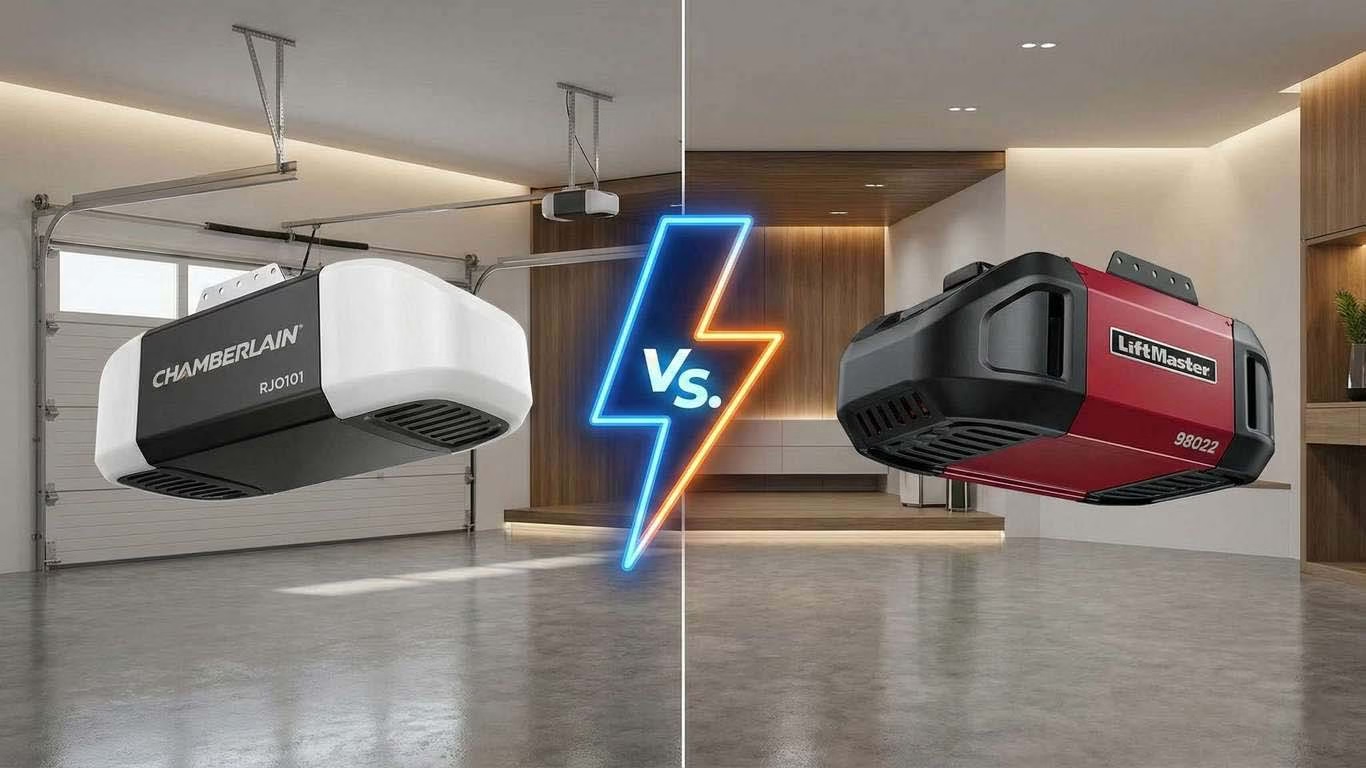
If you’re asking “is LiftMaster better than Chamberlain?” here’s the straight answer:
- Winner (Best Value / DIY): Chamberlain RJO101
Same parent company, largely the same core platform, built-in myQ, easier to buy, easier to return, and typically less “dealer markup.” For a DIY homeowner, the RJO101 is the practical choice 95% of the time. - Runner Up (Best for Pro Install / Heavy Doors): LiftMaster 98022
It’s the dealer channel version. You usually get a better wall control (often the 880LMW-style LCD smart panel), and the official door-weight rating tends to be higher. If you’ve got a seriously heavy custom door and you’re hiring a pro anyway, this is the safer bet.
Below is the quick comparison table.


| Feature | Chamberlain RJO101 | LiftMaster 98022 | Edge |
|---|---|---|---|
| Best For | DIY / Amazon buyers | Professional install | Depends |
| Price | $$ — Value Winner | $$$ — Dealer Markup | Chamberlain |
| Motor Type | 24V DC wall mount | 24V DC wall mount | Tie |
| Max Door Weight | ~650 lbs | ~850 lbs | LiftMaster |
| Wall Control | Standard button | LCD Smart Panel (880LMW) | LiftMaster |
| Cable Tension | Internal monitor | Internal monitor | Tie |
| Wi-Fi / myQ | Built-in | Built-in | Tie |
| Warranty | Lifetime motor / 5yr parts | Lifetime motor / 5yr parts | Tie |
Technical Deep Dive: The Hidden Differences (What Actually Matters)
First, the big misconception: “Are chamberlain and liftmaster the same?” Functionally, yes in the way most homeowners mean it. The Chamberlain Group runs both brands. LiftMaster is the dealer/pro channel brand, Chamberlain is the retail/consumer channel brand. That’s why people ask “does Chamberlain make LiftMaster” or “is Chamberlain part of LiftMaster.” Same family, different route to market.
Now, the stuff that changes your decision:
A) The motor and core drive feel very similar.
This is why most “liftmaster 98022 vs chamberlain rjo101 specs” comparisons end up boring: both are 24V DC wall-mount units with myQ built in. If your door is balanced correctly, both will feel smooth and quiet compared to a clunky overhead chain drive.
B) The cable tension monitor update (newer models are less annoying).
Older wall-mount openers were famous for the external/physical cable tension monitor being one more thing to mount, align, and troubleshoot. The newer RJO101 and 98022 generations use improved internal tension monitoring, so that old “extra hardware” headache is often reduced or not required the same way it was in earlier versions. Translation: fewer install steps and fewer false trips for DIYers.
C) The wall control is where LiftMaster often “earns” its premium.
On many dealer packages, the LiftMaster 98022 tends to include the nicer wall control—commonly the LCD smart panel (often referred to as 880LMW). That matters because:
- You can typically program remotes and adjust settings from the wall without climbing a ladder.
- It’s more informative when you’re troubleshooting (helpful for a pro, nice-to-have for a homeowner).
Chamberlain retail kits often ship with a simpler push-button wall console. It works fine. It’s just not as “feature rich” at the wall.
D) Door weight rating: the real reason to step up.
Officially, the LiftMaster 98022 is usually rated for heavier doors (~850 lbs in the table data you provided). The Chamberlain RJO101 is more “standard residential,” typically ~550–650 lbs territory. Here’s my technician translation:
- If you have a normal steel sectional door (even insulated), the RJO101 is plenty.
- If you have an 18ft solid wood custom door, full-overlay hardware, or anything that makes you say “this door is a beast,” that’s where the LiftMaster rating starts to matter.
E) Compatibility questions (remotes, accessories, rails):
People search these a lot:
- “are chamberlain and liftmaster compatible”
- “are chamberlain and liftmaster remotes compatible”
- “can a chamberlain remote work with a liftmaster opener / will chamberlain remote work on liftmaster”
In practice: most modern Chamberlain/LiftMaster accessories are compatible when they’re on the same generation/platform (same radio/security protocol). But don’t guess—check what your opener supports before you buy extra remotes or keypads. If you’re mixing brands, match the compatibility list (or match the learn-button generation). That’s the cleanest answer to “does Chamberlain remote work with LiftMaster.”
Also: wall-mount openers don’t use the same “rail” concept as trolley openers. So if you’re asking “are chamberlain and liftmaster rails the same,” that question applies more to traditional belt/chain models, not these side-mount units.
Quick side note for people cross-shopping older models:
If you’re coming from searches like “chamberlain rjo70 vs liftmaster 8500w,” “chamberlain rj070 vs liftmaster 8500,” or “chamberlain rjo20 vs liftmaster 8500,” the pattern is the same: similar mechanical DNA, different channel packaging, controls, and support pathway. The newer RJO101/98022 generation mainly improves the install experience and monitoring behavior.
Installation & Compatibility “Gotchas” (Read This Before You Buy)
This is where wall-mount openers either feel amazing… or turn into a Saturday you’ll never get back.
A) You need power near the torsion shaft.
Plan for an outlet within about 6 feet of where the unit mounts. If you don’t have it, budget for an electrician or a properly installed outlet. Extension cords are not the move.
B) Side clearance is real.
You generally need around 3 inches of side clearance by the torsion shaft area. If you’ve got tight framing, low clearance, or weird obstructions, measure twice before you click “Buy.”
C) Track type matters (standard lift is easiest).
These wall-mount units work best with standard lift tracks. If you have low headroom track setups, you may need a special kit or track changes. Don’t assume it’ll “just fit.”
D) Door balance matters more than the opener.
A wall-mount opener is not a “fix my bad door” machine. If your door is heavy, slams down, won’t stay halfway open, or binds in the tracks, you need spring/door service first. Otherwise you’ll trip sensors, strain parts, and hate your new purchase.
E) “Should a Chamberlain garage door opener be level?”
Yes—within reason. You’re mounting to the shaft/structure and the unit should sit square and solid so it doesn’t rack under load. If it’s twisted or mounted on flexy wood, you’ll get vibration, noise, and premature wear. Level/square mounting isn’t “perfectionism,” it’s reliability.
F) Brand mixing with other door brands (Linear, Raynor):
You’ll see searches like “does chamberlain work with linear,” “is chamberlain compatible with raynor,” etc. The opener brand and the door brand are usually not the issue. Doors are mostly mechanical. Compatibility problems usually come from controls/remotes/accessories (radio/security protocols), not from the fact that the door is Raynor or the old receiver was Linear. If you’re reusing old remotes, that’s where you can get stuck.
Final Buying Advice (Decisive Scenarios)
Scenario A: You are installing it yourself.
Buy the Chamberlain RJO101.
You get the best combination of price, availability, and support. That answers “which garage door opener is better Chamberlain or LiftMaster” for most homeowners: Chamberlain wins on value when the door is normal and you’re DIY.
- Practical reason: retail warranty flow is usually simpler.
- Practical reason: returns are easier if you hit a measurement/fit surprise.
- Practical reason: you’re not paying for dealer channel packaging you don’t need.
Scenario B: You have a truly heavy door (18ft solid wood custom, high-end hardware) and you’re hiring a pro.
Buy the LiftMaster 98022 and pay for a pro install.
That’s the honest answer to “which LiftMaster model is the best” in this narrow wall-mount context: the one rated for the job and installed correctly. The extra wall-control features are a bonus; the real win is the heavier rating and dealer support structure.
Scenario C: You’re stuck on compatibility questions (remotes/keypads) and want to reuse old stuff.
Before you buy, confirm what you’re trying to reuse is supported. That’s the real fix for:
- “is chamberlain remote compatible with liftmaster”
- “will a chamberlain remote work with a liftmaster opener”
- “do chamberlain remotes work with liftmaster”
If you want “no surprises,” plan to use the included controls and then add accessories that explicitly list compatibility with your exact opener generation.
Bottom Line
If you’re a typical homeowner comparing liftmaster 98022 vs chamberlain rjo101mc because you want a quiet wall-mount opener without dealer games: get the Chamberlain RJO101.
If your door is unusually heavy and you’re already committed to a pro install: get the LiftMaster 98022.
If you want, tell me your door size (single vs double), material (steel/wood), and whether you have standard lift or low headroom tracks—and I’ll tell you in one sentence if you’re in the 95% that should buy the Chamberlain or the 5% that should step up to LiftMaster.