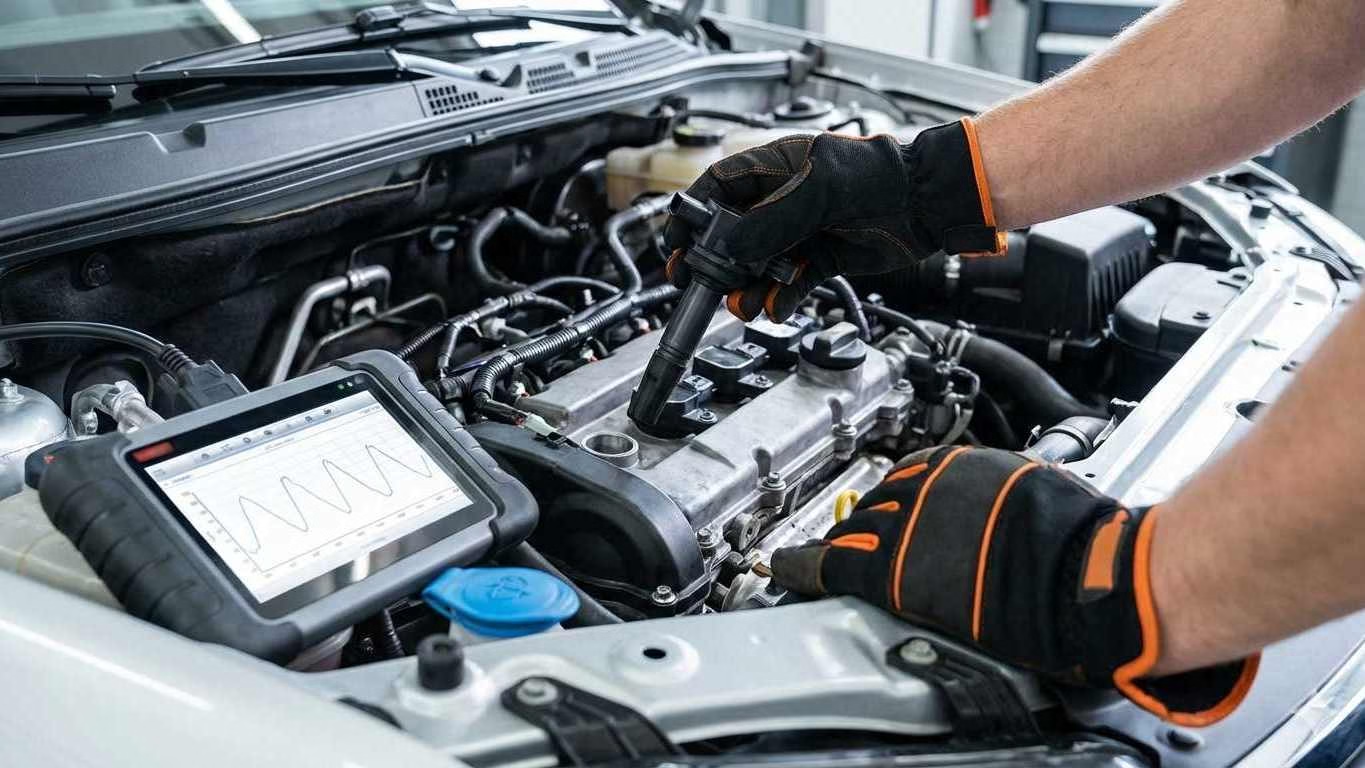
Most people still treat a misfire like it’s 1998: “It’s shaking, so it must be a spark plug.” Sometimes you get lucky. Most times, you just waste money.
Modern engines don’t misfire in isolation. They misfire inside a tightly controlled system. This system constantly corrects fuel, monitors crank speed, and adapts to airflow. The real cause usually leaves clues in live data long before parts look bad.
If you learn to read certain patterns—fuel trims, misfire counters, and ignition behavior—you can diagnose misfires without part swapping. You’ll see what changes, why it changes, and what that pattern means.
Looking for the right tools for the job? A quality OBD2 scanner is your first step toward accurate diagnosis without guesswork.
The “Misfire = Bad Plug” Myth
Yes, a spark plug can cause a misfire. So can many other things:
- Vacuum leaks
- Clogged fuel injectors
- Low compression
- Bad MAF sensor signals
- Lazy oxygen sensors
- Coils that fail only under load
Your engine doesn’t care what you replaced. It only cares if combustion happened when it should have.
Guessing is the most expensive way to fix misfires. The fastest way is watching what your engine tells you in real time. Focus on three key data points: misfire counters, fuel trims, and ignition behavior. Read these correctly, and you’ll narrow down causes before touching a single tool.
Section 1: What a Misfire Actually Is (Short but Clear)
A misfire is simple: a cylinder didn’t “push” like it should have.
Two types matter most for diagnosis:
- Random/multiple misfire
This happens when misfires spread across cylinders or an entire bank. Causes usually affect shared parts: air measurement, fuel delivery, vacuum leaks, or sensor problems. - Single-cylinder misfire
This happens when one cylinder keeps underperforming. Causes stay near that cylinder: spark plug, coil, injector, compression issues, valve problems, or a nearby air leak.
Stored codes are just summaries. Live data shows the actual event. Codes tell you what the computer noticed. Live data shows you when it happens, under what conditions, and how the system responded.
Section 2: Using Misfire Counters the Right Way
Misfire counters show you “where and when.” They track tiny changes in crankshaft speed after each firing event. Your car’s computer turns these changes into misfire counts per cylinder and operating condition.
What changes?
The misfire counter goes up for specific cylinders during certain time windows and driving conditions.
Why it changes?
Because that cylinder didn’t add expected power. This could be from spark issues, fuel problems, air distribution, compression loss, or even EGR system problems.
What the pattern means for diagnosis:
- Spot a single-cylinder problem
If only one cylinder’s counter climbs while others stay flat, stop thinking “system problem.” Start thinking “this specific cylinder has an issue.” That shifts your focus to ignition parts, fuel injectors, compression, or a local air leak. What you might see:
- Misfire count rises steadily on cylinder 3 at idle
- Count barely moves at 2,500 RPM with no load What it means:
- Idle has high vacuum and low airflow
- Problems show up here first: small intake leaks, injector delivery issues at low flow, or ignition instability
- Recognize load-based misfires
Load-based misfires are gold for accurate diagnosis. They point strongly to:
- Ignition breakdown
- Fuel pressure limits
- Mechanical weakness under pressure Two common patterns: Pattern 1:
Misfire count stays quiet at idle but spikes during acceleration (especially in higher gears).
Meaning: Higher cylinder pressure needs stronger spark. Weak coils, cracked boots, wide plug gaps, and bad insulation fail here. Some fuel issues also appear under load, but fuel trims usually reveal those. Pattern 2:
Misfire count rises only at idle and disappears when you rev the engine.
Meaning: Think vacuum leaks, EGR problems at idle, injector issues at low flow rates, or mechanical problems that matter most at slow speeds (like a slightly burned valve).
- Watch for “moving” misfires under load
If your worst cylinder changes with load or RPM, be careful about blaming one part too soon. What changes?
Cylinder A misfires at idle. Cylinder B misfires during acceleration. Why it changes?
Different conditions stress different weaknesses. Idle stresses mixture and vacuum integrity. Load stresses ignition voltage and fuel volume. A moving target often means a shared issue (fuel pressure, airflow measurement, or overall ignition energy) rather than one dead part.
Use misfire counters to map the problem. But don’t stop there. Next, see how your engine tried to fix it.
Section 3: Fuel Trims — The Pattern That Tells the Truth
Fuel trims are your computer’s correction method. They show how much it’s adding or removing fuel to hit the target air-fuel ratio.
Short-Term Fuel Trim (STFT) = Immediate correction, always moving.
Long-Term Fuel Trim (LTFT) = Learned correction over time, a “memory” of persistent bias.
What “positive” and “negative” really mean:
- Positive trim (+12%) means the computer is adding fuel. It thinks the mixture is too lean (too much air, not enough fuel).
- Negative trim (-10%) means the computer is removing fuel. It thinks the mixture is too rich (too little air, too much fuel).
Remember: trims don’t show truth. They show what the computer believes based on sensor feedback. That’s why patterns matter more than numbers.
Vacuum Leaks (Unmetered Air)
What data changes?
- STFT and LTFT go positive (often obvious at idle)
- Misfire counters may climb randomly or focus on cylinders near the leak
- MAF readings may look “normal” while trims disagree
Why it changes?
A vacuum leak adds air the computer didn’t measure. At idle, the throttle is nearly closed and vacuum is high. A small leak becomes a large percentage of total airflow. This leans the mixture, sensors report lean, and trims climb positive to compensate.
The pattern that matters (idle vs. cruise):
- At idle: trims strongly positive (STFT swings high, LTFT creeps up)
- At steady cruise or 2,500 RPM no-load: trims improve (closer to zero) because the leak becomes a smaller percentage of total air
The vacuum-leak fingerprint:
“Big positive trims at idle, noticeably less positive off-idle.”
This pattern is clear once you’ve seen it. It’s one of the cleanest diagnoses you’ll get.
Pro tip:
If it’s a localized leak (like an intake gasket at one runner), the misfire might affect only one cylinder at idle. Trims still go positive because oxygen sensors see extra oxygen. Many mistake this for an injector problem because it’s cylinder-specific. The idle/off-idle trim difference is what keeps you on track.
Weak Ignition / Coil Failure
What data changes?
- Misfire counters rise on a specific cylinder (often worse under load)
- Fuel trims may look surprisingly normal or show erratic spikes
- O2 sensor signal may show extra oxygen during misfires (tricking the computer into thinking it’s lean)
Why it changes?
A misfire doesn’t burn the mixture. Unburned oxygen goes out the exhaust. Oxygen sensors measure oxygen content, not fuel. So a misfire can trick the computer into thinking the engine is lean, causing brief positive corrections.
Key difference:
- A true lean condition (like a vacuum leak) produces consistent trim bias tied to operating conditions.
- An ignition misfire often produces “messy” trim behavior—short spikes, unstable switching, or trims that don’t form clean patterns.
What this means for diagnosis:
- If misfires spike under load and trims aren’t consistently positive in a load-dependent way, suspect ignition strength.
- If trims are near normal but misfire counters climb, that’s often ignition or mechanical issues, not fueling.
Practical takeaway:
Don’t demand wild trim numbers to prove ignition failure. A weak coil can misfire with boring-looking trims. Misfire counters and load dependency tell the real story.
Clogged or Failing Injectors
What data changes?
- Misfire counters rise on one cylinder (often worse at idle and light load)
- Overall trims may go positive, but sometimes only slightly
- Injector pulse width may climb as the computer tries to correct, but that cylinder still misfires
Why it changes?
A restricted injector delivers less fuel than commanded. That cylinder runs leaner than others. Oxygen sensors see extra oxygen, and the computer adds fuel globally. This makes other cylinders slightly rich while the bad cylinder stays lean enough to misfire.
What this means for diagnosis:
- Cylinder-specific misfire + trims trending positive (especially when misfiring) suggests fuel delivery problems.
- The key clue: trims respond like the engine is lean, but the misfire stays mostly on one cylinder.
This tells you:
The computer is trying to fix a lean signal. But its correction is “global.” It can’t target one cylinder precisely on most systems. So it adds fuel everywhere. This improves overall sensor feedback but doesn’t fully fix the one cylinder still short on fuel.
How it differs from a vacuum leak:
- A vacuum leak’s trim signature changes dramatically between idle and cruise.
- A restricted injector often doesn’t show that clean split. The misfire stays tied to one cylinder. Trims may not normalize off-idle the same way.
Experience-based check:
If misfires are strongest when injector pulse width is smallest (hot idle), and improve with a slight RPM increase, a restricted injector is likely the culprit. Low pulse width is where marginal injectors fail most.
Bad Sensors (MAF / O2 / AFR) — When Trims Lie
What data changes?
- Fuel trims show strong bias, but misfire behavior doesn’t match expected patterns
- MAF readings may not match actual engine load
- O2/AFR sensor signals may be sluggish, stuck, or unrealistically stable
Why it changes?
Fuel trims correct based on sensor feedback. If feedback is wrong, trims become “a correction to a lie.” The computer faithfully adds or removes fuel to satisfy sensors that aren’t telling the truth.
What this means for diagnosis:
MAF under-reporting airflow:
- What changes: Trims go positive across many conditions (idle and cruise)
- Why: MAF signal bias makes the computer think less air is entering than reality
- Pattern meaning: Consistent positive trims at idle and cruise. Misfires may be random or appear under load because mixture is genuinely lean everywhere
MAF over-reporting airflow:
- What changes: Trims go negative broadly
- Why: Computer injects too much fuel for the actual air
- Pattern meaning: Negative trims across conditions, rich smell, possibly fouled plugs, misfires that look “rich” (especially at idle)
O2/AFR sensor problems:
- What changes: STFT may peg or respond slowly; switching may be sluggish; trims may look extreme without matching engine behavior
- Why: Feedback signal is delayed or biased; computer over-corrects or “hunts”
- Pattern meaning: Trims that don’t match load conditions, and O2 behavior that doesn’t show normal switching response
Professional mindset:
If trims scream “lean” but the engine doesn’t act like a truly lean engine (no change with added propane near intake, no clear idle vs. cruise split, no consistent load correlation), don’t keep forcing the vacuum-leak story. Verify sensor integrity and plausibility first.
Understanding sensor behavior is crucial. For deeper insights on interpreting these signals, check out our guide on how to read OBD2 live data and fuel trims.
Section 4: Coil Testing With Live Data (Beyond Ohms)
Resistance checks feel useful because they give you a number. The problem is coils often fail only when running: heat, vibration, and high cylinder pressure expose insulation breakdown that static tests miss.
What data changes?
- Misfire counters rise in a specific cylinder under stress (load, RPM, heat)
- Sometimes you’ll see timing corrections or roughness indicators
- O2 feedback may show brief lean-appearing events during misfires
Why it changes?
During acceleration, cylinder pressure rises. Higher pressure needs higher spark voltage to jump the plug gap. A marginal coil may fire fine at idle (low pressure) and fail when demand increases. That’s why “it idles fine but misfires on the highway” is such a common ignition story.
How to use live data to find weak coils:
- Graph misfire counters against load/RPM
Don’t just stare at numbers. Put RPM, load (or MAP), and cylinder misfire counts on one screen and recreate the problem.
- If misfires spike during moderate acceleration (not randomly), that’s classic weak ignition under demand.
- Compare cold vs. hot behavior
Coils and boots often fail when hot.
- If misfires appear after heat soak, and counters jump under load when hot but not cold, you’re watching insulation failure in real time.
- Use cylinder swap testing as confirmation (not first step)
Swapping coils can help, but only after live data points you toward ignition.
- If misfires happen only under load and follow the coil to its new cylinder, that’s confirmation.
- If misfires don’t follow, you just learned it wasn’t the coil—even if the code “suggested” it.
Practical warning:
If you swap coils without understanding the trim/misfire pattern first, you can waste hours chasing coincidences. This is especially true with intermittent misfires.
Section 5: Putting It Together — A Diagnostic Workflow That Actually Works
This isn’t a checklist. It’s a logic chain. Each step narrows the problem and guides your next move.
- Read misfire counters first (find “where” and “when”)
With a warm engine in closed loop mode if possible, watch per-cylinder counts at:
- Idle
- 2,000–2,500 RPM no-load
- During a controlled road test (moderate load in a higher gear often reveals issues) What it tells you:
- Single-cylinder consistent: focus on that cylinder (ignition/injector/compression/local leak)
- Multi-cylinder/random: think system issues (air measurement, fuel pressure/volume, vacuum leak, sensor bias)
- Observe fuel trim behavior at idle and load (find “why the computer is correcting”)
Watch STFT and LTFT:
- At hot idle
- At steady cruise
- During the exact moment misfires increase What it tells you:
- Big positive at idle, improves off-idle: vacuum leak signature
- Positive across idle and cruise: airflow measurement issue, fuel delivery issue, or sensor bias
- Trims mostly normal but misfire persists: ignition strength or mechanical integrity likely
- Cross-check ignition behavior using stress patterns
Test conditions that increase spark demand:
- Moderate acceleration
- Higher gear pulls
- Heat soak after driving What it tells you:
- Misfire increases with load/heat: weak coil/boot/plug gap/secondary issues likely
- Misfire only at idle with clear trim signature: ignition is less likely the root cause
- Confirm mechanically only after data agrees
Once data points you in a direction, confirm with the right test:
- Suspect injector: balance test, commanded rich test response, cylinder drop contribution
- Suspect vacuum leak: smoke test, propane enrichment response, MAP behavior
- Suspect mechanical: compression test, leakdown, relative compression, valve sealing checks
The key discipline:
Live data tells you where to spend your verification effort. Verification proves it. Random parts swapping does neither.
Section 6: Common Misdiagnosis Traps (The Stuff That Wastes Money)
- Replacing coils because a code “points” to one
A code doesn’t point to the cause. It points to the cylinder that failed to contribute power. That cylinder can misfire from fuel, air, mechanical issues, or ignition. Without checking load-based misfire behavior and trim response, you’re just guessing. - Ignoring fuel trims because “it runs okay”
A car can run “okay” while the computer adds 20% fuel at idle to cover a vacuum leak. That correction is a clue, not comfort. Trims are often the earliest signal your problem isn’t ignition at all. - Trusting freeze-frame data alone
Freeze-frame is a snapshot from one moment. Misfires are often intermittent and condition-based. If the failure is heat-related or load-related, a freeze-frame at idle can completely mislead you. Live graphing during symptom reproduction beats freeze-frame every time. - Misreading misfire-induced O2 behavior as “lean fuel problem”
A misfire can send oxygen down the exhaust and make the O2 sensor report lean even when fuel delivery is fine. If you chase fuel delivery without checking the misfire/load pattern, you can end up “fixing” nothing while trims dance around the misfire. - Declaring victory after a cylinder swap “seems better”
Intermittent misfires come and go. If you don’t reproduce the same conditions and watch the same live data trend, “it feels better” isn’t a diagnostic conclusion.
Conclusion: Misfires Aren’t Mystery Problems—They’re Data Problems
A misfire isn’t a riddle solved by swapping the most common part. It’s an event with a cause, and that cause leaves a signature in live data.
Misfire counters tell you where and when combustion fails. Fuel trims tell you how the computer is reacting and whether the problem is air, fuel, or a sensor lie. Ignition stress patterns tell you whether spark energy collapses when demand rises. When these three agree, your confirmation test becomes a formality—not a fishing expedition.
Diagnose the pattern, then verify the cause. That’s how you stop guessing.
Misfires are data problems, not mystery problems. And with the right tools and approach, you can solve them every time.
Before you tackle your next diagnostic challenge, make sure you have the right equipment. A reliable OBD2 scanner that shows live data is essential for modern engine diagnostics. Don’t try to solve today’s problems with yesterday’s methods.