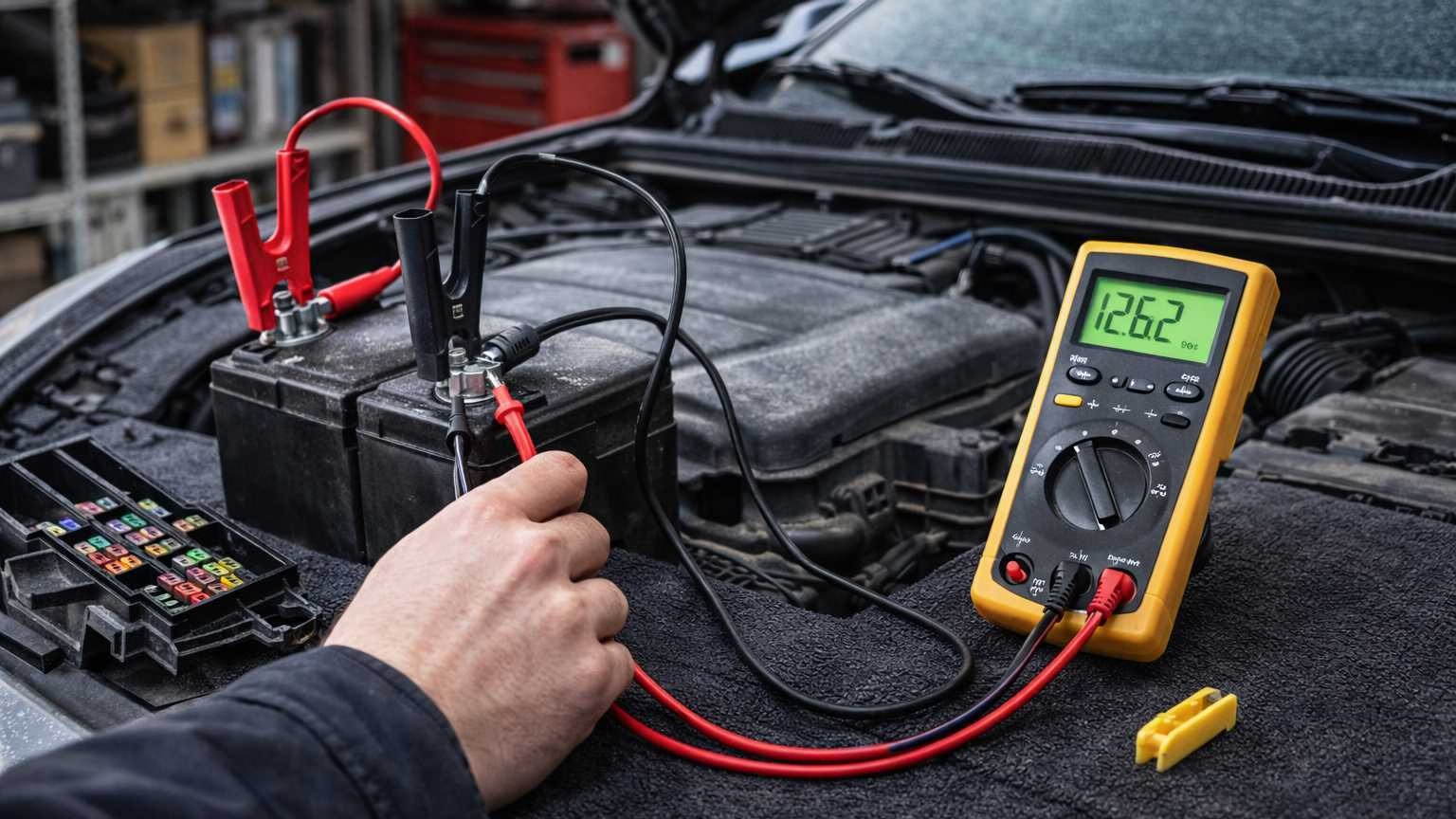
🔋 Testing for Battery Drain at Home: To properly trace which fuse or circuit is draining your battery overnight, you can’t just guess. You will need a standard Digital Multimeter with 10A DC capability to accurately measure the exact millivolt draw across your fuses while the car is completely powered off.
1) Quick Problem Check
Is your car fine today but dead tomorrow? You might have a parasitic drain.
Signs you need this test:
- Your battery dies overnight or after 1-2 days parked
- Your car randomly won’t start even with a newer battery
- You need jump-starts more than once a week
- Your battery tests “okay” but still dies when parked
This test works best when:
- Your battery is charged but still dies while parked
- Your charging system works fine when driving (no warning lights, no dimming)
Your battery itself might be bad instead when:
- It can’t hold a charge even right after charging
- It’s older (usually 3-5 years, sometimes less in hot areas)
- Your engine cranks slowly every morning
- Voltage is low right after driving
This test shows if something is stealing power while your car sleeps. It doesn’t prove your battery is good.
2) Tools You Need (Very Few)
- Digital multimeter with amps setting (A or mA)
- Basic wrench (usually 10mm) for the battery terminal
- Patience (cars need time to fall asleep!)
3) Safety Rules (Don’t Skip!)
Read this first!
Never start your car with the multimeter connected. Starter current can spike to hundreds of amps. This will blow your meter’s fuse. It could also damage your meter and wiring.
Keep doors and lights closed. Opening doors wakes up computers and lights. This ruins your reading. Your “parasitic drain” might just be courtesy lights.
How multimeter fuses blow (and how to avoid it):
- Using the wrong meter port (keep red lead in the “10A” port when starting)
- Starting on the wrong range (always begin with the highest amps setting)
- Turning on lights or accessories while testing
Golden rule: Meter in series + heavy load on = blown fuse or bad day.
4) Step-by-Step Battery Drain Test
Step 1: Put Your Car to Sleep (2-5 minutes)
- Park on level ground. Set the parking brake.
- Turn off everything: lights, radio, chargers, accessories.
- Remove your key or turn ignition fully off.
- Close all doors. If you must keep a door open, use a screwdriver to latch the door striker so the car “thinks” it’s closed.
- Open the hood. If your hood has a light, unplug it or remove the bulb. Hood lights look exactly like battery drains.
Step 2: Wait for Full Sleep Mode (5-20 minutes)
Cars stay awake after shutdown. They save settings and run checks before sleeping.
- Wait at least 10 minutes. Some cars take 20-30 minutes.
- Keep your key fob away from the car (several feet). Smart keys can keep modules awake.
- Don’t open doors. Don’t bump the car. Don’t press key fob buttons.
Step 3: Multimeter Setup (Get This Right)
- Set your meter to measure current (A).
- Move the red lead to the “10A” or “A” jack.
- Keep the black lead in “COM.”
- Start on the highest range (usually 10A). Don’t start on mA.
Step 4: Connect the Meter Safely
You’ll measure current leaving the battery while the car is off. The meter must be “in series” between the battery post and cable.
Work on the negative terminal. It’s safer and reduces short-circuit risks.
- Loosen the negative (-) battery terminal with your wrench.
- Lift the clamp off the battery post. Keep it from touching the post.
- Connect meter leads:
- Black lead to the battery negative post
- Red lead to the removed negative cable clamp
- Hold connections firmly. Loose connections wake modules and spike readings.
Never let the cable clamp touch the post while testing. This bypasses your meter and ruins the test.
Step 5: Read the Numbers Right
- If display shows “0.02 A,” that’s 0.02 amps.
- To convert to milliamps (mA), multiply by 1,000.
- 0.02 A = 20 mA
- If reading is under 0.10 A (100 mA) on the 10A range, you can switch to mA range for more precision.
- Only do this if you’re sure the draw is low.
- Move red lead to mA jack and change dial to mA.
- When in doubt, stay on 10A. Safety beats precision.
You might see:
- Higher numbers at first, then a drop as the car sleeps
- Small jumps as modules briefly wake and settle (normal early on)
5) Understanding Your Results
Modern cars need some power to keep memories alive (clock, security system, keyless entry). The question is how much.
Normal readings after full sleep:
- Good: 20-50 mA (0.020-0.050 A)
- Watch closely: 50-80 mA (0.050-0.080 A)
- Problem: over 80-100 mA (0.080-0.100 A), especially with overnight drain
- Serious: 200+ mA (0.200 A+) will kill your battery fast
Why readings jump early:
- Car isn’t fully asleep yet
- Lights or door sensors active
- Alarm/keyless system waking up
- You bumped the car or used key fob
If your reading never settles and stays high, treat it as real drain or a “kept awake” condition.
6) Finding the Bad Circuit
Once you confirm high drain, find which circuit is responsible. Go slow and be methodical.
Fuse-Pull Method (One at a Time)
- Keep meter connected and stable
- Find your fuse boxes (usually under dash and in engine bay)
- Pull one fuse at a time
- Watch meter after each fuse:
- If current drops sharply (example: 180 mA down to 30 mA), you found the drain circuit
- If no change, put fuse back and try next one
Track your progress:
- Keep a simple note list: Fuse number + label + “no change” or “drop”
- Take a photo of fuse layout before starting
- Pull and replace same fuse before moving on. Don’t leave multiple fuses out.
Don’t guess randomly:
- Random fuse pulling creates chaos
- Some fuses wake modules when removed
- Without tracking, you’ll chase fake readings
Tip: If pulling a fuse wakes the car and readings spike, wait again for sleep mode before continuing. Don’t average spikes into your decision.
7) Common Mistakes (And How To Avoid Them)
Most bad results come from technique—not your car.
- Opening doors mid-test
You just turned on lights and woke computers. Your reading is now junk. Start over. - Using wrong multimeter port
Red lead in V/Ω port while measuring amps blows fuses instantly. Always use 10A/A port first. - Skipping sleep cycle
Measuring right after shutdown shows normal high draw. Wait 10-20 minutes. - Trusting instant readings
If you connect and immediately decide “it’s 300 mA,” you’re guessing. Watch the draw settle. - Working on positive terminal
Use the negative terminal. Working on positive increases short-circuit risks. - Turning things on while testing
No headlights. No blower. No radio. No starting. Any big load blows meter fuses. - Letting cable touch post
This bypasses your meter, breaks the circuit, and can reset modules. Keep them separated.
8) What This Test Can’t Tell You
This test is powerful but has limits.
- Alternator diode failures
Bad diodes can drain batteries. Sometimes this shows as parasitic drain. Sometimes it’s intermittent. You might need a separate alternator test. - Intermittent drains
If drain happens only sometimes (once a week), you might miss it in a 20-minute test. You may need longer monitoring. - ECU or module wake-up faults
Some cars wake repeatedly due to bad door switches or network issues. You’ll see draw jumping up and down. This is hard to diagnose with a basic meter.
Next steps when needed:
- High steady draw: Use fuse-pull method
- Normal draw but dead battery: Load-test your battery and check charging
- Intermittent drain: Note patterns (time, weather, after locking). Consider a shop with logging equipment
9) Finding a Reliable Multimeter
I don’t personally test every product mentioned. Instead, I analyze real-world owner experiences from forums and Reddit to identify consistent patterns—so you don’t have to do that research yourself.
10) Quick Summary
You can test for parasitic battery drain at home in about 20 minutes. Follow these safety rules:
- Wait for your car to fully sleep (10-20 minutes)
- Set meter to highest amps range first
- Connect on the negative terminal
- Keep doors closed and lights off
If readings stay high after sleep mode: stop jump-starting repeatedly. Find the bad circuit using the fuse-pull method. Fix the root cause, or your battery will keep dying.
Still having battery issues after this test? You might need a quality battery maintainer for storage or to combat those damaging short trips that slowly kill car batteries.